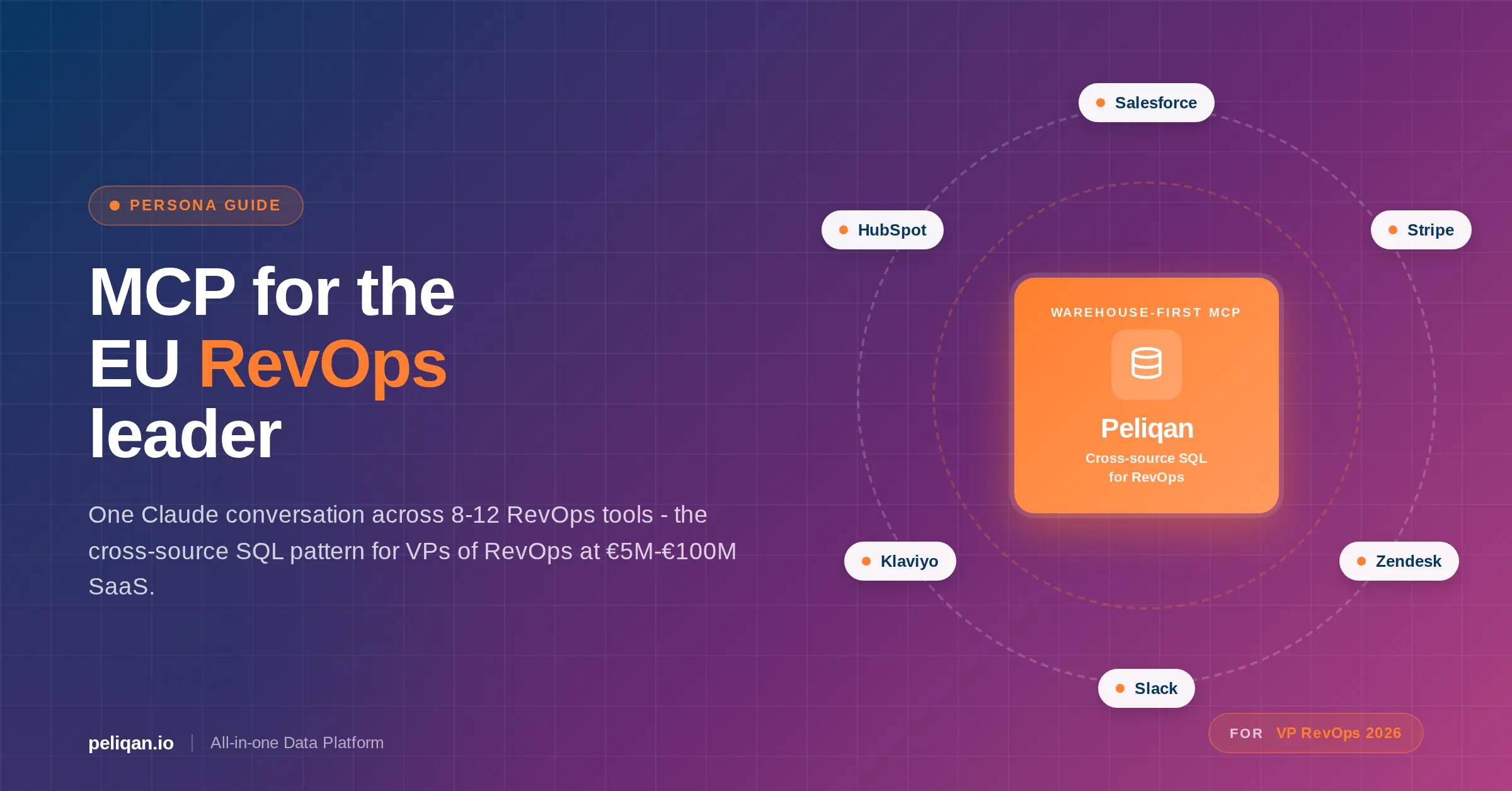





“Show me the top-100 customers by ARR with open Sev-1 Zendesk tickets where Stripe payments have failed twice in the last 60 days.” This is the Monday-morning question every VP of RevOps actually asks. Specifically, it spans Salesforce, Stripe, Zendesk, and product analytics in one breath. None of those vendor MCPs answer it alone. This is the persona post for the EU RevOps Leader running an 8-12 tool stack and looking for one Claude conversation across all of it. It is the sibling to the existing MCP for the EU CFO playbook, written for the function that reads the same data in a different shape.
The EU RevOps leader’s operating reality in 2026 looks like this. The CRM is Salesforce or HubSpot or Pipedrive. Payments run through Stripe. Support sits in Zendesk. Marketing automation runs through Klaviyo or Brevo. Furthermore, product analytics live in Mixpanel or Amplitude. Knowledge lives in Notion. Day-to-day collaboration happens in Slack. Finally, the lightweight roadmap or campaign tracker probably sits in Airtable. As a result, the head of RevOps owns 8 to 12 systems whose data never quite joins up where the decisions need to happen.
The 2026 vendor response has been to launch “agentic” platforms. Specifically, Clari and Salesloft shipped a joint MCP server in April 2026 that opens forecast and pipeline intelligence to any AI tool. Furthermore, 6sense repositioned as an agent-powered Revenue Intelligence platform. Gong shipped its own AI agents. Mutiny and Default added agentic personalisation. However, every one of these tools is still a single-vendor MCP – it speaks one slice of the stack, not the whole stack.
The cross-source question lives outside any single vendor’s reach. That is the warehouse-first MCP pattern’s home turf. Furthermore, this post is the persona-level hub for nine connector blogs already published in the cluster, anchored to the cross-source MCP cornerstone and the sibling MCP for the EU CFO playbook.
Who the EU RevOps leader is in 2026
The 2026 EU RevOps leader is typically a VP, Head, or Director of Revenue Operations at a SaaS scale-up between €5M and €100M ARR. Specifically, the role owns forecasting, pipeline health, churn analysis, marketing-to-sales attribution, customer-success motions, and the systems that hold all of those. Furthermore, this person has budget at €150 per month and up. Indeed, they make the buying decision on RevOps tooling and answer to the CRO or COO.
The frustration is real. Specifically, the team has 8 to 12 tools, each with its own dashboard. Every dashboard shows a slice. Furthermore, the cross-source view that determines retention or forecast accuracy lives in spreadsheets the team rebuilds every quarter. As a result, the standing operational ask is unchanged from 2020: how do we get one view of the customer across every system?
The 2026 difference is that AI agents now make this practical. Specifically, 76% of CFOs are budgeting for autonomous agents this year, and RevOps is the second function getting agent budget after finance. Furthermore, the Numero acquisition of Royu on May 13, 2026 signals the agentic system-of-work pattern is now reaching the CRO’s office, not just the CFO’s.
The seven standing questions every RevOps leader asks
The questions below are not theoretical. Indeed, each is a real Monday-morning ask that takes hours of manual analysis without cross-source MCP. With it, each becomes one prompt.
1. Top-100 churn-risk customers across support and payments
“Show me top-100 customers by ARR with open Sev-1 Zendesk tickets where Stripe payments have failed twice in the last 60 days.” Specifically, this joins Salesforce ARR or HubSpot deal value, Zendesk ticket severity, and Stripe payment intent status. As a result, the CS leader gets the intervention list before the renewal window closes.
2. Renewal-risk triage from rising support load
“Which Pipedrive or Salesforce renewal-stage deals have rising Zendesk ticket counts in the last 30 days?” Furthermore, the agent flags any deal where ticket volume is climbing while renewal probability is dropping. As a result, the AE and the CSM see the same risk list before standup.
3. Forecast cleaning at quarter-end
“Pipedrive or Salesforce forecast versus Stripe closed revenue, by AE, this quarter – flag any AE with more than 25% variance.” Specifically, the agent runs the variance analysis in 60 seconds instead of the four-hour Friday-afternoon spreadsheet rebuild. Indeed, this is the workflow that compresses quarter-end FP&A from a multi-day exercise to one Claude prompt.
4. Marketing-to-revenue attribution by channel
“Which Brevo or Klaviyo nurture campaigns drove HubSpot MQL to SQL to closed-won deals in the last quarter, ranked by Stripe revenue?” Furthermore, the agent attributes revenue back to the originating campaign and channel. Indeed, the Klaviyo MCP playbook covers the e-commerce side, while the Brevo MCP playbook covers the EU marketing automation alternative.
5. Slack signal mining for deal momentum
“Slack #sales-wins chatter versus Salesforce closed-won – which deals closed quietly versus celebrated?” Specifically, the agent joins Slack channel activity to deal close events. As a result, the head of sales spots cultural signals about pipeline health that no dashboard surfaces. The pattern lives in the Slack MCP playbook.
6. Multi-product engagement health
“For our top 50 customers, what is the engagement trend – Mixpanel feature adoption against Zendesk ticket volume against Slack Connect partner channel activity?” Furthermore, the cross-source view surfaces customers where product use is dropping while support load is rising. Indeed, this signal predicts churn earlier than any single metric.
7. Event-driven cascade verification
“When a Stripe Dispute opens, did Zendesk get a Sev-2 ticket, did Salesforce flag the account, and did our CS team get pinged in Slack?” Specifically, the agent audits the end-to-end automation chain. As a result, the RevOps leader catches broken cascades before customers do. The Zendesk MCP playbook covers the support side of this pattern.
Five cross-source workflows the warehouse-first MCP unlocks
The seven questions above are point-in-time prompts. However, the five workflows below run on cadence and compound across quarters.
Renewal-risk dashboard
The agent joins Pipedrive renewal stage to Zendesk ticket count to Stripe MRR delta. Specifically, one Claude prompt produces the at-risk renewal list every Monday. Furthermore, it replaces the three CSV exports the team used to merge by hand. As a result, the prompt pays for the platform in the first month.
Forecast cleaning at quarter-end
The agent compares Salesforce or Pipedrive forecast to Stripe closed against Exact Online invoiced. Specifically, the variance by AE drops out in 60 seconds. Furthermore, the same workflow shifts FP&A capacity from spreadsheet construction to narrative writing for the quarterly review.
Marketing-to-revenue attribution
Klaviyo or Brevo campaign engagement joins HubSpot deal stage joins Stripe payment confirmed. Specifically, the agent ranks campaigns by realised revenue per recipient. As a result, the head of marketing and the head of sales argue about real numbers instead of attribution-tool defaults.
Dispute-to-CS cascade audit
Stripe Dispute opened triggers Zendesk Sev-2 ticket creation, Salesforce account flag, Slack alert. Specifically, the agent audits the whole chain end-to-end. Furthermore, when one step breaks (the Slack alert did not fire, the Salesforce flag did not update), the agent surfaces the gap before it becomes a customer-facing incident.
Founder-RevOps Monday morning briefing
Slack #leadership channel sentiment plus Stripe revenue trend plus Salesforce pipeline coverage plus Zendesk ticket health. Specifically, this is the temperature-of-the-company prompt every founder wants. As a result, the RevOps leader becomes the operating-model spine of the Monday standup instead of the spreadsheet janitor.
How adjacent RevOps platforms fit alongside Peliqan
The 2026 RevOps tooling landscape is crowded. Indeed, fair-framing matters because each tool has a legitimate job.
Numero acquired Royu in May 2026 for the agentic system-of-work pattern targeting controllers and finance teams. Specifically, the focus is on bookkeeping, reconciliation, and accounting workflows. As a result, Numero ladders into the CFO’s office more than the CRO’s, as covered in the sibling CFO persona post earlier in this cluster.
6sense Revenue AI captures buyer-intent signals across the dark funnel. Furthermore, the platform recently repositioned as an agent-powered Revenue Intelligence solution. However, 6sense is purpose-built for ABM and intent rather than cross-source operational analytics across the full RevOps stack.
Mutiny handles account-based personalisation. Default automates RevOps workflow operations. Gong and Chorus run conversation intelligence. Clari plus Salesloft launched a forecast-focused MCP server in April 2026. Each of these is excellent at one job. However, none reads across the whole RevOps stack as a SQL surface.
Peliqan sits beneath all of these as the warehouse-first cross-source layer. Specifically, the RevOps leader can keep their existing 6sense, Clari, Gong, or Mutiny investments and add Peliqan for the cross-source SQL the others cannot deliver. As a result, the architectures layer rather than compete. The comparison context sits in the Composio + Pipedream + Peliqan MCP analysis and the broader best MCP server listicle.
The cooperative architecture for the EU RevOps team
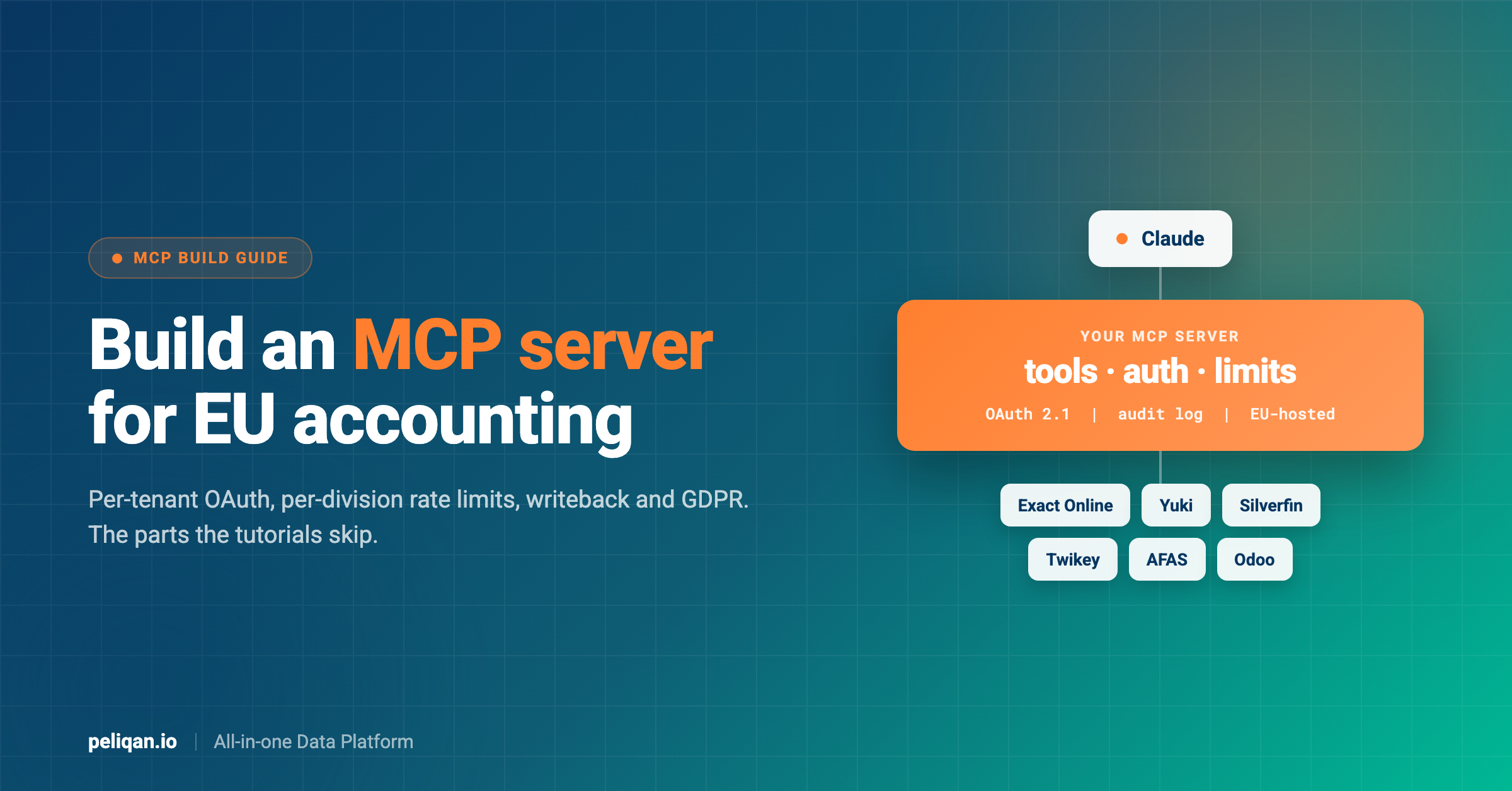
The cooperative MCP pattern from the Notion, Slack, and Airtable playbooks applies directly to the RevOps function. Specifically, three MCPs run in one Claude session and each handles the job it was built for.
First, the vendor-native MCPs cover in-platform actions. Specifically, Salesloft plus Clari MCP handles forecast and pipeline execution. Slack MCP handles the team-collaboration layer. Notion MCP handles knowledge retrieval. Airtable MCP handles the lightweight tracker layer.
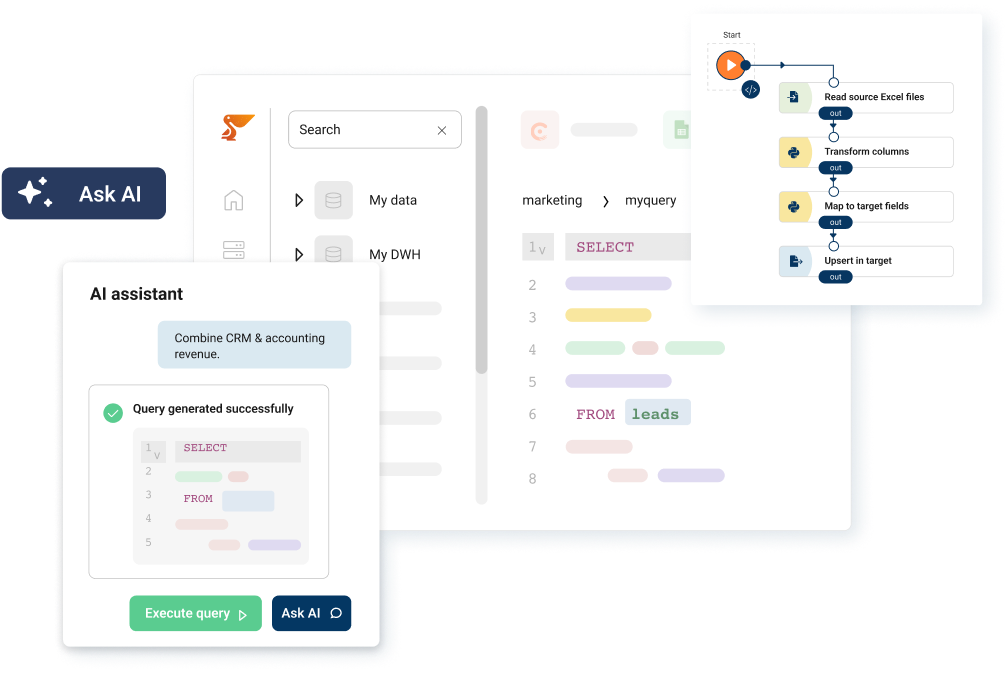
Second, Peliqan’s warehouse-first MCP handles cross-source SQL. Specifically, it joins data across every connected system and produces the multi-vendor JOINs no native MCP can write. As a result, the RevOps team gets one Claude session that covers both in-vendor actions and cross-source analytical reasoning.
Third, the audit log spans both layers. Specifically, every Peliqan query lands in one unified ledger, and every Salesforce or Stripe writeback through reverse ETL gets attributed to the same audit trail. Furthermore, this ledger satisfies the August 2, 2026 EU AI Act Article 26 obligations for any high-risk RevOps use case.
Architecture beneath the RevOps cross-source MCP
The four layers the RevOps team should think about
ICP and pricing for the RevOps buyer
The ideal customer is the VP, Head, or Director of RevOps at an EU-headquartered SaaS scale-up between €5M and €100M ARR. Specifically, the team has 8 to 12 tools, the CRO is asking for cross-source forecast accuracy, and the next renewal cycle is closing in. Furthermore, EU jurisdiction matters because DORA, NIS2, and the EU AI Act Article 26 deadline on August 2, 2026 all apply. As a result, the procurement checklist needs EU-hosted, SOC 2 Type II, audit-logged, with column-level masking by default.
Peliqan’s pricing is fixed from €150 per month annual (€1,800 per year). Furthermore, the platform includes 250+ connectors, the Postgres + Trino warehouse, reverse ETL, and the MCP server in one bundle. Therefore, the cross-source RevOps capability does not add to the bill on top of the base subscription. The compliance posture sits in the GDPR-compliant MCP servers pillar.
Common failure modes the RevOps team should avoid
Three patterns trip up RevOps cross-source MCP rollouts in the first 90 days. None is a vendor problem. All three are architecture choices that compound badly.
The first is the “another dashboard” mistake. Specifically, the team installs Peliqan or any cross-source tool and treats it as the thirteenth dashboard. As a result, nothing changes operationally. The fix is to retire two existing dashboards inside the first month. Indeed, the cross-source MCP exists to replace, not to add.
The second is the “writeback-too-soon” mistake. Specifically, the team enables reverse-ETL writeback to Salesforce or Pipedrive on day one without auditing what the agent will write. As a result, the first overzealous prompt overwrites a deal stage and the CRO loses trust. The fix is a 30-day read-only period followed by manual-approval writeback before automated writeback. Furthermore, the audit log must capture every proposed writeback before the team enables auto-execution.
The third is the “no champion” mistake. Specifically, RevOps owns the rollout but the CRM admins (Salesforce, HubSpot, Pipedrive) are not in the loop. As a result, the agent breaks an automation the admins built and the rollout stalls. The fix is to brief the admin team in week one and co-design the writeback rules. Indeed, the cross-source MCP is a RevOps tool but a stack-wide responsibility.
Real-world example from the cross-source RevOps lane
Real-world example: Skindr
Skindr consolidated advertising and RevOps data across multiple ad networks, CRM, and analytics into Peliqan’s warehouse. Specifically, the team runs faster channel-attribution analysis with fewer manual spreadsheet joins. Furthermore, the same cross-source pattern translates to mid-market SaaS RevOps teams joining marketing engagement to CRM stage to Stripe revenue. Read the full Skindr case study.
How to roll out RevOps cross-source MCP in 60 days
The deployment plan breaks into three phases. First, connect the three highest-value sources to Peliqan: the CRM, Stripe, and the support system. Specifically, generate API tokens, paste them into the Peliqan workspace, and select tables to sync. Furthermore, configure column-level masking for any PII the agent should not see.
Second, install the MCP server with pip install mcp-server-peliqan and connect Claude. Then run the first three cross-source queries from the seven above. Indeed, the renewal-risk or churn-risk query usually reveals at least one customer the team did not know was at risk. As a result, the cross-source MCP investment pays back inside the first 14 days.
Third, layer the cooperative architecture. Specifically, add Salesloft or Clari MCP for forecast execution, Slack MCP for the team-collaboration surface, and Notion or Airtable MCP for knowledge and lightweight tracking. As a result, the RevOps team runs three to five MCPs side by side without overlap. Finally, hand the audit log to the security team for SOC 2 evidence and Article 26 readiness.
The bottom line for the EU RevOps leader in 2026
The RevOps function ballooned to 8 to 12 tools over the last five years. Specifically, every tool has its own dashboard. Furthermore, the cross-source questions that determine retention, forecast accuracy, and renewal risk never resolve cleanly inside any single dashboard.
For 2026, the architectural answer is the cooperative MCP pattern. Specifically, the vendor-native MCPs (Salesloft Clari, 6sense, Mutiny, Slack) handle their in-platform jobs. Then a warehouse-first MCP beneath joins everything in cross-source SQL with audit-logged writeback. As a result, the RevOps leader gets one Claude conversation that spans the whole stack instead of toggling across 12 tools.
The procurement decision that compounds is not which RevOps point tool to buy next. Specifically, you will probably keep adding them. Rather, it is whether you have a warehouse layer beneath every tool that can answer the cross-source questions all of them, individually, cannot. For EU teams under Article 26 and DORA pressure, that layer needs to be EU-hosted, SOC 2 Type II, and audit-logged. That is the choice that survives the next three years of agentic RevOps work and the next SOC 2 renewal at the same time. The architectural foundation sits in the Peliqan MCP product page.