




Every Monday morning, a Pipedrive-led sales team faces the same gap. The pipeline view inside Pipedrive shows what is closing. However, it does not show whether those deals turned into Stripe revenue, whether the customer is on the hook for an Exact Online invoice, or whether the support team has seen a spike in tickets at the same account.
Pipedrive serves more than 100,000 paying companies across 100+ countries. The Estonian-founded CRM owns the EU SMB-to-mid-market scale-up tier in a way Salesforce and HubSpot do not. Furthermore, Pipedrive shipped its own AI – the Pipedrive AI Sales Assistant launched in 2023, expanded into the full Pipedrive AI suite in April 2024.
Therefore, the question is not “should I use AI on Pipedrive”. The question is which MCP server connects Pipedrive to Claude in a way that joins pipeline with payments, ledger, and support across an EU stack. This blog answers that question without overselling.
Pipedrive AI stays inside Pipedrive by design – excellent for in-product workflows. Peliqan MCP is the cross-source layer that joins Pipedrive with Stripe, Exact Online, Mollie, Zendesk, and product analytics in one Claude prompt. Different jobs, complementary stacks.
Why this matters in 2026
Three forces have converged on Pipedrive-led sales teams in 2026. Firstly, Pipedrive AI suite (April 2024) brought GenAI into the platform, which raised the bar for what sales reps expect their AI agents to do. Consequently, the conversation has moved past “should we use AI in Pipedrive” to “how do we use AI across Pipedrive and everything next to it”.
Secondly, EU AI Act enforcement is open at €35M or 7% of global turnover for ungoverned AI on customer data. Naturally, this matters more for EU-headquartered Pipedrive customers than for the US installed base.
Finally, the cross-source RevOps questions that EU scale-ups need to answer in 2026 – pipeline versus actual Stripe revenue, forecast versus Exact Online closed, retention versus product usage – span systems that Pipedrive AI alone cannot reach. As a result, the right MCP architecture for Pipedrive in 2026 is one that pairs with Pipedrive AI, not one that replaces it.
What Pipedrive is, and why the Estonian-EU SMB positioning matters
Pipedrive at a glance: the EU SMB CRM that won the scale-up tier
Pipedrive at a glance
What makes Pipedrive different from HubSpot, Salesforce, and Teamleader
Pipedrive sits in a distinct architectural slot. Salesforce is the global enterprise CRM. HubSpot is the US marketing-led mid-market CRM. Teamleader is the BE/NL SMB CRM with built-in invoicing. By contrast, Pipedrive is the international SMB-to-scale-up CRM with strong developer-friendly APIs and an Estonian/EU heritage.
Specifically, the dev-friendly API, the open Marketplace, and the strong developer community make Pipedrive the default sales CRM for EU scale-ups that want extensibility without committing to Salesforce-grade implementation overhead.
Why connecting Pipedrive to Claude is harder than it looks
Six constraints every Pipedrive AI project hits
Where the per-token-budget model breaks at scale
Pulling a single deal from Pipedrive is straightforward. Indeed, the REST API handles that elegantly. The harder problem is everything an AI agent actually needs to do at scale: pull deals across a multi-territory sales org, join with Stripe payments, refresh hourly, and write back enrichment without exhausting the shared daily token budget.
Specifically, wrapper-style MCPs proxy individual API endpoints. Consequently, they cannot compose analytic queries across multiple sources, and they hit the same token-budget ceiling that protects production integrations.
The real cost of fragmented Pipedrive reporting
What slow Pipedrive reporting costs a scale-up sales team
The hidden cost is not the slow report itself. Rather, it is the operating model that builds up around it – the weekly forecast meetings, the manual stage cleaning, the renewal calls that miss the Stripe payment failure signal. By contrast, cross-source AI on top of Pipedrive, hosted in the EU, with auditable writeback, is the single highest-leverage RevOps investment a scale-up can make in 2026.
6 ways to connect Pipedrive to Claude
1. Pipedrive AI Sales Assistant (native, in-product)
Pipedrive’s native AI is the fastest path to in-Pipedrive intelligence. Specifically, the AI Sales Assistant ranks high-win-chance deals, predicts pipeline outcomes, and surfaces sales recommendations directly inside the platform. The April 2024 Pipedrive AI suite expanded this with email drafting, smart summarisation, and OpenAI-powered insights.
The trade-off is the standard one for native AI: Pipedrive AI stays inside Pipedrive by design. Consequently, it cannot join Pipedrive deals with Stripe payments, Exact Online invoices, or Zendesk tickets.
Best for: In-product sales workflows where the question stays inside the Pipedrive data model.
2. Direct REST API v2 with custom Python
Any developer can authenticate against the Pipedrive REST API and pull Deals, Persons, Organizations, Activities, Products. Furthermore, the open SDK ecosystem and Marketplace partner community give plenty of starting points. However, the cost is in the plumbing: token-budget queueing, OAuth refresh, multi-territory fan-out, and the cross-source join logic that no Pipedrive API provides natively.
Building a maintainable layer is weeks of engineering before the first useful AI prompt arrives.
Best for: Teams with in-house data engineering and a narrow set of fixed extracts.
3. Community GitHub Pipedrive MCP servers
Several community MCP servers wrap the Pipedrive API as MCP tools. Notably, repos like GarethWright/PipeDrive-MCP-Server, WillDent/pipedrive-mcp-server, and Wirasm/pipedrive-mcp expose full CRUD over Deals, Persons, Organizations, and Activities. These projects are free, self-hostable, and useful as prototypes.
However, they are single-account by design, require DIY OAuth and .env management, and the audit trail for writeback is whatever you build on top.
Best for: Engineering teams prototyping a Claude or Cursor workflow against a single Pipedrive account.
4. Composio Pipedrive MCP
Composio’s Pipedrive integration ships as MCP tools across Composio’s broader toolkit, with direct support for the Claude Agent SDK, OpenAI Agents SDK, and Claude Code framework. The platform handles OAuth and the tool router pattern elegantly.
However, Composio is US-hosted by default – a structural compliance gap for EU buyers under GDPR and EU AI Act. Additionally, there is no warehouse beneath, so cross-source SQL with non-Pipedrive systems is not in scope.
Best for: Single-account prototypes and dev-tool-centric AI agents where US hosting is acceptable.
5. Pipedream MCP for Pipedrive (yes, that combination exists)
The naming is memorable: Pipedream MCP for Pipedrive. Specifically, Pipedream MCP exposes Pipedrive actions across its 10,000+ tool catalog spanning 2,700+ apps. Zapier MCP and n8n’s Pipedrive node serve similar use cases.
These are workflow MCPs at scale. As such, they excel at event-driven automation (“when a deal moves to Won in Pipedrive, post to Slack and create a Stripe customer”) but are not analytical platforms. No warehouse, no cross-source SQL, and Zapier MCP in particular is task-quota-capped.
Best for: Event automation and lightweight prototypes, not RevOps analytics.
6. Warehouse-first MCP platform (Peliqan)
Peliqan syncs every Pipedrive entity – Deals, Persons, Organizations, Activities, Products, Leads, Pipelines, Stages, Notes, Files – into a managed EU-hosted Postgres + Trino warehouse, queues all calls inside the daily token budget, and exposes the cleaned tables to Claude, ChatGPT, Cursor, or any MCP client through the Peliqan MCP server.
Claude writes real Postgres SQL with full JOINs and window functions. Moreover, writeback flows back through reverse ETL with a full audit log. Cross-source SQL joins Pipedrive with Stripe, Exact Online, Mollie, Zendesk, Mixpanel, and 240+ other connectors. EU-hosted, SOC 2 Type II, GDPR-native.
Best for: EU scale-ups running Pipedrive at multi-territory scale with cross-source revenue intelligence needs. See the Pipedrive connector.
Comparison: 6 ways to connect Pipedrive to AI
| Method | Writeback | Cross-source SQL | Warehouse | EU hosting | Rate-limit handling | Audit log |
|---|---|---|---|---|---|---|
| Pipedrive AI (native) | In-Pipedrive | No | No | Pipedrive hosting | Pipedrive-managed | In-Pipedrive |
| Direct API + Python | Custom-built | Hand-rolled | Hand-rolled | Depends on host | Hand-rolled | Custom-built |
| Community GitHub MCPs | Read + write | No | No | Self-host | DIY | DIY |
| Composio Pipedrive | Per-action | No | No | US-default | Generic | Partial |
| Pipedream / Zapier / n8n MCP | Per-workflow | Event-only | No | US-default (n8n EU) | Per-flow | Workflow logs |
| Peliqan MCP | Full audit log | SQL across 250+ apps | Postgres + Trino | EU, SOC 2 Type II | Token-budget aware | Prompt-to-API trail |
The Pipedrive entities that matter most for sales-ops AI
| Pipedrive entity | What it powers | Sales-ops AI use case |
|---|---|---|
| Deals | Pipeline, stages, value, owner | Stuck-deal triage, forecast cleaning |
| Persons + Organizations | Contact and account master | Account 360, stakeholder mapping |
| Activities | Calls, meetings, emails, tasks | Activity-to-revenue correlation, rep engagement |
| Products + Line Items | SKU catalog and deal-line attach | Product-mix analysis, upsell signals |
| Leads | Pre-deal qualification | Lead scoring, conversion triage |
| Pipelines + Stages | Workflow definition per team | Multi-territory rollup, stage-duration analysis |
| Notes + Files | Conversation history per deal | RAG-grounded answers, deal context |
| Insights / Reports | Native reporting layer | Custom dashboards, KPI tracking |
Decision framework: which Pipedrive architecture fits your shape
Match the architecture to your sales shape
The sales-ops playbook: 5 Pipedrive + Claude workflows that change the cadence
The temptation is to bolt Pipedrive AI onto the dashboard and call it transformation. However, the actual value comes from compressing the workflows that recur every Monday, every renewal, every quarter-end. Five workflows repeat across EU scale-ups running this architecture.
1. Pipedrive deal versus Stripe revenue reconciliation
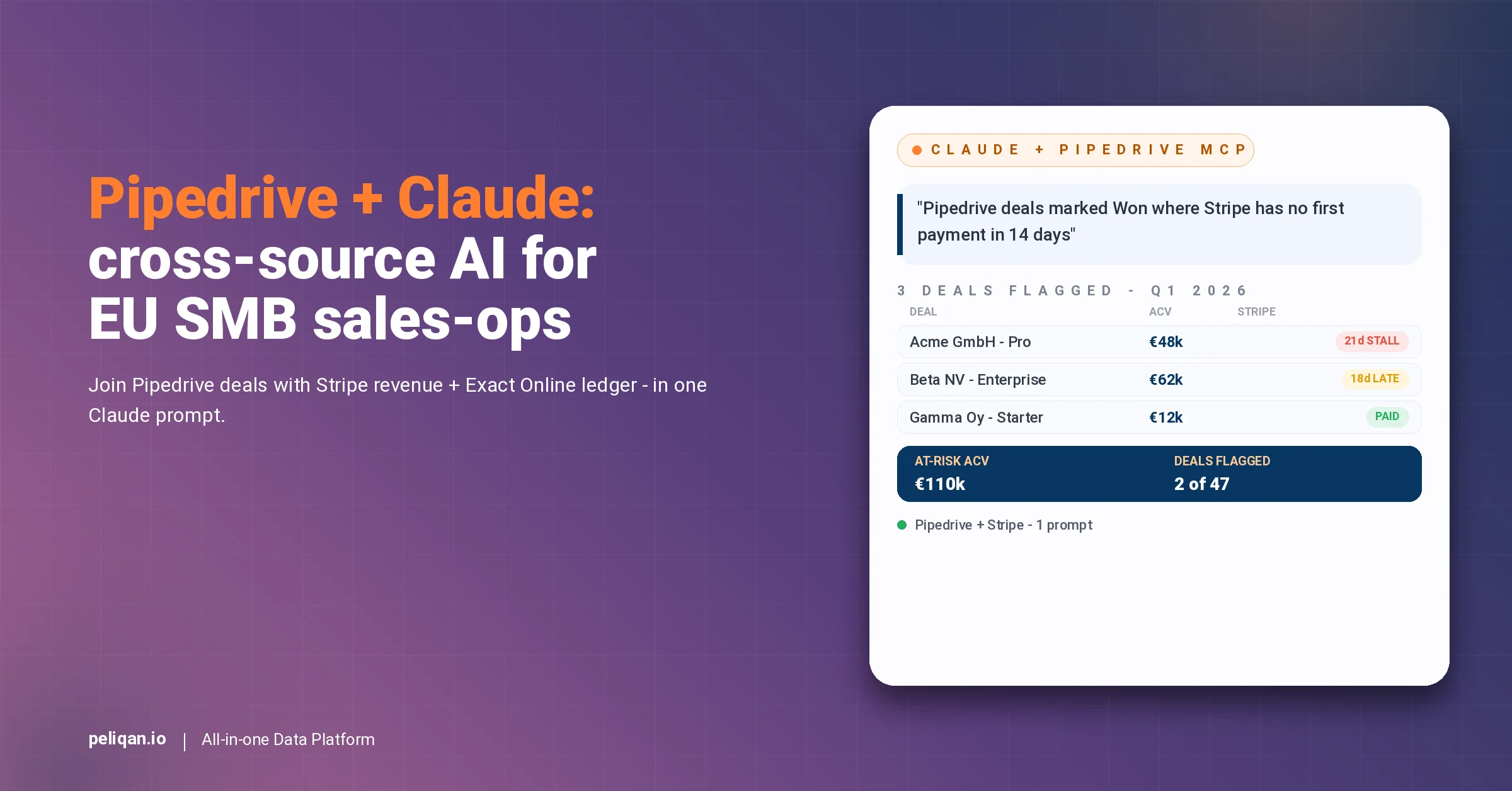
“Show me every deal marked Won in Pipedrive in the last 30 days where Stripe has not received the first payment within 14 days.” This is the cross-source query that catches stalled onboarding, payment issues, or premature deal-close. Specifically, the warehouse joins Pipedrive Deals with Stripe Charges and PaymentIntents on the customer master, and the Claude agent returns the prioritised follow-up list.
2. Pipeline cross-checked against support tickets
“For our top-100 customers by ARR, show me Pipedrive deals at renewal, joined to Zendesk Sev-1 and Sev-2 tickets opened in the last 30 days.” This is a four-source join no per-API MCP wrapper can answer. Notably, cross-source joins in Peliqan handle the multi-source aggregation cleanly.
3. Forecast cleaning against closed revenue
“Compare Pipedrive forecast value for this quarter against Exact Online closed revenue, by sales rep, and flag any rep whose forecast variance is above 25%.” Naturally, the Exact Online CFO playbook covers the finance-side pattern that joins natively to Pipedrive forecast in the same MCP context.
4. Lead enrichment via auditable writeback
“For every new lead created in Pipedrive in the last 7 days, append firmographic data from third-party sources, score the lead, and update the Pipedrive lead record with the enrichment.” Importantly, this writeback workflow needs a defensible audit trail. Reverse ETL in Peliqan handles the orchestration and the audit log.
5. Multi-territory sales rollup across workspaces
“Across all our regional Pipedrive workspaces (EU, US, APAC), give me consolidated pipeline by stage, by rep, by region – with month-over-month deltas.” Specifically, multi-workspace consolidation is the workflow that nobody can build inside Pipedrive natively. Multi-customer management handles the per-workspace isolation and the cross-workspace aggregation in a single MCP context.
How Peliqan handles Pipedrive
What you get with the Pipedrive MCP server on Peliqan
Why warehouse-first matters specifically for Pipedrive + Stripe scale-ups
EU scale-ups running Pipedrive plus Stripe have a unique architectural unlock: the cross-source revenue picture. Specifically, the warehouse holds both systems side-by-side, and the Claude prompt joins pipeline with actual payment in one query. As a result, the deal-versus-revenue reconciliation that finance and sales argue about weekly becomes one prompt.
Furthermore, the general Claude MCP overview covers the protocol-level details for engineering teams evaluating the move.
Where Pipedrive + Claude fits in the broader EU CRM stack
For BE/NL SMBs running Teamleader instead of Pipedrive, the Teamleader Claude MCP playbook covers the Benelux-specific pattern that includes built-in invoicing. Pipedrive is the dev-friendly international scale-up alternative.
For global enterprises on Salesforce or US mid-market on HubSpot, the same warehouse-first architecture applies. Indeed, the main MCP hub covers the cross-source pattern across the entire connector catalog.
Likewise, the Composio vs Pipedream vs Peliqan comparison covers the architectural side-by-side for buyers comparing MCP options across categories.
Implementation primitives that power the workflows
Materialized tables show how to stage Pipedrive data once and serve it to Claude in milliseconds – critical for the conversational latency a sales leader expects in a Monday morning forecast call.
Additionally, building AI agents in Peliqan covers the implementation pattern for the cross-source workflows.
Furthermore, alerting and messaging handles the proactive layer – stage drift, stalled deals, payment failures – that should post to Slack before they become quarter-end problems.
For engineering teams building their own
For engineering teams that prefer to roll their own MCP layer on top of Pipedrive, the build MCP server guide covers the protocol details. However, for most EU scale-ups, the Peliqan-managed Pipedrive connector is the faster path – the token-budget handling, the multi-workspace fan-out, the cross-source joins, and the audit log all ship pre-wired.
Furthermore, the Pipedrive AI page shows the live agent patterns for forecast cleaning, deal triage, and multi-territory rollup – the three workflows that most often justify the architecture in the first quarter of use.
What sales leaders should do this quarter
Three steps turn a Pipedrive + Claude conversation from a slide into an operating model.
Firstly, pick one cross-source question that has been stuck between RevOps and finance for a quarter – pipeline-versus-Stripe revenue, forecast cleaning, multi-territory rollup – and prove it can be answered from a single Claude prompt against a warehouse-backed Pipedrive.
Secondly, audit your current MCP tooling against EU GDPR and EU AI Act requirements. Any US-hosted MCP serving an EU customer base is a future compliance gap; any wrapper without an audit log is a future deal-desk risk.
Thirdly, evaluate whether Pipedrive AI Sales Assistant plus a warehouse-first MCP is the right architectural pair for your stack. In most EU scale-up environments, they are complementary rather than competing.
Ultimately, the MCP layer is becoming the AI operating system of EU sales-ops. Picking well in 2026 means treating Pipedrive AI as the in-product layer and the warehouse-first MCP as the cross-source layer. The pipedrive claude stack is one short architectural decision away.