




The RevOps question that defines every Monday morning in 2026 is brutally simple: “Show me every deal stuck more than 30 days in Negotiation across all three of our Salesforce orgs, ranked by ACV, joined to last week’s product usage in Mixpanel and any open Zendesk tickets at the same accounts.” A salesforce mcp server should answer that in under a minute. In practice, four BI dashboards and three SOQL queries later, the answer arrives on Wednesday – or it arrives as a guess. The wall is not Claude. The wall is SOQL.
Salesforce’s own query language caps at 50,000 rows per transaction, can’t join across orgs, can’t run analytic functions, and has no native cross-source story. Add the governor limits – 100,000 API calls per day, 25 concurrent long-running requests – and any heavy AI workload immediately competes with the Apex jobs that keep production running. This is the gap that claude salesforce, salesforce ai agent, and salesforce claude integration are quietly being asked to close. The shortest path is a warehouse – and that is the architectural decision that separates a Peliqan-class MCP server from every wrapper-style MCP shipping in 2026.
Salesforce is used by more than 150,000 companies globally, including 90%+ of the Fortune 500, with a 20.7% share of the CRM market. The installed base is the largest concentration of pipeline, account, and customer-relationship data in the enterprise software market. The ceiling on what AI can do against that data is set by three things: the limits of SOQL, the governor framework that protects production workloads, and the multi-org reality that almost every enterprise lives inside. The right MCP architecture for Salesforce has to handle all three at once, and it has to do so without making the AI agent a second-class citizen against Salesforce’s own Agentforce ecosystem.
What a Salesforce MCP server actually is, and why the architecture choice matters
Salesforce + MCP at a glance
The Salesforce MCP conversation is no longer about whether AI can read your CRM. Every MCP server can do that. The conversation is about whether the AI can answer the questions a RevOps leader, a CRO, or an IT-data team actually needs answered – across orgs, across sources, with auditable writeback, in a way that doesn’t compete with Apex for governor budget. That is the architectural fork in the road.
Why connecting Salesforce to Claude is harder than it looks
Six constraints every Salesforce AI project hits
The painful part is not pulling a single Opportunity record. SOQL handles that elegantly. The painful part is everything a real RevOps prompt requires once it touches more than one entity, more than one org, or more than one system. Wrapper-style MCPs that proxy individual API endpoints can never answer those questions, no matter how many tools they ship.
The real cost of Salesforce data silos in the AI era
What slow Salesforce reporting actually costs a RevOps team
The hidden cost is not the slow report. It is the operating model that builds up around a slow report – the meetings to triage, the spreadsheets to reconcile, the renewal calls that miss the right signal. Cross-source AI on top of Salesforce, hosted in the right jurisdiction, with auditable writeback, is the single highest-leverage RevOps investment in 2026.
6 ways to connect Salesforce to Claude
1. Manual reports and exports
Build reports in Salesforce, export to CSV or to Tableau CRM, paste into Excel, send to the team. It works for a single quarterly review. It does not answer cross-source questions, it cannot handle multi-org consolidation, and it cannot be the answer to a Claude prompt.
Best for: One-off pipeline reviews in single-org SMBs.
2. Direct SOQL via REST API and custom Python
Any data engineer can authenticate against the Salesforce REST API and run SOQL. The catch is SOQL’s join limits and the 50,000-row ceiling. To answer “show me every opportunity touched by every BDR in the last 90 days, with their last activity and the related accounts’ MRR”, a single SOQL query cannot do it – you script multiple calls, paginate, join client-side, and burn through governor budget.
Best for: Teams with a dedicated data engineer and a narrow set of well-defined extracts.
3. Salesforce Agentforce (and Agentforce 3 MCP)
Agentforce is Salesforce’s native AI agent framework. The June 2025 Agentforce 3 release added MCP-client support so Agentforce agents can call external MCP servers. The trade-off is direction: Agentforce is Salesforce-first – the agent lives inside the Salesforce ecosystem, the data lives inside the Salesforce ecosystem, and cross-source value flows out of Salesforce rather than into Claude. There is also a practical tool ceiling – early Agentforce builds capped concurrent tools at around 20.
Best for: Salesforce-only AI use cases for teams already committed to the Salesforce AI stack.
4. Generic action-based MCP wrappers (Zapier MCP, Pipedream MCP)
Zapier MCP and Pipedream MCP expose Salesforce actions to MCP clients. They work well for event-driven automations – “when a Lead is created, post to Slack” – and they ship fast. They are not analytical platforms. There is no warehouse beneath, no cross-source SQL, and Zapier MCP in particular is task-quota-capped which limits how aggressive an AI workload can be.
Best for: Event automations and lightweight prototypes, not RevOps analytics.
5. Composio Salesforce MCP and open-source community servers
Composio’s Salesforce MCP exposes a respectable set of read and writeback tools – create Account, Contact, Lead, Opportunity, Campaign, Task. Open-source community Salesforce MCP servers on GitHub do similar work. Both are useful starting points. Both are US-hosted by default (a compliance gap for EU buyers under GDPR and EU AI Act), neither stores data in a warehouse, and neither supports cross-source SQL with non-Salesforce systems. They are also single-org by design.
Best for: Single-org Claude/Cursor prototypes against the core CRM entities.
6. Warehouse-first MCP platform (Peliqan)
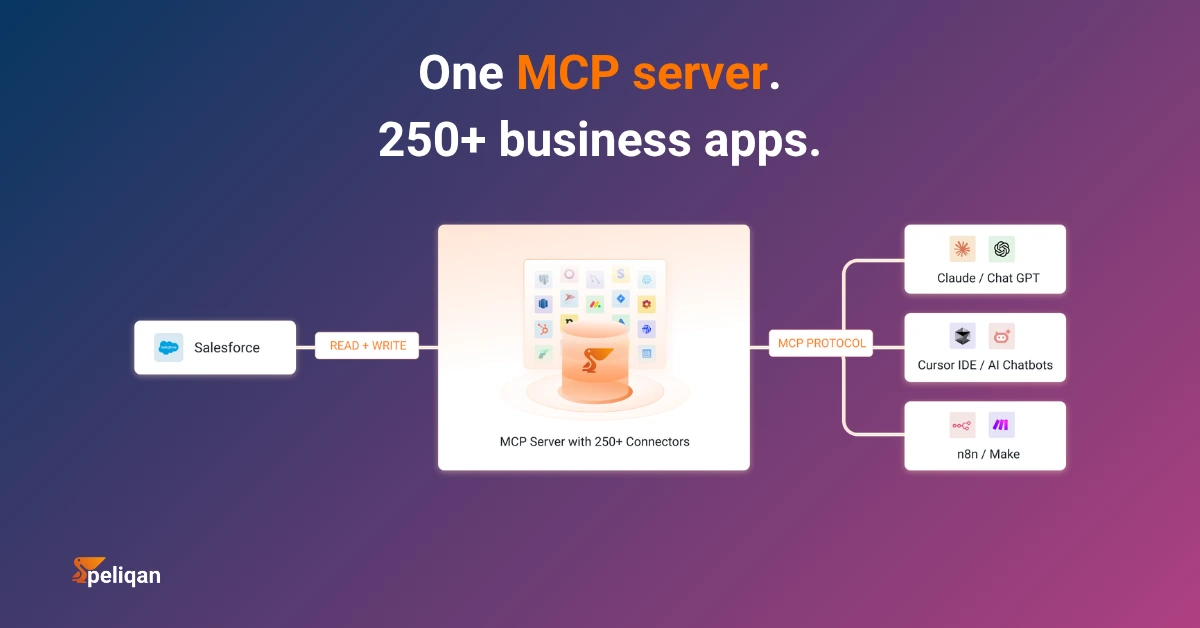
Peliqan syncs every Salesforce org – production, sandbox, and acquired orgs – into a managed Postgres + Trino warehouse, queues all calls inside Salesforce’s governor framework, and exposes the cleaned tables to Claude, ChatGPT, Cursor, or any MCP client through the Peliqan MCP server. Claude writes real Postgres SQL with full JOINs, window functions, and analytics. Writeback flows back through reverse ETL with a full audit log. Cross-source SQL joins Salesforce with HubSpot, Stripe, Mixpanel, Zendesk, Exact Online, Snowflake, and 240+ other connectors. EU-hosted, SOC 2 Type II, GDPR-native.
Best for: RevOps and CROs running multi-org Salesforce at audit-grade cadence. See the Salesforce connector.
Comparison: 6 ways to connect Salesforce to AI
| Method | Real JOINs | Multi-org | Writeback + audit | Cross-source | EU-hosted |
|---|---|---|---|---|---|
| Manual reports | No | Manual merge | No | No | N/A |
| Direct SOQL + Python | SOQL-limited | Hand-rolled | Custom-built | Hand-rolled | Depends on host |
| Agentforce / Agentforce 3 | SOQL-bound | Single org | In-Salesforce only | Salesforce-ecosystem | Salesforce hosting |
| Zapier / Pipedream MCP | No | Per-flow setup | Task-quota-capped | Event-only | US-default |
| Composio / community MCP | No | Single org | Partial | No | US-default |
| Peliqan MCP | Full Postgres SQL | All orgs unified | Full audit log | SQL across 250+ apps | EU, SOC 2 Type II |
The Salesforce entities that matter most for AI workflows
| Salesforce entity | What it powers | RevOps AI use case |
|---|---|---|
| Account | Customer and prospect master | Account health, expansion signals, renewal-risk |
| Opportunity + OpportunityLineItem | Pipeline, stages, ACV, products | Forecast cleaning, stuck-deal triage |
| Lead | Inbound and outbound prospects | Lead scoring, enrichment, SLA monitoring |
| Contact | Decision-maker map per account | Stakeholder mapping, multi-thread coverage |
| Task + Event | Rep activity history | Activity-to-revenue correlation |
| Campaign + CampaignMember | Marketing source attribution | Source-influenced pipeline, attribution analysis |
| Case | Support tickets | Renewal-risk signals, escalation cohorts |
| Quote + Order | CPQ outcomes | Discount analysis, deal-desk anomalies |
Decision framework: which Salesforce MCP architecture fits your shape
Match the architecture to the use case
The RevOps playbook: 5 Salesforce + Claude workflows that change the cadence
The temptation with Salesforce + AI is to bolt a chatbot onto a dashboard and call it transformation. The actual value comes from compressing the workflows that recur every Monday, every renewal cycle, every forecast call. Five workflows repeat across the RevOps teams we have seen running this architecture.
1. Daily pipeline review across all orgs
“Show me every Opportunity stuck more than 30 days in Negotiation, ranked by ACV, across production and our two acquired orgs.” That is one Postgres SQL query against the warehouse, with full window functions for stage duration and a UNION across orgs. The same prompt against SOQL takes three separate queries, manual pagination through the 50,000-row ceiling, and a merge in Python. Joining data in Peliqan is the architectural unlock.
2. Renewal-risk cross-source signal
“Which accounts in our top-200 by ARR have falling Mixpanel usage AND open Zendesk Sev-2 tickets AND no Opportunity activity in 30 days?” That is a three-source join no single-system MCP can answer. The warehouse holds Salesforce, Mixpanel, and Zendesk in the same Trino layer; the Claude prompt returns a ranked list and the suggested customer success motion. SQL on anything in Peliqan covers the federated query pattern.
3. Forecast cleaning at the deal level
“Flag every Opportunity in Stage 4 or higher with a Close Date in the past 14 days, no rep activity in 7 days, or probability inconsistent with stage.” That is the deal-desk review every Friday, automated. A Claude agent reads the cleaned warehouse, flags candidates, and through reverse ETL can write a follow-up Task back to the responsible rep in Salesforce – with the original prompt logged in the audit trail.
4. Lead enrichment from cross-source signals
“For every Lead created in the last 7 days, append HubSpot marketing engagement, LinkedIn firmographics where available, and the closest matching Account from our existing book of business.” The cross-source enrichment lands as a Salesforce Lead update via UpdateConnector-equivalent writeback. Building AI agents in Peliqan covers the implementation pattern.
5. Multi-org consolidation for boards and acquirers
“Across all 4 Salesforce orgs, give me consolidated pipeline by stage, by owner, by region, with intercompany double-counting removed.” That is the cross-org board view that does not exist natively in Salesforce. The Peliqan warehouse holds all orgs side-by-side; multi-customer management handles the fan-out and per-org isolation.
How Peliqan handles Salesforce
What you get with the Salesforce MCP server on Peliqan
The Peliqan Salesforce MCP server is the shortest path from a multi-org Salesforce environment to an AI operating model that uses Claude in production rather than in pilot. The warehouse handles the slow, queued, governor-aware sync. The MCP server exposes clean tables to any client. Reverse ETL closes the loop so writeback flows back into Salesforce with a defensible audit log. And the cross-source layer means that when RevOps wants to ask a question spanning Salesforce, HubSpot, Stripe, and Zendesk, that is one query. The general Claude MCP overview covers the protocol details.
The main MCP hub covers the cross-source pattern across the entire connector catalog, the ROI math for a typical mid-market RevOps team, and the comparison framing against Composio, Apideck, and the Salesforce-native Agentforce stack.
For teams whose marketing operations live in HubSpot alongside Salesforce, the same warehouse holds both CRMs and joins them seamlessly for full-funnel analytics – the sibling MCP pattern referenced in the decision framework above applies directly.
For teams whose enterprise data lives in Snowflake, the Snowflake MCP guide covers the data-warehouse-side pattern that Peliqan can sync from or to – especially useful when Salesforce sits beside an existing Snowflake reporting layer.
The Postgres MCP overview is the architectural foundation – Peliqan’s warehouse is Postgres-compatible with Trino federation on top, which is what makes Claude’s real SQL possible against Salesforce data.
For developers building their own MCP layer on top of Salesforce, the build MCP server guide covers the protocol if you want to roll your own – though for most Salesforce teams, the Peliqan-managed connector ships with the governor-aware sync and the audit trail already wired in.
For EU buyers running Salesforce alongside European ERPs, the cross-source story compounds. The Exact Online MCP landing page covers the Dutch finance-side pattern that joins natively to Salesforce pipeline in the same MCP context.
The Teamleader MCP page covers the Belgian-and-Benelux CRM sibling – useful for groups running Salesforce in the US/UK and Teamleader in Benelux subsidiaries, with the cross-region pipeline join happening at the warehouse layer.
For deeper object-by-object coverage, the Salesforce AI page shows the live agent patterns for pipeline review, forecast cleaning, and renewal-risk – the three workflows that most often justify the architecture in the first quarter of use.
Materialized tables show how to stage Salesforce data once and serve it to Claude in milliseconds – critical for the conversational latency a RevOps leader expects in a forecast call.
Data quality monitoring covers the alerting layer for forecast anomalies, stage drift, and ownership gaps that should trigger Slack notifications before they become deal-desk problems.
What RevOps and CROs should do this quarter
Three steps turn a Salesforce + Claude conversation from a slide into an operating model.
First, pick one cross-source question that has been stuck between RevOps and analytics for a quarter – renewal risk, forecast cleaning, multi-org consolidation – and prove it can be answered from a single Claude prompt against a warehouse-backed Salesforce.
Second, audit your current AI tooling for governor pressure and data residency. Any tool sharing the live Salesforce API with production Apex is a future incident; any US-hosted MCP serving an EU buyer is a future compliance gap.
Third, classify your Salesforce AI use case against EU AI Act risk tiers and document the audit log requirement now – not after the assessor arrives.
The RevOps function is moving from monthly forecasting to weekly intelligence, and Salesforce is the data layer that backs most of it. Putting a warehouse and an MCP server between the CRM and the prompt surface is not optional – it is the difference between a RevOps leader who can answer cross-source questions in 60 seconds and one who promises an update by next Friday. The salesforce mcp stack is the next operating-model change, and it is one short architectural decision away.