




The Dutch CFO question that quietly defines whether finance is a brake or a lever in 2026 is simple: “What do my numbers look like across all 12 divisions, as of this morning?” If the answer takes two days, three Excel exports, and a controller-level merge before it reaches the board, the finance function is running on 2019 plumbing.
Exact Online powers more than 675,000 SMEs and accountants across the Netherlands, Belgium, Germany, and the UK – but the product is built to record transactions, not to surface them across divisions in conversational English. This is where exact online claude, exact online ai, and exact online mcp move from talking point to operating model. The shortest path from Exact Online to a Claude-grade answer goes through a warehouse, and the decision to put one there is now squarely on the CFO’s desk.
Three pressures have converged on Dutch and Benelux finance teams at the same time. The EU AI Act enforcement window is open, with fines of up to €35M or 7% of global turnover for ungoverned AI. Belgium’s mandatory B2B Peppol e-invoicing went live on January 1, 2026, and the three-month grace period ended on April 1 – which means cross-border Dutch sellers shipping into Belgium are now living inside the same regulatory envelope.
And the finance talent pipeline that used to absorb manual close work has thinned out so far that CFOs are quietly building AI into the workpaper rather than waiting for next year’s hires. The blog you’re reading is the playbook for stitching Exact Online to Claude in a way that survives an EU AI Act audit, an FOD Financien inquiry, and a private-equity month-end review without the controller team burning a weekend.
What is Exact Online, and why it sits at the center of every Benelux finance stack
Exact Online at a glance
Exact Online is the default ERP for Dutch SMEs that have outgrown spreadsheets but aren’t ready for Microsoft Dynamics or NetSuite. It is also the system of record for thousands of NL and BE accountancy firms managing client portfolios. The reason it matters for the AI conversation is not the size of the user base – it is the multi-division architecture. A €40M Dutch holding running Exact Online for 12 operating companies, three foreign subsidiaries, and a property entity is the rule, not the exception. The CFO question is almost never “show me one division” – it is “show me all of them, joined, today.”
Why connecting Exact Online to Claude is harder than it looks
Five constraints every Exact Online AI project hits
The painful part is not pulling a single invoice or a single journal entry. The painful part is everything that makes Exact Online useful at the holding level: queued fan-out across divisions, persisted state across syncs, joins to non-Exact sources, and an audit log strong enough to defend the writeback.
CData’s MCP server handles individual reads well but does not solve the warehouse problem. Apideck’s unified API normalises across providers but doesn’t store state. Composio is AI-first but US-default. The CFO-grade architecture has to be warehouse-first, and the warehouse has to live in the EU.
The real cost of slow multi-division Exact Online reporting
What slow Exact Online reporting actually costs a CFO
The hidden cost is not the time it takes to close. It is the conversations the CFO cannot have during the gap – the renewal call that needed the latest receivables view, the board update that arrived a day late, the cross-border VAT question that surfaced in audit but could have been caught in week one. Putting Exact Online behind a warehouse and a Claude MCP server is not an IT project. It is a finance operating-model change.
5 ways to connect Exact Online to Claude
1. Manual exports and Excel
Most Dutch finance teams still start here. You log into Exact Online, run the reports per division, drop them into Excel, paste into a master sheet, and answer the question. It works for a single quarter close, a single division, and a single CFO who knows where every macro lives. It does not work for daily AR review across 12 divisions, it does not work for cross-source joins, and it never works for a Claude prompt.
Best for: One-time investigations or single-division holdings.
2. Direct Exact Online REST API plus custom Python
The Exact Online REST API is well-documented and supports OAuth 2.0. Any data engineer can write a Python pipeline that walks Divisions → SalesInvoices → GLTransactions → Receivables and lands the result in a database. The catch is the rate limit (60 calls per minute per division, plus a 10-error-per-hour ceiling) and the multi-division fan-out problem. A naive script that pulls a 12-division group in parallel will trip throttling and corrupt state. You spend weeks building a queue, backoff, OAuth refresh, and a schema map before you get to a single AI prompt.
Best for: Teams with a dedicated data engineer and a single divisional scope.
3. Power BI or Tableau custom connector
Power BI’s Web.Contents and Tableau’s Web Data Connector can hit the Exact Online API directly. Many Dutch CFOs start here because Power BI is already on the desk and the IT team already has a tenant. The architecture buys you one or two static dashboards. It breaks the moment the question is anything other than a pre-built filter – cross-source joins fail, writeback does not exist, and there is no Claude interface. Refreshes hit the rate limit unpredictably under multi-division loads.
Best for: A small number of static management dashboards for a single division.
4. Generic MCP servers (CData, Apideck, Composio, Pipedream, Zapier MCP)
The MCP marketplace has multiple Exact Online options. CData ships an Exact Online MCP server with read, write, update, and delete – elegant for a single-division use case but no warehouse beneath. Apideck offers a unified MCP server that normalizes Exact Online into a generic accounting schema, which is useful for cross-provider portability but flattens away the division-level detail Dutch CFOs care about. Composio is AI-first but US-default and weak on EU compliance. Pipedream is event-driven, not analytical. Zapier MCP is mostly read-only. None of these solves the multi-division warehouse problem or the EU-hosted compliance gate.
Best for: Prototyping a single-division Claude workflow, not production CFO playbook.
5. Warehouse-first MCP platform (Peliqan)
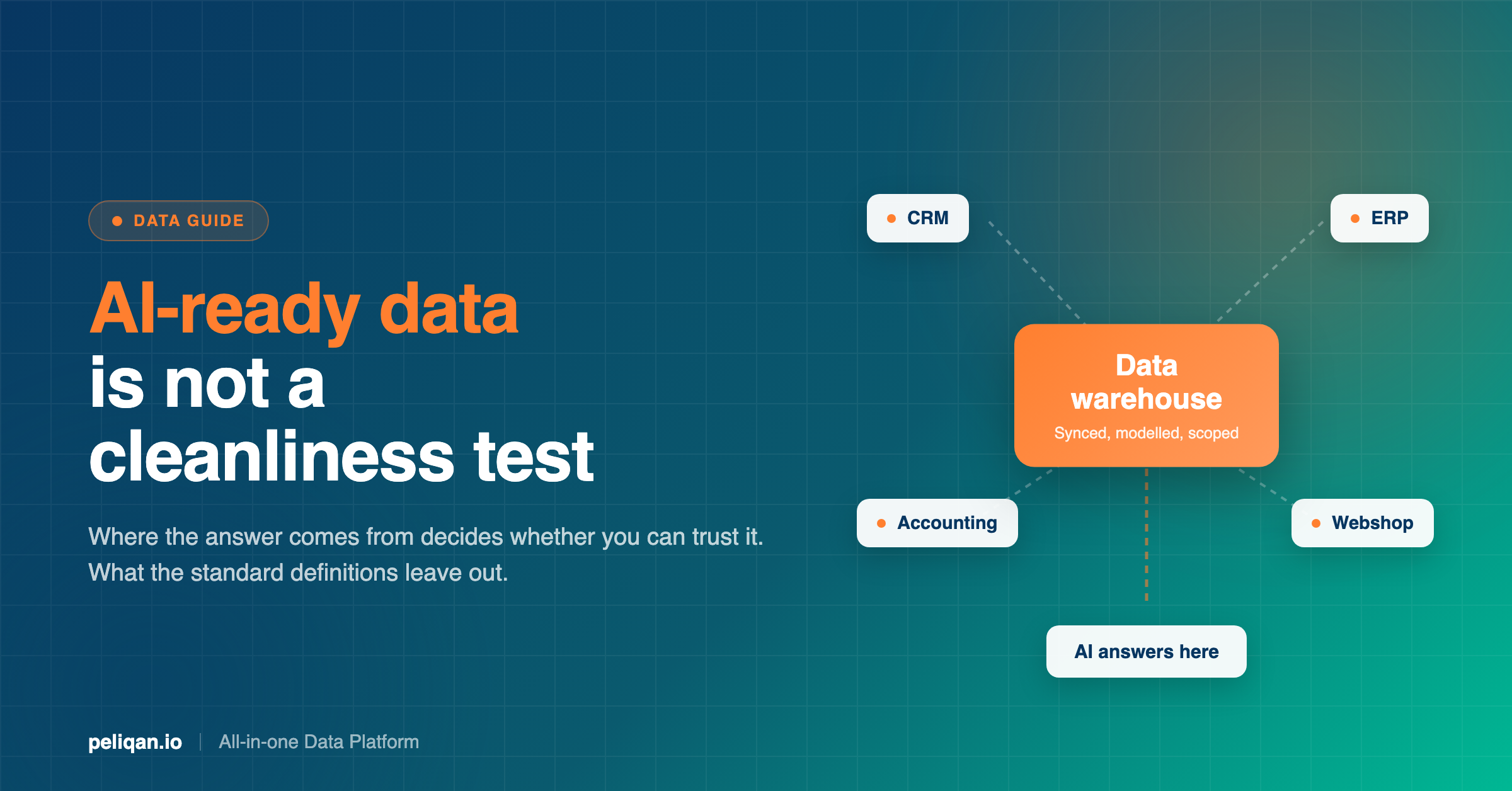
Peliqan syncs every Exact Online division – and every endpoint in each division – into a managed EU-hosted Postgres + Trino warehouse, queues all calls inside the rate limit, persists state across syncs, and exposes the cleaned tables to Claude, ChatGPT, Cursor, or any MCP client through the Peliqan MCP server. Writeback flows back through reverse ETL with a full audit log. Cross-source SQL joins Exact Online with Teamleader, AFAS, Billit, HubSpot, and 240+ other connectors in one query. EU-hosted, SOC 2 Type II, GDPR-native.
Best for: Dutch and Benelux CFOs running multi-division Exact Online at audit-grade cadence. See the Exact Online MCP server.
Comparison: 5 ways to connect Exact Online to AI
| Method | Multi-division | Cross-source joins | Auditable writeback | EU-hosted MCP | Rate-limit handling |
|---|---|---|---|---|---|
| CSV / Excel | Manual merge | No | No | N/A | N/A |
| Direct API + Python | Hand-rolled | Hand-rolled | Custom-built | Depends on host | Hand-rolled |
| Power BI / Tableau | Limited | Limited | No | Microsoft tenant | Refresh-bound |
| CData / Apideck / Composio | Partial | No | Limited | US-default | Generic |
| Peliqan MCP | Native, all divisions | SQL across 250+ apps | Full audit log | EU, SOC 2 Type II | Built-in queue + backoff |
The Exact Online entities that matter most for the CFO playbook
Not every Exact Online endpoint is equally important to the CFO. The handful below carry roughly 80% of the reporting and AI value, and the warehouse design should treat them as first-class.
| Exact Online entity | What it powers | CFO playbook use case |
|---|---|---|
| Divisions | Legal entity master | Consolidation perimeter, intercompany matching |
| SalesInvoices | All issued invoices, status, customer link | Revenue rollup, DSO, Peppol delivery cross-check |
| GLAccounts | Chart of accounts per division | COA harmonisation, anomaly detection |
| GLTransactions | All journal entries with line detail | Same-day P&L, trial balance, intercompany reconciliation |
| Receivables / Payables | Open AR/AP per customer/supplier | DSO/DPO, late-payer triage, cash forecast |
| Projects + TimeTransactions | Project ledger, billable time | Project margin, WIP, realization rate |
Decision framework: which architecture matches your finance shape
How to pick the right Exact Online AI architecture
The CFO playbook: 5 Exact Online + Claude workflows that move margin
The temptation with AI is to bolt a chatbot onto the finance dashboard and call it a transformation programme. The actual value comes from compressing the work that recurs every week, every month, every quarter. Five workflows repeat across the Dutch CFOs we have seen running this architecture.
1. Auto-aggregated multi-division month-end
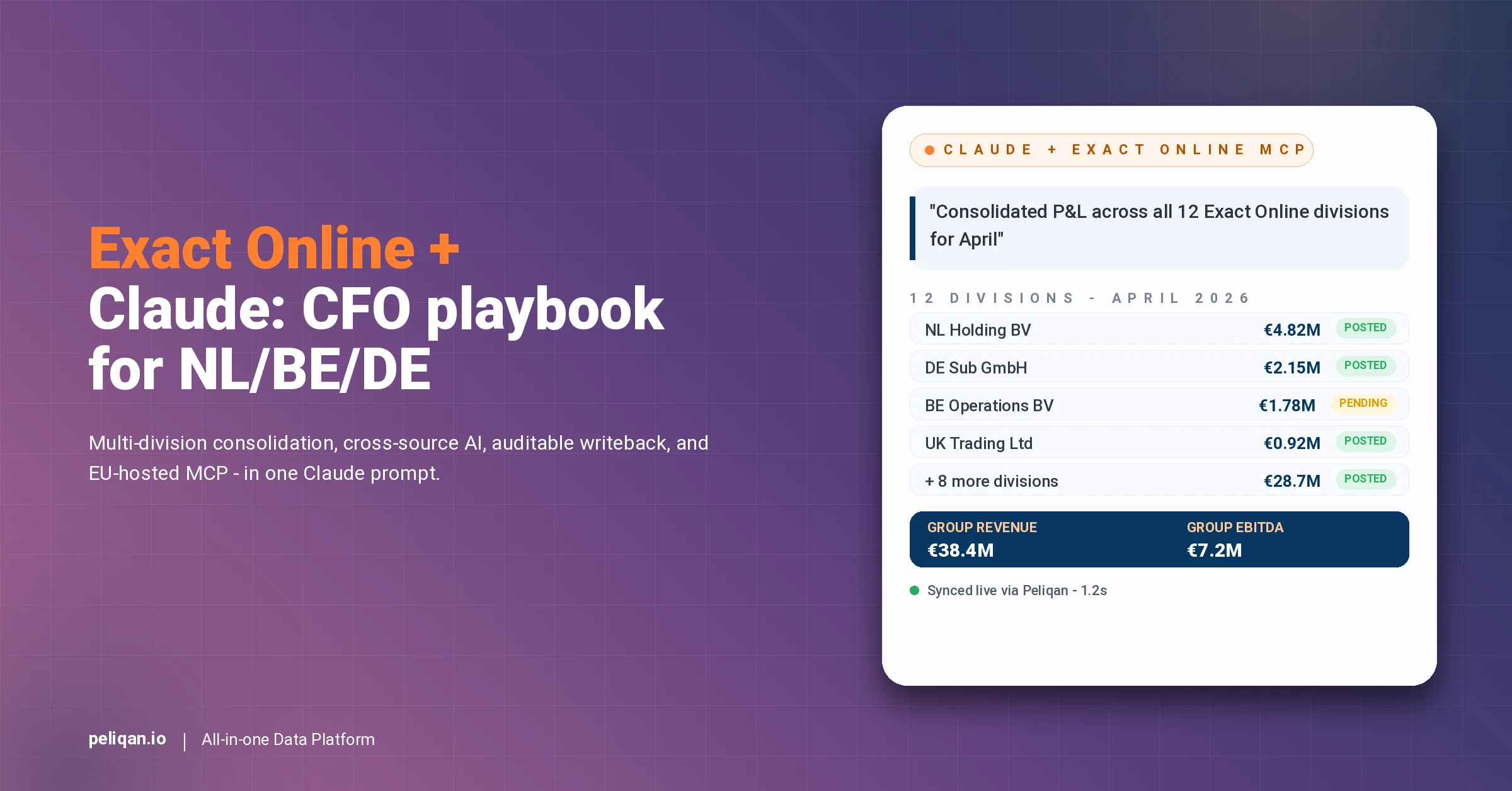
“Give me the consolidated P&L across all 12 divisions for April, with intercompany eliminated.” In a raw Exact Online flow, this is a controller export-and-merge week. In a warehouse-backed Claude flow, it is one prompt against a materialized monthly trial balance with division dimensions intact. Intercompany pairs are flagged because the warehouse already joined supplier-side and customer-side ledgers across divisions. The CFO gets the answer at the same time the controller would have started writing the macro.
2. Cross-source: Exact Online + Teamleader + AFAS in one Claude prompt
“Show me every Teamleader deal closed in Q1 where the Exact Online invoice has been issued but the AFAS HR system shows the project lead has left the company.” That question crosses three systems and is impossible inside any single one of them. With a warehouse-first MCP, it is one SQL statement. Cross-source SQL is the single feature that differentiates a warehouse-first MCP from CData, Apideck, or Composio – none of them join across providers. How cross-source joins work in Peliqan is the architectural detail underneath.
3. Peppol-era VAT reconciliation for Dutch sellers into Belgium
The Belgian B2B Peppol mandate is now live. Dutch companies invoicing customers in Belgium are subject to the same delivery, acknowledgement, and structured-format rules – and the FOD Financien penalty schedule attaches to the buyer’s side of the transaction. An AI agent with access to Exact Online sales invoices plus Billit Peppol acknowledgements can reconcile in real time: did the invoice we issued in Exact actually clear Peppol on the Belgian side, and was it accepted by the buyer’s access point? The same agent can drive a corrected resend through reverse ETL.
4. AR collections and DSO triage at the group level
“Which customers are 30+ days overdue across all divisions, ranked by exposure, with their open Teamleader deal value?” The warehouse already has Receivables joined to Accounts joined to Divisions joined to CRM. A Claude agent returns the prioritised collections list, drafts the dunning email, and (with the controller’s approval) writes a follow-up record back to Exact Online. The CFO sees daily DSO instead of monthly. Data quality checks handle the alerting layer when the AR balance jumps unexpectedly.
5. Auditable AI writeback – the EU AI Act-safe path
When a Claude agent posts a journal entry correction to Exact Online, the act of writing has to be reversible, attributable, and logged. Peliqan’s reverse ETL records the originating prompt, the user who authorised the write, the source data, and the response from Exact Online’s API. That trail is exactly what an EU AI Act assessor or a Big-4 audit team will ask for. Reverse ETL in Peliqan handles the orchestration and the log.
How Peliqan handles Exact Online + Claude
What you get with the Exact Online MCP server on Peliqan
The Peliqan Exact Online MCP server is the shortest path from a multi-division Dutch ledger to a CFO-grade AI workflow. The warehouse handles the slow, queued, audit-grade sync. The MCP server exposes the clean tables to Claude. Reverse ETL closes the loop so corrections flow back into Exact Online with a defensible audit log. And the cross-source layer means that when the CFO wants to ask a question that spans Exact Online, Teamleader, AFAS, and the bank, that is one query – not a six-month integration project. The Claude MCP overview covers the protocol details for engineers.
For finance teams already running additional Visma group brands – Yuki for bookkeeping, Silverfin for compliance workpapers – Peliqan covers all of them in a single warehouse and a single MCP context. The main MCP hub covers the cross-source pattern and the ROI math for a typical Benelux SME group.
The materialized tables guide shows how to stage the slow-sync data once and then query it from Claude in milliseconds – which is critical for the conversational latency a CFO expects when asking the same question five times in a board meeting.
For Belgian and cross-border use cases, the Peppol angle deserves explicit attention. Dutch sellers invoicing customers in Belgium now have to clear Peppol. Belgian buyers receiving from Dutch suppliers do too. The warehouse pattern that powers the CFO playbook also powers Peppol monitoring on both sides of the border – the same MCP context, the same audit log, the same Claude prompt surface. Building AI agents in Peliqan covers the implementation pattern.
For Dutch holdings and Benelux accountancy firms running dozens of Exact Online tenants, multi-customer management covers the fan-out architecture – per-tenant isolation, white-label dashboards, and the cross-tenant aggregation that lets a single Claude prompt answer at the group level.
For deeper Exact Online specifics, the Exact Online connector page lists the complete table coverage and the writeback matrix per endpoint.
The Exact Online AI page shows the live agent patterns for receivables triage, anomaly detection, and consolidated reporting – the three workflows that most often justify the architecture in the first quarter of use.
The connect-to-data guide walks through the OAuth setup for the first division, the second division, and the multi-tenant onboarding pattern for accountancy firms that need to wire up dozens of client environments at once.
What CFOs should do this quarter
Three things turn an Exact Online + Claude conversation from a slide into an operating system.
First, run the multi-division consolidation prompt against a sample period and time it – if the answer takes longer than 60 seconds, the warehouse is the bottleneck and the architecture decision is already made.
Second, pick one cross-source question that has been stuck in the controller queue for a quarter (open AR by customer industry, project margin by partner, intercompany imbalances) and prove it can be answered from a single Claude prompt.
Third, audit your current AI tooling against the EU AI Act risk classification – any tool that touches finance data without an auditable log of mutations is a future fine in waiting.
The CFO function in NL, BE, and DE is moving from monthly reporting to daily decisioning, and Exact Online is the ledger that backs most of it. Putting a warehouse and an MCP server between the ledger and the prompt surface is not optional – it is the difference between a CFO who can answer a board question in 60 seconds and one who promises an update by next Friday. The exact online claude stack is the next operating-system change, and it is one short architectural decision away.