Apache Airflow has been the default data orchestrator since 2014 – but DAG complexity, infrastructure overhead, the Airflow 3.0 breaking changes, and the end-of-life clock ticking on Airflow 2 are pushing teams to evaluate Airflow alternatives. Here is a complete comparison of the top Apache Airflow alternatives and competitors for 2026.
Airflow is the most widely deployed workflow orchestrator in the world, with hundreds of thousands of installations and integrations into every major cloud. It runs the DAGs that move data into warehouses, train ML models, and power the analytical backbone of companies from Airbnb to Goldman Sachs. But almost every team that has run Airflow at scale will tell you the same thing: the operational tax is real, the learning curve punishes new engineers, and the gap between “Airflow can do this” and “Airflow can do this well” keeps widening as data stacks shift toward event-driven, asset-aware, low-infra patterns.
The pressure is intensifying in 2026. Airflow 3.0 introduced breaking changes that force a migration regardless of which path you take. Astronomer is pushing Airflow upmarket with consumption pricing. Kestra just raised a $25M Series A. Prefect, Dagster, and Mage AI are all shipping AI-native features. And a new generation of all-in-one platforms argues that most teams running Airflow are using it as an expensive cron, and that a unified data orchestration platform is a better fit than a bespoke scheduler plus connectors plus a warehouse plus a transformation tool stitched together.
This guide compares the 11 best Apache Airflow alternatives across three categories – all-in-one data platforms, modern Python-first orchestrators, and cloud-native managed services – so you can pick the right replacement for your team’s data maturity, infrastructure tolerance, and budget. We start with Peliqan, the all-in-one data platform that eliminates the need for a standalone orchestrator entirely for most teams.
Apache Airflow: platform overview and why teams look for alternatives
Apache Airflow was created at Airbnb in 2014 and graduated from the Apache Incubator in 2019. It is a Python-based workflow orchestrator that uses Directed Acyclic Graphs (DAGs) to define and schedule pipelines. The platform ships with a scheduler, a webserver UI, a metadata database, executors, and an enormous library of operators for everything from Snowflake to Slack. It is free, open source under Apache 2.0, and battle-tested at the largest data teams in the world.
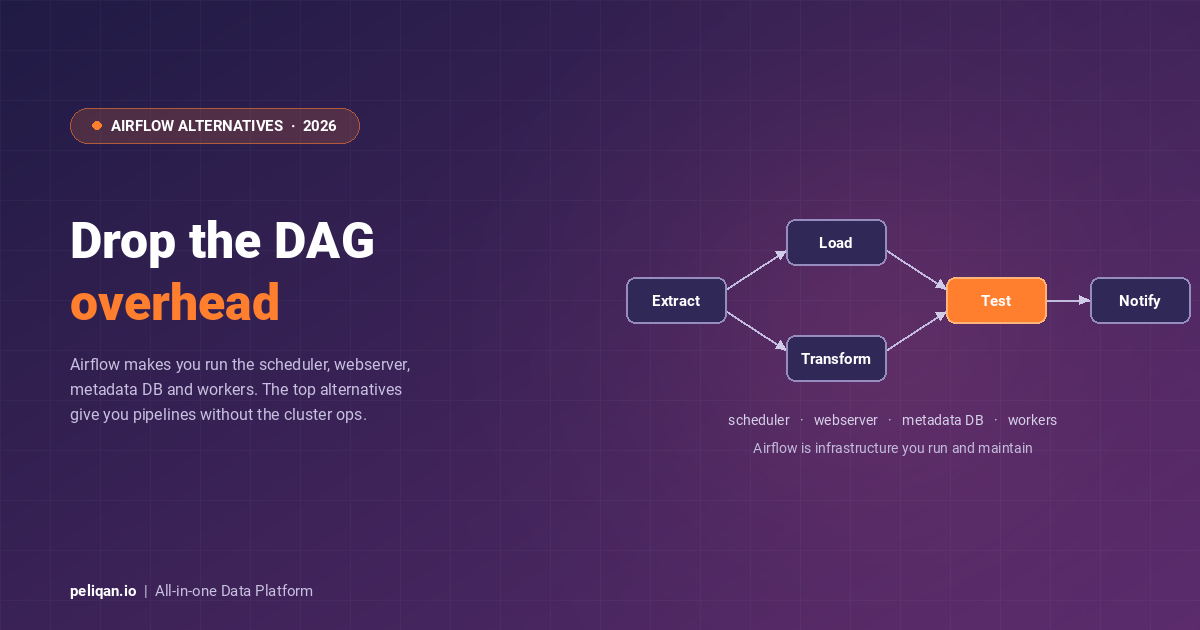
The catch is that Airflow is a piece of infrastructure, not a finished product. You provision and maintain the scheduler, the webserver, the metadata DB, and the Celery, Kubernetes, or LocalExecutor workers. You write DAGs in Python. You debug task failures by connecting into containers or grepping logs. You handle Python dependency hell, secrets management, and connection pooling. None of this is unreasonable for a mature data engineering team, but for most teams it is far more infrastructure than the problem warranted.
Why teams move off Airflow in 2026
- Operational overhead: running a production Airflow cluster means babysitting the scheduler, webserver, metadata DB, executors, and a constantly drifting Python dependency tree. Most teams underestimate the cost, and one engineer’s full-time job is often the going rate.
- Steep learning curve: DAG authoring, the Jinja templating layer, XComs, operator quirks, and executor configuration require months of ramp-up. New hires routinely break production DAGs in their first quarter.
- Batch-first design: Airflow was built for daily batch jobs. Event-driven workloads, streaming, sub-minute schedules, and dynamic workflows are awkward at best. Deferrable operators and dataset triggers helped, but real-time still feels bolted on.
- No data awareness: Airflow tracks task success, not data success. A task can return code 0 while writing corrupted, missing, or stale rows, and Airflow will happily mark the run green. Teams stitch on dbt tests, Great Expectations, or custom Python to fill the gap.
- Operator complexity: Airflow operators implement functional work themselves, so an orchestration bug and an execution bug end up in the same Python file, which makes debugging harder at scale.
- Airflow 3 migration tax: Airflow 2 reaches end-of-life in 2026. Airflow 3.0 introduces breaking changes (TaskFlow-only authoring, the new executor architecture, Python 3.10+ minimums). Every team has to migrate something, and many are using the forced migration to evaluate alternatives.
None of these are deal-breakers on their own. Airflow continues to be the right answer for teams with engineering depth, complex multi-system DAGs, and tight integration requirements that span 50+ tools. But for the majority of teams who use Airflow primarily to schedule ELT jobs into a warehouse and run a handful of transformation steps, the operational overhead has become disproportionate to the problem, which is exactly the gap the alternatives below have built into.
The top Apache Airflow alternatives for 2026
The 11 platforms below were selected based on SERP ranking data, G2 review volume, funding traction, and direct feature overlap with Airflow’s orchestration scope. Each section covers what the tool does, how it differs from Airflow specifically, current pricing, and the team profile it fits best.
1. Peliqan
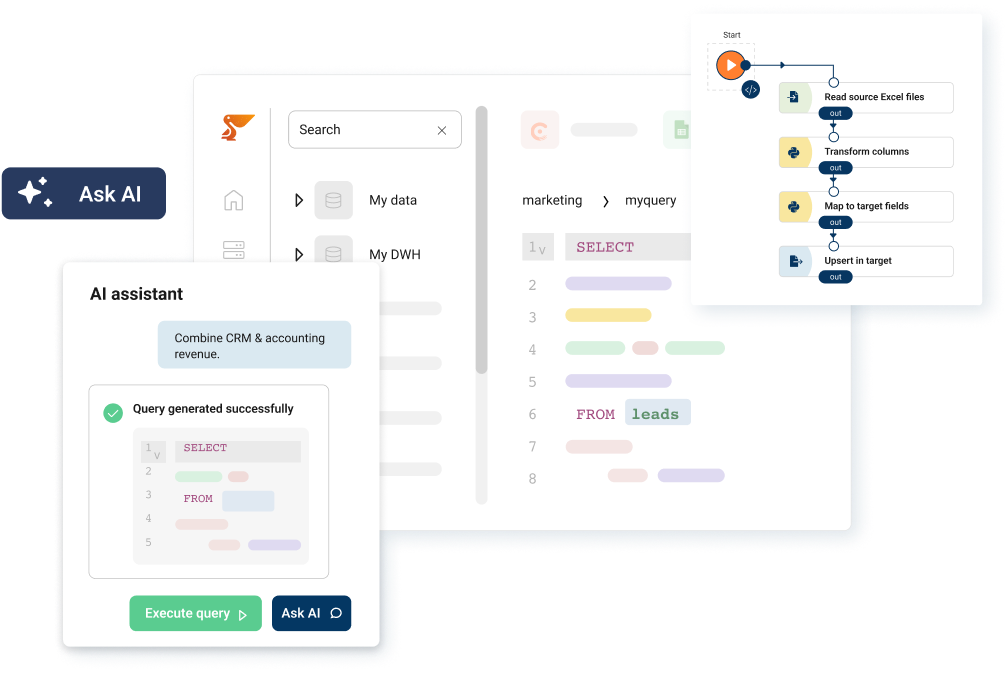
While Apache Airflow is a pure orchestrator that requires you to bring everything else – connectors, warehouse, transformations, reverse ETL – Peliqan is an all-in-one data platform that bundles ingestion, warehousing, transformation, scheduling, and activation into a single product. For most teams running Airflow today, this is the move that eliminates 80% of the reason they reached for Airflow in the first place.
The core idea is simple: 250+ pre-built connectors handle the data ingestion that you would otherwise wire up with Airflow operators. A built-in Postgres and Trino warehouse holds the data, so you do not need a separate Snowflake or BigQuery contract for staging. SQL and low-code Python transformations replace the dbt-plus-PythonOperator pattern. A native scheduler runs your pipelines on cron, intervals, or event triggers. And reverse ETL pushes the curated outputs back to your business apps, all in one platform, one bill, one auth layer.
This positioning matters because most teams who reached for Airflow originally did so because no single tool covered ingestion, transformation, and scheduling well enough to avoid stitching three things together. That assumption no longer holds. A modern Python ETL workbench with a built-in scheduler and warehouse changes the build-vs-buy math entirely: you are no longer comparing Airflow to Prefect, you are comparing the whole orchestrator-plus-stack-around-it approach to a single platform.
For teams that need actual orchestration semantics (cross-tool DAGs, dynamic task generation, complex retry logic), Peliqan does not replace Airflow head-to-head; that is what Prefect and Dagster are for. But for the much larger population of teams using Airflow as a glorified cron to move data into a warehouse and run dbt, Peliqan removes the entire orchestration layer as a concern. You schedule your Python and SQL jobs directly, see lineage automatically, and get data quality monitoring with Slack alerts baked in.
Peliqan ships SOC 2 Type II, ISO 27001, GDPR, HIPAA, and CCPA compliance, EU-hosted on AWS Frankfurt by default. White-label and multi-tenant management make it a strong fit for agencies and ERP consultants who otherwise stand up one Airflow cluster per client. An open-source MCP server plus connector-specific MCP repos let Claude, ChatGPT, and Cursor query and write back to your data directly, a capability Airflow has no equivalent for.
Real-world example: CIC Hospitality
CIC Hospitality replaced a fragmented stack of cron jobs and manual data work with Peliqan, consolidating 50+ data sources into one platform and automating their board-level reporting end to end. The result: 40+ hours per month saved on data work that previously required dedicated engineering time. Most teams running Airflow for similar use cases would be better served replacing the entire stack, not just the orchestrator.
Key features:
- 250+ connectors with a 2-week custom connector SLA, no DAG-authoring required for ingestion
- Built-in managed warehouse (Postgres + Trino), no separate warehouse contract
- Native scheduler with cron, intervals, and event triggers; SQL + Python transformations in the same workbench
- Automatic data lineage, semantic models, and SQL on anything federated queries
- Reverse ETL, white-label, multi-tenant, on-prem connectivity
- SOC 2 Type II, ISO 27001, GDPR, HIPAA, CCPA, EU-hosted; open-source MCP server
- Transparent, fixed monthly pricing on the pricing page
Best for: teams using Airflow primarily as a scheduler for ELT and transformation jobs who want to collapse the four-tool stack (orchestrator plus warehouse plus transformation plus reverse ETL) into one platform with predictable pricing.
2. Prefect
Prefect is the most popular modern Python-first orchestrator and the closest like-for-like replacement for Airflow. Founded in 2018 and backed by $46M+ in funding, Prefect lets you turn standard Python functions into workflows by decorating them with flow and task decorators, with no DAG file boilerplate, no Jinja templating, and no special operator pattern to learn.
The Prefect 3.0 engine added dynamic task mapping, native async execution, and a hybrid cloud model where the orchestration plane runs in Prefect Cloud while your code runs on your infrastructure, so your data never leaves your VPC. Pricing is seat-based and predictable: a free Hobby tier, $100/month Starter for small teams, and Enterprise for advanced governance and SSO. Crucially, Prefect does not meter per task or per execution, which avoids the cost spiral that hits Airflow teams on managed services. Best for: data engineering teams that want a clean Python-first Airflow replacement with modern observability and no usage-based billing surprises.
3. Dagster
Dagster takes a fundamentally different design stance than Airflow: pipelines should be shaped around the data they produce, not the steps they execute. The asset-centric model treats every table, model, dashboard, and ML feature as a first-class object with lineage, materialization metadata, and freshness policies attached. For analytics-heavy teams running dbt, ML pipelines, or any workflow where data freshness matters more than task scheduling, this is a meaningfully better abstraction than Airflow’s DAG-of-tasks.
Dagster Labs has raised $49M+ and the platform ships Dagster+ as a managed cloud offering starting at $10/month for solo users, with deep dbt, Snowflake, and Databricks integrations. The trade-offs: Dagster has a steeper initial learning curve than Prefect, an evolving ecosystem with documentation gaps, and a smaller operator library than Airflow’s mature plugin set. Best for: analytics engineering and ML teams that care about asset lineage, data freshness SLAs, and developer ergonomics, and are willing to invest in a steeper learning curve for a cleaner mental model.
4. Kestra
Kestra is the fastest-growing open-source orchestrator of the last 18 months. The Paris-based startup raised a $25M Series A led by RTP Global in March 2026 and now powers 30,000+ organizations including Bloomberg, Toyota, and JPMorgan Chase. The design choice that sets Kestra apart from Airflow: workflows are defined in declarative YAML rather than imperative Python, and the engine is built from day one for event-driven and high-throughput workloads, not daily batch.
With 1300+ built-in plugins, you can orchestrate anything (Kubernetes jobs, dbt runs, Python scripts, cloud APIs, message queues) without writing custom glue code. The open-source edition is free forever for self-hosted deployments, Kestra Cloud offers managed SaaS with usage-based pricing, and the Enterprise edition adds namespace-level RBAC, Git integration, and air-gapped deployment. Best for: engineering teams that want a declarative, polyglot orchestrator built for event-driven workloads and prefer YAML configuration over Python DAGs.
5. Mage AI
Mage AI takes a notebook-first approach to pipeline authoring. Where Airflow forces you to think in DAG files and operators, Mage gives you a Jupyter-style UI where you write modular blocks of Python, SQL, or R that snap together into pipelines. Visual lineage shows up automatically as you wire blocks together, and the live execution view replaces Airflow’s grid and Gantt views with something closer to a notebook execution report.
The platform is open-source under Apache 2.0 and offers Mage Pro tiers from $100/month plus compute. The hyper-concurrency engine claims up to 40% cost reduction versus traditional orchestrators by dynamically scaling workloads, and recent additions include AI-native blocks that update and self-heal pipelines as they run. Best for: analyst-engineer hybrid teams that prefer a notebook UI over a DAG file and want lower runtime cost than Airflow on managed cloud.
6. Astronomer (Astro)
If you want to stay on Airflow but offload the operational overhead, Astronomer’s Astro is the canonical managed offering. Astro runs Airflow as a service with autoscaling workers, environment promotion, an improved UI, and enterprise features like RBAC, audit logging, and SSO. The product is built by the team that effectively maintains modern Airflow, so feature parity and update cadence are excellent.
Pricing is consumption-based, starting at $0.35/hour per Airflow environment with worker sizes from $0.13/hour, and real-world monthly bills typically land between $1,500 and $5,000 for production workloads, scaling higher for multi-environment enterprise deployments. The Airflow 3.0 migration is included for active customers. Best for: teams committed to the Airflow ecosystem who want to keep their existing DAGs and operators but eliminate the cluster-ops burden.
7. AWS Step Functions
AWS Step Functions is the serverless workflow orchestrator native to AWS. It uses Amazon States Language (a JSON-based DSL) to define state machines, integrates natively with 200+ AWS services, and bills purely on usage, with no idle scheduler to pay for and no cluster to maintain. Standard Workflows cost $0.025 per 1,000 state transitions after a monthly free tier, while Express Workflows use a model based on requests plus duration.
For AWS-only shops running event-driven workflows (Lambda chains, ECS task orchestration, ETL on Glue), Step Functions is operationally cheaper and more reliable than self-hosted Airflow. The trade-offs: AWS lock-in, a JSON DSL that is less expressive than Python, and limited observability outside the AWS console. Best for: AWS-native teams running event-driven workflows who want to eliminate cluster ops and accept the JSON DSL trade-off.
8. Google Cloud Composer
Cloud Composer is Google’s managed Airflow service, the GCP equivalent of MWAA on AWS. Composer 3 uses a Data Compute Unit pricing model plus Cloud SQL storage and Cloud Storage for DAGs and logs. For teams already on GCP, the integration with BigQuery, Dataflow, Pub/Sub, and Vertex AI is genuinely best-in-class.
The catch is the same as MWAA on AWS: Composer manages the Airflow infrastructure but you still write DAGs, debug operators, and manage Python dependencies the same way you would on self-hosted Airflow. You are paying GCP to run the scheduler and webserver for you, not to remove the Airflow learning curve. Best for: GCP-committed data teams that want managed Airflow with deep BigQuery and Vertex AI integration.
9. Azure Data Factory
Azure Data Factory is Microsoft’s fully managed cloud data integration service with 90+ pre-built connectors and a visual pipeline designer. Unlike Airflow, ADF is more ETL-pipeline-centric than general workflow-orchestrator-centric: it shines at moving data between systems with copy activities, mapping data flows, and Synapse integration, and is less natural for non-data orchestration tasks.
Pricing is activity-based and hard to predict ahead of time, with real-world bills for analytics workloads often running into the low thousands per month for Synapse plus Data Factory combined. For Microsoft-stack shops already using Synapse, Fabric, or Power BI, ADF is the path of least resistance; for everyone else, the activity-based pricing and Microsoft lock-in make it a harder recommendation against modern Python-first alternatives. Best for: Microsoft-stack data teams already invested in Synapse, Fabric, or Power BI who want the path of least resistance.
10. Argo Workflows
Argo Workflows is the Kubernetes-native workflow engine maintained by the CNCF. With 13,000+ GitHub stars and adoption at BlackRock, Intuit, and Red Hat, it has become the default choice for teams running orchestration directly on Kubernetes. Workflows are defined as Kubernetes Custom Resources in YAML, and each step runs as a container, which makes Argo dramatically more efficient than Airflow for parallel job execution at scale.
Argo is fully open-source under Apache 2.0, so you only pay for the underlying Kubernetes infrastructure. The trade-off is steep: it assumes deep Kubernetes expertise, has minimal first-class data engineering features (no managed connectors, no metadata catalog, no native lineage), and the developer experience is YAML-heavy. Best for: platform engineering teams running Kubernetes-first infrastructure who need maximum parallelism and are comfortable with YAML-defined workflows.
11. Temporal
Temporal is not strictly an Airflow alternative; it solves a different but adjacent problem: durable, fault-tolerant execution for long-running business workflows. Where Airflow schedules data pipelines, Temporal handles things like user onboarding flows, payment retries, multi-day approval processes, and any business logic that needs exactly-once execution with built-in retries and state persistence.
Type-safe SDKs in Go, Java, TypeScript, Python, and PHP make Temporal a natural fit for application engineering teams that want orchestration semantics in their backend code rather than in a separate DAG file. Temporal Cloud is the managed offering with usage-based pricing, and self-hosted is free under Apache 2.0. For data teams Temporal is overkill, but for any team trying to use Airflow as a general-purpose business workflow engine, Temporal is a much better fit. Best for: application engineering teams that want orchestration semantics inside their service code, especially for long-running business workflows that require durable state.
Feature comparison table
Quick reference across the 11 Airflow alternatives. Use this to shortlist before deeper evaluation. Numbers reflect publicly published pricing and product documentation as of 2026.
How modern orchestration is evolving in 2026
Three structural shifts are reshaping the orchestration category this year, and all three are pulling teams away from classic Airflow.
First, the asset-centric model has won the design argument. Dagster pioneered it, Airflow 2.4+ adopted Datasets to mimic it, and even Prefect and Kestra have added asset-aware features in the last 12 months. The implication: orchestration is being absorbed into the data platform layer rather than living as a standalone scheduler. Teams that operate a unified ETL plus warehouse plus transformation stack increasingly skip the dedicated orchestrator entirely.
Second, declarative and low-code authoring are eating the imperative-Python model. Kestra’s YAML, Mage’s notebook blocks, ADF’s visual designer, and Peliqan’s SQL plus low-code Python workbench all reduce the time-to-first-pipeline from days to hours. Pure Python DAGs still win for the most complex use cases, but for the median team they have become an unnecessary tax.
Third, AI-native pipelines and MCP servers are now table stakes. Mage has self-healing AI blocks, Dagster ships AI lineage explanations, and Peliqan, Prefect, and Kestra have all added MCP servers in the last six months that let Claude, ChatGPT, and Cursor query pipeline metadata and trigger runs. Airflow’s MCP support is community-built and lags behind. For teams building AI agents on top of their data stack, the platforms that paired MCP with a real AI agent layer and writeback are pulling ahead.
Decision framework: choosing the right Airflow alternative
Most decisions in this category boil down to four variables: how much orchestration complexity you actually need, how much infrastructure you want to manage, what cloud you live on, and whether your team thinks in Python, YAML, SQL, or notebooks. Map your situation to the right shortlist below.
Quick decision guide
- Using Airflow primarily as a scheduler for ELT and SQL/Python jobs: Peliqan (collapse the four-tool stack into one)
- Want a clean Python-first Airflow replacement with modern observability: Prefect
- Care about data assets, lineage, and dbt-heavy analytics workflows: Dagster
- Need declarative YAML, event-driven workflows, or polyglot pipelines: Kestra
- Prefer a notebook-style authoring experience: Mage AI
- Committed to Airflow but want to eliminate cluster ops: Astronomer Astro
- AWS-only shop with event-driven workflows: AWS Step Functions
- GCP-committed with deep BigQuery / Vertex AI integration: Google Cloud Composer
- Microsoft-stack with Synapse and Fabric: Azure Data Factory
- Kubernetes-first platform team needing maximum parallelism: Argo Workflows
- Long-running business workflows requiring durable state: Temporal
The pattern worth noticing: most teams running Airflow today are not using it for the workloads it is uniquely good at. If you are using Airflow to schedule a handful of ELT jobs into Snowflake and run dbt, almost any modern alternative will be a quality-of-life upgrade. If you are running 500+ DAGs across 50+ systems with complex inter-team dependencies, the migration cost goes up sharply and the Astronomer Astro plus Airflow 3 path becomes more defensible.
Migration considerations: moving off Airflow in practice
Migrating off Airflow is mostly a project of disentangling four things that Airflow conflates: scheduling, execution, observability, and connector logic. Plan for these in order.
Start by auditing what your DAGs actually do. Most teams find that 60-80% of their DAGs are running variations of “extract from source, load to warehouse, run dbt, notify Slack.” This subset migrates trivially to any of Peliqan, Prefect, Dagster, Kestra, or Mage, and often becomes a single Peliqan pipeline plus a dbt project rather than 30 separate DAG files. The remaining 20-40% is where the actual orchestration complexity lives, and where the choice between Prefect, Dagster, and Kestra starts to matter.
Watch out for hidden Airflow dependencies: XComs used as a poor-man’s data passing layer, custom hooks built around connection strings stored in the metadata DB, and DAG-level scheduling assumptions that do not translate cleanly to event-driven engines. Budget two to three times the time you initially estimate. Run the new orchestrator in parallel with Airflow for 30-60 days before cutting over, and use the migration window to delete the 20-30% of DAGs that nobody has actually looked at in two years.
Conclusion
Apache Airflow remains the most capable general-purpose workflow orchestrator in open source, and for teams with deep engineering benches running complex multi-system DAGs at scale, the answer is still Airflow, probably on Astronomer Astro to skip the cluster ops. But that is a narrower band of teams than most organizations realize. For the much larger population using Airflow as an expensive cron to move data into a warehouse and run dbt, the alternatives in this guide are not just acceptable replacements, they are categorically better fits.
Peliqan stands out for teams that want to graduate beyond a standalone orchestrator entirely. With 250+ connectors, a built-in warehouse, native scheduling for SQL and low-code Python, reverse ETL, and EU-hosted SOC 2 and ISO 27001 compliance at transparent, fixed pricing, it replaces what would otherwise be Airflow plus a warehouse contract plus a transformation tool plus a reverse ETL tool with one unified platform. Prefect, Dagster, Kestra, and Mage lead the modern orchestrator category for teams that genuinely need orchestration as a primary capability. Astronomer, Cloud Composer, and the other managed-Airflow services serve the keep-Airflow camp, while AWS Step Functions, Argo, and Temporal cover the cloud-native, Kubernetes-native, and durable-execution edges of the category.
When evaluating Airflow alternatives, audit what your existing DAGs actually do, separate the orchestration complexity from the boilerplate, and pressure-test the alternative on a representative workload before committing. The Airflow 3.0 migration is forcing every team to make a decision anyway, so use the window to make a real one. To see what a unified data platform looks like compared to running your own Airflow cluster, you can try Peliqan free or book a demo to walk through your specific orchestration workload