





Python ETL is the practice of using Python to extract data from sources, transform it into a usable shape, and load it into a destination like a data warehouse. This guide explains what Python ETL is, the top 8 Python ETL tools compared, how to build an end-to-end pipeline in four steps with code, and when a low-code platform beats hand-rolled Python.
Python has become the de facto language for ETL (Extract, Transform, Load) workflows thanks to its simplicity and rich ecosystem of libraries like Pandas, SQLAlchemy, and Apache Airflow. But managing end-to-end pipelines in raw Python usually means stitching multiple tools together, writing repetitive boilerplate, and leaning on scarce data engineering time. This guide covers both sides: the Python ETL toolkit, and the low-code platforms that remove most of the plumbing.
What is Python ETL?
Python ETL is the use of Python and its libraries to move and reshape data: extracting it from databases, SaaS APIs, files, or streams; transforming it through cleaning, joining, and reformatting; and loading it into a target system such as a warehouse or data lake. Python is popular for this because it has mature libraries for every stage, from Pandas and NumPy for transformation to SQLAlchemy for database access and Airflow for orchestration. The result can be anything from a 20-line script that syncs one CSV to a full production pipeline with scheduling, monitoring, and error handling.
Why teams use Python for ETL, and where it gets hard
Raw Python gives complete control, which is exactly why teams reach for it, but that control comes with real operational cost. Three hurdles show up again and again. Complex setup means connecting data sources, orchestrating pipelines, and maintaining infrastructure all demand engineering resources. Tool fragmentation means teams juggle separate products for ingestion (Airbyte), transformation (dbt), reverse ETL (Census), and BI (Metabase), each with its own config and failure mode. And limited scalability means scripts that work on small datasets often buckle under heavy loads or complex transformations.
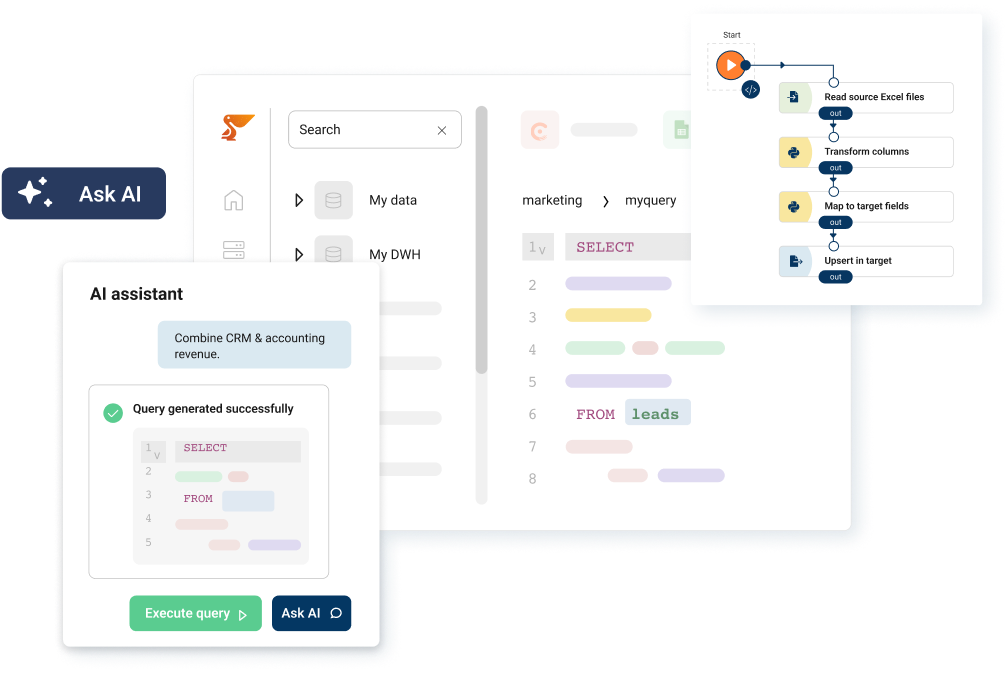
A low-code platform addresses these by bundling the stack: a UI for connecting 250+ data sources, a built-in warehouse (or your own Snowflake or BigQuery), low-code Python for transformations and ML, and one-click deployment of tools like Metabase, Airflow, and reverse ETL pipelines. You keep Python where it adds value and drop it where it is just plumbing.
Peliqan vs traditional Python ETL
Top 8 Python ETL tools compared
The Python ETL ecosystem ranges from full platforms to single-purpose libraries. Here are eight of the most widely used, and where each fits.
1. Peliqan
A unified low-code Python ETL platform that bundles 250+ connectors, a built-in warehouse, reverse ETL, and low-code Python and SQL into one interface, with AI-assisted automation and one-click deployment. Best for: teams that want an end-to-end pipeline without assembling separate ingestion, transformation, and orchestration tools. Trade-off: a newer entrant with a growing ecosystem.
2. Apache Airflow
The most widely adopted open-source workflow orchestrator, defining pipelines as code (DAGs) with a huge community and integration library. Best for: engineering teams that need flexible, scalable scheduling. Trade-off: a steep learning curve and significant configuration and maintenance overhead.
3. Luigi
A Python batch-processing and workflow framework (originally from Spotify) with simple dependency management. Best for: lightweight, straightforward batch jobs. Trade-off: a dated UI and fewer advanced features, so it is less suited to complex modern workflows.
4. Bonobo
A lightweight ETL framework for building pipelines as plain Python with minimal ceremony. Best for: small projects and quick prototypes. Trade-off: not designed for large-scale or complex pipelines, with limited community support.
5. Singer
An open-source specification for data extraction through composable taps (sources) and targets (destinations). Best for: teams that want a flexible, community-driven connector framework. Trade-off: it requires manually assembling components and lacks integrated workflow management.
6. Pandas (custom scripts)
The DIY approach: custom Python using Pandas, NumPy, and similar libraries for extraction and transformation. Best for: maximum flexibility, full control, and rapid prototyping. Trade-off: scripts are labor-intensive to maintain and do not scale well without significant engineering.
7. Airbyte
An open-source data integration tool with an extensive, growing library of pre-built connectors and a modular architecture. Best for: quick data extraction across many sources. Trade-off: you still need separate tooling for transformation and orchestration.
8. Stitch Data
A cloud-based managed service focused on data extraction and loading with a simple, quick setup. Best for: reliable, low-configuration ingestion. Trade-off: limited built-in transformation, so it often needs additional tools for a full ETL workflow.
Build an end-to-end Python ETL pipeline in 4 steps
Here is the shape of a complete pipeline, using Peliqan to handle the infrastructure so the Python stays focused on logic. The same four stages apply whatever tools you use.
Step 1: Extract data from any source
Connect to databases (PostgreSQL, MySQL), SaaS apps (Salesforce, HubSpot), cloud storage (S3, Google Drive), or APIs, with auto-generated pipelines, schema detection, and incremental syncs. In a script, query any connected dataset directly:
# Query Salesforce data without writing API code
salesforce_data = pq.connect("salesforce").query("SELECT * FROM leads")
Step 2: Transform with low-code Python and SQL
Combine spreadsheet-style edits, reusable SQL models with dependency tracking, and Python scripts in one interface. Business users filter and add columns with Excel-like formulas, while developers use Pandas or NumPy in far less code:
# Calculate customer LTV with pandas, sourced from BigQuery
@pq.transform(output_table="customer_ltv")
def calculate_ltv():
    orders = pq.bigquery.query("SELECT * FROM orders")
    ltv = orders.groupby("customer_id")["revenue"].sum()
    return ltv
Step 3: Load to your data warehouse
Load into a built-in warehouse that scales to terabytes, or sync transformed data to Snowflake or BigQuery, with tables optimized for analytics through partitioning and indexing. This is the point where modeled, clean data becomes queryable for BI and AI.
Step 4: Activate data with reverse ETL and APIs
Push insights back to operational tools through no-code field-mapped syncs or Python writebacks that add custom logic like lead scoring before syncing, the step that turns analysis into data activation:
# Send high-value leads to Salesforce
high_value_leads = pq.sql("SELECT * FROM customer_ltv WHERE ltv > 10000")
pq.salesforce.update("Lead", high_value_leads)
Advanced Python ETL capabilities
Beyond the basics, modern Python ETL adds AI, real-time delivery, and governance. An AI assistant can write SQL from plain English so you reach insights faster, instead of hand-writing every query.
ETL outputs can be exposed as REST endpoints, so you can publish data APIs in one click, or trigger Python scripts from external events through webhooks (for example, a Stripe payment).
For enterprise governance, column-level data lineage tracks how values move across SQL, Python, and spreadsheets, while a data catalog annotates datasets and enforces access controls, so a Python ETL pipeline stays auditable as it grows.
When to choose a platform over pure Python ETL
Raw Python wins when you need total control or have a genuinely unusual pipeline. A platform wins on speed (raw data to production in hours, not weeks), collaboration (analysts work in SQL and spreadsheets while developers script in Python against the same data), and cost efficiency (no overhead from running Airflow, dbt, and separate ETL tools). Most mid-market teams do not need bespoke infrastructure; they need pipelines that work and stay working.
Peliqan brings the whole ETL lifecycle into one platform: 250+ connectors, a built-in Postgres and Trino warehouse (or bring your own Snowflake, BigQuery, or Redshift), SQL and low-code Python transformations, and reverse ETL. It is SOC 2 Type II, ISO 27001, GDPR, HIPAA, and CCPA certified, EU-hosted on AWS Frankfurt, with custom connectors delivered within 2 weeks.
Real-world example: CIC Hospitality
CIC Hospitality unified data from 50+ sources across 40+ hotels into one platform, using SQL and Python transformations instead of hand-maintained scripts. They now save 40+ hours per month by automating board reports that were previously built by hand. Read the case studies.
Conclusion
Python remains the most flexible way to build ETL, and for custom or research-grade pipelines, libraries like Pandas, Airflow, and Singer are hard to beat. But for production data work, the operational cost of stitching tools together is often higher than the value of full control. The pragmatic 2026 pattern is to keep Python for the logic that genuinely needs it and let a low-code platform handle ingestion, the warehouse, orchestration, and activation. To see how that works on your own sources, you can try Peliqan free.