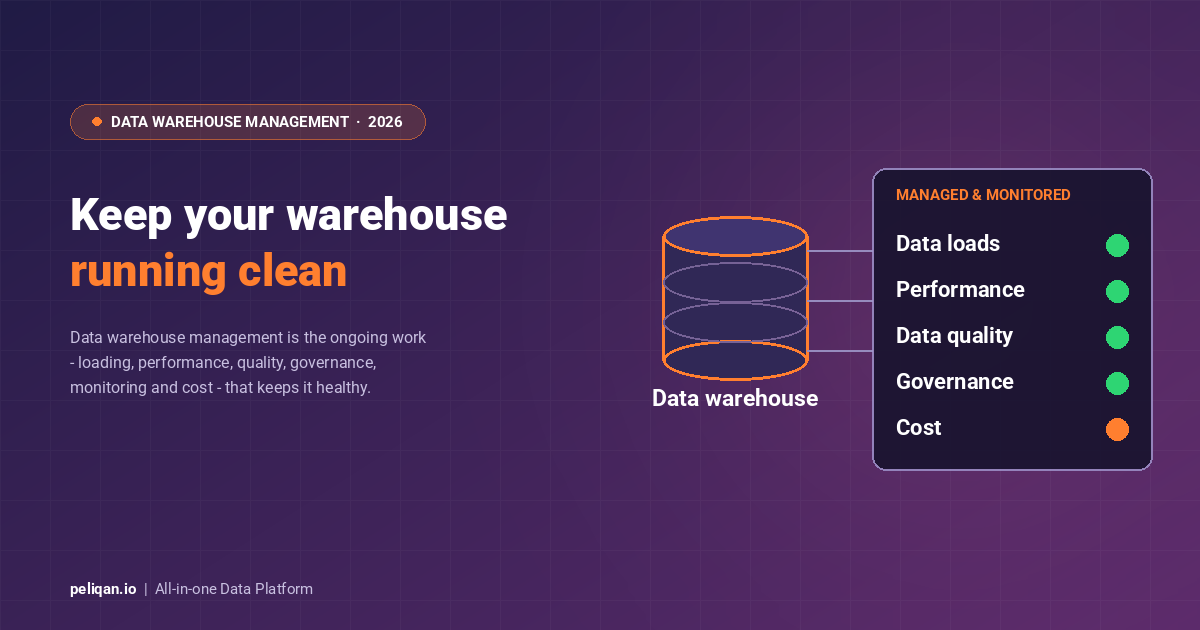





Data warehouse management is the ongoing work of keeping a data warehouse fast, accurate, secure, and cost-effective after it goes live: loading data, tuning performance, enforcing quality and governance, monitoring health, and controlling spend. This guide covers the core areas of warehouse management, the best practices that keep a warehouse healthy, the common challenges, and how an all-in-one platform automates most of the work.
Building a warehouse gets the attention, but managing one is where most of the long-term cost and risk live. A warehouse that was clean and fast at launch slowly degrades: queries slow down, costs creep up, data quality drifts, and governance gaps open as new sources and users arrive. Good data warehouse management is what keeps that decay from happening. This guide focuses on the operations side, what comes after you implement a warehouse.
What is data warehouse management?
Data warehouse management is the set of ongoing processes that keep a warehouse performing well and producing trustworthy data throughout its life. It spans loading and refreshing data, optimizing query performance, maintaining data quality, enforcing governance and security, monitoring system health, and managing cost. Where warehouse design and architecture are largely one-time decisions, management is continuous: it is the day-to-day and month-to-month work that determines whether the warehouse stays an asset or becomes a liability.
The core areas of data warehouse management
Effective management covers six areas, each with its own ongoing responsibilities.
Two of these deserve special attention because they are where warehouses quietly fail. Data quality drifts when no one is watching, so continuous data quality monitoring with automated checks and alerts is essential.
Governance gaps are the other silent failure: they widen as more people and sources get access, so maintaining clear data lineage from the start makes audits and impact analysis far easier later.
Data warehouse management best practices
- Automate data loading: use scheduled, incremental syncs with automatic schema-change handling so refreshes do not need babysitting.
- Monitor quality continuously: set validation rules and anomaly alerts rather than discovering bad data when a stakeholder questions a dashboard.
- Optimize proactively: review query patterns regularly and apply indexing, partitioning, and materialized views before performance becomes a complaint.
- Govern from day one: enforce role-based access, encryption, and lineage as standing policy, not a retrofit after an audit.
- Track cost as a metric: watch compute and storage spend monthly and right-size resources, since warehouse bills grow quietly.
- Keep models modular: break transformations into small, maintainable pieces so you can update one without breaking the whole warehouse.
- Document and iterate: follow established data warehouse best practices and revisit models as sources and needs change.
Common data warehouse management challenges
Several issues recur once a warehouse is in production. Performance degradation creeps in as data volumes climb and queries that were instant become slow. Cost overruns surprise teams when usage-based pricing scales faster than expected. Data quality drift happens silently as source systems change and validation falls behind. Schema changes from upstream SaaS apps break pipelines without warning. Governance complexity grows as more users and sources are added. And the operational burden of running separate tools for ingestion, transformation, and monitoring consumes scarce engineering time. Choosing the right data warehouse tools upfront reduces several of these at once.
How an all-in-one platform simplifies management
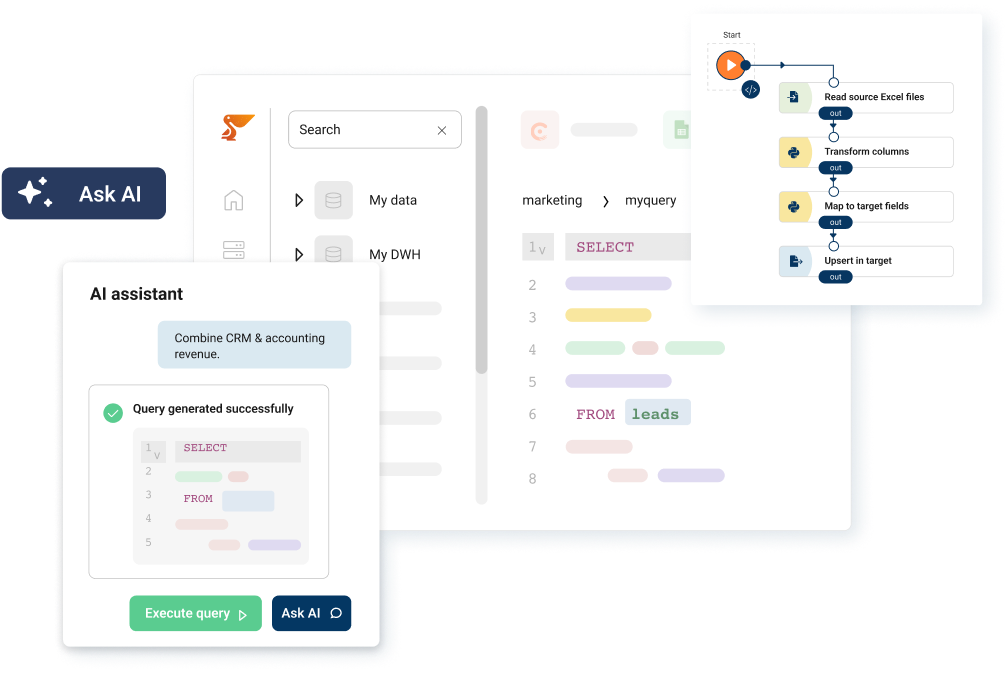
Most management overhead comes from stitching together separate tools for ingestion, transformation, monitoring, and governance, each with its own failures. Peliqan reduces that by handling the whole lifecycle in one place: automated pipelines with incremental syncs and schema-change handling, a built-in warehouse, SQL and low-code Python transformations, and built-in lineage and quality monitoring. Instead of managing five products, a team manages one platform, which is what makes warehouse operations feasible without a dedicated data engineering function.
Because the warehouse, pipelines, and monitoring live together, routine work like refreshing materialized tables, catching a failed sync, or tracing a number back to its source happens in one place instead of across four dashboards. Similar monitoring approaches like APM help teams track application performance and quickly identify issues affecting system reliability.
It offers 300+ connectors, a built-in Postgres and Trino warehouse (or bring your own Snowflake, BigQuery, or Redshift), and materialize and replicate options to keep downstream tables fast. It is SOC 2 Type II, ISO 27001, GDPR, HIPAA, and CCPA certified, EU-hosted on AWS Frankfurt, with custom connectors delivered within 2 weeks, so governance and compliance are part of the platform rather than something you bolt on and maintain separately.
See warehouse management without the busywork
Book a 30-minute demo and we’ll show you automated pipelines, built-in monitoring, and governance running on your own data, in minutes, not months.
Conclusion
Data warehouse management is the quiet, continuous discipline that decides whether a warehouse stays valuable or slowly decays. The fundamentals are steady: automate loading, monitor quality and performance, govern access, and watch cost. The advantage in 2026 comes from consolidation, letting one platform handle ingestion, transformation, monitoring, and governance so the team manages outcomes instead of infrastructure. Get the operations right and the warehouse you built keeps paying off for years.