




Data warehouse implementation is the practice of designing, building, and deploying a warehouse that consolidates data from CRMs, ERPs, databases, SaaS apps, and files into a single source of truth for analytics and AI. This guide covers the 10 steps every successful implementation follows, the common pitfalls, the best practices for 2026, and how to compress the typical 12-24 week timeline using an all-in-one platform.
Most data warehouse projects do not fail because of technology, they fail because requirements drift, data quality is treated as an afterthought, and the team underestimates how much governance, testing, and user training actually take. The 10-step playbook below is what teams that ship on time and on budget tend to follow. The first three steps determine 70% of the outcome.
Steps in data warehouse implementation
Data warehousing delivers concrete benefits: integration of data from across the business, a single view of organizational performance, faster analytics, and the foundation every serious AI initiative needs. The centralization enables better decision-making, AI agents that do not hallucinate, and reporting that finance, sales, and operations can all trust.
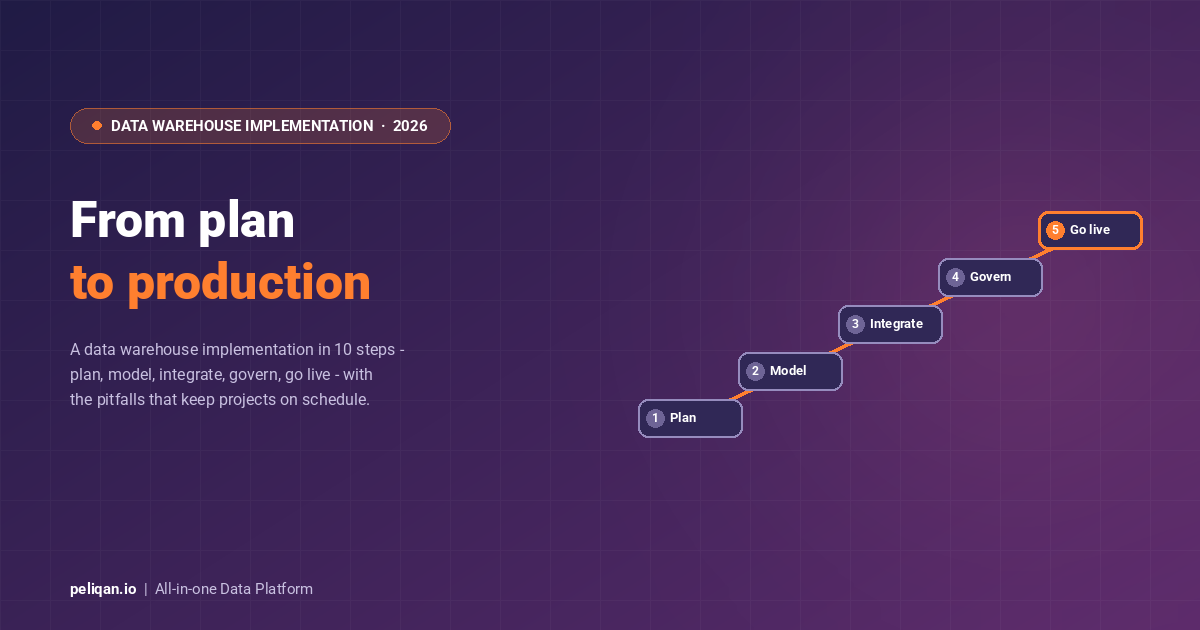
Implementing a warehouse involves a systematic approach to make sure the project meets business objectives and technical requirements, through unified data integration. The 10 steps below outline the process:
- Requirement gathering and analysis
- Data modeling
- Data integration and ETL/ELT process
- Data cleansing and validation
- Building data marts
- Data security and governance
- Testing and quality assurance
- Deployment and maintenance
- User training and adoption
- Ongoing management and optimization
1. Requirement gathering and analysis
Define the business objectives and questions the warehouse should answer, and align them with overall strategy and KPIs, since skipping this is how teams build something nobody uses. Determine who will use the data warehouse services and what their specific needs are.
Then catalog all relevant internal and external data sources. Most mid-market companies discover 60-150 sources during this audit, more than they expected. Finally, assess the volume, format, and quality of that data before designing the architecture.
2. Data modeling
Start with conceptual modeling (entities, attributes, and relationships as an ERD), then move to logical modeling that defines the warehouse schema in detail (tables, columns, data types, keys), choosing between star, snowflake, or galaxy schema designs. Finish with physical modeling that optimizes for performance and storage through indexing, partitioning, clustering, and selective denormalization.
3. Data integration and ETL/ELT process
Extract data from source systems using the right method (database queries, APIs, file transfers) and use change data capture for efficient incremental loads. Transform and standardize so business entities (customer, account, order) match across systems, then load into the warehouse optimized for performance. In 2026, ELT (load first, transform inside the warehouse) is the dominant pattern over traditional ETL.
4. Data cleansing and validation
Profile the data to find inconsistencies, errors, and missing values, then cleanse: correct errors, handle missing values, and standardize formats with automated rules. Add validation rules and automated checks for accuracy, completeness, and conformity to business logic so data quality holds over time rather than degrading after launch.
5. Building data marts
Determine the specific needs of each user group through workshops and interviews, then select the relevant data for each business function, creating views and aggregations tailored to them. Design a separate data mart per group with appropriate indexing and materialized views to keep their queries fast.
6. Data security and governance
Protect sensitive data with authentication, authorization, and encryption, setting up role-based access control and column-level security where needed. Establish governance policies for data quality, metadata, and retention, with lineage tracking and impact analysis. SOC 2 Type II, ISO 27001, GDPR, HIPAA, and CCPA compliance should be baked in, not bolted on, which is far easier on a platform where security and governance are native.
7. Testing and quality assurance
Test individual ETL components with a suite of unit tests, then run integration tests across the full pipeline to verify data flow and accuracy on both full and incremental loads. Add performance testing under different load conditions to find bottlenecks, and run user acceptance testing with key stakeholders on reports and dashboards before production cutover.
8. Deployment and maintenance
Deploy to production with a documented runbook and a change-management process for future updates. Continuously monitor performance and set up automated alerts for query anomalies, schedule incremental data refreshes to maintain freshness, and implement backup and recovery procedures with regular disaster-recovery drills.
9. User training and adoption
Provide role-based training with user guides, video tutorials, and hands-on workshops so people can access, query, and analyze data confidently. Step-by-step tutorials built with a video generation tool can make training more engaging and easier to follow.
Drive adoption through change management: communicate the benefits of the warehouse clearly, address concerns, and nurture data warehouse champions within each business unit.
10. Ongoing management and optimization
Monitor data quality continuously with scorecards and trend analysis, and regularly optimize warehouse performance by analyzing query patterns and tuning indexes. Keep metadata accurate in a central repository and enforce governance with regular audits, so the warehouse keeps pace with the business instead of decaying.
By systematically following these 10 steps, organizations build a warehouse that meets immediate analytic needs and supports future growth in AI agents, real-time analytics, and the rapidly evolving data stack.
Common challenges in implementing a data warehouse
While the benefits are substantial, organizations consistently hit the same obstacles. Understanding them upfront is the difference between a 4-month implementation and a 14-month one.
Data warehouse implementation best practices
To maximize the effectiveness of a warehouse implementation, follow the practices below. They are grounded in real production deployments, not theory.
- Establish clear objectives: define specific, measurable goals aligned with strategy, so stakeholders know the purpose and expected outcomes upfront.
- Prioritize data quality: implement stringent quality controls from day one, and regularly assess and cleanse data to maintain accuracy and reliability.
- Build for scale by design: anticipate growth with a scalable architecture and flexible storage that absorbs evolving needs without major overhauls.
- Pair with advanced analytics: connect the warehouse to BI and machine learning development tools to turn raw data into forward-looking, actionable intelligence.
- Encourage interdepartmental collaboration: shared ownership over data assets between IT and business units is the single best predictor of long-term success.
- Implement strong security: safeguard sensitive data through encryption, authentication, and access controls, treating security as a trust-building factor not just a checkbox.
- Keep improving: review performance and gather user feedback regularly, adapting to new insights so the warehouse stays aligned with how the business operates.
Architectural decision tree (quick guide)
Walk through these questions to scope your implementation:
- Do you have 5-30 sources to integrate? Cloud-native warehouse plus managed ELT is a fast path.
- Do you have 50+ sources or complex transformations? An all-in-one platform reduces vendor sprawl.
- Are you in a regulated industry like healthcare or financial services? On-prem or hybrid deployment with SOC 2 Type II, ISO 27001, GDPR, HIPAA, and CCPA built in.
- Do you need real-time analytics? ELT with change data capture and a streaming-friendly warehouse.
- Are you feeding AI agents downstream? Modeled entities, an MCP server, and a governed data layer.
- Budget tight but you have engineers? An open-source stack (Postgres, Airbyte, dbt, Airflow).
- Budget tight and no engineers? An all-in-one platform with fixed pricing.
Watch out: the most common implementation pitfalls
- Skipping the data audit: teams that do not audit sources upfront discover hidden systems 3 months in. Plan for it.
- Modeling for performance instead of business intent: premature optimization makes the warehouse hard to query. Build the model around what the business asks, then tune.
- Treating governance as phase 2: bolting on access control, lineage, and audit logging after launch typically doubles the work.
- Underestimating user training: the warehouse is only as useful as the people who query it. Budget 15-20% of the project for training and adoption.
- Picking the wrong pricing model: row-based pricing scales steeply. Model 12-month total cost of ownership at expected data volumes before signing.
Real-world example: Globis
Globis, a SaaS ERP provider, activates customer data through Peliqan to predict sea container arrivals. They combine ERP records with external weather feeds, run ML in Python, and publish predictions back as APIs into operational systems, exactly the warehouse plus activation pattern that drives measurable business outcomes. Read the case studies.
Conclusion
Successful warehouse implementation hinges on understanding the challenges and following the best practices. By focusing on clear objectives, ensuring high data quality, and encouraging collaboration across departments, organizations build infrastructure that supports their analytical and AI needs for years. CIC Hospitality is a good example: by unifying 50+ sources into one warehouse, they now save 40+ hours per month on reporting that used to be manual.
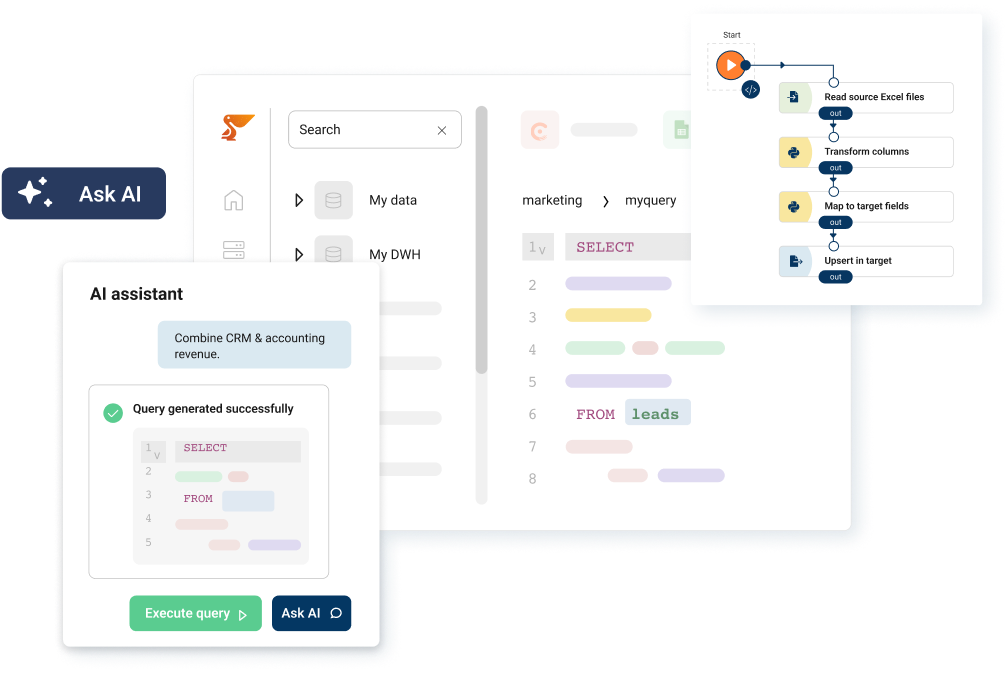
Peliqan addresses these challenges directly with a built-in warehouse, 250+ connectors, SQL and low-code Python transformations, reverse ETL, and AI agent tooling. It is SOC 2 Type II, ISO 27001, GDPR, HIPAA, and CCPA certified, EU-hosted on AWS Frankfurt, with a built-in Postgres and Trino warehouse, custom connectors delivered within 2 weeks, and fixed pricing, so businesses implement a working warehouse in weeks instead of months and avoid the 5-vendor stack that breaks at every renewal.