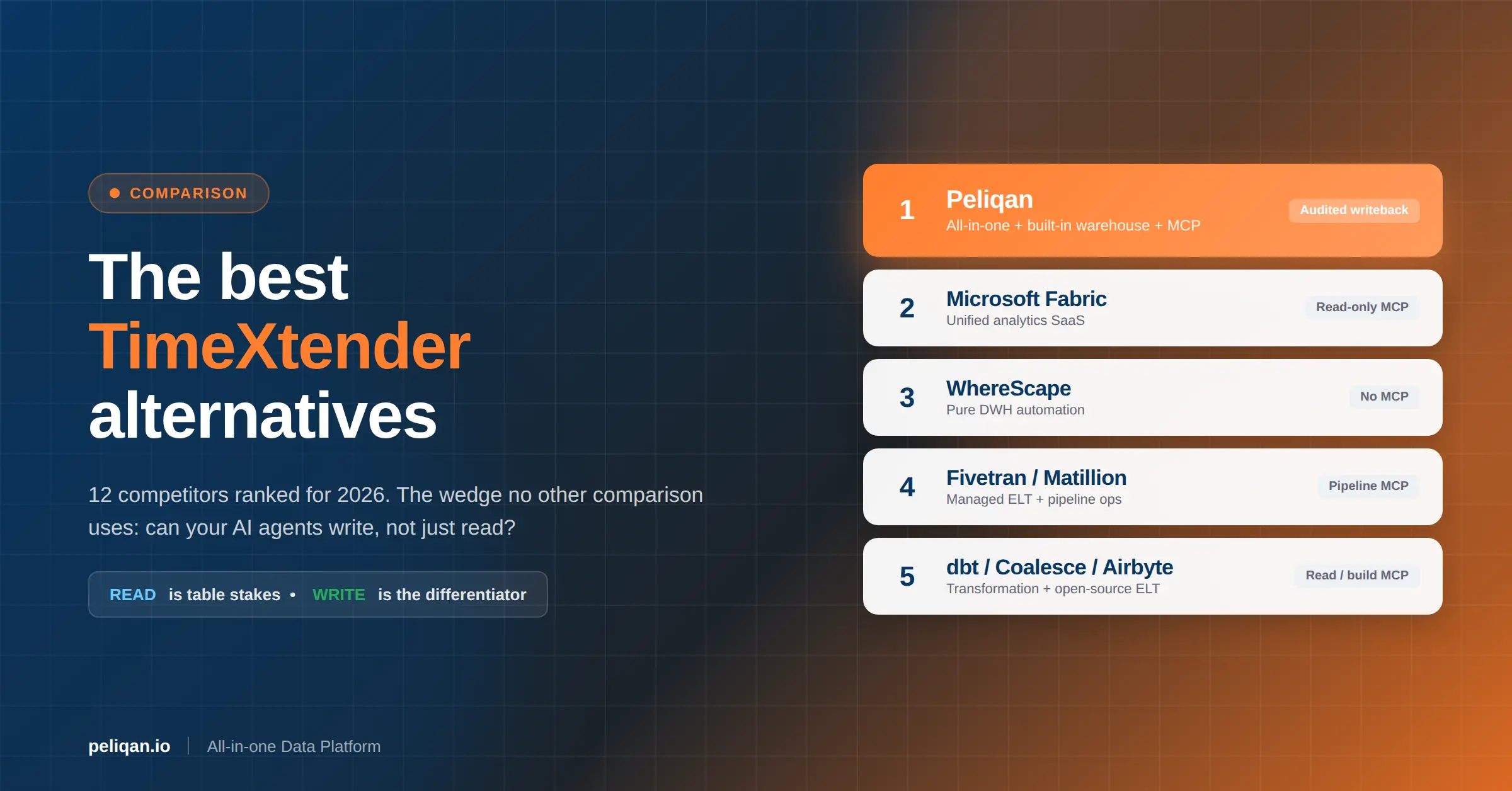





Looking for a TimeXtender alternative in 2026? TimeXtender is a metadata-driven data-warehouse-automation platform, and it does that job well. But the question this year isn’t only “can you build a warehouse.” It’s “can your AI agents read and write across your business apps, safely and with an audit trail.” Most TimeXtender competitors are still ELT or warehouse-automation tools. This guide ranks the 12 best TimeXtender alternatives and shows why Peliqan, an MCP-native all-in-one data platform with audited writeback, leads the list.
TimeXtender has 3,000+ customers and a solid Microsoft-centric heritage. So this isn’t a post about TimeXtender being bad. It’s about a category shift. In 2024 the buying question was “which tool automates my data warehouse build fastest.” In 2026 the question added a second half: “and can an AI agent act on that data, not just read it.”
That second half is where the alternatives separate. Some competitors shipped an MCP server that lets AI manage the pipeline tool. Some shipped one that lets AI read governed analytics. Only one was built so AI agents can query cross-source data in a single SQL statement and write the result back to the source app through an audited connector layer. So here’s the ranked list, the honest comparison table, and the wedge that decides it.
Quick answer: the best TimeXtender alternative in 2026
For teams that want AI agents to read and write across business apps, Peliqan is the strongest 2026 alternative. It’s an all-in-one platform with a built-in warehouse and an MCP server that supports audited writeback across 300+ connectors. For Microsoft-only shops, Microsoft Fabric is the closest ecosystem overlap. For pure data-warehouse-automation parity, WhereScape is the closest historical match. For transformation-heavy Snowflake teams, dbt or Coalesce fit best.
The one-line verdict for each buyer
What TimeXtender is, and where it stops
TimeXtender is a metadata-driven data integration and warehouse-automation platform, founded in 2006 and now unified as the “TimeXtender Data Platform.” It ships four modules: Data Integration, Data Enrichment (Master Data Management), Data Quality, and Orchestration. So it automates the ingestion, transformation, modeling, and delivery of a governed data estate.
The deployment model matters for this comparison. TimeXtender is a “bring your own storage” automation layer. It separates business logic from physical storage and generates the code that builds your warehouse on SQL Server, Azure, Microsoft Fabric, Snowflake, or AWS. So it isn’t a hosted warehouse itself. It’s the build-automation tier that sits on top of infrastructure you already own.
TimeXtender pricing in 2026
TimeXtender Data Integration is priced by annual subscription tier. Starter runs $34,000 per year, Standard $45,000, Premium $76,000, and Enterprise $150,000 per year. Add-on modules Data Enrichment and Data Quality start at $7,500 per year each. Premium Support is 10% of annual contract value with a $10,000 minimum. So this is materially more expensive than mid-market ELT tools, and the pricing model rewards larger Microsoft-centric deployments.
Does TimeXtender have an MCP server?
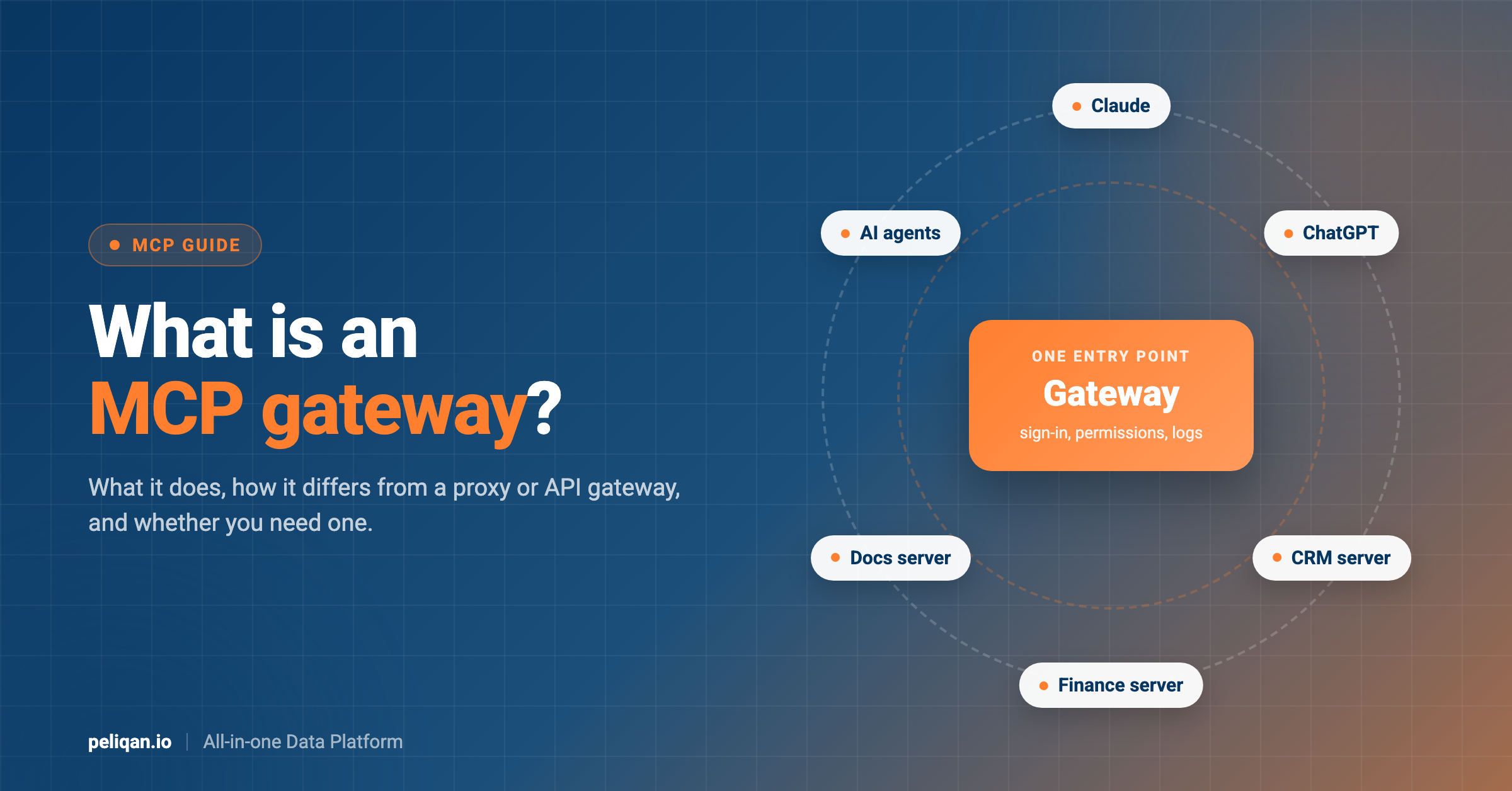
Yes, and it’s worth being precise here. TimeXtender launched its own MCP server in 2025-2026, currently in Preview. It connects AI clients like Claude and ChatGPT to governed semantic models via OAuth. However, it’s read-only by design. The documentation describes read-only query validation and read-only database authentication. It exposes semantic models (measures, entities, relationships), not raw data, and it can’t write back to your business apps. So AI agents can ask questions of TimeXtender’s governed metrics, but they can’t act on them. That distinction is the wedge for this entire comparison. The writeback MCP cornerstone covers why read-only versus write-capable is the decision that matters in 2026.
Why MCP read-vs-write is the 2026 decision
Model Context Protocol (MCP) is the standard that lets AI agents connect to your data systems. So by 2026, most serious data tools shipped an MCP server. That part is now table stakes. The differentiator is what the MCP server lets the agent do.
There are three flavors of MCP server across the TimeXtender alternatives. First, pipeline-management MCP, where the AI manages the data tool itself (trigger a sync, check a pipeline, analyze credit usage). Second, read-only analytics MCP, where the AI reads governed metrics or warehouse tables. Third, writeback MCP, where the AI reads cross-source data and writes the result back to the source app. Almost every competitor sits in the first or second bucket. Peliqan sits in the third.
The three MCP flavors, and who ships which
So the practical test for any TimeXtender alternative is simple. Can an AI agent update a CRM record, create an invoice, post a journal entry, or change a pipeline stage through the MCP server? For most of this list, the answer is no. For Peliqan, it’s yes. The cross-source MCP SQL cornerstone walks through the query pattern.
For a wider view of the field, the best MCP servers roundup ranks the options by capability.
The 12 best TimeXtender alternatives in 2026
1. Peliqan (the top pick)
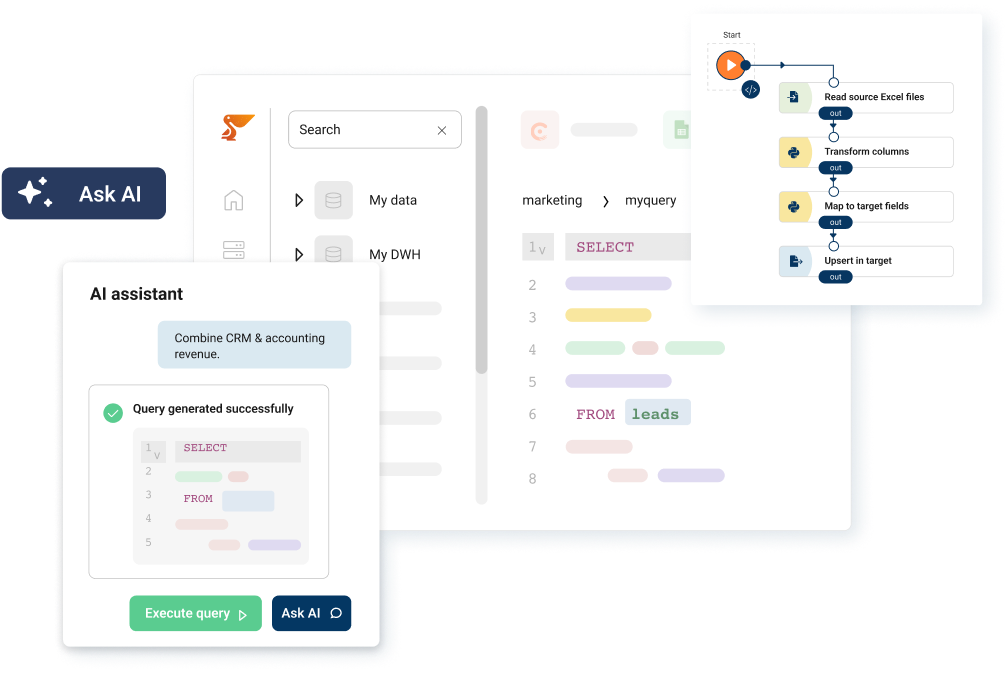
Peliqan is an all-in-one data platform: ELT plus a built-in Postgres and Trino warehouse plus reverse ETL plus low-code Python and SQL. On top of that sits an MCP server that exposes 300+ connectors through one endpoint with full writeback. So AI agents can read from one system and write to another in a single flow: read Stripe payment history, update the HubSpot lifecycle stage. Writebacks route through Peliqan’s connector layer with an audit log, and the default is read-only with per-role and per-table write enablement.
The built-in warehouse matters for AI workloads. AI queries hit a cached copy in Postgres, not the live SaaS API. So the agent doesn’t saturate rate limits or hammer production. Pricing is Connect at EUR 75/month, Pro at EUR 500/month, and Enterprise custom. SOC 2 Type II, ISO 27001, GDPR. The Claude MCP setup playbook covers the connection pattern.
2. Microsoft Fabric
Fabric is Microsoft’s unified analytics SaaS, priced on capacity units (F-SKUs). It’s TimeXtender’s biggest competitive overlap because both target Microsoft-centric buyers. Fabric’s MCP support is expanding fast, with a Local MCP generally available and a Fabric Data Agent that can act as an MCP server. However, the Fabric Data Agent MCP is analytics and answer-oriented over OneLake data. It’s not business-app writeback. So Fabric is the right pick for an all-Microsoft shop that wants native Power BI and OneLake, but not for cross-app agent actions. See our Peliqan vs Microsoft Fabric comparison for the detail.
3. WhereScape
WhereScape is TimeXtender’s closest historical competitor: pure data-warehouse automation via WhereScape RED, 3D, and Data Vault Express. It generates native code for SQL Server, Snowflake, Databricks, Fabric, Oracle, and BigQuery, and serves 700+ customers. So if the requirement is a like-for-like warehouse-automation replacement, WhereScape is the closest match. It has no MCP server as of 2026. Its AI messaging is about building AI-ready warehouses, not exposing an MCP endpoint for external agents.
4. Fivetran
Fivetran is managed ELT with consumption-based pricing on Monthly Active Rows. It moves data into your warehouse with hundreds of connectors and a strong reliability record. Fivetran ships an MCP server, but it’s an operational one: it manages connectors and syncs, read-only by default with an opt-in flag that governs pipeline config, not business-app writeback. So Fivetran is an ingestion-first pick, not an agent-action pick. See our Peliqan vs Fivetran comparison for the full breakdown.
5. Matillion
Matillion is cloud-native ETL/ELT (the Data Productivity Cloud) with credit-based pricing. In June 2025 Matillion launched Maia, a team of agentic AI data engineers, at Snowflake Summit. Matillion ships an MCP server for monitoring pipeline executions, analyzing credit consumption, and triggering runs. Write tools are gated behind a read-only flag. So the MCP is pipeline-ops, not cross-app writeback.
6. dbt
dbt is the SQL transformation layer that anchors the modern data stack. Its MCP support is mature: a local dbt MCP launched in April 2025, and at Coalesce 2025 dbt Labs announced general availability of the remote dbt MCP server plus dbt Agents in beta. The MCP exposes models, metrics, lineage, and the Semantic Layer, and can run dbt commands that modify warehouse objects. So it’s powerful for transformation, but it’s a transformation-layer MCP, not a cross-app writeback layer.
7. Coalesce
Coalesce is column-aware transformation automation, Snowflake-native, and arguably the closest to TimeXtender’s automation positioning on Snowflake. It launched Coalesce Copilot in 2025 and ships a transform MCP server scoped to managing Coalesce nodes, pipelines, jobs, and runs, with a read-only mode and explicit confirmation on destructive operations. So the MCP drives pipeline development, not business-app writeback, and it’s Snowflake-only.
8. Airbyte
Airbyte is open-source ELT with 600+ connectors and self-host or cloud deployment. It has several MCP servers: PyAirbyte MCP, a Connector Builder MCP, and an Embedded Operator MCP, with safe-mode and read-only controls. So Airbyte is strongest as a data-movement and connector-building layer for agents, especially for teams that want open-source and the widest connector catalog. Writeback is oriented to sync and build operations, not governed business-app mutations. See our Peliqan vs Airbyte comparison for more.
9. Qlik Talend
Qlik acquired Talend, and Qlik Talend Cloud is the enterprise data-integration result. The Qlik MCP server went GA in early 2026, letting assistants like Claude and ChatGPT query governed Qlik data and analytics. So it’s an analytics-oriented MCP for governed reads, aimed at enterprise buyers already invested in Qlik, not a cross-app writeback layer.
10. Azure Data Factory
Azure Data Factory is Microsoft’s native ELT and orchestration service, priced pay-per-activity. It’s the DIY Microsoft-native alternative: low cost per unit but engineering-heavy to operate. It has no dedicated business-app-writeback MCP; the Fabric and Azure MCP efforts sit above it. So ADF suits teams with strong data engineering that want maximum control and minimum license cost.
11. Keboola
Keboola is an all-in-one mid-market data platform: ELT plus storage plus transformations plus data apps. It launched its MCP server in June 2025, an open-source server exposing storage, SQL transformations, jobs, and flows to Claude, Cursor, and VS Code, with read-only header controls. So Keboola has a strong all-in-one story, and its MCP is oriented to building and operating Keboola pipelines rather than governed writeback into external SaaS apps.
12. Rivery and Dataddo
Rivery is a managed ELT and data-ops platform with credit-based pricing. Dataddo is a no-code ELT and reverse-ETL tool with connector-based pricing, strong for BI feeds. Both are solid mid-market ingestion picks. Neither ships a prominent business-app-writeback MCP as of 2026. So they compete on ingestion simplicity and price, not on agent actions.
TimeXtender alternatives compared
Here’s the full comparison. The last column is the one no other ranking page uses, and it’s the one that decides the 2026 buying question.
For the MCP-first architecture in depth, see our 8-way MCP architecture comparison.
How to choose the right TimeXtender alternative
Start with the AI-agent question
Ask whether your AI agents need to act or only to read. If the roadmap includes agents that update records, create invoices, resolve tickets, or change pipeline stages, you need a writeback MCP, and that narrows the field to Peliqan fast. If the agents only need to answer questions from governed metrics, the read-only options (TimeXtender, Fabric, Qlik, dbt) are viable.
Then weigh deployment and cost
TimeXtender’s annual license starts at $34,000 and climbs to $150,000, which suits larger Microsoft-centric estates. So a mid-market team that wants an all-in-one platform without a five-figure floor should compare that against Peliqan’s EUR 500/month Pro tier or a consumption tool like Fivetran. The MCP for the CFO hub covers the total-cost lens for AI-agent data infrastructure.
Match the tool to the team
An all-Microsoft team lands on Fabric. A team replacing TimeXtender’s warehouse automation like-for-like lands on WhereScape. A Snowflake transformation team lands on dbt or Coalesce, and if the debate is warehouse choice itself, our Peliqan vs Snowflake comparison covers it. A team that wants one platform for ingestion, warehouse, reverse ETL, and agent actions lands on Peliqan. So the choice follows the shape of the team, not just the feature checklist.
The bottom line on TimeXtender alternatives
TimeXtender is a capable warehouse-automation platform, and for a Microsoft-centric team that wants to automate a governed data estate, it still does that job. So this isn’t a story about a tool falling behind on its core function.
It’s a story about the buying question changing. In 2026, data platforms are judged on whether AI agents can act on the data, not just read it. Most TimeXtender alternatives shipped an MCP server, but the overwhelming majority are read-only or pipeline-management endpoints. So the field narrows sharply once you filter for governed writeback across business apps.
Peliqan is the one all-in-one platform on this list built for that. ELT, a built-in warehouse, reverse ETL, and an MCP server with audited writeback across 300+ connectors, at EUR 500/month for the production tier rather than a five-figure annual license. So if your next data platform needs to serve AI agents that read and write, Peliqan is the TimeXtender alternative to start with.
Explore the Peliqan MCP server to see the writeback pattern in action.
This post is informational. Vendor pricing, product features, and MCP capabilities reflect publicly available information as of 2026 and may change. Verify current details with each vendor before any procurement decision.