




Most “best MCP servers” lists rank developer tools: GitHub, Figma, Docker, Playwright, Postman. Those are great if you are shipping a coding agent. However, they tell a European CFO, RevOps lead, accountancy-firm partner, or Odoo consultant almost nothing about which MCP servers actually matter for running a business.
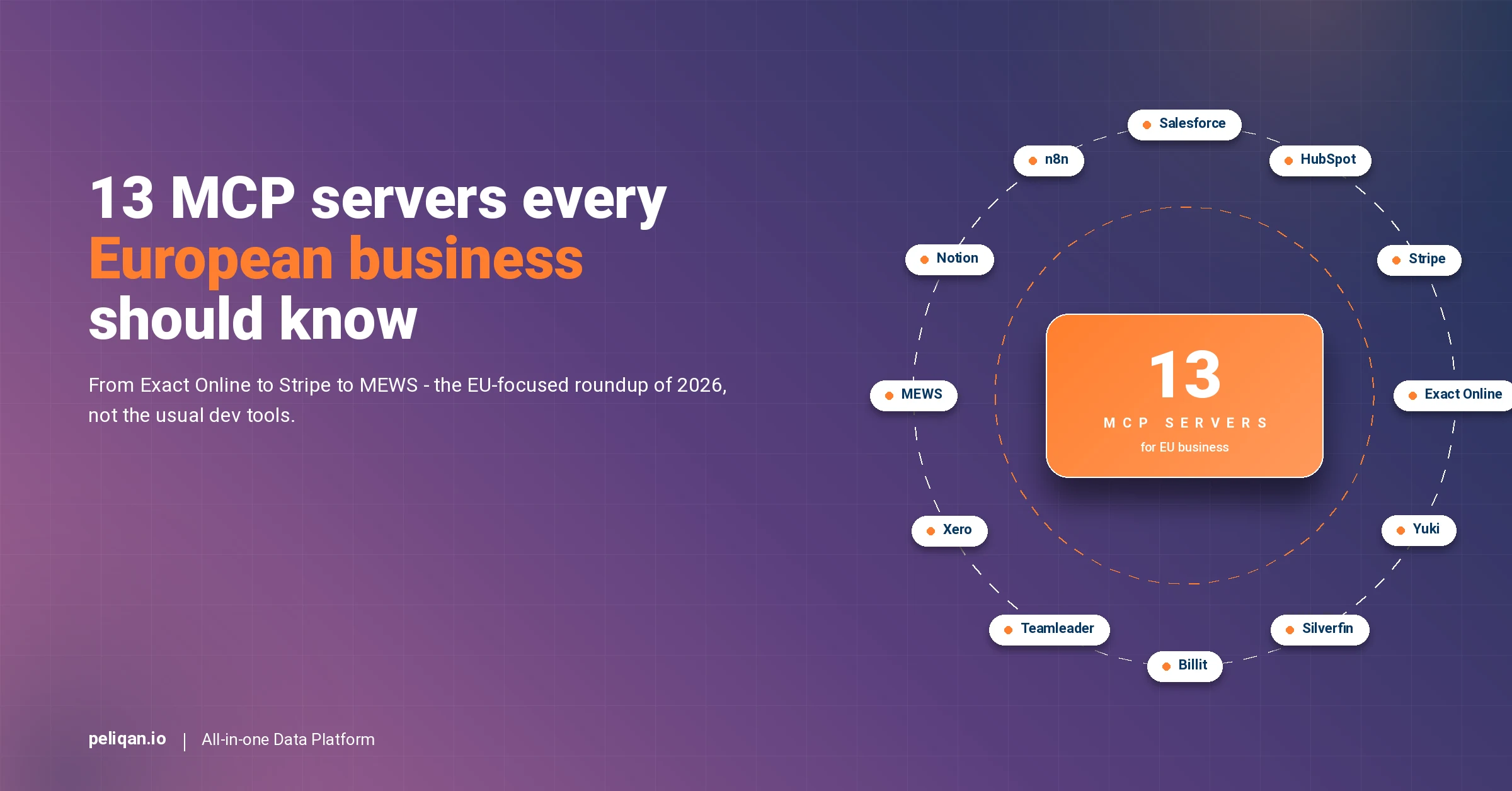
However, this list is different. Specifically, it is built for the EU business buyer in 2026 – the CFO with twelve subsidiaries on Exact Online, the Belgian bookkeeper running Yuki across 200 clients, the Odoo partner managing 50 customer databases, the UK accountant facing MTD-ITSA in April, the hotel revenue manager on MEWS. Therefore, the 13 entries below cover the MCP servers most relevant to that audience, in the order an EU business should evaluate them.
Fair voice is the rule. Specifically, each entry names the real pain it solves, the five things your team can actually do with it, and the payoff. Furthermore, where competing MCPs serve the same job, the competitors are named and credited. In short, no anti-competitive framing – just the honest analyst view of which MCP fits which use case for European business buyers.
Why this list is different from the usual dev-focused MCP roundup
Most public MCP rankings are written by US-default platforms or developer-tool vendors. Specifically, they emphasise GitHub, Figma, Docker, Postman, Slack, and the rest of the engineering stack. Naturally, those tools matter for AI coding agents and dev workflows. However, they are not the operating layer of a European mid-market business.
European business buyers care about a different layer entirely: ERP, CRM, accounting, e-invoicing, payments, hospitality PMS, and the cross-source SQL that joins them all. Furthermore, EU buyers care about hosting jurisdiction (GDPR, EU AI Act), audit-grade writeback for SOC 2 reviews, and vertical depth into the Benelux + UK + Nordics + EU SMB stack. The MCP servers on this list address that operating reality.
1. Peliqan MCP: the EU warehouse-first MCP gateway for business data
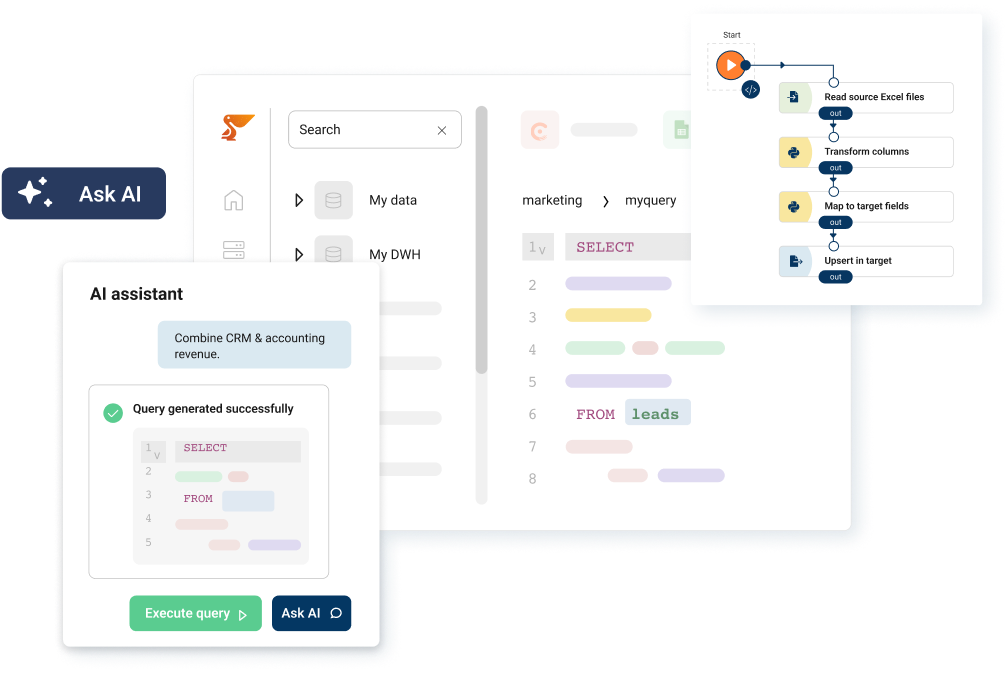
A warehouse-first MCP server is a category before it is a brand. Specifically, it syncs every connected source into a managed warehouse, exposes real SQL with full JOINs and window functions to AI clients, and routes writeback through reverse ETL with a prompt-to-API audit log. In practice, Peliqan is the EU-hosted reference implementation of this pattern, with 250+ connectors across the European business stack.
- Query cross-source data in one SQL: join Salesforce opportunities with Stripe payments and Zendesk tickets at the same accounts.
- Consolidate multi-tenant client books: per-tenant isolation across 50+ client Odoo, Yuki, or Xero databases with one MCP context.
- Route writeback safely: push corrections to Exact Online, Salesforce, or NetSuite with a full audit log of which prompt triggered which mutation.
- Stay inside EU jurisdiction: EU-hosted, SOC 2 Type II, GDPR-native, ISO 27001 in progress.
- Materialise hospitality KPIs: pickup, pace, STLY, RevPAR, F&B per occupied room – pre-computed once and served to Claude in milliseconds.
For the architectural deep dive on pricing and the warehouse pattern, the main Peliqan MCP page covers the connector list and writeback matrix in full.
2. Salesforce MCP (Agentforce 3): the global CRM anchor
Salesforce ships native MCP-client support in Agentforce 3 (June 2025), which means agents can call external MCP servers without custom code. Notably, the platform serves 150,000+ companies globally, 90%+ of the Fortune 500, and holds 20.7% of the CRM market. Consequently, it remains the default revenue layer for any global RevOps team.
- Trigger Apex workflows: let Claude invoke server-side automation from the agent surface.
- Triage stuck deals: ask Agentforce to surface opportunities past their close date with no rep activity.
- Update pipeline at scale: bulk-edit stage, close date, or owner across hundreds of records via prompt.
- Search across Account / Contact / Opportunity: Agentforce handles the SOQL behind the scenes for in-Salesforce questions.
- Run native AI features: predictive scoring, Einstein activity capture, and the Agentforce action library all stay inside the platform.
However, for cross-source questions that span Salesforce plus Stripe, ledger data, or support tickets, the Salesforce MCP playbook covers the warehouse-first pattern that complements Agentforce.
3. HubSpot MCP: the mid-market CRM with a marketing engine
HubSpot serves close to 300,000 customers across 135+ countries and runs at roughly $3.1B in revenue. Importantly, the platform sits on the marketing-led side of the CRM market. As a result, its MCP becomes especially relevant when the AI agent needs to connect marketing engagement to sales pipeline and downstream payments.
- Score MQLs from engagement signals: let Claude read email opens, form submissions, and workflow membership.
- Create or update deals: push opportunities into Sales Hub from a natural-language prompt.
- Generate marketing emails: draft sequences inside HubSpot Marketing Hub via Breeze or external AI.
- Triage tickets: classify Service Hub tickets and route to the right agent based on context.
- Build cross-funnel views: pair HubSpot with ERP, payments, and support for full lifecycle analytics.
Naturally, the cross-funnel join (marketing to sales to revenue) is the next step. Specifically, the HubSpot MCP write-up covers the warehouse-first pattern for that combination.
4. Stripe Agent Toolkit: in-product AI for payments operations
Stripe processed $1.05 trillion in 2025 and the company sits at a $106.7B valuation. Specifically, the official Stripe Agent Toolkit exposes payments and billing operations to AI agents through MCP – excellent for in-Stripe workflows like creating customers, issuing refunds, or looking up charges. However, it stays Stripe-shaped by design.
- Issue refunds via prompt: resolve disputes or partial refunds from a chat interface.
- Create customers and subscriptions: let Claude provision new accounts during onboarding.
- Look up charges and balance transactions: answer finance questions about specific payments in real time.
- Search the Stripe knowledge base: Agent Toolkit ships with docs search for support-style queries.
- Trigger Stripe Sigma queries: run native Stripe analytics from an AI agent without leaving the platform.
Conversely, for cross-source revenue intelligence joining Stripe with CRM, ERP, and support data, the Stripe + Claude playbook covers the warehouse-first pattern that the Agent Toolkit cannot reach.
5. Exact Online MCP: the Dutch and Benelux CFO anchor
Exact Online powers 675,000+ SMEs and accountants across NL, BE, DE, and the UK. Notably, KKR has owned the platform since 2019. Consequently, Exact Online has become the default ERP for Dutch and Benelux mid-market companies – especially those running multi-division accounting through a single tenant.
- Consolidate multi-division P&L: roll up revenue, margin, and operating expense across 12+ subsidiaries with intercompany eliminated.
- Triage AR by entity: rank overdue invoices across divisions and flag the largest exposures by customer.
- Reconcile journal entries: surface anomalies in GLTransactions before month-end close.
- Track Peppol delivery: cross-check Exact Online sales invoices against Belgian Peppol acknowledgements.
- Forecast cash by subsidiary: combine Receivables, Payables, and bank data for a 13-week treasury view.
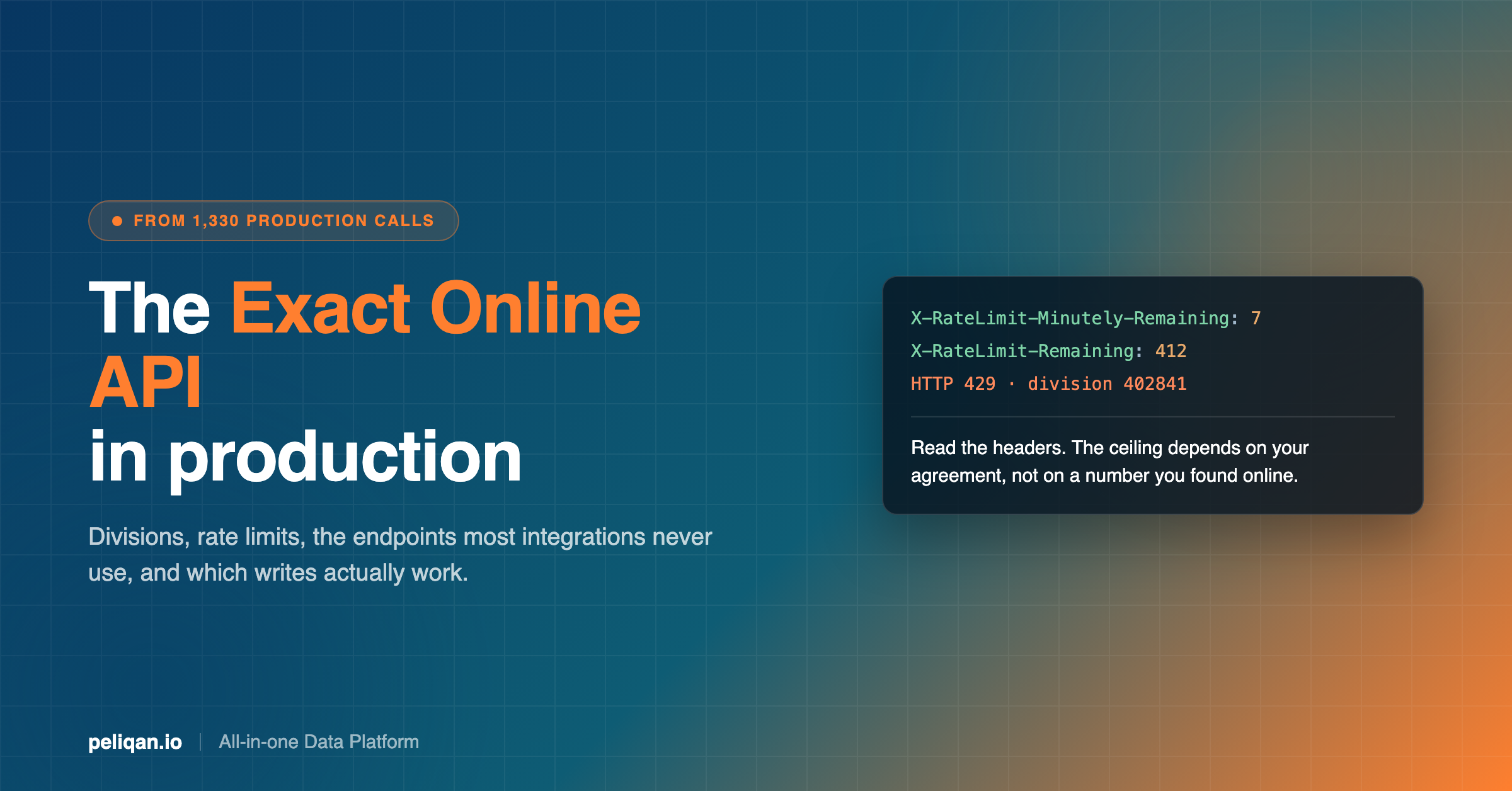
Additionally, the full multi-division architecture and rate-limit handling sit in the Exact Online CFO playbook.
6. Yuki MCP: hands-free month-end for Dutch SMBs
Yuki is the Dutch SMB bookkeeping platform owned by Visma, with strong penetration across 50,000+ NL customers. Importantly, the platform is built around automation. As such, the AI promise on top of Yuki is closing month-end without exporting trial balances to Excel.
- Automate month-end close: reconcile bank statements, flag missing postings, and surface VAT issues before submission.
- Cross-check VAT returns: compare Yuki output with the underlying journal data for inconsistencies.
- Run cross-client reporting: for accountancy firms, aggregate KPIs across 200+ Yuki client environments.
- Detect duplicate invoices: surface near-duplicates that escaped Yuki’s native deduplication.
- Auto-categorise transactions: let Claude propose GL accounts for unposted bank lines.
Furthermore, the Yuki Visma group context and accountancy-firm patterns are covered in detail in the Yuki Claude MCP write-up.
7. Silverfin MCP: AI for Belgian accountancy firms
Silverfin is Visma’s €300M post-accounting and compliance platform, serving 850+ accountancy firms across 15 countries with strong concentration in BE and NL. Specifically, the product centres on the workpaper. Consequently, it becomes the natural surface for AI inside a Belgian accountancy practice.
- Triage open reconciliations: surface every client file with stalled bank rec older than 5 days past target.
- Run RAG against workpaper history: answer auditor-style questions using prior-period notes and signed-off justifications.
- Detect chart-of-accounts anomalies: flag accounts moving more than two standard deviations from their 12-month average.
- Reconcile Peppol-era VAT: match Silverfin postings to Belgian Peppol delivery events in one workflow.
- Generate advisory upsell signals: surface clients with margin contraction or rising debtor concentration ripe for partner conversations.
In particular, for the rate-limit-of-1 constraint and multi-client portfolio pattern, the Silverfin MCP playbook covers the architectural detail.
8. Billit Peppol MCP: the Belgian e-invoicing mandate layer
Belgium’s mandatory B2B Peppol e-invoicing went live on January 1, 2026. Specifically, Billit operates as the dominant Belgian Peppol Access Point with 120,000+ businesses and 2M+ invoices per month. As a result, the regulatory hook makes Billit MCP non-optional for Belgian sellers: non-compliance fines run €1,500 to €5,000 per offence plus proportional VAT penalties of 60-100%.
- Monitor Peppol delivery status: surface every B2B invoice not acknowledged within 24 hours.
- Diagnose rejection root cause: group failed invoices by Peppol error code with the suggested remediation.
- Cross-check ledger versus Access Point: reconcile Billit sent invoices with Exact Online or AFAS GL.
- Triage late payers by Peppol cohort: rank overdue invoices by customer and cross-source context.
- Auto-resend corrected UBL: trigger reverse-ETL writeback to push a fixed invoice through the Access Point with audit log.
Likewise, the full Peppol mandate timeline and the cross-source pattern with Exact Online sit in the Billit Peppol AI playbook.
9. Teamleader Focus MCP: the EU SMB sales-and-invoicing CRM
Teamleader Focus is the Belgian-founded SMB CRM acquired by Visma in 2022, with more than 15,000 businesses across BE, NL, FR, ES, IT, and DE. Notably, the community has shipped multiple GitHub MCP servers – globodai-group/mcp-teamleader, Tailormade-eu, Weichie – alongside the managed warehouse-first option.
- Run daily pipeline reviews: filter stuck deals across NL and FR sales teams in a single prompt.
- Analyse quote-to-cash velocity: surface quotations sent but not accepted with the customer-side activity history.
- Track project profitability: join Projects with TimeTracking to flag overruns above 20% of budget.
- Monitor cash collection: rank overdue invoices joined to Peppol delivery status and bank reconciliation.
- Forecast the founder dashboard: build a quote-to-cash funnel from quotation through Stripe payment in one query.
Additionally, the Teamleader Focus vs Orbit distinction and rate-limit handling are covered in the Teamleader Claude MCP playbook.
10. Xero MCP (JAX – Just Ask Xero): UK and EU SMB accounting
Xero serves 4.2M+ subscribers across 180+ countries, with dominant share in AU, NZ, and the UK. Specifically, the platform shipped its native AI – Just Ask Xero (JAX) – in 2024. Furthermore, the UK regulatory hook around MTD-ITSA (mandatory April 6, 2026 for £50k+ income) makes Xero AI a 2026 priority for UK accountancy firms.
- Run cross-client debtor briefings: aggregate overdue invoices across an entire practice’s Xero portfolio in one prompt.
- Pre-check MTD-ITSA submissions: surface unreconciled bank transactions and unposted invoices for every quarterly client.
- Assist bank reconciliation: match unreconciled bank lines to Xero invoices based on amount and contact proximity.
- Generate practice-wide KPIs: total revenue, average DSO, bank rec backlog days, MTD submission status by client.
- Cross-source Xero + Stripe: reconcile invoices with Stripe payments and bank feed for SaaS-client cash forecasts.
Notably, the practice-scale multi-tenant pattern (and how it survives MTD-ITSA quarterly cadence) is covered in the Xero Claude MCP playbook.
11. MEWS MCP: AI for hospitality at multi-property scale
MEWS is the cloud-native hospitality OS serving 5,000+ properties across 85+ countries. Notably, the platform raised a $300M Series D in January 2026 at a $2.5B valuation. In addition, Choice Hotels International selected MEWS as a franchisee PMS option. Multiple MCP options exist – for example, Vinkius ships a hosted MEWS MCP with 12 tools, alongside the warehouse-first option for multi-property groups.
- Brief revenue managers daily: surface last-night pickup vs STLY across all properties, by segment, with ADR delta.
- Prepare front-office arrivals: generate VIP and special-request briefings without exposing passport numbers.
- Analyse F&B contribution: rank outlets by F&B revenue per occupied room and flag leakage.
- Run night audit checks: surface unbalanced bills, mismatched payments, and unposted folio items before close.
- Consolidate group reporting: RevPAR by region, ADR by segment, occupancy by day-of-week across the entire estate.
Importantly, the full Connector API rate-limit handling, multi-property fan-out, and PII masking pattern live in the MEWS Claude MCP playbook.
12. Notion MCP: the knowledge layer for European teams
Notion shipped its official hosted MCP server in 2025, evolving from a downloadable v1 into a one-click OAuth integration. Notably, the platform serves 30M+ users globally and is the default knowledge layer for European startups and SMBs. In practice, the MCP is excellent for Notion-only workflows; however, pair it with a warehouse-first MCP when the question crosses Notion plus CRM, ERP, or payments.
- Retrieve pages and blocks: let Claude pull workspace documents into context for cross-source answers.
- Query databases with filters: ask natural-language questions against any Notion database.
- Create or update pages: let an agent draft a project brief or meeting note directly inside Notion.
- Run RAG across team knowledge: ground AI answers in your meeting notes, OKRs, and project docs.
- Pair with operational MCPs: combine Notion knowledge with Salesforce, Stripe, or Exact Online for richer agent responses.
Specifically, for the architectural pattern when Notion sits alongside operational data sources, the cross-source playbook on the Claude MCP cornerstone shows the warehouse-first integration approach.
13. n8n MCP: workflow orchestration with EU hosting
n8n is Berlin-headquartered, EU-hosted by default for self-hosted instances, and the only other strongly-EU MCP on this list besides Peliqan. Specifically, the community czlonkowski/n8n-mcp server lets Claude Desktop, Cursor, or Windsurf build and orchestrate n8n workflows through natural language. In practice, n8n is the workflow MCP layer while a warehouse-first MCP sits as the data layer beneath it. Partners, not competitors.
- Generate n8n workflows by prompt: have Claude scaffold a multi-step automation from a description.
- Orchestrate cross-app actions: chain operations across hundreds of integrations inside one workflow.
- Self-host inside EU jurisdiction: run n8n alongside other MCP servers in the same Docker environment for compliance.
- Pair with a data MCP: use n8n for triggers and orchestration, a warehouse-first MCP for analytical queries.
- Extend with custom nodes: wrap any EU SaaS API as an n8n node and expose it through MCP without writing a standalone server.
Overall, the architectural complement between n8n (workflow) and a warehouse-first MCP (data) is one of the cleanest stack patterns for EU teams who want both event automation and cross-source analytics from the same AI agent surface.
Honourable mentions: the US MCP heavyweights
No fair MCP list ignores Composio, Pipedream, Apideck, or Zapier MCP. Indeed, they occupy real architectural slots and serve their target use cases well. Therefore, the framing for European business buyers is what they are excellent at – and where the structural gaps appear.
The four US-default MCPs every European buyer should know about
Specifically, the full architectural side-by-side – including the migration paths from any of these to a warehouse-first model – sits in the Composio vs Pipedream vs Peliqan comparison.
The Odoo angle: an EU SMB ERP every partner ecosystem should evaluate
Odoo deserves its own callout. Specifically, this Belgian-founded open-source ERP serves 12M+ users worldwide, raised a €500M round in November 2024 at a €5B valuation, and grew the partner ecosystem to dozens of countries. Multiple MCP options exist – the community ivnvxd/mcp-server-odoo is the most-starred GitHub repo, while warehouse-first Odoo MCP serves the partner-channel use case.
For Odoo partners managing 50+ client databases, the cross-database cockpit pattern is uniquely valuable. Specifically, the Odoo Claude MCP playbook covers the open-source advantage, multi-database fan-out, and the dedicated Odoo Partners offering.
How to pick the right MCP for your stack
Match the MCP to your operating shape
Likewise, for a deeper read on EU AI Act, GDPR, and EU data residency considerations across the MCP market, the planned cornerstone post at GDPR-compliant MCP servers goes into the regulatory dimension in detail.
Build vs buy: the engineering perspective
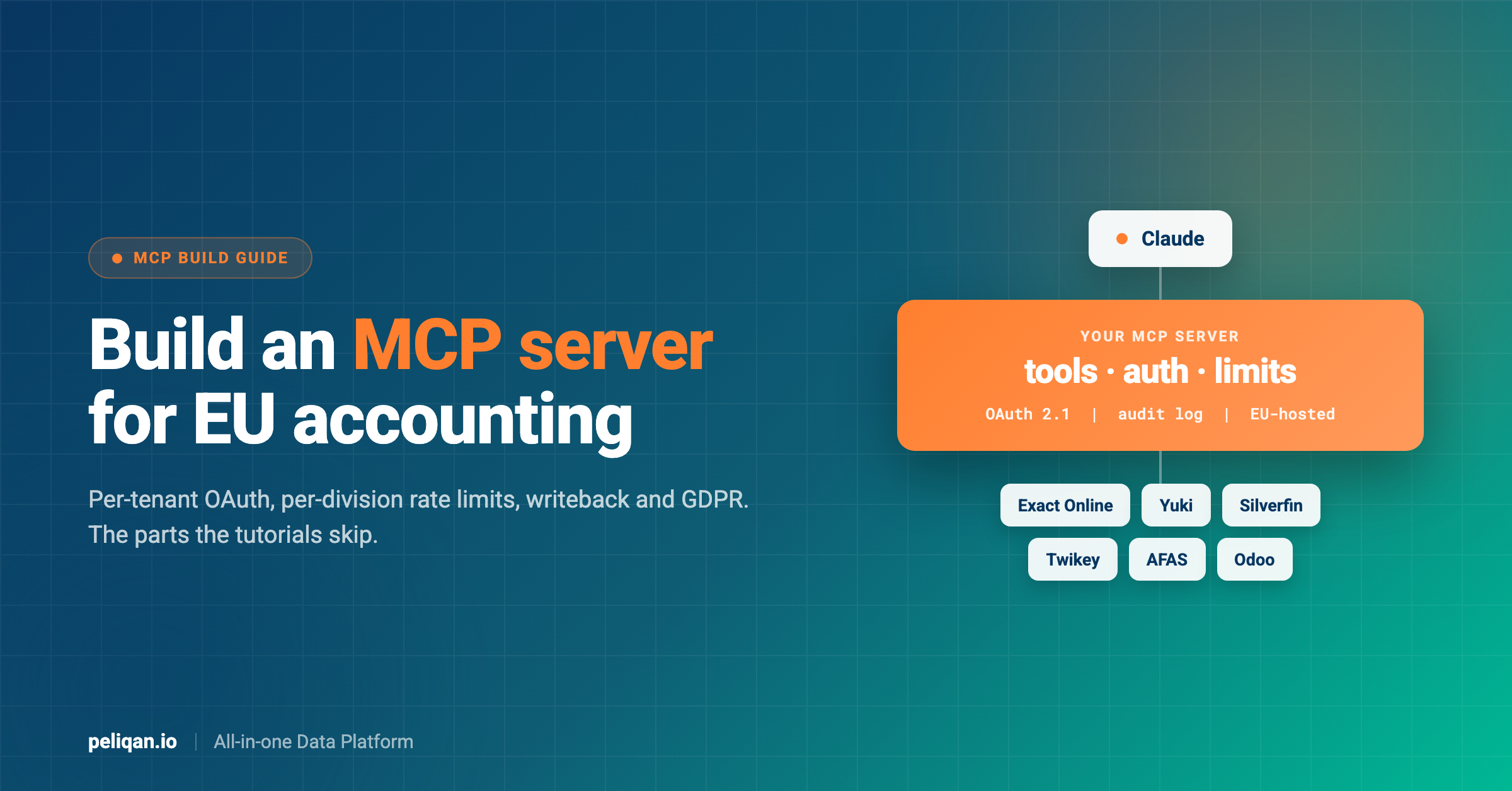
For engineering teams that prefer to roll their own MCP layer, the build MCP server guide covers the protocol details. Naturally, the trade-off is the standard one: more control, more maintenance burden, slower time-to-value. In practice, most EU business teams arrive at the same conclusion – the managed warehouse-first model pays back in the first quarter of use.
Furthermore, the main category overview lives on the Peliqan MCP help documentation, with the setup walkthrough and the connector matrix.
Real-world example: CIC Hospitality
CIC Hospitality consolidated 50+ data sources across its hotel estate and saved 40+ hours per month on board-report automation. Read the full case study for the architectural pattern that combined MEWS, accounting, and bank reconciliation in one Claude-ready warehouse.
What to do this quarter
If you are an EU CFO, RevOps leader, or partner-channel practitioner reading this list in 2026, the right next step is not to install all 13. Instead, pick the two or three that touch your existing operating stack, evaluate the architectural fit, and prototype a single cross-source question that none of your current tools can answer.
Firstly, identify which MCPs map to the systems you already run. Typically, most EU businesses run two to five of the platforms on this list.
Secondly, decide whether you need event automation (workflow MCPs) or analytical intelligence (warehouse-first MCPs) or both. Indeed, the architectures are complementary.
Thirdly, factor in your geography and compliance posture. Specifically, EU buyers serving regulated customers should weight EU-hosted MCPs heavily; in fact, the cost of switching jurisdictions after a SOC 2 or EU AI Act review is much higher than picking the right hosting from day one.
Ultimately, the MCP layer is becoming the AI operating system of European business. As such, picking well in 2026 is the difference between AI as a real productivity multiplier and AI as a perpetually-stuck pilot project.