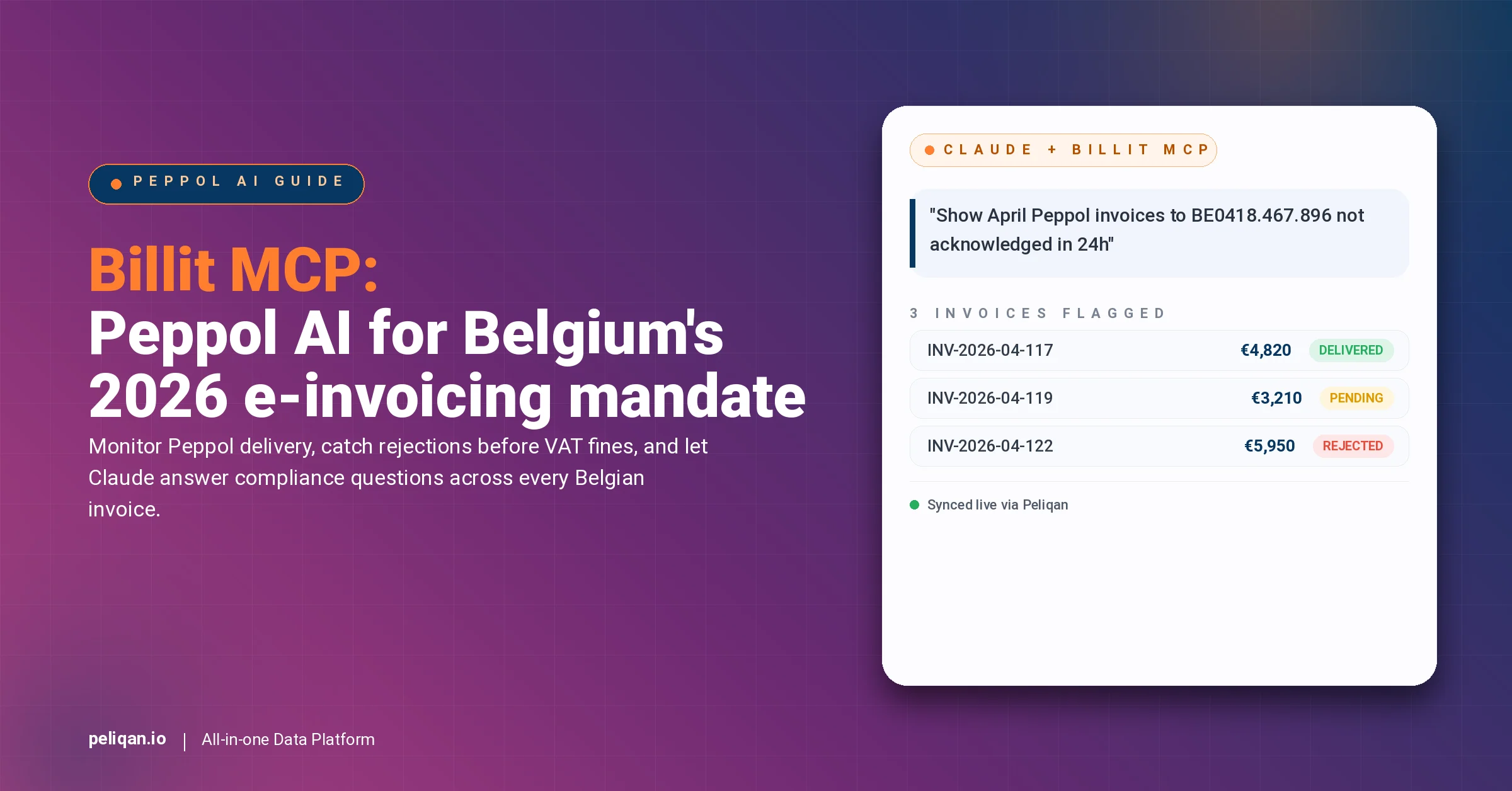





On January 1, 2026, Belgium switched on mandatory B2B e-invoicing. Every VAT-registered Belgian business now has to send and receive structured invoices through the Peppol network, in Peppol BIS 3.0 format, or face fines of €1,500 for a first offence, €3,000 for a second, and €5,000 for a third – on top of proportional VAT penalties of 60-100% of the VAT due. The three-month grace period ended on April 1, 2026, and full enforcement is live. If your invoices flow through Billit’s Peppol Access Point – and roughly half of all Belgian Peppol traffic does – you suddenly need real-time visibility into delivery status, rejections, and reconciliation gaps. This is where peppol ai and billit mcp stop being buzzwords and start being a board-level requirement.
Billit is the dominant Peppol Access Point in Belgium. Around 120,000 users push more than 2 million invoices per month through its gateway, and over 50% of all Belgian Peppol users send or receive via Billit. The Belgian Federal Public Service Finance is now using Peppol message logs as part of its enforcement framework. That means a single rejected invoice, a missing acknowledgement, or a delivery exception is no longer just an operational nuisance – it is an audit signal. Finance teams running Billit need answers in plain English: “Did supplier X’s April invoices clear Peppol?” “Which customers haven’t acknowledged our November invoices?” “Are any of our Peppol exceptions linked to the 60% VAT fine risk?” Billit’s UI is built for entering and approving invoices, not for board-level monitoring. That gap is exactly what the Billit MCP server fills.
What is Billit, and why it suddenly matters more
Billit at a glance
Billit’s product is two things stitched together. On the surface, it is a friendly invoicing app for freelancers, SMEs, and accountants – quotes, invoices, expense scans, payment links. Underneath, it is one of the largest certified Peppol Access Points in Europe, connecting Belgian businesses to the network that the Federal Public Service Finance is now using as the backbone for mandatory B2B e-invoicing. The 2026 mandate doesn’t change Billit – it changes what finance teams need from it.
Why connecting Billit to a warehouse and AI is harder than it looks
The hidden complexity of Peppol data
The painful part isn’t pulling a single invoice out of Billit – that’s a clean API call. The painful part is everything that turns Peppol data into management information: stitching async acknowledgements to sent invoices, joining UBL line items with customer data and ERP postings, fanning out across multiple Billit accounts, and answering questions that span Peppol + ERP + bank in one breath. Generic iPaaS tools and per-app MCP servers don’t solve this. They route data; they don’t model it.
The real cost of unmonitored Peppol traffic
What it costs to stay blind to Peppol exceptions
The mandate didn’t just change a workflow. It moved Peppol delivery status into the same regulatory tier as VAT returns. Every Belgian finance team running Billit now needs a monitoring layer that connects Peppol acknowledgements, invoice lifecycle, customer master data, and the ERP postings that come downstream. The cheapest way to build it is not a separate dashboard – it is to pipe Billit into a warehouse and let AI agents answer the questions.
5 ways to connect Billit to a warehouse and AI
1. CSV export from the Billit UI
Billit lets you export invoice lists, customer lists, and basic Peppol logs to CSV from the web app. For a single legal entity with low invoice volume, this is the cheapest possible starting point. You open the export, drop it into Excel, and run pivots. The trade-off is obvious: there is no Peppol delivery state, no acknowledgement timestamps, no joining to ERP or CRM, and the export is a snapshot – by the time you finish the pivot, the next batch of invoices has already shipped. Best for: One-off audits or a single freelancer.
2. Direct API calls with custom Python scripts
Billit publishes both the core invoicing API and a separate Peppol Access Point API. A developer can stand up Python scripts to pull invoices, customers, products, and Peppol participant data on a schedule, then push the results into a database. This works, but the cost is hidden in the plumbing: webhook receivers for delivery acknowledgements, retry logic for rate-limited calls, OAuth refresh, schema drift, and a fan-out layer for accountancy firms running dozens of administrations. Best for: Teams with a dedicated data engineer and a single Billit account.
3. Power BI custom connector or Excel scraping
Power BI’s Web.Contents and Excel’s Power Query can hit the Billit API directly. Many Belgian SMEs start here because Power BI is already on the desk. The model breaks when the question becomes anything other than “show me invoices in this date range” – Peppol acknowledgements, customer-level joins, and multi-administration consolidation hit Power BI’s refresh and credential limits fast. It is also a one-way street: there is no path back to push corrections into Billit. Best for: A single dashboard for one entity.
4. Generic iPaaS (Zapier, Make, n8n)
Zapier, Make, and n8n have community connectors or webhook recipes for Billit. They are excellent for event-based automations like “when a Peppol invoice is rejected, post to Slack”. They are not warehouses, so they cannot answer historical questions, run cross-source queries, or persist Peppol delivery state for analysis. The MCP variants of these tools (Zapier MCP in particular) are mostly read-only or shallow on the Billit endpoint surface. Best for: Event-driven alerting, not analytics.
5. Warehouse-first MCP platform (Peliqan)
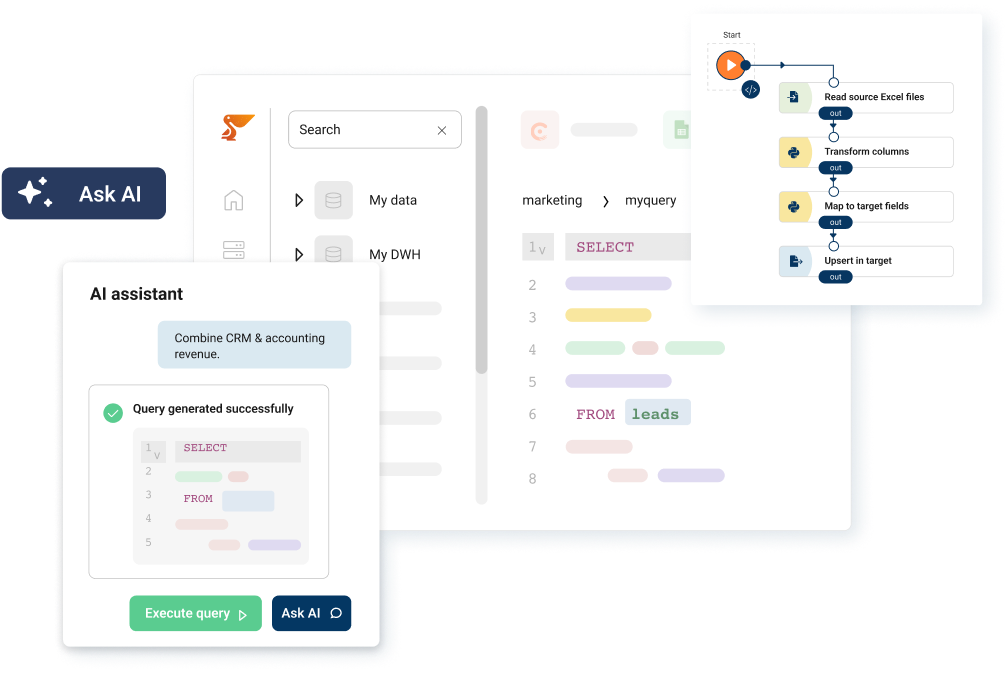
Peliqan syncs every Billit endpoint – invoices, customers, products, Peppol participants, acknowledgements, webhooks – into a managed Postgres + Trino warehouse, then exposes that warehouse to Claude, ChatGPT, Cursor, and any MCP client via the Peliqan MCP server. The AI client sees clean, joined tables instead of raw API endpoints. Peppol delivery state is stateful, queryable, and reconcilable against ERP postings. Writeback is built in via reverse ETL, so an AI agent can not only flag a rejected invoice but trigger a corrected resend. Best for: Belgian finance teams, accountancy practices, and consolidated groups running Billit as the Peppol gateway. See the Billit MCP server.
Comparison: 5 ways to connect Billit, side by side
| Method | Peppol monitoring | Cross-source joins | Writeback | AI / MCP | Multi-admin |
|---|---|---|---|---|---|
| CSV export | Manual, snapshot | No | No | No | No |
| Direct API + scripts | Custom-built | Hand-rolled | Hand-rolled | No, unless bolted on | Hand-rolled fan-out |
| Power BI / Excel | Limited | Limited | No | Copilot only | Painful |
| iPaaS (Zapier/Make) | Alerts only | No | Partial | Read-mostly MCP | Per-flow setup |
| Peliqan MCP | Stateful, queryable | SQL across 250+ apps | Built-in reverse ETL | Full MCP server | Native multi-customer |
The Billit data entities that matter most for Peppol monitoring
Not every Billit endpoint is equally important. For a Peppol AI use case – the kind you’d ask Claude about every Monday morning – five entities carry most of the value:
| Billit entity | What it powers | Peppol monitoring use case |
|---|---|---|
| Orders (invoices) | Sent and received B2B invoices | Volumes by customer, by status, by VAT code |
| PeppolEvent / Acknowledgements | Delivery, accept, reject events | Rejection rate, average ack delay, stuck invoices |
| Parties / Participants | Customers, suppliers, Peppol IDs | Customers not yet Peppol-enabled, dual-channel risk |
| Products / Lines | Line items, VAT rates, categories | VAT code anomalies, margin by SKU |
| Payments | Linked payments, statuses | DSO, partial payments, late payer cohort |
Decision framework: which connection method fits your situation
How to pick – in one paragraph each
What Peppol AI actually looks like in practice
Peppol AI is not a chatbot bolted to an invoicing app. It is an AI agent that has direct, governed read and write access to the Billit data layer through MCP, with cross-source context from your ERP, bank, and CRM. The questions a CFO actually asks at month-end stop being database queries and start being natural-language conversations.
Real-time Peppol delivery monitoring
“Show me every invoice we sent through Peppol in the last 14 days where the customer hasn’t acknowledged within 24 hours.” A Claude agent connected to the Billit MCP server returns a ranked list, grouped by customer, with the original UBL and the suspected reason for the silence. The acknowledgement timestamps are queryable because Peliqan materializes them in the warehouse instead of treating webhooks as fire-and-forget events. How materialized tables work is the technical detail underneath.
Peppol rejection root-cause analysis
When a Peppol invoice is rejected, the message buyer-side error code (e.g., BR-CO-25 missing payment terms, or a VAT validation failure) is logged but rarely surfaced. An AI agent with access to your Billit data plus a vector index of Peppol BIS 3.0 rules can return: “67% of your April rejections are buyer Peppol IDs that aren’t registered in SMP; 22% are missing UBL-CR-414 mandatory tags; 11% are duplicate document references.” That’s a single prompt instead of a half-day forensic exercise.
Late payer triage with cross-source context
The richest Peppol monitoring question is also the simplest: “Which customers are 30+ days overdue, and do we have an active deal with them?” Billit knows about the invoice and the payment status. HubSpot or Salesforce knows about the deal. The bank knows about reconciliations. A warehouse-first MCP can join all three in one query; iPaaS and CData cannot.
Compliance reporting on autopilot
For the FOD Financien e-reporting wave coming in 2028, the data trail you’ll need is the same one you should already be capturing today: every Peppol message, every UBL payload, every acknowledgement, every correction. A warehouse-first approach turns that obligation into a query, not a project. AI agents can run weekly compliance audits using data quality checks that flag drift before an auditor does.
How Peliqan handles Billit and Peppol monitoring
What you get with the Billit MCP server on Peliqan
The shortest path from “Billit + Peppol” to “AI agent that answers regulator-grade questions” runs through a warehouse. Peliqan ships that warehouse with the Billit connector pre-built and the Peppol acknowledgement reconciliation already modelled. You pip-install the MCP server, point Claude or Cursor at it, and start asking. The general Claude MCP overview covers the protocol-level details.
The main MCP hub covers the cross-source pattern – how to join Billit, ERP, CRM, and bank data inside a single MCP context that Claude can reason over. The cross-source pattern is the deeper unlock; per-app MCP servers like Composio cannot match it because they proxy individual APIs without a warehouse beneath.
For Belgian finance teams already running Billit, two integrations matter most beyond Peppol monitoring itself. The first is reverse ETL: when an AI agent identifies a Peppol exception, it should be able to push the corrected invoice back to Billit, not just log it. Reverse ETL in Peliqan handles this with a low-code Python and SQL UI, and the writeback round-trip preserves the original UBL document reference so the audit trail stays intact.
The second is alerting. SQL-driven alerts can post to Slack or email the moment a Peppol rejection rate crosses a threshold, the moment a customer’s Peppol ID stops resolving, or the moment outbound delivery latency spikes. None of these signals are surfaced inside Billit by default; all of them are now regulator-relevant.
If your stack already includes Exact Online or AFAS for ERP, the same warehouse covers both. Cross-source queries between Billit (Peppol delivery), Exact Online (GL journal), and Mollie or Ponto (cash reconciliation) become one SQL statement. That cross-source pattern is the single biggest reason Belgian finance teams move off iPaaS and onto a warehouse-first MCP. See the Exact Online MCP page for the sibling pattern.
The full Billit entity coverage – every endpoint, every webhook, every Peppol participant field – is documented on the Billit connector page.
If you also need a Power BI or Tableau view on top of the same warehouse, the Power BI + Billit page covers that combination.
The walkthrough for connecting your BI or DB tool takes you through the setup, including the cached Postgres endpoint that lets Power BI and Tableau hit the warehouse without paying Billit API costs on every refresh.
For accountancy firms running Billit as the Peppol gateway across dozens of clients, Peliqan supports multi-customer management out of the box. You get one MCP context that can answer “show me every client whose April Peppol rejection rate is above 3%” without writing a per-client script. The same architecture supports white-label dashboards if you want to give clients direct read-only access to their Peppol status – a competitive wedge against firms that still send Excel reports.
What to do this quarter
The Peppol mandate is no longer a “coming soon” project; it is operational reality, and FOD Financien’s grace period has expired. The next 90 days are about turning Billit from a transactional invoicing app into a monitored regulatory layer. The cheapest mistake is to wait for the first €5,000 fine. The second cheapest is to build a custom Python pipeline that you’ll be maintaining in 18 months. The most defensible move is to put a warehouse and an MCP layer between Billit and the questions you’d rather ask in English.
If your team is already running on Billit and you want to see what Peppol AI looks like with your own data, the fastest entry point is the Billit AI page on Peliqan. From there, the MCP server is a pip-install away, and Claude or Cursor can start answering compliance and DSO questions in the same chat where you’ve been writing prompts all year.
Building your own MCP server from scratch is an option, but for Billit specifically, the connector and the Peppol acknowledgement model already exist – skip the six months of plumbing and start with the warehouse already populated.
Peppol monitoring is the use case that finally makes Belgian e-invoicing AI more than a slogan. Billit MCP is the lever. The window for getting ahead of the regulator and your DSO chart is open right now – and unlike the 2026 grace period, this one doesn’t have a hard end date stamped on it.