




Belgian accountancy firms are running on Silverfin and running out of capacity at the same time. Visma’s €300M cloud post-accounting platform now serves over 800 firms across 15 countries, with 320,000+ end-client files and 30 of the UK’s top 100 firms in production. The product is excellent at compliance workflow. It is not built to answer “which of my 200 clients are at the highest risk of a VAT audit next quarter?” in plain English. That gap is where silverfin ai stops being a marketing phrase and starts being a margin lever. The fastest path from a Silverfin workpaper to a Claude-grade answer is an MCP server – and the constraint isn’t AI capability, it’s that Silverfin’s API is throttled to a single concurrent call. Designing around that limit is the whole game.
The pressure on Belgian accountants in 2026 is not a slow burn. Mandatory B2B Peppol e-invoicing went live on January 1 with fines reaching €5,000 per offence and proportional VAT penalties of 60-100% on non-compliant invoices. The EU AI Act in Belgium hits operational thresholds with audit obligations and potential fines of up to €35M or 7% of global turnover. Client books are still closed manually in spreadsheets that were emailed in PDF. Junior auditor headcount is harder to find than ever, and ICAEW’s 2026 research shows that the firms growing fastest are the ones embedding AI into the workpaper – not the ones experimenting with chatbots beside it. AI for accountants in Belgium has shifted from “interesting” to “default”, and Silverfin sits at the center of the workflow.
What Silverfin is, and why an AI layer on top is the next obvious step
Silverfin at a glance
Silverfin’s promise is “connect once, automate the workflow”. It pulls structured data out of ERPs and ledgers – Exact Online, AFAS, Yuki, Twinfield, Wolters Kluwer – into a normalized trial balance and reconciliation layer. The workpaper is the source of truth for the auditor’s file. The product wins on compliance discipline; it loses when the question is firm-wide rather than file-by-file. Anything that crosses multiple clients, multiple periods, or multiple data sources turns into a manual export-then-Excel exercise. That’s the slot AI for accountants Belgium is meant to fill.
Why connecting Silverfin to AI is harder than it looks
The four constraints every Silverfin AI project hits
The constraint that quietly kills most Silverfin AI prototypes is the rate limit. A Python script that fans out across a 200-client portfolio looks fine in development and times out in production. The fix is not “more workers” – the fix is a warehouse that does the slow, queued sync once and exposes the result to the AI agent as fast, in-memory tables. That architecture is the difference between an LLM that takes 90 seconds to answer and one that takes 2 seconds.
What slow Silverfin analytics actually cost
The compounding cost of Excel-grade portfolio reporting
The point isn’t that Silverfin is slow. It is excellent at what it was designed for. The point is that the next layer up – cross-client analytics, AI-assisted month-end, predictive compliance – cannot be done inside Silverfin and cannot be done with the API alone. It needs a warehouse, and on top of the warehouse, a Silverfin MCP server.
5 ways to connect Silverfin to AI agents
1. Silverfin Assistant module
Silverfin ships its own AI module – the Assistant – which automates chart-of-accounts mapping, anomaly detection, and reconciliation suggestions inside the workpaper. It is excellent for in-file efficiency. It is not a portfolio analytics layer, and it does not expose your Silverfin data to Claude, ChatGPT, Cursor, or any external MCP client. Best for: Per-file workflow acceleration, not firm-wide intelligence.
2. Direct REST API + custom Python
Silverfin’s REST API v4 is well-documented and clean. Any data engineer can write a script that walks firms, companies, periods, and reconciliations. The catch is the concurrent-call-of-1 limit. To pull a 200-client portfolio for the last 12 months, a naive script takes hours. You need backoff, queueing, resumable jobs, and a schema map – which means a small data engineering project before you write a single AI prompt. Best for: Firms with a dedicated data engineer and patience for plumbing.
3. Power BI custom connector
Power BI’s M language can hit the Silverfin API and build reports. Belgian firms that already run Power BI for management reporting can extend the connector to Silverfin, build a portfolio dashboard, and call it done. The model breaks when you want to ask questions the dashboard doesn’t anticipate, when you want writeback (Power BI doesn’t), and when you want an LLM in the loop. Best for: Static portfolio dashboards for managing partners.
4. Generic MCP servers (Composio, Pipedream, Zapier MCP)
The US-based MCP marketplaces have Silverfin connectors at varying depths. Composio is the deepest, Pipedream is event-driven, Zapier MCP is mostly read-only. None of them has an EU-hosted warehouse, none of them can join Silverfin with Exact Online or Yuki in a single query, and none of them is SOC 2 Type II hosted in the EU – which matters when your audit working papers are involved. Best for: Quick prototypes, not production AI workflows on regulated data.
5. Warehouse-first MCP platform (Peliqan)
Peliqan syncs every Silverfin endpoint into a managed Postgres + Trino warehouse, queues the API calls inside the rate limit, and exposes the cleaned tables to Claude and any MCP client through the Peliqan MCP server. Writeback flows back through reverse ETL. Cross-source SQL between Silverfin, Yuki, Exact Online, AFAS, and Billit is one query. EU-hosted, SOC 2 Type II, GDPR-native. Best for: Belgian and EU accountancy firms running Silverfin at portfolio scale. Browse the Silverfin MCP server.
Comparison: 5 ways to connect Silverfin to AI
| Method | Rate-limit handling | Cross-client analytics | Writeback | EU-hosted MCP | Cross-source SQL |
|---|---|---|---|---|---|
| Silverfin Assistant | Built-in | No | In-file only | N/A | No |
| Direct API + scripts | Hand-rolled | Custom-built | Custom-built | Depends on host | No |
| Power BI connector | Refresh-bound | Static dashboards | No | Microsoft tenant | Limited |
| Composio / Pipedream | Generic | No | Read-mostly | US-default | No |
| Peliqan MCP | Built-in queue | SQL across portfolio | Reverse ETL | EU, SOC 2 Type II | 250+ apps in one query |
The Silverfin entities that matter most for AI use cases
| Silverfin entity | What it powers | AI use case |
|---|---|---|
| Companies (client files) | Per-client master data | Portfolio segmentation, industry analytics |
| Periods | Monthly, quarterly, annual closes | Close-stage tracking, late-close alerts |
| Reconciliations | Working papers, balance proofs | Open-item triage, AI-suggested matches |
| Accounts | Chart of accounts, balances | Anomaly detection, COA harmonisation |
| Workflows | Compliance task lists | Bottleneck detection, partner workload |
| Files / Attachments | Source documents | RAG-grounded answers, evidence retrieval |
Decision framework: pick the right Silverfin AI architecture
Match the architecture to the firm size and use case
AI for accountants Belgium: the workflows that actually move margin
The temptation with AI is to spin up a chatbot and call it transformation. The real value comes from compressing the high-cost workflows that recur every month across every client. Five patterns repeat across the Belgian Silverfin firms we’ve seen.
Portfolio-wide month-end close monitoring
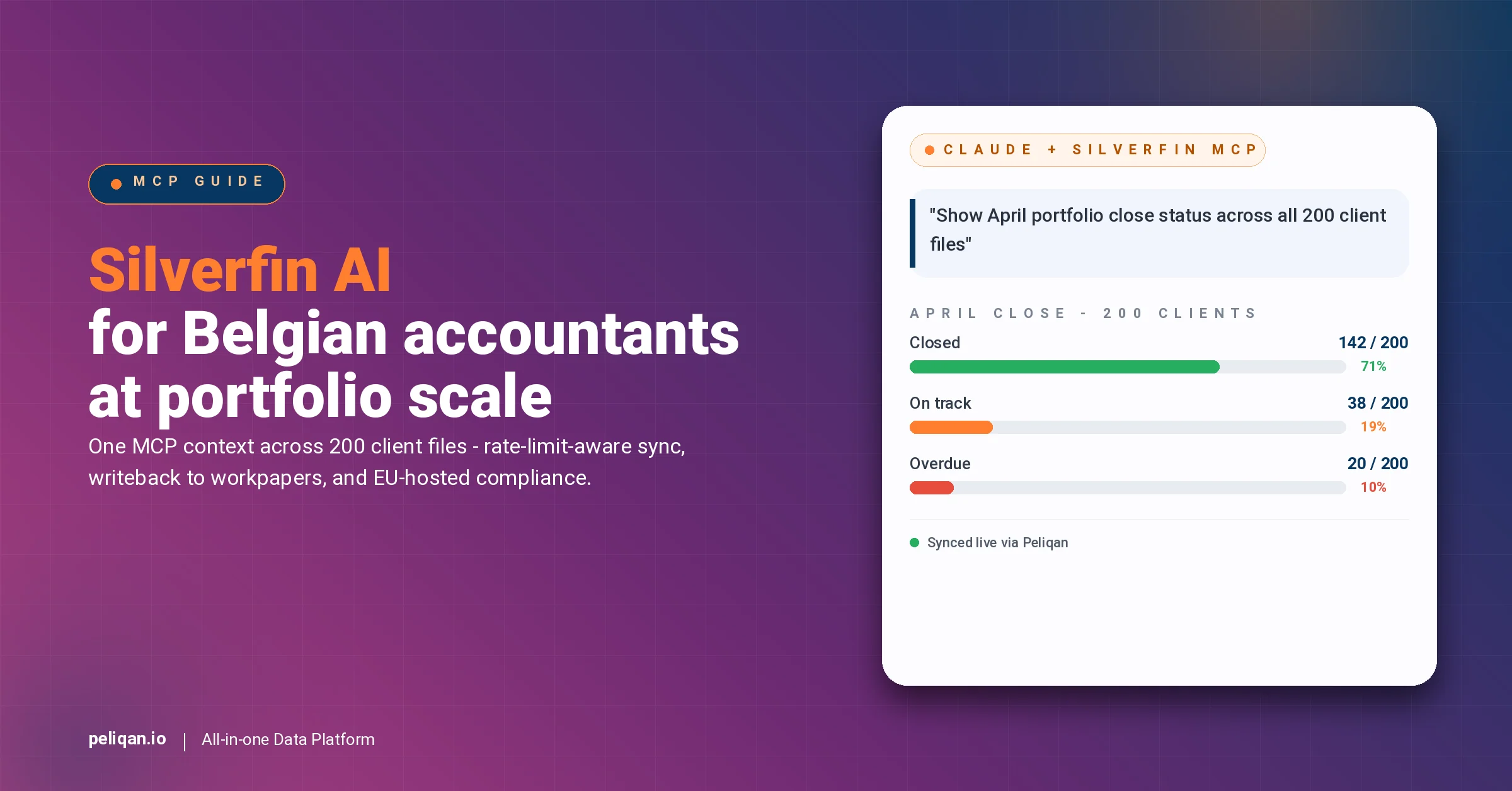
“Show me every client where the April reconciliation is still open more than 5 days past target.” This is one SQL query against the warehouse. In raw Silverfin, it is a partner clicking through 200 client files or asking the team in Slack. A Claude agent with MCP access to Silverfin returns the list in seconds, ranked by client revenue and assigned partner. The same agent can push a workflow comment back to the responsible accountant via writeback.
Reconciliation triage with RAG
Each open reconciliation in Silverfin has source documents, prior-period explanations, and signed-off justifications. A RAG-augmented MCP context lets an AI agent answer “what was the auditor’s note last quarter for this account?” without the senior accountant opening the workpaper. Silverfin’s reconciliation API exposes the raw data; the AI value comes from layering vector search on top.
Anomaly detection across the chart of accounts
An AI agent that has every client’s monthly trial balance in the warehouse can flag accounts moving more than two standard deviations from their 12-month average. This is the work that historically only got done at year-end audit. With a warehouse-backed Silverfin MCP, it’s a weekly job. Data quality monitoring handles the alerting layer.
Compliance forecasting for Peppol-era VAT
Belgian B2B Peppol invoicing is now mandatory. The structured data flowing through Peppol mirrors what’s posted in Silverfin. An AI agent can reconcile the two in real time and surface drift – the Peppol invoice was sent at €10,000, the Silverfin posting is €9,000, the difference is a likely VAT misclassification – long before an FOD Financien audit catches it.
Advisory upsell signal generation
Cross-client analytics surface signals that don’t exist in the single-file view. Clients with shrinking margins for three quarters in a row. Clients carrying inventory days that are doubling. Clients with debtor concentration crossing 30%. Each signal is a billable advisory conversation. A Claude agent with MCP can produce the partner’s next-week prospecting list automatically.
How Peliqan handles the Silverfin MCP layer
What you get with the Silverfin MCP server on Peliqan
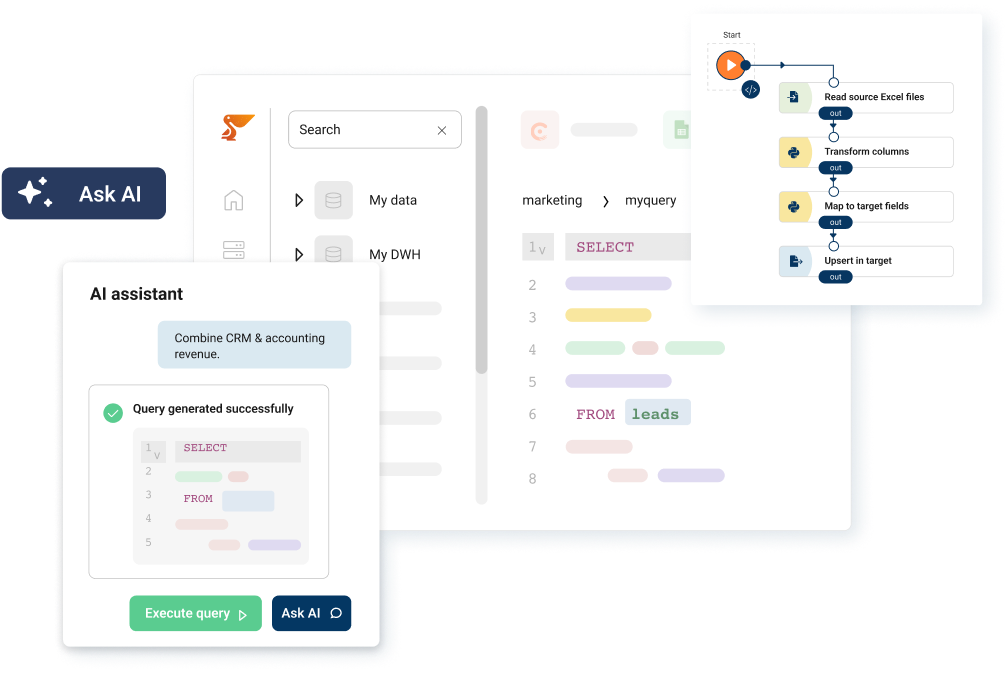
The Silverfin MCP server in Peliqan is the answer to the question “how do we make AI useful inside our firm without spending six months on data engineering?” The warehouse does the slow, queued, audit-grade sync. The MCP server exposes it to Claude, Cursor, ChatGPT, or any internal agent. The reverse ETL closes the loop so writes go back into Silverfin cleanly. And the cross-source layer means that when your partners want to ask “across all our Yuki + Silverfin clients, which ones look like next-quarter audit risks?”, that’s one query, not a project.
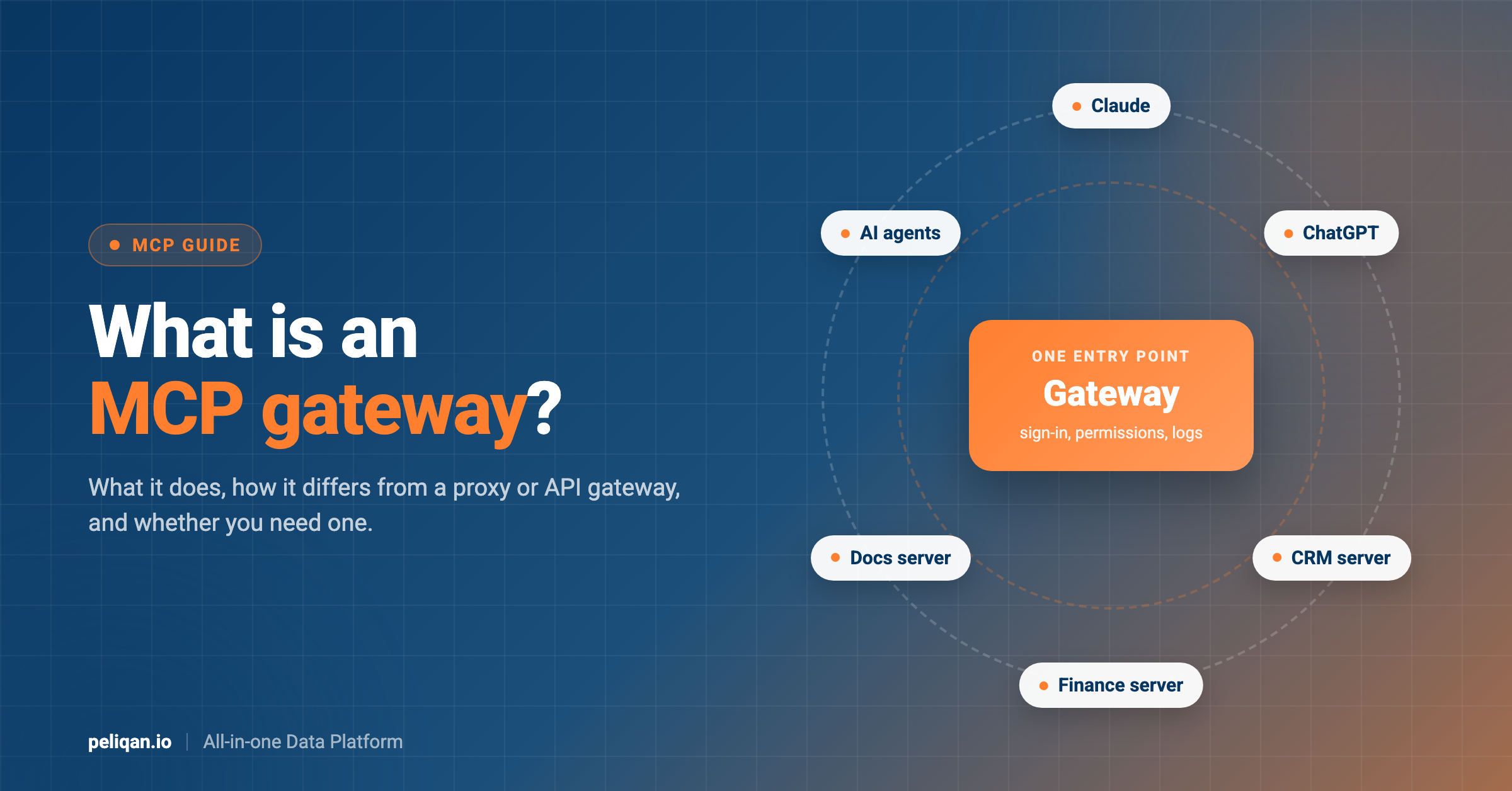
The general Claude MCP overview covers the protocol details.
For the cross-source pattern across EU SaaS – and the ROI math behind a Benelux accountancy practice that wires Silverfin, Yuki, Billit, and a bank feed into one warehouse – the main MCP hub walks through the architecture, the pricing, and the typical payback period for a 200-client firm.
For firms running Silverfin alongside Visma’s other Benelux brands – Yuki, Visma e-conomic, Adsolut, Octopus – Peliqan covers all of them with a single warehouse and a single MCP context. There is no need to pick one tool’s AI assistant over another’s. Materialized tables let you stage the slow-sync data once and query it thousands of times, which is the only practical way to work around Silverfin’s concurrent-call-of-1 limit.
Building agents inside Peliqan means your firm-specific logic – the partner sign-off rules, the materiality thresholds, the IBR-IRE statutory templates – stays on your platform, not on a vendor’s hosted assistant. That separation also matters for EU AI Act compliance: the audit log of which prompt was issued, against which data, and what writeback it triggered, all lives in your tenant.
The deeper unlock is reverse ETL. Peliqan’s reverse ETL writes back to Silverfin, Yuki, Exact Online, AFAS, and the bank APIs alike. An AI agent that triages a reconciliation in a partner’s chat window can then post the resolution back to the Silverfin workpaper without anyone opening the UI. The audit trail is preserved. The partner’s time isn’t burned. For firms with a Belgian compliance line – VAT, social charges, statutory accounts – this is the single feature that turns AI from a demo into an operating model.
If the practice is already running Billit for Peppol e-invoicing, the same warehouse handles both. Peppol delivery status, Silverfin postings, and bank reconciliations join in one SQL statement. That cross-source pattern is what differentiates a warehouse-first MCP from every other approach. The Exact Online MCP page covers the same pattern for Dutch ERP.
The full entity coverage for Silverfin – companies, periods, reconciliations, accounts, files, workflows – is documented on the Silverfin connector page.
For firms that want a Power BI layer on top of the Silverfin warehouse instead of (or alongside) the AI agent, the Power BI + Silverfin page covers that combination.
The joining-data guide covers how cross-source joins are modelled in the warehouse layer – the missing primitive in Composio and Pipedream, and the reason a single SQL query can answer “which clients have inconsistent VAT codes across Silverfin and Billit?”
What to do next
The Belgian accountancy market in 2026 is not waiting for the firms still piloting AI. Mandatory Peppol e-invoicing is operational. The EU AI Act enforcement window is open. Junior auditor headcount is squeezed. Clients are asking questions in plain English and expecting answers in seconds. The firms that win the next three years are the ones whose Silverfin data lives in a warehouse, whose AI agents talk to that warehouse through MCP, and whose writeback flows back into Silverfin cleanly enough to preserve audit integrity.
If your firm is running on Silverfin and you want to see what Silverfin AI looks like with your own client portfolio, the fastest entry point is the Silverfin AI page on Peliqan. From there, the MCP server is a pip install away and Claude can start answering portfolio questions in the same chat you’ve been using for the last year.
The general build MCP server guide covers the protocol if you want to roll your own.
The HubSpot MCP write-up shows the same warehouse-first pattern applied to a CRM-side use case – a useful pairing if your advisory practice has a HubSpot-driven sales motion alongside the Silverfin compliance work, and a reminder that the same MCP context can serve both the bookkeeper and the partner.
Silverfin MCP is the leverage point. It is the bridge between a compliance platform that does its job well and the AI layer that turns compliance into advisory revenue. The constraint isn’t whether the models are smart enough – they are. The constraint is whether your firm has a warehouse and an MCP server sitting in the right place. That’s the project to scope this quarter.