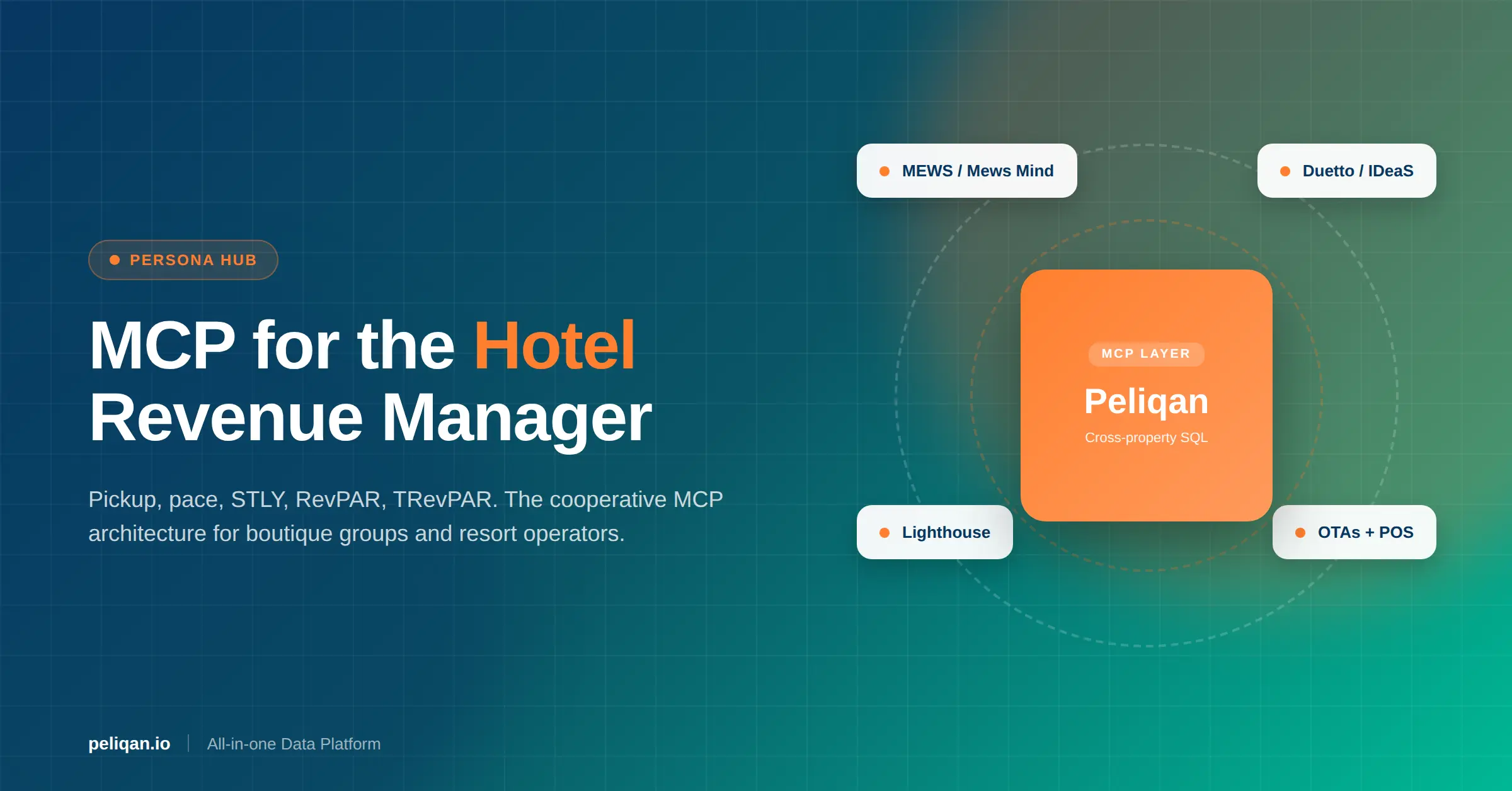





MCP for hospitality in 2026 is not one platform. It’s three native AI surfaces (Mews Mind inside MEWS, Duetto and IDeaS for pricing recommendations, Lighthouse for rate-shopping intelligence) with a warehouse-first MCP on top to answer the questions none of them can answer alone. This is the persona hub for the Revenue Manager, Director of Revenue, or GM at a boutique hotel group, independent collection, or resort operator running €5M to €100M in room revenue. Pickup, pace, STLY, RevPAR, TRevPAR per occupied room, and F&B leakage become first-class MCP citizens. No other vendor positions on hospitality metrics natively.
The news hook is real. On January 22, 2026, MEWS closed a $300M Series D at a $2.5B valuation led by EQT Growth, the largest funding round ever in hospitality software. MEWS is now AI-native by mandate, with 15,000 customers and 132,000+ monthly active hoteliers across 85 countries. Duetto won the HotelTechAwards #1 RMS title for the fourth year running (2022-2025) and serves 7,200+ properties. IDeaS, the SAS-owned RMS, delivers more than 250 million pricing and inventory decisions every day to 30,000+ clients across 158 countries. Lighthouse (formerly OTA Insight) closed a $370M KKR investment in November 2024 and rolled out AI Channel Manager.
So the AI layer in hospitality is funded, shipping, and competitive. However, every revenue manager we talk to still pulls 8 dashboards before the 9 a.m. pickup meeting. That’s the gap this post closes.
The cooperative architecture for hospitality AI in 2026
The right mental model is four cooperating MCP surfaces, each doing what it was built for. So Mews Mind handles inside-MEWS conversational queries. Duetto and IDeaS handle real-time price recommendations. Lighthouse handles rate-shopping intelligence. Peliqan layers cross-source revenue, cost, F&B, and group reporting on top. The same cooperative pattern is documented across our MEWS + Claude MCP cornerstone.
The four hospitality MCP surfaces a Revenue Manager needs to know
For the regulatory layer, see our GDPR-compliant MCP servers reference.
The 7 standing questions every Revenue Manager can’t answer in one tool
If you run revenue for a boutique group between 5 and 50 properties, these seven questions come up every week. Each one sits across at least two systems. So a single-tool MCP gives you a partial answer at best.
The standing question set
So the operator needs an AI agent that can do all seven without four browser tabs and an Excel export ritual. That’s the warehouse-first wedge.
The 5 cross-source workflows that pay for the warehouse
1. Daily pickup briefing
Join MEWS reservations to Lighthouse comp-set rates to Duetto or IDeaS price recommendations. So the morning briefing becomes one prompt: “Show me yesterday’s pickup vs STLY, segment by segment, with the RMS recommendation and the comp-set rate for each room type.” The agent returns one table. No tab-switching. The cross-source MCP SQL cornerstone covers the architectural pattern.
2. Group block wash forecasting
Join MEWS group bookings to historical wash percentages by group type, lead time, and pickup velocity. So the agent projects which blocks will pick up versus which should be released back to transient inventory. Industry wash typically runs 15-30 percent for corporate groups, higher for association meetings booked far in advance. The earlier you release rooms back, the more transient ADR you capture at peak demand.
3. Corporate RFP underpace alert
Join MEWS company accounts to negotiated volume commitments to YTD actual room nights. So the agent flags which corporate accounts are tracking below their pledge, and by how much, before the quarterly review meeting. This is the workflow that turns RFP renewal conversations from “I’ll get back to you” to “you’re at 64 percent of pledge with 90 days left, here’s what we need to recover or renegotiate.”
4. Multi-property F&B per occupied room
Join MEWS occupancy to Lightspeed or Toast POS revenue by outlet, by meal period, by day-of-week. So the agent surfaces the breakfast attachment rate that should be 85 percent but is running 62 percent at property #3. The warehouse materialization documentation covers the pattern for nightly POS reconciliation against PMS occupancy.
5. Channel profitability all-in
Join MEWS reservations by channel to commission rates to cancellation cohorts to chargeback data from the payment processor. So Booking.com’s commission-net revenue per occupied room can be compared apples-to-apples against direct, Expedia, Hotelbeds, and corporate-negotiated channels. Most channel mix decisions get made on gross ADR because nobody has the time to net out cancellations and chargebacks. That’s exactly the question the warehouse pattern answers in one query.
The 3 failure modes of single-tool hospitality analytics
This is the defensible IP every Director of Revenue should take into the procurement room. Three failure modes recur across every hotel-group stack we audit. Each one is structural, not a vendor bug.
Failure mode 1: RMS recommends, nobody acts
Duetto’s GameChanger or IDeaS G3 generates excellent rate recommendations. The problem is adoption at the property level. Recommendations sit in an RMS dashboard that the on-property revenue manager opens twice a week, applies selectively, and then defaults back to gut feel for the rest. So the central RMS investment pays off at maybe 40 percent of its potential value. The warehouse pattern surfaces the gap by joining RMS recommendation history to actual rates loaded into MEWS, by property, by day. The Director of Revenue can see exactly which properties are ignoring the system and what it cost in foregone RevPAR.
Failure mode 2: pickup blindness
Pickup reports lag 24 hours at most properties because PMS data syncs to the RMS in nightly batches. So the 9 a.m. pickup meeting is looking at yesterday’s snapshot, not real-time on-the-books. By the time Tuesday’s pickup deceleration shows up in the report, it’s already Wednesday afternoon and the rate adjustment is two days late.
The MEWS Connector API ceiling of 1,000 requests per hour makes real-time PMS-to-RMS sync structurally tight when multiple integrations share the budget. Furthermore, the MCP rate limits guide covers the full set of API ceilings across the hospitality stack.
The warehouse pattern pulls deltas incrementally and serves the agent fresh data on demand via reverse ETL back to the RMS.
Failure mode 3: property-level optimization, group-level blindness
Each property optimizes its own ADR independently while group-level revenue contracts overall. Consider this. Property A pushes Booking.com rates up to capture peak weekend demand. Property B (5km away, same group) keeps Booking.com rates flat. So both properties cannibalize each other on the same OTA search results page, and the group loses the booking to a competitor altogether. No native tool sees this because each property’s RMS scope ends at its own ADR ceiling. The cross-property warehouse pattern joins both properties’ OTA channel performance and surfaces the cannibalization in one query.
The hospitality MCP vendor map, fair-framed
Mews Mind, Duetto, IDeaS, Lighthouse, Snowflake, and Composio each occupy a real lane. So the question isn’t “which one beats the others.” It’s “which one fits where in your stack.” Here’s the honest map.
For a deeper TCO comparison across the MCP server market, see our MCP server pricing 2026 guide.
For the Snowflake-hosted alternative specifically, the Snowflake MCP reference covers when a single-warehouse MCP fits and when it doesn’t.
GDPR + EU AI Act: hospitality PII is the regulatory minefield
Hospitality data is one of the most sensitive PII categories in any EU stack. So the regulatory layer matters more here than in most verticals.
Every reservation carries guest names, passport numbers (for international stays), dietary restrictions (which qualify as GDPR special category data when they reveal religious or health information), payment cards, and room preferences. An AI agent that touches MEWS data without column-level masking is one prompt away from a GDPR or EU AI Act incident. The EU AI Act and MCP Article 26 reference covers the deployer obligations that land August 2, 2026.
So the procurement question for any hospitality AI surface is: does it apply column-level masking by default, log every query against PII for the Article 26 audit trail, and keep data inside EU jurisdiction? Mews Mind inherits MEWS RBAC, which is a strong default for in-platform queries. Duetto and IDeaS operate on aggregated data and don’t typically expose PII to the agent. Lighthouse handles external market data. The cross-source warehouse layer is where the masking story actually has to be enforced, and where it most often fails by default in vendor-built tools.
5 buyer sub-segments and the right answer for each
The recommendation depends on property count, group structure, and EU jurisdiction. So here’s the decision framework, organized by where most hotel operators actually land in 2026.
For the multi-property close pattern at finance level, see our EU CFO hub.
Peliqan’s posture on the hospitality stack
Peliqan was built EU-hosted, warehouse-first, and multi-source from day one. So the hospitality-specific procurement-checklist questions all have prebuilt answers.
How Peliqan handles the Revenue Manager’s stack
For the MEWS-specific connector documentation, see the MEWS MCP landing page for setup specifics including the Connector API budget pattern and column-level masking defaults.
Real-world example: CIC Hospitality
CIC Hospitality unified 50+ data sources across its multi-property portfolio (PMS, channel managers, POS, accounting, CRM) into Peliqan’s EU-hosted Postgres + Trino warehouse. The team eliminated manual Excel consolidation, saving more than 40 hours per month on automated board reporting. The architecture is exactly the multi-property warehouse pattern this post describes. Each property’s stack is just another connector, every entity rolls up to one analytical layer, and the AI agent answers cross-property questions in a single SQL JOIN. Read the full CIC Hospitality case study.
The 4-stage hospitality adoption path
Stage 1: 1-5 properties, days 0-30
Turn on Mews Mind inside MEWS. Add Lighthouse Rate Insight for comp-set visibility. Pick one cross-tool question. A good starter is “what was our pickup yesterday vs STLY, segment by segment, and how does that compare to the comp-set rates Lighthouse shows for the same dates?” Accept that the answer requires switching between tabs. So move to Stage 2 when you find yourself asking the same multi-property question more than once a week.
Stage 2: 5-25 properties, days 30-90
Layer in Duetto GameChanger or IDeaS G3 RMS. Keep Mews Mind and Lighthouse. Treat the RMS recommendations as the in-channel answer for pricing. Start a parallel weekly question that the native tools cannot answer. A good one is multi-property F&B leakage by outlet, joined to PMS occupancy. So move to Stage 3 when you cross 25 properties, when you add a second PMS through acquisition, or when group cannibalization becomes a measurable line-item loss.
Stage 3: 25-50 properties, days 60-120
Deploy a warehouse-first MCP alongside the native ones. The five cross-source workflows above become weekly muscle memory. Daily pickup briefing, group block wash forecasting, corporate RFP underpace, multi-property F&B per occupied room, channel profitability all-in. So move to Stage 4 when PE diligence enters the picture, when EU AI Act compliance becomes a procurement question, or when the portfolio adds a second brand.
Stage 4: PE-backed multi-brand, EU-resident, resort operator
Warehouse-first is the default. EU-hosted in Belgium, SOC 2 Type II, ISO 27001 certified, audit-logged writeback, fixed pricing. Furthermore, the compliance story (EU AI Act Article 26 from August 2, 2026; GDPR special category data; column-level masking on passport, dietary, and payment fields) becomes the procurement story.
The bottom line on MCP for the Revenue Manager
The MEWS Series D in January 2026 and the Lighthouse $370M KKR investment in November 2024 confirm what every Director of Revenue has known for two years. Hospitality is AI-native by mandate now. However, the native AI surfaces (Mews Mind, Duetto, IDeaS, Lighthouse) each see only their own data.
So the cheap procurement decision is the cooperative architecture. Mews Mind inside MEWS. Duetto or IDeaS for pricing recommendations. Lighthouse for rate intelligence. A warehouse-first MCP on top for the seven standing questions and five cross-source workflows that no single tool was built to answer.
The revenue managers who win 2026 aren’t the ones who picked the best single tool. They’re the ones who let each tool do its job and let an AI agent walk across them. Pickup, pace, STLY, RevPAR, TRevPAR per occupied room, F&B leakage become daily muscle memory instead of a Tuesday-morning fire drill. The next year of agentic hospitality work compounds on whatever architecture you set in May 2026.
This post is for informational purposes only. Vendor pricing, product features, and AI Act timelines reflect publicly available information as of May 2026 and may change. Verify current details with each vendor before any procurement decision.