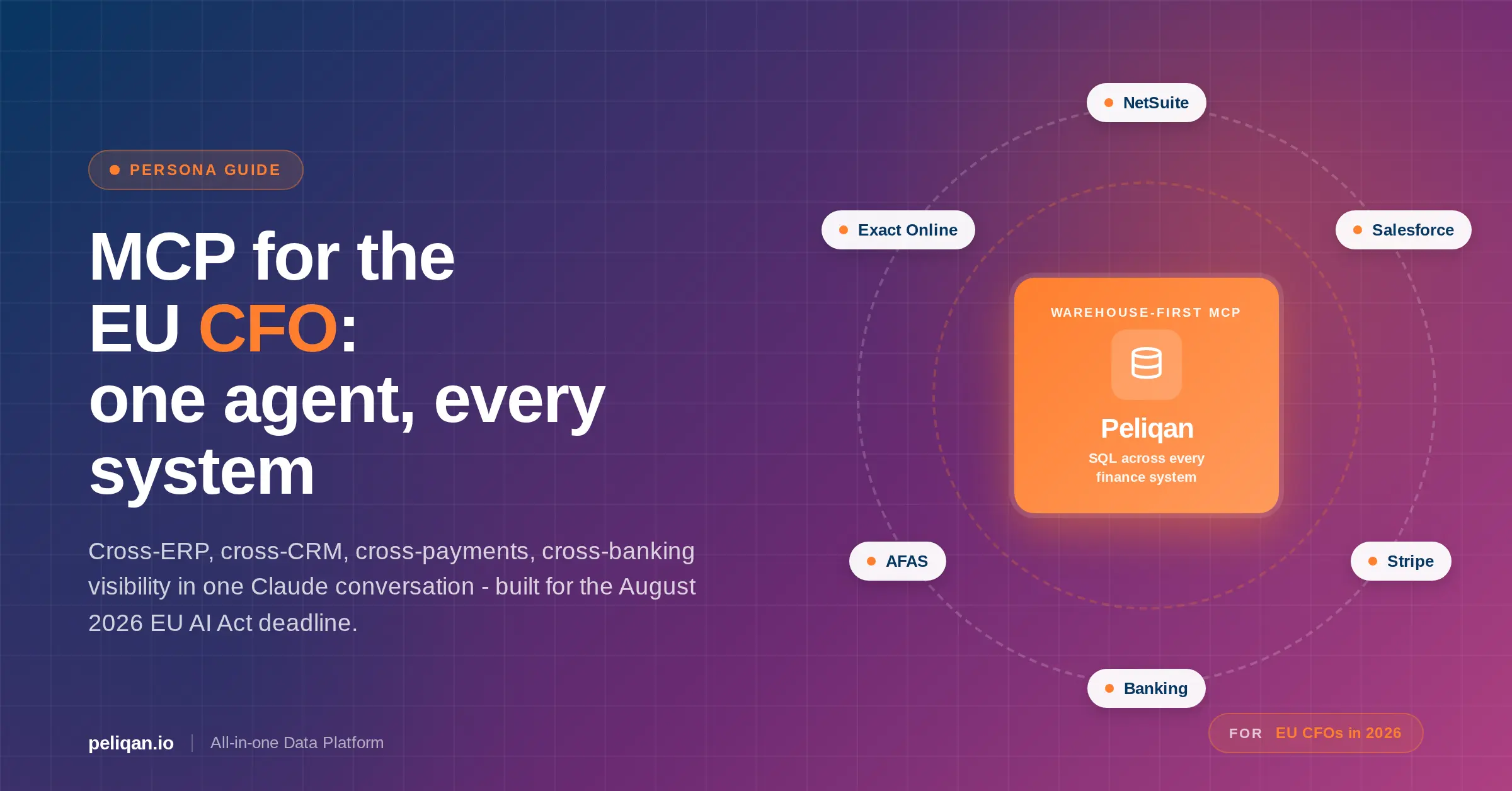





MCP for the EU CFO is the integration pattern that lets a single Claude conversation span every system in the finance stack. In 2026, the office of the CFO is shifting from copilot pilots to autonomous agent deployments. However, most enterprise AI tools target developers, not finance leaders. This is the practitioner guide for the EU CFO who needs cross-ERP, cross-CRM, cross-payments, cross-banking visibility through one MCP server. Specifically, it covers the seven questions an AI agent must answer, the architectural requirements that fit Article 26 and DORA at once, and the platform decision framework by CFO sub-segment.
The CFO role changed twice in 2026. First, on May 13, 2026, Numero acquired Royu to build “an agentic system of work for the Office of the CFO.” That deal landed in the same week as several other agentic-finance product launches. Second, CFO Dive reported HPE’s CFO put agentic AI at the centre of 2026 finance priorities, with the internally-named “Alfred” tool cutting HPE’s reporting cycle by 40%. Indeed, 54% of finance chiefs now name AI agent integration as a digital transformation priority.
The 2026 agentic AI spending market reached $12.4 billion. Moreover, 76% of CFOs are now allocating budgets specifically for autonomous agents rather than copilot or assistance tools. The decision velocity, compliance, and reporting-burden priorities have shifted from theoretical to budgeted. For the EU CFO specifically, the picture is even sharper because three regulatory regimes intersect with this shift at once: DORA (live since January 2025), the EU AI Act Article 26 (live August 2, 2026), and Peppol e-invoicing mandates rolling out country by country.
This is the post that connects the dots. First, the seven questions every EU CFO wants AI to answer. Then, the architecture beneath those answers. Finally, the procurement decision framework by CFO sub-segment.
Who the EU CFO is in 2026
The EU CFO is not the US CFO with a different time zone. Indeed, the regulatory load, the systems landscape, and the buying motion are all distinct. Six contextual realities define the 2026 EU CFO buyer.
Six realities that shape the 2026 EU CFO mandate
That context matters. In particular, it rules out two architectural patterns the US market still favours. First, US-hosted MCP vendors carry CLOUD Act exposure. Second, copilot-only AI tools don’t satisfy the autonomous-agent procurement criteria most EU CFOs are now using.
The seven questions every EU CFO wants AI to answer
The questions below cluster into three groups. The first three concern cash and revenue visibility. Then come the reconciliation and risk questions. Finally, two questions cover compliance and forecasting.
1. Show me consolidated cash position across all subsidiaries
This is the standing Monday-morning question. However, in most EU groups it takes until Friday because someone has to pull bank balances from three banks, match them to ledger positions in two ERPs, and convert currencies. With one MCP server reading the warehouse, the answer becomes a single SQL query that runs in seconds.
2. Which top-100 customers have overdue invoices and open support tickets?
This is the customer-risk question. Specifically, it joins ERP invoice ageing to CRM account tier to support ticket severity. For instance, an Exact Online MCP server on its own can show the invoices. However, joining the data to Salesforce or HubSpot or Zendesk needs the warehouse layer beneath.
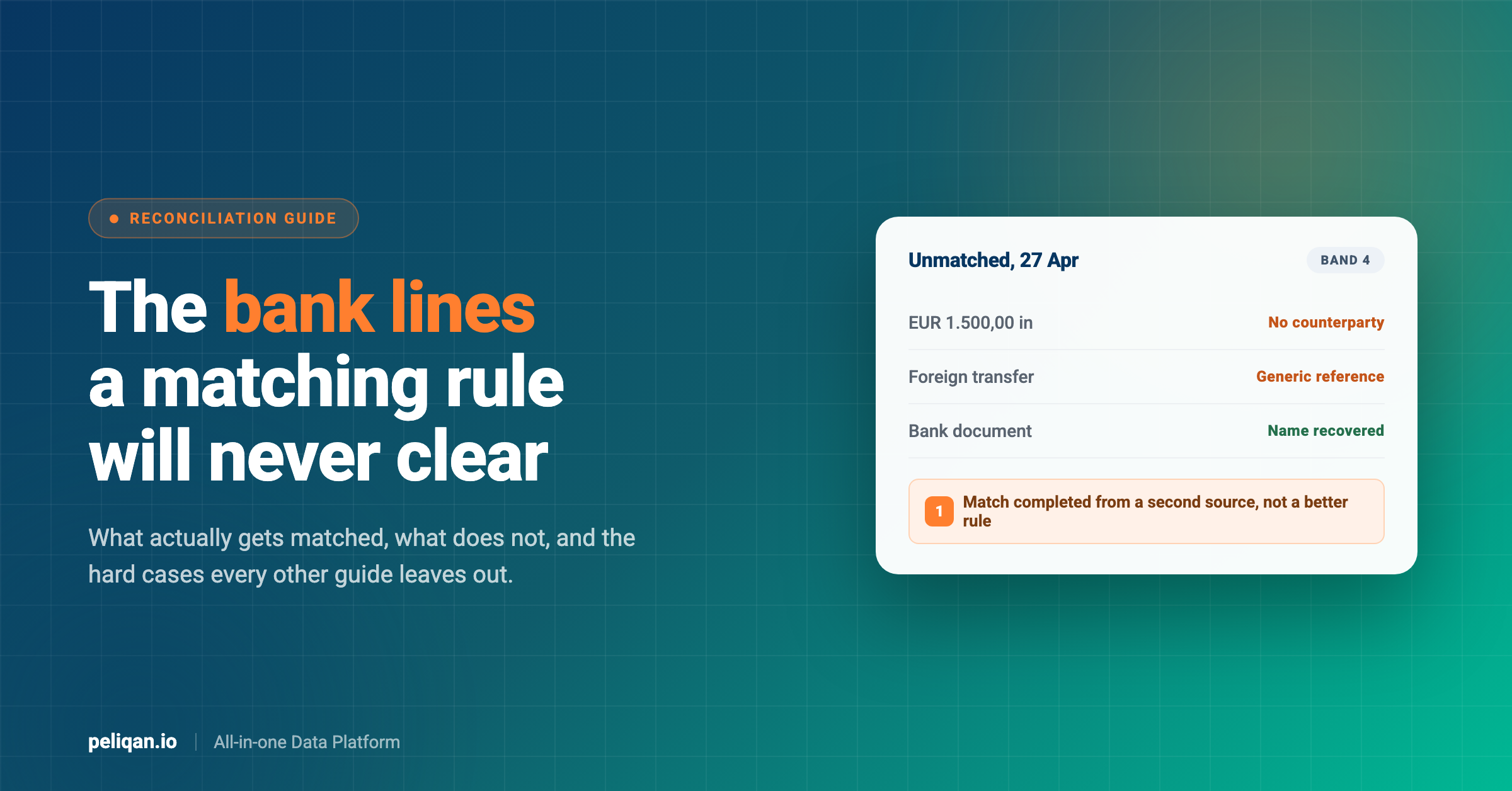
3. Reconcile Stripe revenue against ERP closed invoices, flag mismatches over €5k
Payments and accounting drift constantly. As a result, monthly close requires a reconciliation pass. AI agents can run that pass weekly instead, with the audit trail every CFO needs for the next external audit cycle.
4. Which Peppol invoices have not been acknowledged within 48 hours?
In Belgium since January 2026 and France from September 2026, Peppol e-invoicing makes invoice delivery a regulated activity. Therefore, the CFO needs visibility on which invoices were transmitted, acknowledged, or rejected. Otherwise, late acknowledgements compound into cash-flow problems.
5. Forecast 13-week cash flow with current AR ageing and projected AP
Cash forecasting drives every other finance decision. Indeed, in PE-backed groups it drives most board conversations. The MCP-readable warehouse lets the agent pull AR ageing from the ERP, projected AP from the procurement system, and current bank positions in one query.
6. Detect journal entry anomalies more than 2 standard deviations from baseline
Anomaly detection is a real-world fraud control. Moreover, it satisfies several control objectives under SOC 2 and the EU AI Act audit-log obligations at the same time. The pattern is straightforward: agent reads the journal entries, computes the baseline, surfaces the outliers, logs every step.
7. Generate the SOC 2 evidence package for this quarter’s controls
This is the question that closes the loop. Specifically, the same audit log the agent produced answering the previous six questions feeds the SOC 2 evidence pack. Consequently, the work the CFO did to deploy AI agents pays for itself at the next SOC 2 renewal.
What architecture lets one MCP server answer all seven
The questions above share three features. First, each spans multiple systems. Second, each needs a real query surface, not workflow calls. Third, each demands an audit log that survives external review.
That combination rules out per-API MCPs because they can’t join across systems. It rules out workflow MCPs because they don’t have a query surface. Furthermore, it rules out unified-API MCPs because their flattened schemas lose ERP and banking depth. Only the warehouse-first pattern, covered in detail in the cross-source MCP cornerstone, answers all three requirements. The architectural alternative is documented in the Apideck MCP alternative comparison for buyers weighing unified-API patterns against warehouse-first.
What the EU CFO needs from an MCP server
None of these requirements is theoretical. In fact, each one maps to a concrete artefact the CFO has to produce at the next audit or board meeting.
Decision framework by CFO sub-segment
The right MCP architecture varies by company size, geography, and structure. Specifically, four CFO sub-segments emerge from the EU buying motion in 2026.
Solo CFO at €5M to €20M ARR SaaS
Typical stack: Exact Online plus Stripe plus one CRM. For this CFO, MCP unlocks weekly cash and revenue reconciliation in a single prompt. Moreover, it replaces the manual Friday-afternoon report-builder cycle the FP&A intern usually runs.
PE-backed mid-market CFO at €20M to €200M
Typical stack: NetSuite multi-subsidiary, Salesforce, Stripe, plus subsidiary-specific ERPs. Here MCP unlocks board-grade consolidation, intercompany reconciliation, and 13-week cash forecasting across the group. Furthermore, the audit log feeds the quarterly PE board pack.
Belgian, Dutch, or French CFO with accountancy firm relationship
Typical stack: Exact Online, AFAS, Yuki, Silverfin, Billit Peppol. For this CFO, MCP unlocks cross-client reporting, multi-entity consolidation, and Peppol delivery monitoring. The AFAS AI surface preserves the Get-Connectors that horizontal unified APIs flatten away.
UK accountancy partner running Xero practice-wide
Typical scope: 200+ clients on Xero plus MTD-ITSA reporting obligations. Here MCP unlocks pre-submission compliance across the entire practice. As a result, accountants can review exceptions instead of reading every return manually.
Group CFO or treasurer across multi-entity, multi-FX
Typical stack: multiple banking partners, multiple ERPs, multi-currency exposure. Therefore, this CFO needs 13-week cash forecasting across the group with FX conversion materialised in the warehouse. The federated query engine covered in the SQL on anything help doc handles this without copying data.
How named competitors fit the EU CFO buyer
The 2026 vendor landscape for the office of the CFO splits into seven categories. Crucially, none of them is the right answer for every CFO. However, each fits a specific job.
The honest pattern: vendor-native MCPs solve in-vendor jobs. Spend-management AI tools solve spend jobs. Enterprise iPaaS solves enterprise IT integration. However, only the warehouse-first pattern solves the cross-source CFO question. That is the architectural slot the persona post lives in.
How HPE’s CFO frames the operating-model shift
HPE’s CFO Marie Myers offers a useful frame. Specifically, the team built a tool internally nicknamed “Alfred” with Deloitte, branded externally as CFO Insights. Furthermore, that tool cuts financial reporting cycles by about 40%. The strategic insight underneath: stop treating AI as a feature to add to existing reports. Instead, treat it as the substrate on which the next generation of finance operating models gets built.
The same shift applies in EU mid-market. Indeed, the path from “manual report builder” to “AI-assisted financial intelligence office” is not 7 point tools stitched together. Rather, it is one MCP layer reading from one warehouse that holds every connected system. From there, the agent can answer any cross-source question the CFO asks.
Three real workflows that compound for the EU CFO
Beyond the seven questions, three repeatable workflows show up across every EU CFO conversation in 2026. Each one runs weekly or monthly. Moreover, each one pays back the MCP investment many times over.
Weekly cash and revenue reconciliation pass
Every Monday morning, the FP&A team used to spend two to four hours pulling bank balances, ledger positions, and Stripe payouts into a single spreadsheet. With one MCP query, the agent does this in seconds. Furthermore, the agent flags any mismatch above the threshold the CFO sets. As a result, the time saved compounds across the year into roughly 150 hours of FP&A capacity.
Monthly close acceleration
Month-end close in most EU mid-market companies takes 8 to 12 working days. However, with cross-source SQL running against a warehouse, several close steps move from manual to automated. Specifically, intercompany reconciliation, journal anomaly detection, accruals review, and revenue rec all become single queries instead of multi-spreadsheet processes. Many groups report shaving 2 to 4 days off close as a result.
Quarterly board pack assembly
The board pack is the deliverable that determines whether the next fundraise lands or stalls. Traditionally, the FP&A lead spends a week assembling consolidation, segment views, and variance commentary. However, with the agent reading the warehouse, the data slides drop out in one query each. Then the FP&A lead spends that week on the narrative and the strategic commentary instead. That shift, indeed, is what HPE’s Marie Myers described when she talked about Alfred cutting the reporting cycle by 40%. The same pattern shows up in the Pipedream alternatives buyer’s guide for teams migrating from workflow-first to warehouse-first architecture.
What the EU CFO inherits from DORA, NIS2, and the EU AI Act together
The three regulatory regimes overlap more than most procurement teams realise. Specifically, DORA covers operational resilience for ICT third parties. NIS2 covers essential and important entities including many financial services. Then the EU AI Act adds the deployer obligations for high-risk AI systems on top.
For the EU CFO, the practical consequence is that one procurement review now satisfies three regulatory tracks. First, the sub-processor list satisfies DORA’s ICT third-party risk register. Second, the audit log satisfies NIS2’s incident notification obligation. Third, the same audit log satisfies Article 26 of the EU AI Act. Therefore, the same MCP vendor’s compliance posture answers all three reviews at once. Moreover, the work done for any one of these regulations now pays down the next.
That convergence is the under-discussed reason warehouse-first MCP keeps winning the EU procurement conversation in 2026. Indeed, the unified compliance artefact is what separates platforms that pass one regulatory review from platforms that pass all three.
Compliance posture for the EU CFO procurement checklist
Procurement reviews now include a compliance section that didn’t exist 12 months ago. Specifically, the EU AI Act’s August 2026 deadline means CISOs and DPOs sit at the table from day one. Therefore, the MCP vendor’s posture matters before pricing matters.
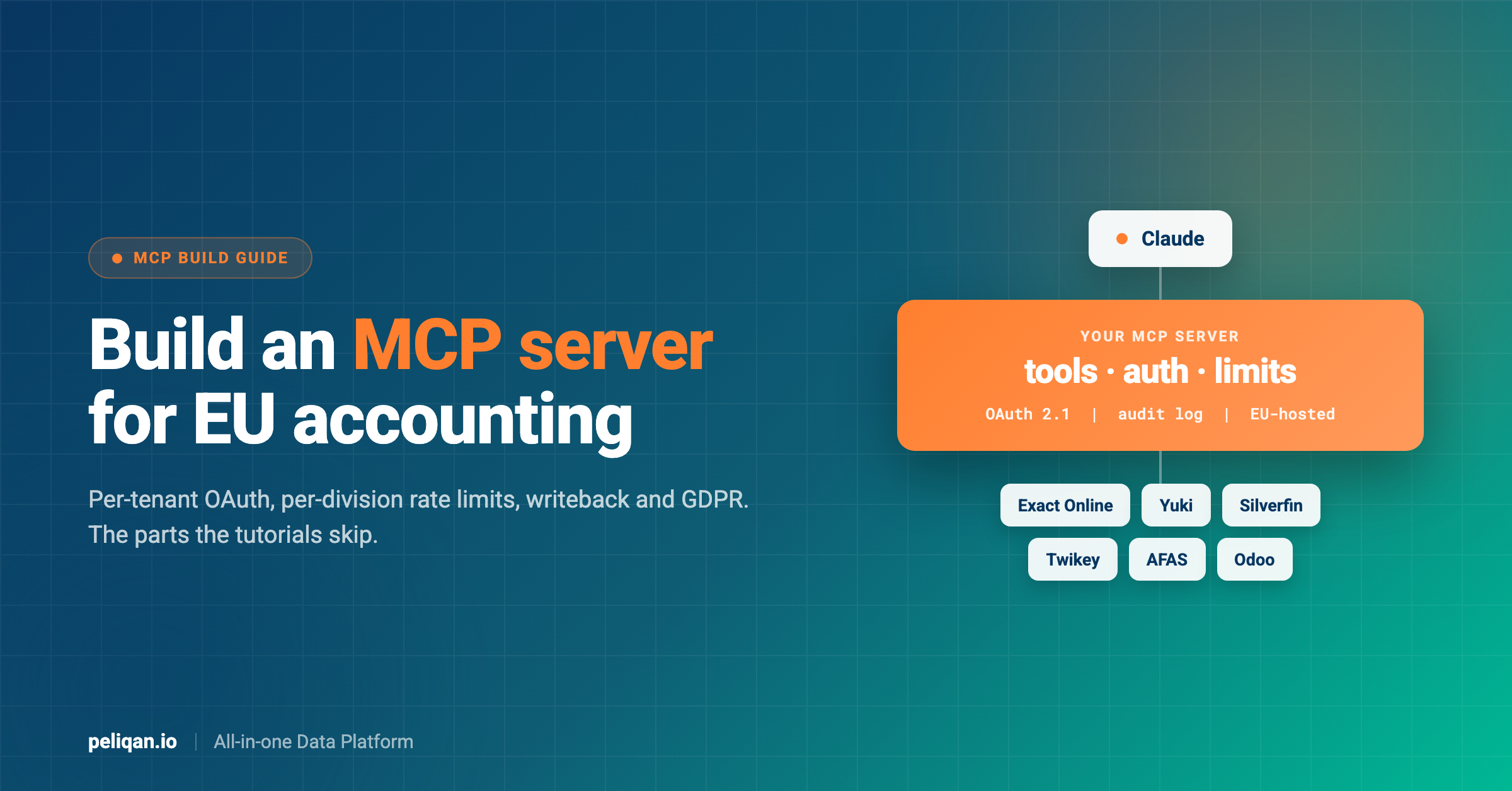
The six procurement questions that map cleanly onto Article 26 sit in the dedicated EU AI Act and MCP compliance breakdown. For the CFO specifically, two of the six matter most. First, the audit log of every prompt and writeback, retained for six months. Second, EU jurisdiction hosting that doesn’t carry CLOUD Act exposure on US-headquartered infrastructure.
Peliqan’s posture answers both natively. The platform is EU-hosted in Belgium, SOC 2 Type II certified, ISO 27001 in progress, with column-level masking shipped by default and audit-logged reverse-ETL writeback. Moreover, the Peliqan Trust Center publishes the SOC 2 report and sub-processor list. That is the procurement-ready posture EU CFOs are asking for.
Real-world example from the EU CFO lane
Real-world example: CIC Hospitality
CIC Hospitality consolidated 50+ data sources into one Peliqan warehouse. As a result, the finance team saves more than 40 hours per month on board reporting. Furthermore, the same audit log that supports the board pack feeds the SOC 2 evidence cycle and the EU AI Act log-retention obligation. Read the full CIC Hospitality case study.
How to get started this quarter
The path from today to August 2, 2026 has three concrete steps. First, list the systems already in the finance stack. Typically that’s an ERP (Odoo, NetSuite, Exact Online, AFAS, Xero, or Business Central), a CRM (Salesforce, HubSpot, Pipedrive, or Teamleader), a payments processor (Stripe), and one or two banking feeds.
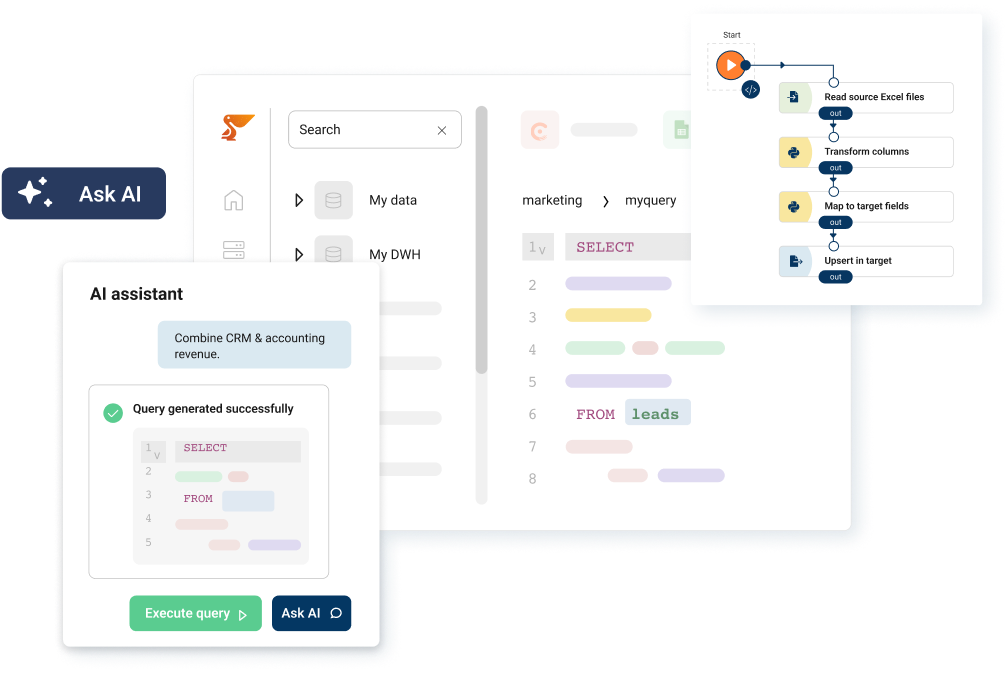
Second, connect those systems to Peliqan and let them sync into the warehouse. The connector layer respects per-source rate limits automatically. Then install the MCP server with pip install mcp-server-peliqan and point your AI client at it. The Claude MCP setup guide covers the client-side configuration.
Third, ask the first cross-source question from the seven above. Usually that’s the consolidated cash position or the customer-risk join. From there, the next six questions roll out over the following weeks. Meanwhile, the audit log accumulates and starts feeding the SOC 2 evidence cycle for the next renewal.
For the platform overview, see the Peliqan platform page. For deeper architectural context on the warehouse beneath, the Postgres MCP guide walks through the Postgres + Trino layer. Likewise, the main MCP product page covers the read-write surface in detail.
The bottom line for the EU CFO in 2026
The CFO role is shifting from report assembler to agentic-operations leader. Indeed, 76% of CFOs are now budgeting for autonomous agents, not copilots. The architectural decision that compounds is not which point tool to buy. Rather, it is which integration pattern to standardise on.
For the EU CFO specifically, the answer points one direction. Warehouse-first MCP, EU-hosted, audit-logged, with per-connector depth across ERP, CRM, payments, banking, and support. That is the substrate every other 2026 finance investment lands on. Moreover, it is the only pattern that answers all seven of the questions in this post inside one Claude session.
The vendor inside the pattern matters less than the pattern. However, the procurement checklist still has to be passed. EU jurisdiction, audit logs, attestations, sub-processor list, column-level masking, granular RBAC. Get those six right, and the CFO is procurement-ready for August 2026 and SOC 2 renewal at the same time. That is the cleanest 2026 EU CFO decision available.