





Apideck launched its MCP server on Product Hunt in May 2026 with 229 tools auto-generated from its OpenAPI spec. The architecture is genuinely elegant for embedded SaaS – but it’s not the right shape for every job. If you’re shopping for an Apideck MCP alternative because you need cross-source SQL, per-connector depth, EU-hosted writeback, or internal RevOps and CFO analytics instead of customer-facing embed, this post compares the eight most credible options on the market and shows which architectural pattern fits which job.
Apideck is a strong product. Belgian-rooted, $7.5M Series A from Airbridge Equity Partners and PMV, 150+ connectors across accounting, CRM, HRIS, file storage, and e-commerce, plus a Vault product that handles OAuth and integration UI cleanly. Their May 2026 MCP server post describes how they auto-generated 229 tools from their OpenAPI spec using Speakeasy, then solved the context-window blowup with dynamic tool discovery that drops the initial cost from 25-40K tokens to about 1,300 tokens. The engineering is real.
The architectural ceiling is also real. Unified APIs – the pattern Apideck, Merge, and Finch all share – flatten multiple providers into a single schema, which is the whole point and the whole limitation. The schema is the lowest common denominator across the underlying systems. You can’t write a SQL JOIN across two unified APIs. Per-connector depth is intentionally hidden. And the pass-through architecture means latency is tied to the slowest upstream API. For embedded SaaS that’s fine. For internal CFO analytics across Exact Online, Salesforce, and Stripe, it’s the wrong shape.
This post compares the eight most credible Apideck MCP alternatives in 2026: Peliqan (warehouse-first), Merge (unified API with caching), Unified.to (real-time pass-through), Nango (self-host), Codat (accounting specialist), Workato (enterprise iPaaS), Pipedream (workflow MCP), and Composio (per-toolkit). Each gets a fair-frame “best for” plus a real “watch out” so the choice is yours to make – not ours to sell.
What Apideck is and isn’t
When you’d look beyond Apideck
- You need cross-source SQL JOINs across accounting plus CRM plus payments plus support – unified APIs can’t join across themselves at the SQL layer.
- You need per-connector depth – Exact Online’s 12 divisions, AFAS Get-Connectors, NetSuite’s subsidiary structure – that the lowest-common-denominator schema hides.
- Your use case is internal analytics, RevOps, or finance rather than customer-facing embedded integration.
- You need audit-logged writeback that satisfies SOC 2 evidence and EU AI Act Article 26 deployer obligations across many systems.
- Your buyer is the EU CFO or DPO who wants jurisdiction-level certainty, not “EU region of a US hyperscaler.”
- You want vertical depth in BE/NL accountancy, Odoo partner channel, or hospitality that Apideck’s horizontal unified APIs don’t reach.
1. Peliqan – warehouse-first MCP for cross-source internal analytics
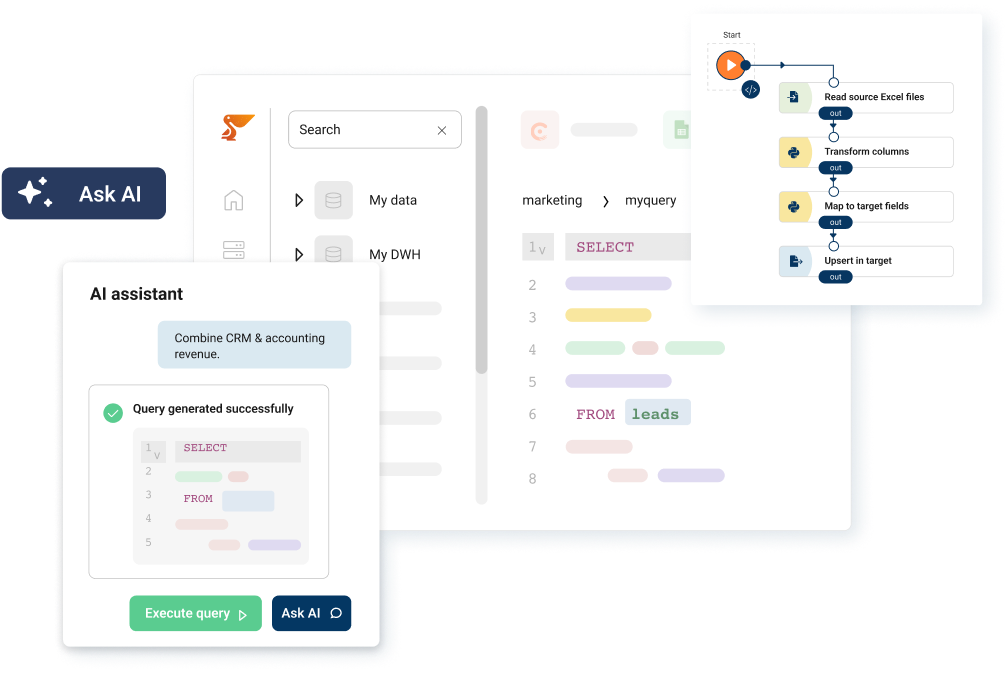
Peliqan is the warehouse-first answer to the Apideck shape. Instead of one unified schema across many providers, Peliqan lands every connector’s data into a Postgres + Trino warehouse in its native schema, then exposes one MCP server that speaks SQL against the whole warehouse. The join happens in a real SQL engine, not in the agent loop, not in a unified-API surface, and not in a workflow runtime. The cross-source SQL cornerstone walks through ten worked examples spanning Exact Online, Salesforce, Stripe, Zendesk, MEWS, AFAS, Yuki, and more.
The product side of the architecture: 250+ connectors with a 48-hour custom-connector SLA, full reverse ETL writeback across every connector, low-code Python + SQL workflows on top, role-based permissions with column-level masking by default, SOC 2 Type II certified, ISO 27001 in progress, EU-hosted in Belgium. Founded by Niko Nelissen and Piet-Michiel Rappelet, who previously sold Blendr.io to Qlik – the team has shipped the warehouse-first integration pattern at scale before.
Best for: EU teams running internal RevOps, finance, and customer-success analytics that need cross-source SQL, audit-logged writeback, and per-connector depth across vertical stacks like Exact Online, Yuki, AFAS, Silverfin, Billit, NetSuite, Xero, MEWS, and Odoo. Also strong for accountancy partners managing multi-client environments through multi-customer management.
Watch out for: Not the cheapest option for pure event-driven automation that doesn’t need analytical depth, and not designed as a customer-facing embedded API surface the way Apideck or Merge are.
Pricing: Fixed pricing from €150/month annual. Hosting: EU-hosted (Belgium). Compliance: SOC 2 Type II, GDPR-native, ISO 27001 in progress, EU AI Act Article 26-ready.
2. Merge – the established unified API with caching
Merge is the largest unified API competitor to Apideck and the first vendor most buyers compare them with. The catalog covers HRIS, accounting, ATS, CRM, ticketing, file storage, and knowledge base – 220+ integrations. The architectural choice that differentiates Merge from Apideck is caching: Merge stores customer data on its own infrastructure with regular polling, where Apideck passes calls through to the source API in real time.
For embedded SaaS builders, the trade-off is fairness around real-time freshness against rate-limit predictability and per-integration cost. Merge charges roughly $65 per linked account per month at the entry tier, which scales with the number of customers you connect. The pricing model rewards mature B2B SaaS with many customer accounts and penalises pre-product-market-fit teams running a long-tail of connections.
Best for: Mid-to-late stage B2B SaaS embedding HRIS, ATS, or accounting connections into their product where polling-based freshness is acceptable and per-account economics work.
Watch out for: Per-account pricing scales fast, no native cross-source SQL JOIN surface, and the same unified-schema flattening as Apideck – per-connector depth is intentionally not exposed.
3. Unified.to – real-time pass-through with no data at rest
Unified.to positions itself directly against Apideck and Merge on the real-time and pricing axis: no data stored at rest, pass-through architecture, transparent pricing, event-driven hooks for systems that emit them. The MCP layer rides on the same real-time pattern, which is useful for applications that can’t tolerate the 15-30 minute polling lag common in cached unified APIs.
The trade-off versus Apideck is essentially feature parity at the unified-API layer combined with a different commercial story. Both share the structural ceiling of unified APIs: no cross-source JOINs across the unified surfaces, schema flattened to the lowest common denominator, vendor-specific depth hidden by design.
Best for: Embedded SaaS builders who need real-time data movement, transparent pricing, and don’t want customer data stored at rest in the integration vendor.
Watch out for: Same unified-API limitations as Apideck for any analytical or cross-source use case; real-time pass-through means rate limits from the slowest upstream API still bottleneck the agent.
4. Nango – run-in-your-cloud integration components
Nango is architecturally different from the other unified APIs on this list. Instead of a managed multi-tenant service, Nango ships deployable components that handle OAuth flows, credential storage, token refresh, rate limit management, and request proxying inside your own cloud environment. You own the operational responsibility and the data path – Nango is the integration framework, not the integration host.
That distinction is important for any deployer with hard data-residency requirements that can’t be satisfied by trusting a vendor’s “EU region” claim. The CLOUD Act conflict that surfaces with US-hosted unified APIs disappears when the integration runtime runs inside your own EU-located cloud account. The cost is operational ownership: you maintain the integration runtime, you pay the cloud bill, and you absorb the vendor-API changes when upstream specs break.
Best for: Engineering teams with serious data-residency or sovereignty requirements who want to own the integration layer in their own cloud and have the headcount to operate it.
Watch out for: Operational ownership is the whole product – if your team isn’t sized to maintain the integration runtime, the savings versus a managed service evaporate quickly.
5. Codat – financial-specialist unified API
Codat is the unified API equivalent of a vertical specialist: deep coverage of accounting, banking, and commerce data sources rather than broad coverage across HRIS, CRM, and ATS. For fintech-adjacent embedded use cases – SMB lending, accounts-payable automation, embedded banking, accounting plug-ins – the depth advantage shows up in fields and endpoints that Apideck’s horizontal Unified Accounting flattens away.
The narrower scope is the entire feature and the entire limitation. If your product needs only accounting and banking depth, Codat is often the right answer. If you need cross-source views that span accounting plus CRM plus payments plus support, Codat doesn’t reach the other domains – and the unified API pattern doesn’t compose across vendors.
Best for: Embedded fintech, SMB-lending, accounts-payable automation, and any product where financial-data depth is the differentiator.
Watch out for: Single-vertical scope – you’ll likely still need a separate solution for CRM, HRIS, or support data.
6. Workato – enterprise iPaaS with Enterprise MCP layer
Workato sits at the top of the enterprise iPaaS market and launched its Enterprise MCP product on October 1, 2025, with a “MCP Monday” weekly cadence that has reached 38+ pre-built MCP servers as of mid-2026. The catalog targets enterprise systems – ZoomInfo, Highspot, Microsoft Teams, Outlook, Notion, Discord, Salesforce, Workday, GitHub, Databricks – and the install model is one-click activation through the Workato console.
The architectural pattern is enterprise iPaaS with a workflow runtime underneath the MCP layer. There’s no warehouse beneath; cross-source analytical SQL isn’t part of the product shape. Pricing reflects the target market – typically six figures annually for the full iPaaS plus MCP bundle. That’s the right answer for the regulated-enterprise buyer with existing Workato investment and the wrong answer for SMB-to-mid-market budgets.
Best for: Enterprise teams already on Workato or other enterprise iPaaS with budget for six-figure annual commitments and a need for integration platform plus MCP under one vendor.
Watch out for: US-hosted (CLOUD Act exposure), no warehouse beneath the MCP layer, and the pricing tier excludes most SMB-to-mid-market teams.
7. Pipedream MCP – workflow-shaped, post-Workday acquisition
Pipedream’s MCP server wraps thousands of API actions into tools that AI agents can call inside event-driven workflows. The architecture is fundamentally workflow-first: each call is a workflow step, each step burns a task on the bill, and the observability shape is “what did this workflow run do” rather than “what data did the analytical question consume.” The November 2025 Workday acquisition shifted Pipedream’s strategic direction toward enterprise Workday-centric agentic work.
For event-driven automation, Pipedream is excellent – “when a Stripe payment fails, post to Slack and update Salesforce” is exactly the shape it was built for. For cross-source analytical queries that need to span thousands of rows in a single JOIN, the per-task economics and the lack of a warehouse layer make Pipedream the wrong tool for the job.
Best for: Event-driven automation, real-time API orchestration, and developer-friendly workflow building with a wide tool catalog.
Watch out for: Post-Workday roadmap is enterprise-Workday-aligned, task-quota economics on every tool call, no analytical layer, US-hosted.
8. Composio – per-toolkit MCPs for dev-tool agent builders
Composio publishes per-toolkit MCP servers covering 500+ tools, with a SOC 2 Type II posture and strong adoption among Cursor and Claude Code developers building dev-tool agents. The architectural pattern is one toolkit per system rather than one unified surface across systems – which means an agent connected to Composio’s Salesforce, Stripe, and HubSpot toolkits has three independent MCP surfaces with no shared schema.
For dev-tool agent workflows (GitHub, Linear, Slack, Notion, Cursor), Composio’s pattern is the right one because the operations are per-system and the agent’s job is sequencing tool calls rather than joining data. For internal RevOps or finance analytics that needs to JOIN across the toolkits, the pattern collapses for the same reason every per-API MCP pattern collapses: the JOIN has to happen in the agent loop, with all the latency, token, and audit-log costs that brings.
Best for: Dev-tool agent builders working in Cursor, Claude Code, or custom IDE agents; per-system workflows where cross-source JOINs aren’t required.
Watch out for: US-hosted, no warehouse, no native cross-source SQL surface, audience-mismatch for CFO and RevOps buyers.
How the eight platforms compare side by side
This matrix is structural, not editorial. Each platform sits where it does because of the architectural choice made at the integration layer – unified-API, real-time, self-host, vertical, iPaaS, workflow, per-toolkit, or warehouse-first. The right choice depends on the job, not on the vendor’s marketing budget.
Use cases side by side
Which platform wins which job
Why Peliqan keeps coming back to the top for cross-source jobs
The pattern is structural, not preferential. Internal RevOps, CFO analytics, customer-success triage, and multi-system reconciliation all share one feature: the question spans more than one system and the answer has to be a single auditable query, not a chain of tool calls. That’s the warehouse-first pattern’s home turf, and the reason it dominates the comparison rows for “cross-source SQL,” “audit log,” and “per-connector depth” in the matrix above.
The architectural details that earn those rows are concrete: 250+ connectors landing into Postgres + Trino, federated query support for SQL on anything via Peliqan’s SQL-on-anything help doc, full reverse ETL writeback through one audited path, role-based access control with column-level masking shipped by default, SOC 2 Type II certification with the report available through the Peliqan Trust Center, and EU-hosted Belgian infrastructure that doesn’t carry CLOUD Act exposure.
For connector-specific depth, the connector pages document each integration’s full coverage – AFAS MCP preserves the Get-Connectors, Exact Online MCP exposes all 12 divisions, the Odoo Claude MCP playbook handles multi-database Odoo partners, and the MEWS MCP playbook covers hospitality multi-property reporting. None of these collapse to a “Unified Accounting” or “Unified CRM” shape because that’s not the job they’re for.
Decision framework: which alternative fits which buyer
The selection question has three honest dimensions: what’s the job, where’s the buyer, and what’s the architectural ceiling you can live with. The matrix below maps each combination to the alternative that fits, without pretending one vendor is the right answer for every column.
A practical decision tree
- Job is embedded SaaS, end-customer-facing integration: Apideck (real-time), Merge (mature), Unified.to (no-storage), Finch (HR specialist), Codat (financial specialist).
- Job is internal RevOps, CFO analytics, cross-source SQL: Peliqan. Warehouse-first is the only pattern that answers this in one query.
- Job is dev-tool agent building (Cursor, Claude Code): Composio.
- Job is event-driven automation: Pipedream or n8n self-host.
- Job is enterprise iPaaS plus MCP under one vendor: Workato.
- Buyer needs absolute data residency: Nango self-host or Peliqan managed EU-hosted.
- Buyer is the EU CFO or DPO under EU AI Act Article 26: Peliqan, with the warehouse-first audit log and EU jurisdiction Article 26 demands.
Real-world example from the warehouse-first lane
Real-world example: OdooExperts
OdooExperts (Rezolv) consolidates reporting and AI workloads across 50+ client Odoo environments through Peliqan’s multi-customer management. Each client’s Odoo instance lands into the same warehouse architecture, exposed through a single MCP server with per-client RBAC – exactly the multi-tenant pattern that’s hard to express through a horizontal unified API. Read the full OdooExperts case study.
The pattern translates outside hospitality and Odoo: CIC Hospitality uses the same warehouse-first MCP architecture for board-grade reporting across 50+ data sources in PMS, payments, and accounting, with 40+ hours per month saved on the manual joins that used to live in spreadsheets. Both case studies sit in the lane where unified APIs structurally can’t reach because the question requires per-connector depth plus cross-source SQL.
Where the market is heading
Three trends matter for the next 12 months of this market. First, the MCP layer is now table stakes – every credible integration vendor has shipped or will ship an MCP server in 2026. Apideck, Merge, Unified.to, Nango, Workato, Pipedream, and Composio all have one. The differentiator is no longer “do you have an MCP” but “what’s the architecture beneath the MCP.”
Second, EU regulatory pressure is reshaping procurement. The EU AI Act’s August 2, 2026 deadline combined with DORA, NIS2, and the looming Cloud and AI Development Act puts a structural premium on EU-headquartered, EU-hosted, audit-logged MCP architecture. US-headquartered vendors hosting “in the EU region” carry CLOUD Act exposure that no SCC or DPA fully resolves.
Third, the analytical vs operational split is hardening. Unified APIs are winning the embedded-SaaS lane. Warehouse-first MCPs are winning the internal-analytics lane. Workflow MCPs are winning the event-driven lane. Per-toolkit MCPs are winning the dev-tool agent lane. The pretence that one architecture serves every job is fading, which is good for buyers because it makes the comparison honest.
The bottom line on Apideck MCP alternatives
Apideck is the right answer for embedded-SaaS builders who want a unified API and an MCP server in one Belgian-rooted vendor. The 229-tool MCP with dynamic discovery is technically elegant and the embedded-product fit is real.
If your job is anything other than embedded SaaS – internal analytics, CFO reporting, multi-system reconciliation, accountancy firm cross-client work, hospitality multi-property reporting, regulated-industry compliance with audit-logged writeback – the warehouse-first pattern wins, and Peliqan is the vendor whose architecture lives there. The cross-source SQL cornerstone walks through ten worked examples that prove the point, and the Peliqan MCP product page covers the read-and-write surface that the analytical layer exposes.
The decision that compounds isn’t between two specific vendors. It’s between two architectural patterns: unified-API horizontal-coverage with flattened schemas, versus warehouse-first vertical-depth with real SQL. Pick the pattern that matches the job your AI agent has to do for the next three years, not the one your product team can demo this week.