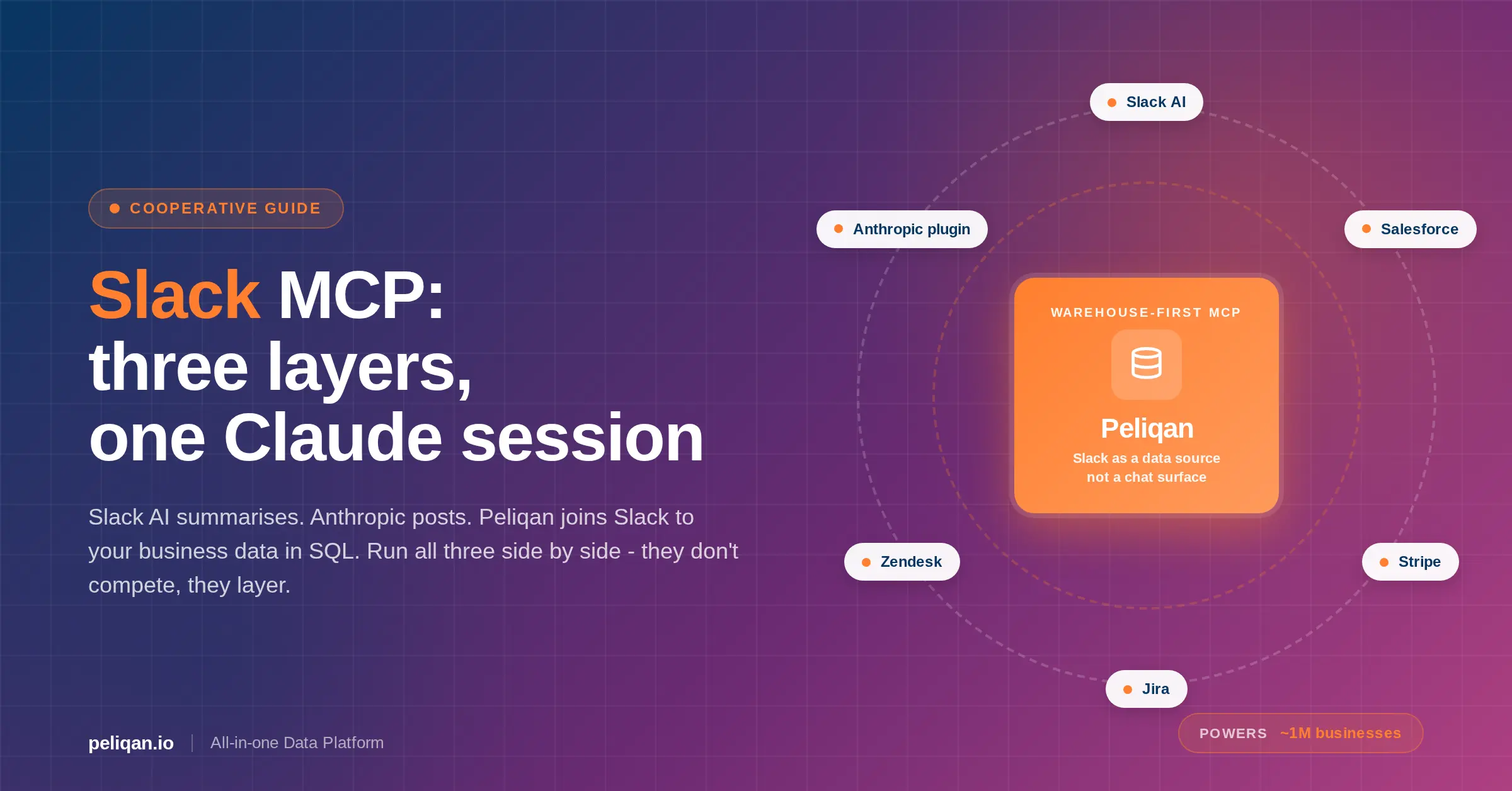


Slack AI summarises your channels. Anthropic’s native Slack integration lets Claude post in Slack. Peliqan’s MCP joins Slack activity to the rest of your business data. Run all three side by side – they don’t compete, they layer. This is the practitioner’s guide to Slack MCP in 2026, covering Slack’s own official MCP server, Anthropic’s Claude Slack plugin, and the warehouse-first cross-source layer that joins Slack signals to Salesforce deals, Stripe revenue, Jira velocity, and Zendesk support volume in one Claude prompt.
“What’s the temperature of the company this morning?” That is the Monday-morning question every founder, CRO, and head of operations actually asks. Specifically, the answer lives across Slack #leadership channel sentiment, Stripe revenue trends, Salesforce pipeline coverage, and Zendesk ticket health. Indeed, no single MCP server answers it alone. However, three MCPs running in one Claude session do.
Slack moved fast in 2024-2026. Specifically, Salesforce acquired Slack for $27.7 billion in 2021 and has driven roughly 2.5x revenue growth since. Furthermore, Slack AI launched in 2024 with summaries, search, and a daily recap digest. Moreover, 30 new AI features rolled out across 2024-2026, including agentic capabilities in Slackbot. As a result, the in-Slack AI experience has matured significantly.
The MCP layer arrived in 2026 through two complementary paths. First, Anthropic published an early reference Slack MCP server (now archived as of May 2025). Then Slack shipped the official Slack MCP server, better-maintained and integrated with Slack’s Real-Time Search API. Furthermore, Anthropic launched Interactive Apps in January 2026, which embed Slack inside the Claude interface for direct message drafting and posting. As a result, Claude can now reach into Slack through three different vendor-blessed paths.
However, none of those three paths answers the cross-source question. Specifically, joining Slack channel activity to Salesforce closed-won deals or Stripe revenue requires a SQL surface beneath. That is the warehouse-first MCP pattern’s home turf, covered in detail in the cross-source MCP cornerstone. This post is the buyer’s guide for running all of these layers together.
What Slack AI does well (and what it doesn’t)
Slack AI shipped in 2024 with three core capabilities. First, Recap delivers a daily morning digest summarising channels the user follows. Second, conversation summaries generate highlights from accessible channels and threads. Third, search uses generative AI to answer natural-language questions against channel content. Furthermore, Slackbot gained agentic capabilities throughout 2024-2026, including the ability to draft messages, schedule meetings, and sift through threads for specific information.
For in-Slack workflows, Slack AI is the right tool. Indeed, “summarise the #engineering channel since Friday” or “what did the team decide about the pricing change?” returns useful answers without leaving Slack. Moreover, the AI features are now included with all paid plans (no separate add-on required as of the 2024 update).
The architectural ceiling is the same one every vendor-native AI hits. Specifically, Slack AI speaks Slack and only Slack. The moment a question crosses into “did the deals we celebrated in #sales-wins actually close in Salesforce?” or “did the #cs-escalations chatter correlate with Stripe payment failures?” Slack AI cannot reach. That is not a flaw; it is the design.
Anthropic’s native Slack integration: what it adds
Anthropic shipped the Slack MCP server through Slack’s official channel and added Interactive Apps for Slack in January 2026. Specifically, the Slack plugin connects Claude Cowork to your Slack workspace, allowing Claude to search messages, retrieve threads, draft updates, and post directly without tab-switching. Furthermore, Interactive Apps embed the Slack interface inside Claude for live preview and posting.
For Claude users who want to read and write Slack content from inside Claude, this is excellent. Moreover, the official Slack MCP server is aligned with Slack’s permission and enterprise-key-management model, so the procurement and compliance teams approve it more easily than third-party MCP wrappers. Indeed, this is the “Claude as a Slack agent” use case, fully blessed by both vendors.
However, the architectural pattern is still “Claude reads and writes in Slack.” It is not “Claude joins Slack data to your CRM and payments data and product analytics in one query.” That is a different job and a different architecture.
The cross-source job neither native path can reach
Five questions that drive operating decisions in 2026 span Slack plus everything else. None is answerable inside Slack AI alone, and none works through Anthropic’s native Slack integration alone either. Indeed, each requires SQL JOINs across at least two systems with consistent identity and a single audit log.
“Which deals in our Salesforce closed-won pipeline last 30 days had high message density in #sales-wins, and which closed silently?” This is the signal-mining question.
“Which Zendesk Sev-1 tickets came from customers also mentioned in #cs-escalations, ranked by Stripe ARR?” This is the customer-risk question.
“Did engineering velocity slip last sprint? Compare Slack #engineering message density to Jira ticket throughput to GitHub PR merge rate.” This is the velocity tracking question.
“Which Slack Connect partner channels are active versus cold, and which correlate with Pipedrive deal stage?” This is the partner-channel question.
“What is the temperature of the company this morning? Cross-reference #leadership sentiment with Stripe revenue, Salesforce pipeline, and Zendesk ticket trends.” This is the founder dashboard question.
None of these is a Slack question. Furthermore, none of them is a Claude-in-Slack question either. Specifically, the JOIN happens across vendors, and the answer needs a SQL surface beneath both Slack and the other systems.
How Peliqan adds the warehouse layer beneath both native paths
Peliqan reads Slack as a data source, not as a chat surface. Specifically, the connector ingests channel messages, channel metadata, member activity, and Slack Connect external channel events into a Postgres + Trino warehouse. Furthermore, the same warehouse holds Salesforce, Stripe, HubSpot, Jira, Zendesk, Pipedrive, and 240+ other connectors. As a result, the cross-source SQL JOIN happens in real query time, not in the agent’s reasoning loop.
Slack through Peliqan’s MCP, end to end
This is the cooperative MCP pattern the Notion playbook introduced. Specifically, two or three MCPs run in one Claude session and each one handles the job it was designed for. Slack’s official MCP handles the Slack chat surface. Peliqan’s MCP handles the cross-source SQL surface. Anthropic’s plugin handles the in-Claude Slack interactive experience. The architectures don’t compete – they layer.
Five Slack MCP use cases that need cross-source SQL
1. Sales-Slack signal mining
The question: which closed-won deals last 30 days had peer-celebrated wins in #sales-wins (high signal) versus silent closes? Specifically, the agent joins Slack message events filtered to the channel against Salesforce closed-won deals. Then it ranks by the correlation. As a result, the head of sales gets a real read on team-culture-driven wins versus quiet pipeline closes.
2. Customer-success Slack triage
The question: which Slack #cs-escalations correlate with Zendesk Sev-1 tickets and Stripe top-100 customer status? Specifically, the agent joins Slack channel activity to Zendesk ticket priority and Stripe revenue rank. Then it surfaces escalations from customers where MRR is at risk. Moreover, this is the cross-source pattern that turns CS noise into actionable signal.
3. Engineering velocity tracking
The question: did engineering velocity drop last sprint? Specifically, the agent joins Slack #engineering message density to Jira ticket throughput to GitHub PR merge rate. Then it surfaces velocity drops before the sprint review. Furthermore, the multi-source signal is more reliable than any single metric. As a result, the engineering manager catches the dip before standup, not at the retro.
4. Cross-org partner channel monitoring
The question: which Slack Connect external partner channels are active versus cold? Specifically, the agent joins Slack Connect channel activity (with proper permissions) to Pipedrive deal stage to shared-account ARR. Then it surfaces partner relationships where chatter is up but deal progression is down. Indeed, this is the standing partner-management question that has never had a good answer.
5. Founder dashboard
The question: what is the temperature of the company this morning? Specifically, the agent reads sentiment of Slack #leadership channel, cross-references Stripe revenue, Salesforce pipeline, and Zendesk ticket trends. As a result, the founder gets a single Monday-morning prompt that ladders into the EU CFO persona post. Furthermore, this is the prompt that compresses three hours of dashboard scanning into one Claude response.
Six Slack MCP options compared
The honest summary: Slack AI and Anthropic’s native Slack plugin win the in-Slack lane. Composio and Pipedream cover dev-tool and workflow lanes respectively. However, only Peliqan reads Slack as a data source and joins it to the rest of your business stack in one SQL query. As a result, the cleanest 2026 Slack stack runs all three patterns side by side rather than picking one. The fuller comparison context sits in the Composio + Pipedream + Peliqan MCP comparison and the best MCP server listicle.
Slack API rate limits to plan around
Three constraints matter most. First, the Web API uses four rate-limit tiers. Specifically, Tier 1 methods accept roughly 1+ request per minute (some posting operations). Furthermore, Tier 2 accepts 20+ per minute, Tier 3 accepts 50+ per minute, and Tier 4 accepts 100+ per minute for most read operations. Moreover, Slack introduced per-workspace per-method limits in 2024 to tighten high-volume access.
Second, the Events API caps at 30,000 events per workspace per app per 60 minutes. As a result, busy workspaces can hit the cap during peak hours. Specifically, Slack sends an app_rate_limited event when the cap triggers, with details on the workspace and timestamp. Furthermore, the right pattern for high-volume ingestion is Socket Mode plus selective event subscriptions.
Third, the 429 response includes a Retry-After header. Therefore, the consumer must back off for the indicated seconds before retrying. Peliqan’s Slack connector respects all three constraints automatically. As a result, the warehouse stays current without saturating Slack’s rate limits even on workspaces with millions of monthly messages.
Compliance posture for hybrid US-EU teams
Many modern companies run Slack as the primary collaboration surface across US and EU teams simultaneously. Indeed, Slack Connect external channels add a layer of complexity because partner data crosses organisational boundaries. Furthermore, the EU AI Act Article 26 deployer obligations on August 2, 2026 apply to any AI agent reading or acting on Slack data in regulated contexts.
For EU companies specifically, the procurement question splits into two parts. First, Slack itself is hosted in Salesforce regions, which carry CLOUD Act exposure for the underlying chat data. Second, the cross-source analytical layer needs EU jurisdiction to satisfy Article 26 audit-log obligations and DORA’s six-month log retention. As a result, the warehouse-first MCP layer beneath needs an EU-hosted answer.
Peliqan ships EU-hosted infrastructure in Belgium, SOC 2 Type II certified, ISO 27001 in progress, with column-level masking and audit-logged reverse ETL by default. Furthermore, the procurement checklist mapping Article 26 obligations sits in the EU AI Act and MCP compliance guide. Likewise, the broader GDPR umbrella sits in the GDPR-compliant MCP servers pillar.
ICP: who Slack MCP plus Peliqan is built for
Three buyer profiles dominate this conversation. First, SaaS RevOps and CS leaders running a Slack-native operating model. Second, engineering managers tracking velocity through Slack message density alongside Jira and GitHub. Third, EU companies with hybrid US-EU teams using Slack Connect for cross-org collaboration.
For SaaS RevOps, the value is signal mining across Slack chatter and CRM data. Specifically, “did the deals we celebrated in #sales-wins actually close?” is a real question that no single tool answers.
For engineering managers, the value is multi-source velocity tracking. Moreover, the cross-link between team activity (Slack), task throughput (Jira), and code velocity (GitHub) catches the velocity dip earlier than any single metric.
For founders running a Slack-native operating model, the value is the morning dashboard prompt. Indeed, “what’s the temperature of the company this morning?” is the question every founder wants answered without scanning four dashboards.
Peliqan’s pricing is fixed from €150/month annual (€1,800/year). Moreover, the platform includes 250+ connectors, the Postgres + Trino warehouse, reverse ETL, and the MCP server in one bundle. Therefore, the Slack MCP capability does not add to the bill on top of the base subscription.
Real-world example from the multi-source signal lane
Real-world example: CIC Hospitality
CIC Hospitality consolidated 50+ data sources into Peliqan’s warehouse, saving more than 40 hours per month on board reporting. Furthermore, the same cross-source pattern works for joining Slack property-team chatter to PMS occupancy data and Stripe folio revenue. As a result, the property GM gets a single morning prompt covering operational health across every system. Read the full CIC Hospitality case study.
A 60-day rollout plan for Slack MCP plus Peliqan
Most teams can deploy a working cross-source Slack MCP setup inside 60 days. The plan breaks into three phases.
First, install Slack’s official MCP server plus Anthropic’s Slack plugin for the in-Slack and Claude-in-Slack lanes. Furthermore, configure the workspace permissions and enterprise key management per Slack’s documentation. As a result, the in-Slack agent experience is live within the first two weeks.
Second, connect Salesforce, Stripe, Zendesk, and the relevant CRM (HubSpot, Pipedrive, or Teamleader) to Peliqan. Then add Slack as a data source through the same connector workspace. Specifically, the Slack ingestion uses Web API and Events API together to balance freshness and rate limits.
Third, install the Peliqan MCP server with pip install mcp-server-peliqan and point Claude at it alongside the existing Slack and Anthropic MCPs. Then run the first three cross-source queries from the use case list above. Indeed, the founder dashboard query usually reveals at least one operational signal the team did not see in the dashboards.
How this connects to the broader Peliqan MCP cluster
The Slack MCP story is the second cooperative-architecture post in the Peliqan cluster. Indeed, the first was the Notion MCP playbook, which introduced the pattern of three MCPs running side by side in one Claude session. Furthermore, the Zendesk MCP playbook published recently covers the customer-success angle of the same warehouse-first architecture.
For the platform foundations, the main Peliqan MCP page covers the connector library and read-write surface. The cooperative pattern itself – Slack AI plus Anthropic plugin plus Peliqan warehouse-first – is the natural sibling to the Notion three-MCP setup.
The bottom line on Slack MCP
Slack AI summarises your channels. Anthropic’s native Slack integration lets Claude post in Slack. Peliqan’s MCP joins Slack activity to the rest of your business data. Run all three side by side. They don’t compete. They layer.
For the in-Slack lane (summaries, recaps, search), use Slack AI. For the Claude-in-Slack lane (Claude draft, preview, post), use Anthropic’s official Slack plugin. For the cross-source analytical lane (Slack signals plus CRM plus payments plus support plus product analytics in one SQL JOIN), use Peliqan’s warehouse-first MCP.
The architectural choice that compounds for the next three years is not which Slack MCP to pick. Specifically, it is whether you have a warehouse layer beneath the Slack chat surface that can answer the cross-source questions Slack alone cannot. For EU teams under Article 26 and DORA pressure, that layer needs to be EU-hosted, SOC 2 Type II, and audit-logged. That is the procurement decision that turns Slack from a chat tool into a data source for the next generation of agentic work.