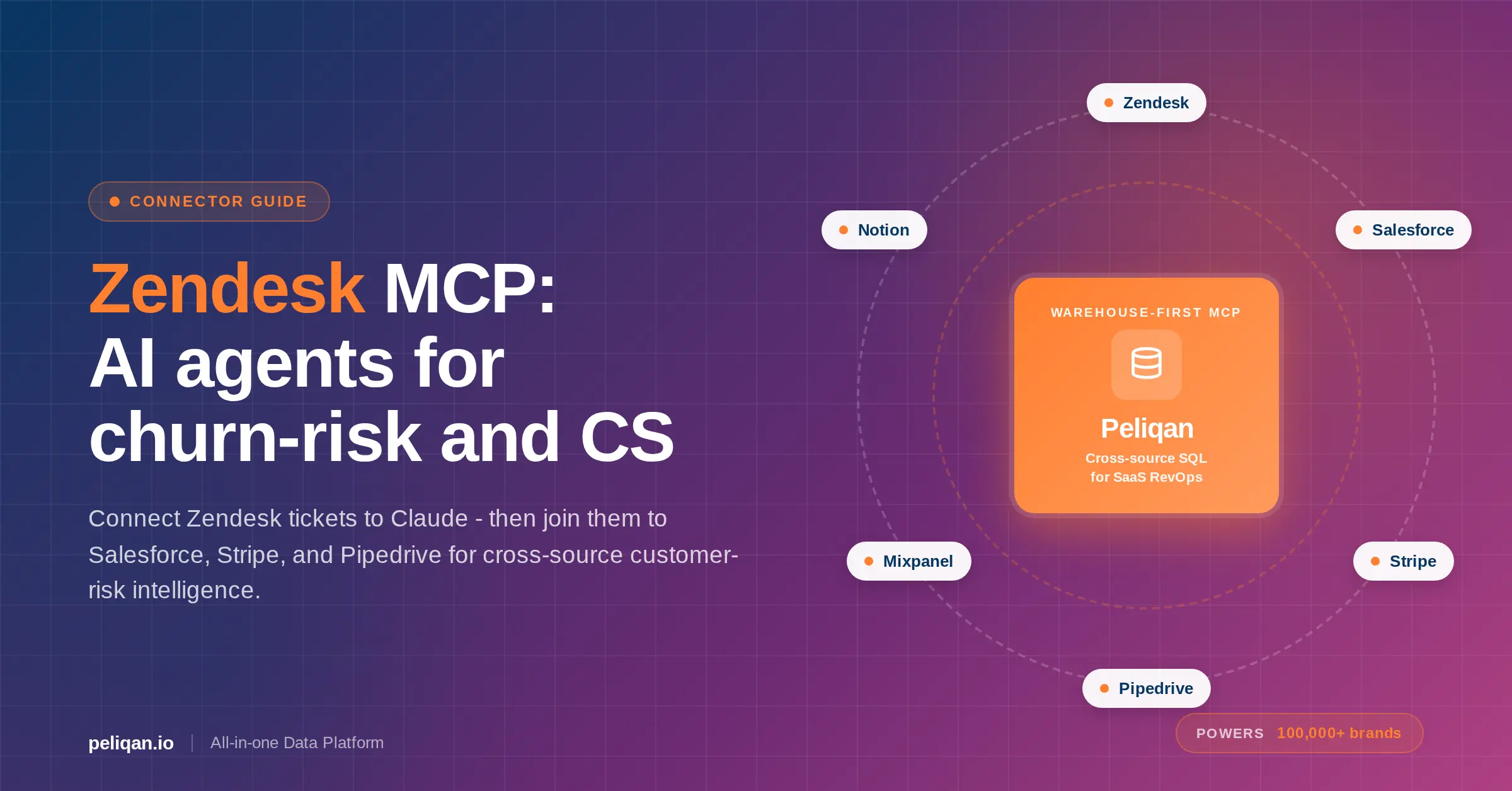





Zendesk MCP is the integration layer that connects Claude and other AI agents to Zendesk ticket, organisation, user, and macro data. Furthermore, multiple Zendesk MCP servers shipped in 2025 and 2026, including the free Swifteq build, the Composio Zendesk toolkit, and Speakeasy-generated options. However, Zendesk’s own native AI (Advanced AI with Intelligent Triage and Smart Assist) stays inside Zendesk. The harder cross-source question – “which top-100 customers have BOTH overdue Stripe payments AND open Sev-1 Zendesk tickets?” – needs the warehouse-first MCP pattern. This guide covers both layers and the procurement decisions for SaaS RevOps teams in 2026k
Zendesk sits at the centre of the customer support stack for 100,000+ brands. Indeed, the company was acquired by Hellman & Friedman, Permira, ADIA, and GIC in November 2022 for $10.2 billion, valuing it at $77.50 per share. Moreover, Zendesk reported $416.9 million in Q3 2022 revenue (its last public quarter), up 20% year-over-year. Today, Zendesk operates as a private company with continued investment in agentic AI capabilities through the Advanced AI add-on.
The MCP ecosystem around Zendesk is now genuinely mature. For example, Swifteq’s MCP Server is free and listed in the Zendesk Marketplace. Composio publishes a Zendesk MCP toolkit. Furthermore, Speakeasy-generated MCP servers cover Zendesk’s full API surface. As a result, the in-Zendesk agent capability is widely available and ready to deploy.
However, the cross-source job remains unsolved by any single vendor. Specifically, customer-success and RevOps teams need Claude to join Zendesk tickets to Salesforce account tier, Stripe payment health, Pipedrive renewal stage, and product usage data in one query. That is the warehouse-first pattern’s home turf. The full architectural case sits in the cross-source MCP cornerstone.
What Zendesk does in 2026
Zendesk’s product spans seven surfaces that share the same customer data layer. Specifically, Support handles tickets across email, chat, voice, and messaging. Guide manages help-centre content. Sell is the CRM. Chat handles real-time conversation. Talk is the voice channel. Furthermore, Explore provides analytics. Finally, Advanced AI adds generative agent capability on top of everything.
For the 2026 RevOps buyer, three things matter most. First, the customer base is large. Zendesk connects 100,000+ brands with hundreds of millions of customers globally. Second, the integration surface is broad. Zendesk has thousands of marketplace apps and a well-documented REST API. Third, the AI strategy is real. Indeed, Zendesk was one of the first companies to access OpenAI’s European endpoints, enabling generative AI for EU customers with EU data residency.
Zendesk’s native AI: what Advanced AI and Resolution Bot do
Zendesk’s Advanced AI add-on includes three core capabilities. Specifically, Intelligent Triage automatically classifies incoming tickets by intent, sentiment, and language, then routes them to the right queue based on those signals. Furthermore, Smart Assist provides agents with a sidebar suggesting macros, related articles, and similar past tickets while they type. Finally, generative response drafting uses the help-centre content and one-click generation for email or chat replies with tone adjustment.
The pricing model shifted in 2024 from monthly active users to automated resolutions. Specifically, customers pay per AI-resolved ticket rather than per chatbot conversation. Suite Professional costs $115 per agent per month. Suite Enterprise costs $169 per agent per month. Furthermore, the Advanced AI add-on costs $50 per agent per month on top of the base subscription, with a minimum of 5 agents.
For in-Zendesk agent work, the native Advanced AI plus a Zendesk MCP server is genuinely good. Indeed, ticket triage, response drafting, and macro orchestration are all real Zendesk strengths. However, the architectural ceiling is the same one every vendor-native MCP hits: it speaks Zendesk and only Zendesk.
The cross-source customer success job Zendesk AI cannot reach
The questions that determine retention and renewal in SaaS span Zendesk plus everything else. For example, here are five representative cross-source questions:
“Show me the top-100 customers by ARR with at least one open Sev-1 Zendesk ticket AND at least one Stripe payment failure in the last 30 days.” This is the customer-risk question. Specifically, it joins Zendesk priority + status, Salesforce ARR, and Stripe payment health.
“Which renewal-stage Pipedrive deals have rising Zendesk ticket counts in the last 60 days?” This is the renewal-risk question. It joins Pipedrive deal stage to Zendesk ticket volume per organisation.
“For each Zendesk ticket category, which Notion runbook should the agent retrieve first?” This is the cooperative AI question. Indeed, Zendesk ticket data plus Notion runbook retrieval is exactly the kind of multi-MCP composition that benefits from the warehouse layer beneath.
“For multi-product customers, which features show low Mixpanel adoption AND high Zendesk ticket volume?” This is the product-CS question. Specifically, low adoption plus high ticket volume signals onboarding gaps that the CS team can intervene on.
“When a Stripe Dispute opens, did Zendesk get a corresponding Sev-2 ticket, and is the Salesforce account flagged appropriately?” This is the dispute-cascade question. Furthermore, it lives at the edge of fraud and CS, which is exactly where AI agents add the most value.
None of these is answerable inside Zendesk’s native MCP alone. Furthermore, none works through a per-API MCP stack, a workflow MCP, or a unified-API MCP. Each requires SQL JOINs across at least two systems with consistent customer identity and a single audit log.
How Peliqan turns Zendesk into a cross-source MCP surface
Peliqan syncs Zendesk data into a Postgres + Trino warehouse alongside 250+ other connectors. Specifically, the warehouse holds tickets, users, organisations, macros, triggers, and webhook events in their native Zendesk schema. Moreover, Peliqan respects Zendesk’s per-account rate limits during ingestion. As a result, the warehouse stays current without tripping the 100 to 2,500 requests-per-minute boundary.
Zendesk through Peliqan’s MCP, end to end
Set-up is the standard motion. First, generate a Zendesk API token from the admin centre. Then add Zendesk as a connector through the Peliqan workspace and select which tables to sync. Finally, install the MCP server with pip install mcp-server-peliqan and point Claude at the endpoint. The full setup guide sits in the Claude MCP setup walk-through.
Five Zendesk MCP use cases that need cross-source SQL
Each use case below is one Claude prompt, one SQL statement, and one audit log entry. Moreover, every one names another system in the JOIN. That is the cross-source pattern in action.
1. Top-100 customer churn-risk
The standing CS leadership question: which customers are quietly leaving? Specifically, the agent joins Zendesk Sev-1 ticket counts to Salesforce ACV to Stripe payment failures in the last 30 days. Then it surfaces the customers where all three signals fire at once. As a result, the CS team gets a prioritised intervention list before the renewal window closes. Indeed, this is the same triangulation pattern the MCP for the EU CFO playbook covers from the finance angle.
2. Renewal-risk triage
The standing RevOps question: which renewal-stage Pipedrive deals are at risk? Specifically, the agent joins Pipedrive renewal stage to Zendesk ticket count over the last 60 days to Stripe MRR change. Then it flags any deal where ticket volume is rising while MRR is declining. As a result, the AE and CSM get the same risk list at the same time.
3. CS playbook routing with Notion
The agent productivity question: when a high-priority ticket arrives, which internal runbook applies? Specifically, the Zendesk ticket category triggers a Notion runbook retrieval through the warehouse. Furthermore, the runbook content lands in the agent’s context window alongside the ticket details. As a result, the human agent gets the relevant macro plus the deeper procedural knowledge in one place.
4. Multi-product CS view with product analytics
The product-CS question: for multi-product customers, which features show low adoption AND high ticket volume? Specifically, the agent joins Mixpanel product usage to Zendesk ticket category. Then it flags features where the support load is high but the product adoption is low. Moreover, this is the onboarding gap analysis that prevents the same ticket from arriving 50 times a month.
5. Dispute to CS cascade
The fraud-and-CS edge case: when a Stripe Dispute opens, did the system create the right downstream actions? Specifically, the agent joins Stripe dispute events to Zendesk ticket creation logs to Salesforce account flag changes. Then it surfaces any dispute where the downstream cascade didn’t fire correctly. Furthermore, this is one of those cross-source questions that lives at the intersection of finance and CS, exactly where AI agents add disproportionate value.
Six Zendesk MCP options compared
The honest summary: Zendesk’s Advanced AI plus Swifteq or Composio MCP servers win for in-Zendesk agent work. Pipedream wins for event-driven Zendesk automation. However, only Peliqan answers the cross-source churn-risk question in one SQL query with audit-logged writeback. As a result, RevOps and CS leaders typically run Zendesk’s Advanced AI plus Peliqan’s MCP together.
Zendesk API rate limits to plan around
Three API constraints matter most for an MCP rollout. First, the per-account rate limit varies by plan. Specifically, Suite Professional accounts get roughly 100 requests per minute by default. Furthermore, the High Volume API add-on raises this to 2,500 requests per minute on qualifying plans. The Advanced AI add-on can also be considered when evaluating the broader API capabilities and requirements. Without the add-on, a chatty agent can saturate the limit fast on busy accounts.
Second, the Update Ticket endpoint has its own constraint. Specifically, each ticket can receive 30 updates per 10 minutes per user, plus an account-wide cap of 100 requests per minute (300 with High Volume). As a result, automated ticket updates need to be batched carefully.
Third, Webhooks are the right pattern for real-time events. Indeed, Zendesk’s Webhook API notifies your system when tickets are created, updated, or solved without polling. Moreover, this eliminates most of the rate-limit pressure for event-driven workflows. Peliqan’s connector uses Webhooks for real-time updates plus periodic full syncs for historical depth.
Compliance posture for EU data residency and Article 26
Zendesk supports EU data residency on Suite Enterprise plans. Furthermore, the company was one of the first to access OpenAI’s European endpoints for generative AI features. As a result, EU customers can deploy Zendesk’s Advanced AI without the data leaving European jurisdiction.
However, the cross-source layer matters more for full compliance posture. Specifically, the moment Zendesk data joins to Salesforce, Stripe, Pipedrive, or other systems, the unified audit log and jurisdiction posture must span all of them. Peliqan handles this through EU-hosted infrastructure in Belgium, SOC 2 Type II certification, column-level masking by default, and audit-logged reverse ETL writeback. The Peliqan Trust Center publishes the SOC 2 report and the sub-processor list.
This posture extends beyond hosting. Zendesk publishes a dedicated AI trust framework documenting how its customer service AI handles data, applies transparency, and keeps human oversight in the loop, and it holds ISO 42001 certification for AI management systems. For deployers, that means the in-Zendesk agent layer arrives with documented governance controls, the same evidence trail Article 26 and SOC 2 reviews ask for.
For deployers planning around the August 2, 2026 deadline, the procurement checklist for the full cross-source CS stack maps directly onto Article 26 deployer obligations. The full breakdown sits in the EU AI Act and MCP compliance guide. Indeed, the same audit log that supports SOC 2 evidence also satisfies the six-month log retention requirement under Article 26.
ICP: who Zendesk MCP plus Peliqan is built for
Three buyer profiles dominate this conversation in 2026. First, SaaS RevOps teams running Zendesk plus Salesforce plus Stripe at $5M to $100M ARR. Second, EU SaaS scale-ups with GDPR-sensitive customer data. Third, customer-success leaders who need cross-source churn-risk intelligence rather than just ticket triage.
For SaaS RevOps, the value is the cross-source customer risk signal. Whether your team relies on enterprise ticketing systems or Zendesk alternatives, answering “is this top-100 account about to churn?” requires joining helpdesk, CRM, and Stripe data. With cross-source SQL, the agent answers it in one query rather than three.
For EU SaaS scale-ups, the value is the combined EU jurisdiction posture. Zendesk’s EU data residency on Suite Enterprise plus Peliqan’s EU-hosted warehouse keeps customer data inside European control across the entire CS analytical layer.
For customer-success leaders, the value is the multi-product CS view. Specifically, the join between product usage (Mixpanel, Amplitude, or PostHog) and support volume (Zendesk) reveals onboarding gaps that no single tool surfaces alone. Furthermore, this is the kind of analytical depth that turns CS from reactive to proactive.
Peliqan’s pricing is fixed from €150/month annual. Moreover, the platform includes 250+ connectors, the Postgres + Trino warehouse, reverse ETL, and the MCP server in one bundle. Therefore, adding Zendesk to the warehouse does not increase the bill on top of the base subscription.
Real-world example from the customer-success lane
Real-world example: CIC Hospitality
CIC Hospitality consolidated 50+ data sources including PMS, payments, accounting, and operational systems into Peliqan’s warehouse. As a result, the team saves more than 40 hours per month on board reporting. Furthermore, the same cross-source pattern applies to SaaS RevOps joining Zendesk tickets to Salesforce account tier to Stripe payment data for full customer health visibility. Read the full CIC Hospitality case study.
The same pattern translates to hospitality customer success. Specifically, the MEWS Claude MCP playbook covers how reservation system data plus customer ticket data plus payment data joins together for multi-property RevPAR and CS visibility.
A 60-day rollout plan for Zendesk MCP plus Peliqan
Most SaaS RevOps teams can deploy a working cross-source Zendesk MCP setup inside 60 days. The plan breaks into three phases.
First, connect Zendesk, Salesforce, and Stripe to Peliqan over the first two weeks. Generate API tokens for each, paste them into the Peliqan connector setup, pick the tables to sync. Furthermore, configure Zendesk Webhooks for real-time ticket events. Then add Pipedrive or HubSpot if those are also in the stack.
Second, install the MCP server and run the first three cross-source queries. Typically that’s top-100 churn-risk, renewal-risk triage, and dispute-to-CS cascade. Indeed, the first three queries usually reveal at least one customer the CS team didn’t know was at risk.
Third, operationalise the audit log and the writeback path. Specifically, train the CS team on prompts that produce reliable answers, then hand the audit log to the security team for SOC 2 and Article 26 readiness. The full architecture pattern sits in the Postgres MCP security guide.
How this connects to the broader Peliqan MCP cluster
The Zendesk MCP story sits inside a wider warehouse-first MCP architecture. For example, the same pattern joins Klaviyo marketing data to Shopify and Stripe revenue in the Klaviyo MCP playbook. Similarly, the Business Central MCP playbook covers ERP-side cross-source for Microsoft customers. Furthermore, the HubSpot MCP guide handles CRM-side cross-source for HubSpot customers.
For Shopify-heavy brands that also need CS visibility, the Shopify MCP setup pairs naturally with Zendesk for post-purchase support intelligence. Finally, the Peliqan platform page covers the connector library, warehouse architecture, and federated query engine that everything else lands on.
The bottom line on Zendesk MCP
Zendesk’s Advanced AI plus the multiple available Zendesk MCP servers (Swifteq, Composio, Speakeasy-generated) cover the in-Zendesk agent job well. Indeed, ticket triage, response drafting, and macro orchestration through Zendesk’s MCP are the right answer for the in-Zendesk lane.
However, the cross-source question lives outside any single vendor’s MCP. Specifically, the customer-success and RevOps questions that determine retention and renewal need SQL JOINs across Zendesk, Salesforce, Stripe, Pipedrive, and product usage data in one query. As a result, the cleanest 2026 SaaS CS stack is both: Zendesk’s MCP for in-platform triage, Peliqan’s MCP for cross-source churn-risk analytics and audit-logged writeback.
For EU SaaS scale-ups specifically, the combined posture matters twice. First, Zendesk’s EU data residency keeps the support data in-region. Second, Peliqan’s EU-hosted warehouse keeps the cross-source analytical layer inside the same jurisdiction. Therefore, the procurement decision aligns naturally with GDPR, the EU AI Act Article 26 deadline, and the next SOC 2 renewal cycle. That is the architectural choice that compounds for the next three years of customer-success work.