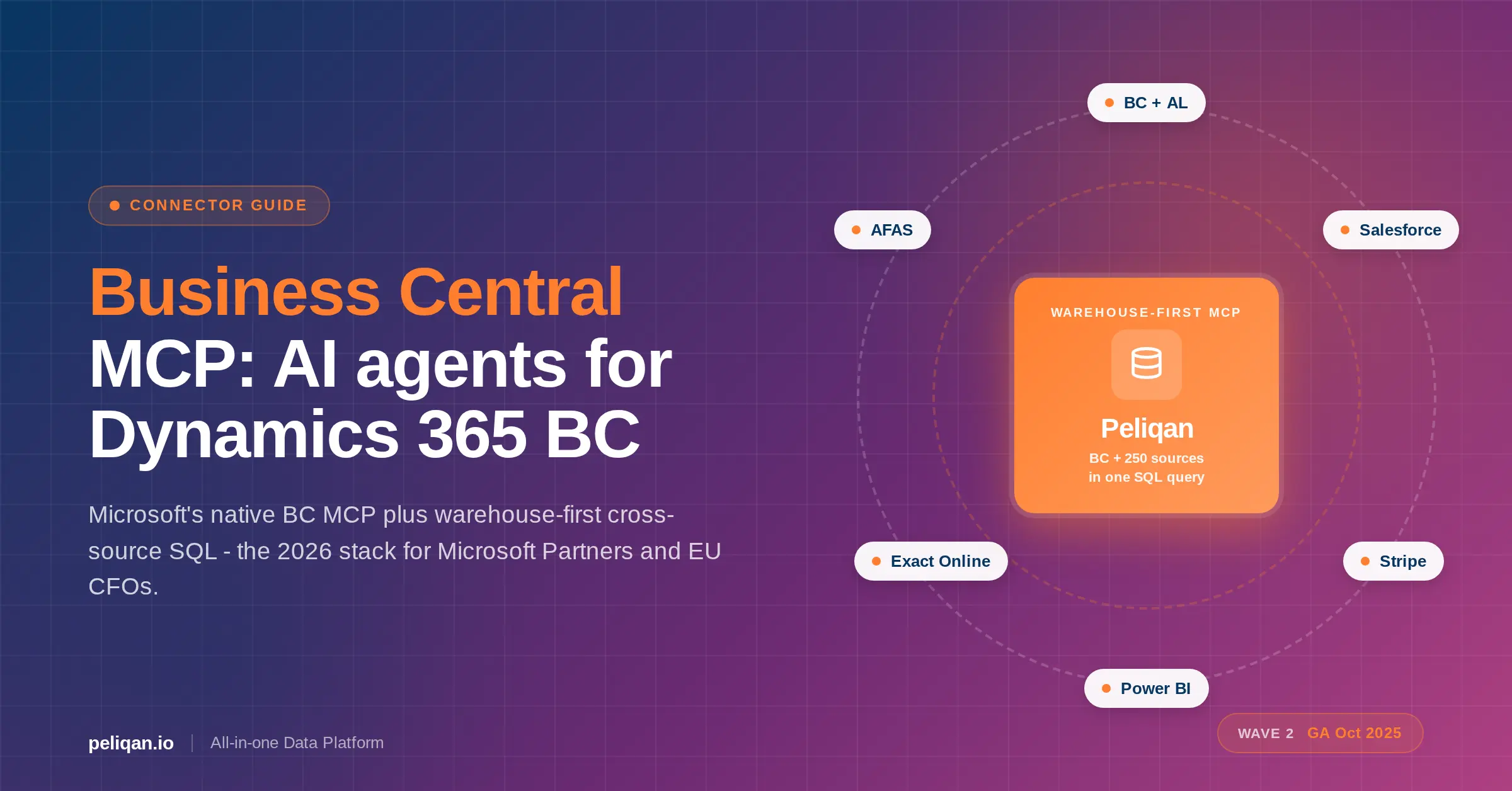





Business Central MCP is the integration layer that lets Claude, ChatGPT, and Cursor read and act on Microsoft Dynamics 365 Business Central data. Microsoft shipped MCP server support as part of the 2025 Wave 2 release, with rolling updates through March 2026. However, the native MCP only speaks BC. For cross-source questions that span BC plus Salesforce plus Stripe plus Exact Online, you need the warehouse-first pattern as a complement. This guide covers both layers, the API constraints to plan around, and the procurement decisions a Microsoft Partner Channel buyer should make in 2026.
Microsoft Dynamics 365 Business Central sits at the centre of the EU SMB ERP conversation in 2026. Indeed, it competes directly with NetSuite for mid-market, with Odoo for partner-led implementations, and with Exact Online and AFAS for Benelux SMBs. The 2025 Wave 2 release went GA on October 1, 2025, with version 27 rolling out updates 27.1 through 27.5 over the following six months. Furthermore, MCP server connectivity arrived as part of that release, alongside Sales Order Agents, Payables Agents, advanced search, and tighter Teams and Power Platform integration.
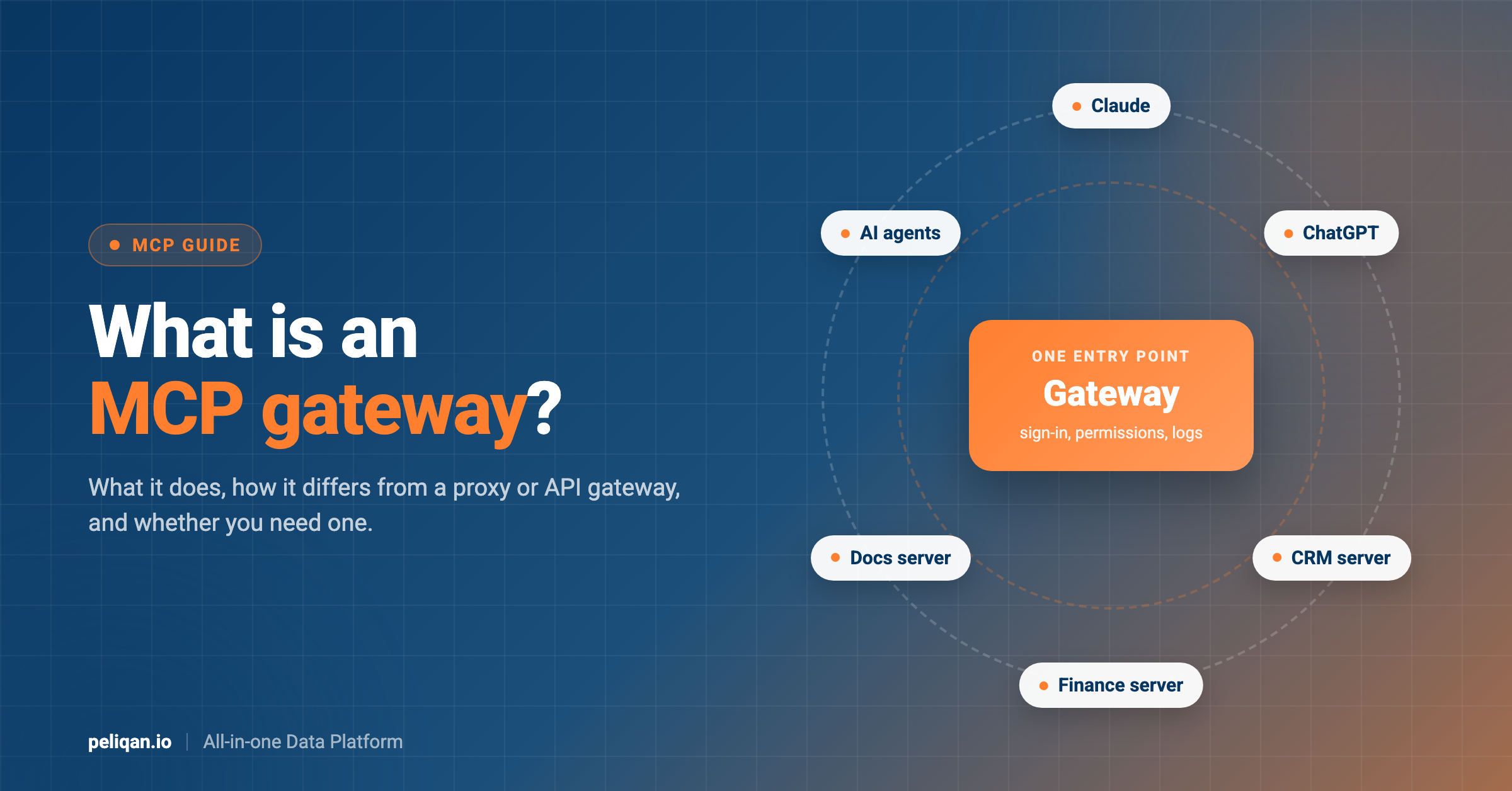
That native MCP is the right tool for in-BC agent work. However, the harder question is the cross-source one. Specifically, how does a CFO running Business Central plus Salesforce plus Stripe plus Exact Online get a single Claude conversation across all four? The native BC MCP cannot reach the other three systems. Therefore, the architectural answer is the warehouse-first Peliqan MCP server running alongside Microsoft’s native one. This post explains why, and how the two layers compose cleanly.
What Business Central is and why it matters in 2026
Business Central traces back to Navision, the Danish ERP Microsoft acquired in 2002. Today, it serves SMB and lower mid-market customers across finance, operations, sales, and service. Moreover, the Microsoft Partner Channel that supports BC has roughly 95% customer retention according to Microsoft’s own data. As a result, the channel itself is a substantial part of the BC story for any vendor selling complementary AI tooling.
The EU footprint is particularly strong. Specifically, BC has deep adoption in Benelux (alongside Exact, AFAS, and Yuki), in DACH (where it competes with SAP Business One), in the UK (where it competes with Xero and Sage), and in the Nordics (where it competes with Visma and PowerOffice). Therefore, anyone selling AI tooling into EU SMB ERP needs a credible BC story.
The 2025 Wave 2 release adds AI-driven enhancements across finance, operations, and e-commerce. Indeed, Microsoft is positioning Business Central as one of the first major ERPs with built-in agentic capabilities. The Sales Order Agent processes incoming sales orders. The Payables Agent handles invoice posting. Furthermore, the new advanced search uses semantic indexing across the entire BC dataset.
Microsoft’s native Business Central MCP: what it does
The native Business Central MCP gives Claude (and ChatGPT, Cursor, Windsurf, VS Code) structured access to BC data and operations. Specifically, the MCP server exposes the Sales Order Agent, Payables Agent, advanced search, and the broader BC API surface to any MCP-compatible client. Moreover, Microsoft Partner consultants can extend the MCP with custom AL-built tools through standard extension patterns.
For in-BC agent workflows, the native MCP is the right answer. Indeed, the AI agent can post journal entries, create sales orders, manage payables, run search queries, and orchestrate Power Automate workflows. Each of these actions inherits BC’s role-based permissions, multi-company structure, and audit trail. Therefore, the agent operates inside the same governance boundary that BC users already trust.
Beyond Microsoft’s official MCP, the community has shipped notable projects. For example, Microsoft MVP Stefano Demiliani’s D365BCAdminMCP exposes 33 administrative tools for BC environment management. Furthermore, Demiliani’s BCMCPProxy and the standalone MCP server included in the AL Development Tools cover developer-facing scenarios. As a result, the BC MCP ecosystem in 2026 is already mature for in-vendor use cases.
The architectural ceiling: where the native MCP stops
Every vendor-native MCP shares one structural limit. Specifically, it speaks one vendor’s data only. In BC’s case, that means Sales Order Agent can process a BC order but cannot reach the Salesforce opportunity that originated it. Similarly, the Payables Agent posts a BC invoice but cannot check Stripe for whether the customer already paid.
That limit matters because most real CFO and RevOps questions cross vendor boundaries. For instance, “show me top-100 customers with overdue BC invoices AND open Salesforce support tickets AND Stripe payment failures” needs three systems in one query. However, three native MCPs in one Claude session do not automatically compose. Indeed, the agent must orchestrate three separate tool calls, then correlate the results in its reasoning loop. Consequently, latency, token cost, and audit-log fragmentation all climb fast.
The warehouse-first pattern solves this by landing every system’s data into one Postgres + Trino warehouse with consistent foreign keys. Then one MCP server exposes the whole warehouse as a SQL surface. As a result, the same question becomes a single SQL JOIN, one round-trip, one audit-log entry. The full architectural case sits in the cross-source MCP cornerstone.
How Peliqan turns Business Central into a cross-source MCP surface
Peliqan syncs Business Central data into a Postgres + Trino warehouse alongside data from 250+ other connectors. Specifically, the connector layer respects BC’s per-user rate limiting model (roughly 6,000 requests per 5 minutes per user). Moreover, it understands the multi-environment and multi-company structure that BC uses, so a single sync can cover several BC environments at once.
Business Central through Peliqan’s MCP, end to end
Set-up follows the standard Peliqan motion. First, install the MCP server with pip install mcp-server-peliqan. Then add Business Central as a connector through the Peliqan workspace, paste your BC tenant credentials, and pick the companies and environments to sync. Finally, point Claude at the MCP endpoint. The Claude MCP setup guide covers the client-side configuration in detail.
Five cross-source Business Central use cases that need SQL
Each use case below is one prompt, one SQL JOIN, one audit log entry. Moreover, none of them is answerable inside BC’s native MCP alone.
1. BC sales orders crossed with Salesforce pipeline
The standing RevOps question: which Salesforce opportunities actually converted into BC sales orders this quarter? The JOIN happens on customer ID or external account ID. Furthermore, it surfaces the lift between forecast and actual delivery, by region and by sales rep. Therefore, the next pipeline review uses real data rather than directional spreadsheets.
2. Multi-company BC consolidation
BC’s native multi-company is good inside BC. However, when a group runs BC in some entities and a different ERP (Exact Online, AFAS, NetSuite, or Yuki) in others, native consolidation breaks. Peliqan’s warehouse lands every ERP into one schema. As a result, the group CFO gets one consolidated view across all entities with FX conversion materialised next to the revenue.
3. BC plus Stripe revenue reconciliation
Many BC customers also run Stripe for subscription revenue or e-commerce. However, revenue posted in BC sometimes drifts from Stripe’s actual capture. The cross-source query joins BC invoice headers to Stripe payment intents, then surfaces any mismatch over the CFO’s tolerance. Indeed, this is the standing Friday-afternoon reconciliation pass that AI agents can run in seconds rather than hours.
4. BC plus Billit Peppol for the Belgian mandate
Belgium’s Peppol e-invoicing mandate went live in January 2026. Specifically, every invoice issued in Belgium must transit through Peppol. The cross-source view joins BC invoice header to Billit Peppol delivery status, flagging any invoice unacknowledged after 48 hours. As a result, the CFO sees the delivery exception list before chasing payment.
5. BC plus Exact Online for hybrid Microsoft + Exact stacks
More common than most consultants assume: groups that run BC in some entities and Exact Online in others. Typically this happens after acquisitions, where the acquirer is on BC and the target is on Exact. The cross-source query lets the AI agent produce a unified P&L and balance sheet across both ERPs without forcing a single-platform migration before the close.
Six Business Central MCP options compared
The honest summary: Microsoft’s native BC MCP wins inside BC. Composio wins for dev-tool agents. Furthermore, Pipedream wins for event-driven automation. Demiliani’s community MCPs win for admin scenarios. Meanwhile, Peliqan wins for cross-source analytics across BC plus the other systems in the stack. None of these patterns compete with each other. Rather, they layer.
Business Central API constraints to plan around
Three API constraints deserve attention before any production BC MCP rollout. Specifically, each one affects how fast and how reliably the AI agent can operate.
First, rate limits. Since late 2023, Microsoft enforces a per-user rate limiting model for OData requests. Specifically, a single service principal gets roughly 6,000 requests per 5 minutes. As a result, an integration that polls orders, syncs inventory, and fetches customer data all under one account saturates that quota quickly. The fix is to use multiple service principals, or to sync once into a warehouse and query the warehouse copy.
Second, environment differences. Production environments have higher rate limits than sandbox environments. Therefore, performance tests in sandbox will under-represent what production allows. Plan capacity accordingly.
Third, the OData $batch endpoint matters more than most teams realise. Specifically, batching multiple create / update / delete operations into one HTTP request counts as one request against the rate limit. Indeed, batch operations are the difference between a sync that completes in 10 minutes and one that takes two hours.
ICP: who Business Central MCP plus Peliqan is built for
Three buyer profiles dominate the BC MCP conversation in 2026. First, Microsoft Partner Channel consultants implementing BC for SMB and mid-market clients. Second, BC customers in Benelux, DACH, UK, and Nordics running mixed ERP stacks. Third, mid-market CFOs running BC plus Salesforce plus Stripe and asking the cross-source question.
For Microsoft Partner Channel consultants, the value is multi-customer management. Specifically, one Peliqan workspace can serve 50+ BC client environments through per-client RBAC. Moreover, this is the same multi-customer pattern that Odoo partners use through Peliqan for their multi-customer rollouts. As a result, Microsoft Partners get a similar capability for BC clients.
For mid-market CFOs, the value is the cross-source question. The full case sits in the MCP for the EU CFO persona post. However, the short version: BC alone answers BC questions. BC plus Peliqan answers the questions that span BC and every other system the CFO has to report on.
For Benelux and DACH buyers specifically, the cross-link to AFAS, Yuki, and other regional ERPs matters more than the headline BC story. Indeed, most real EU mid-market groups run BC alongside one or two of these other systems, not BC alone.
Compliance posture for Article 26 and the Microsoft Partner agreement
Compliance is now a primary procurement axis. Specifically, the EU AI Act Article 26 deadline on August 2, 2026 puts deployer obligations on every business running AI agents that touch high-risk use cases. Furthermore, Microsoft’s own Partner Agreement requires partners to maintain compliance posture for the customer data they handle.
The procurement-grade requirements for any BC MCP setup come down to four items. First, the audit log of every prompt, every SQL, and every writeback. Second, EU jurisdiction hosting with a published sub-processor list. Third, column-level masking for any PII the agent should not see. Fourth, granular RBAC for human oversight. The full breakdown sits in the EU AI Act and MCP compliance guide.
Peliqan ships all four natively. The platform is EU-hosted in Belgium, SOC 2 Type II certified, ISO 27001 in progress, with audit-logged reverse ETL and column-level masking by default. The Peliqan Trust Center publishes the SOC 2 report and the sub-processor list. Therefore, the Microsoft Partner can extend the AI agent capability to BC clients without expanding the compliance review they already pass.
A 60-day rollout plan for Business Central MCP
Most BC partners and CFOs can deploy a working cross-source MCP setup inside 60 days. Specifically, the rollout breaks into three phases. Each phase has clear deliverables and avoids the common mistakes that turn integration projects into multi-quarter slogs.
Phase 1: Connect and sync (Days 1-15)
Start by connecting Business Central to Peliqan. Specifically, generate a service principal in your BC tenant, paste the credentials into the Peliqan connector, and select which companies and environments to sync. Then add the other systems in the stack: Salesforce, Stripe, Exact Online, AFAS, or whichever applies. As a result, the warehouse fills with current data inside the first week.
During this phase, set up the data lineage and column-level masking rules. Specifically, decide which PII fields the AI agent should never see (national IDs, bank account numbers, payment cards). Furthermore, configure the audit log retention to satisfy SOC 2 and Article 26 obligations.
Phase 2: First cross-source queries (Days 16-30)
With data flowing, install the MCP server and connect Claude. Then ask the first three cross-source questions from the use case list above. Typically that’s BC sales orders crossed with Salesforce pipeline, BC plus Stripe reconciliation, and multi-company BC consolidation. Indeed, the first three queries usually catch a reconciliation problem the team didn’t know existed.
Furthermore, use this phase to validate the writeback path. Specifically, identify two or three correction patterns where the AI agent should write back to BC (mark invoice paid, update customer contact, post journal correction). Then exercise each through the reverse ETL audit log. As a result, the audit trail is proven before any production volume hits it.
Phase 3: Production hand-off and SOC 2 evidence (Days 31-60)
By the second month, the AI agent is answering real cross-source questions for real users. Therefore, this phase shifts to operationalisation. First, train the FP&A and RevOps teams on the prompt patterns that produce reliable answers. Second, hand the audit log surface to the security team so they can plug it into the SOC 2 evidence cycle.
Importantly, this is also where the Microsoft Partner Channel value compounds. Specifically, partners can replicate the same setup across multiple BC client environments using Peliqan’s multi-customer management. As a result, the second client deploy takes a fraction of the time the first one did.
Real-world example from the multi-customer ERP lane
Real-world example: OdooExperts (Rezolv)
OdooExperts consolidates reporting across 50+ client Odoo environments through Peliqan’s multi-customer management. Specifically, each client’s ERP lands into the same warehouse architecture with per-client RBAC. As a result, one MCP server serves the whole consultancy with no data crossover between clients. The same pattern translates directly to Microsoft Partner Channel consultancies running multi-client BC implementations. Read the full OdooExperts case study.
Pricing and Peliqan platform integration
Peliqan’s pricing is fixed from €150/month annual. Moreover, the platform includes 250+ connectors, the Postgres + Trino warehouse, low-code Python and SQL workflows, reverse ETL writeback, and the MCP server in one bundle. Therefore, the BC MCP capability does not add to the bill on top of the base subscription.
For deeper architectural context, the Postgres MCP security guide walks through the warehouse and governance layer. Likewise, the Snowflake MCP overview covers the warehouse-first pattern at enterprise data scale. Finally, the Peliqan platform page covers the connector library and the federated query engine in detail.
The bottom line on Business Central MCP
Microsoft’s native Business Central MCP is the right answer for in-BC agent work. Indeed, Wave 2’s Sales Order Agent and Payables Agent are genuinely useful. Furthermore, the community MCPs from Stefano Demiliani and others extend the in-BC capability for admin and developer scenarios.
However, the cross-source question is a different architectural slot. Specifically, joining BC to Salesforce, Stripe, Exact Online, Billit Peppol, or AFAS in one Claude prompt needs the warehouse-first MCP pattern that Microsoft’s native MCP was never built for. As a result, the cleanest 2026 BC stack is both: Microsoft’s MCP for in-BC actions, Peliqan’s MCP for cross-source analytics and audit-logged writeback.
For Microsoft Partner Channel consultants, this is the architecture that lets you add AI agent value across the existing BC client base without rebuilding the integration layer. Moreover, the multi-customer management plus EU hosting plus Article 26 compliance posture turns AI agent rollout from a procurement debate into a SOC 2 attestation step. That is the difference between BC consultants who win the AI conversation in 2026 and consultants who lose it.