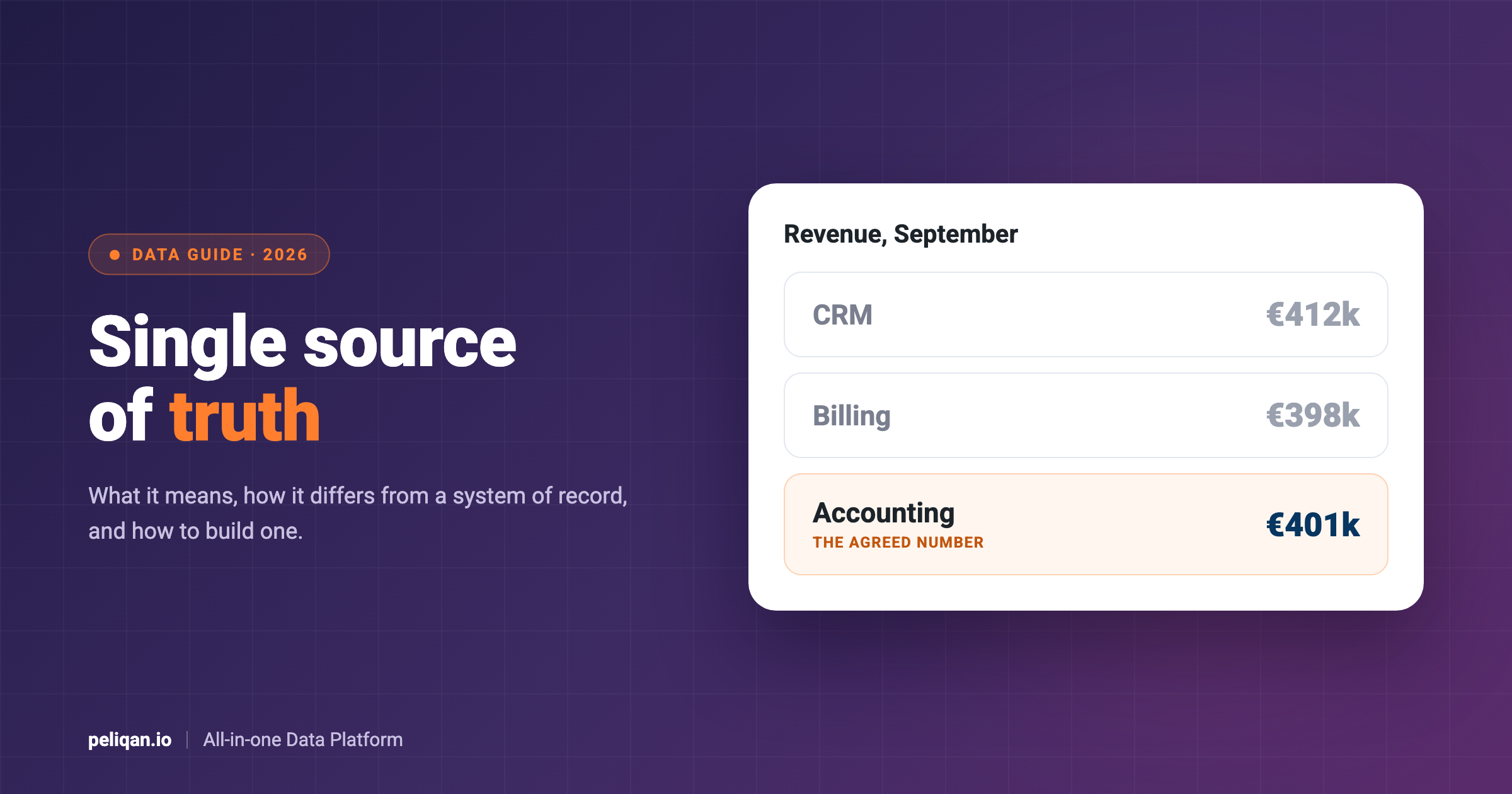


A single source of truth (SSOT) is the one agreed place where a company reads its key numbers. As a result, finance, sales and management all see the same revenue, customers and stock. However, it is not one giant system that replaces every app. This guide explains what the term means, how it differs from a system of record, and how to build one from the apps you already use.
The short answer
A single source of truth is a shared, trusted copy of your business data. Each number has one definition, and everyone reads that same number. Meanwhile, your apps keep doing their own jobs: the CRM still owns deals, and the accounting package still owns invoices.
The single source of truth brings their data together and matches it up. Then it applies one definition for each metric. So when someone asks “what was revenue last month?”, they get one answer instead of three.
Most companies build it as a central data warehouse that their apps feed. On top of that, they add agreed definitions. Finally, reports, spreadsheets and AI assistants all read from it.
What is a single source of truth?
The term comes from information systems design. There, it means you store and edit every piece of data in exactly one place, and everything else points to that place. In business today, people use it more loosely: it is the place you trust when two reports disagree.
You will also see other names for it. For example, people say single version of the truth, one source of truth, single point of truth or golden record. All of these describe the same goal.
Sometimes people talk about “the source of truth” for one item. For instance, “Exact Online is our source of truth for invoices.” In that case, they mean the system whose value wins when copies disagree.
The goal sounds simple, but it answers a real problem. A typical company runs a CRM, an accounting package, a webshop and a support desk. On top of that, it has plenty of spreadsheets. Each one holds part of the picture. However, each one also has its own idea of what a customer or a sale is. So without an agreed place to combine them, every meeting starts with an argument about whose numbers are right.
Single source of truth vs system of record
People often mix up these two terms. Yet the difference matters when you build one.
A good single source of truth respects the systems of record. For example, it does not let people fix a customer’s address in a report. Instead, it sends them back to the CRM. It can also push the change to the CRM for them, so the two never drift apart.
Why most companies don’t have one yet
First, data lives in silos. Each team picks the best tool for its job. However, those tools rarely share an ID for the same customer or product. So matching “Acme BV” in the CRM to “ACME B.V.” in accounting becomes manual work that nobody owns.
Second, definitions differ. Sales counts revenue when it wins a deal. Finance counts it when it books an invoice. Meanwhile, the billing tool counts it when a payment arrives. All three are correct for their purpose. So the real argument is not about data quality, but about which definition to use for which question.
Third, spreadsheets multiply. When it is hard to get data out of apps, people export it to Excel and fix it by hand. Then they share the file. As a result, each copy becomes its own version of the truth, and nobody knows which one is current. Our guide to data integration covers the technical side of pulling these sources together.
Single source of truth examples
The easiest way to plan a single source of truth is one question at a time. For each question, ask which system owns the fact. Then ask what you must combine or agree on before anyone can trust the number.
Notice that no single app can answer most of these questions on its own. That is the real job of a single source of truth. It does not replace the apps; instead, it answers the questions that cross them.
How to build a single source of truth, step by step
1. List your sources and the questions they must answer
Start from the questions management actually asks. Then list every app and spreadsheet that holds part of the answer. Also include the small tools teams use on the side. After all, a forgotten spreadsheet is the most common reason a new report doesn’t match.
2. Pick a system of record for each type of data
For customers, deals, invoices, products and hours, decide which app wins when values disagree. Then write it down. This one decision settles most of the arguments before you touch any technology.
3. Match records across apps
Next, decide how each app identifies the same customer or product. For example, you might use a shared ID, a VAT number, an email domain or a combination. A person then reviews the records that don’t match automatically. Our article on entity resolution explains the common matching methods.
4. Load everything into one central store
Copy the data from each app into one place built for analysis, usually a data warehouse. Use a schedule that fits each source. For instance, finance data may only need a daily update, while support tickets may need one every few minutes. If you are new to the idea, read what a data warehouse is first.
5. Define each metric once
Write the logic for revenue, margin, active customer and every other key metric in one place. In practice, this means shared SQL models or views. Then have every report read from those definitions. This step turns a pile of copied data into a source of truth. Our guide to the semantic model covers this layer in more depth.
6. Keep it in sync, in both directions where needed
Reads should refresh on their own, so nobody exports by hand again. When something needs a correction, send it back to the system of record. In other words, don’t fix it in the copy. That way, the apps and the single source of truth stay aligned. Teams often call this push back to the apps reverse ETL.
7. Let people read it where they already work
People only stop using their own spreadsheets when the trusted data is just as easy to reach. So connect it to the BI tool, to Excel and, more and more, to AI assistants. That way, the single source of truth is also the most convenient source. This is the idea behind self-service analytics.
8. Give it an owner
Finally, name one person or team who owns the definitions and approves changes. Without an owner, teams add new metrics in ten slightly different ways. Soon you are back where you started. Our data governance best practices cover ownership in more detail.
Is a single source of truth a myth?
On Reddit’s data engineering forum, people often call “single source of truth” a cliché. One popular thread even calls it the biggest lie in data. That criticism is fair when vendors sell it as one magic database that ends every disagreement. After all, different teams will always need different views of the data. Also, some numbers, such as revenue, genuinely have more than one valid definition.
The realistic version is smaller and more useful. It means one agreed definition per metric and one known system of record per fact. On top of that, it means one place where people read the combined numbers.
For example, say finance and sales open the same report and see the same revenue for the same definition. Then you have a single source of truth for revenue, even if other data is still messy. So build it one question at a time, starting with the numbers that cause the most arguments.
A single source of truth for AI assistants
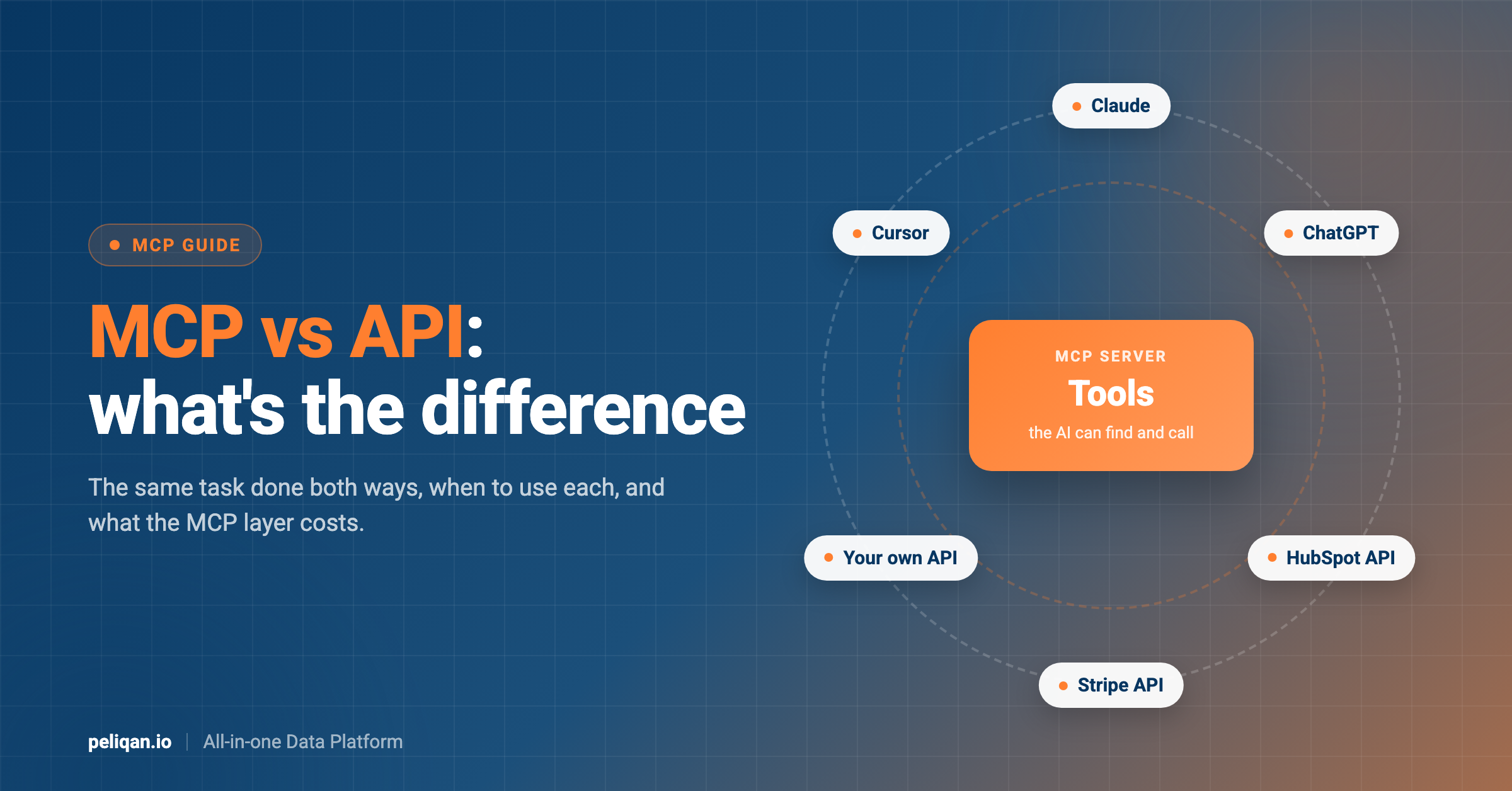
AI assistants such as Claude and ChatGPT make this problem more visible. When an assistant reads each app on its own, it repeats each app’s version of the truth. For example, ask for revenue and you may get the CRM’s won deals one day. The next day, you may get the accounting package’s invoices instead. The assistant also struggles to join data across apps in one answer, as our post on cross-source MCP queries explains.
Pointing the assistant at the single source of truth fixes both problems. It then answers from the same matched records and metric definitions as your reports. As a result, the AI and the dashboard agree. Our comparison of MCP and RAG explains the two main ways assistants reach company data.
Where Peliqan fits
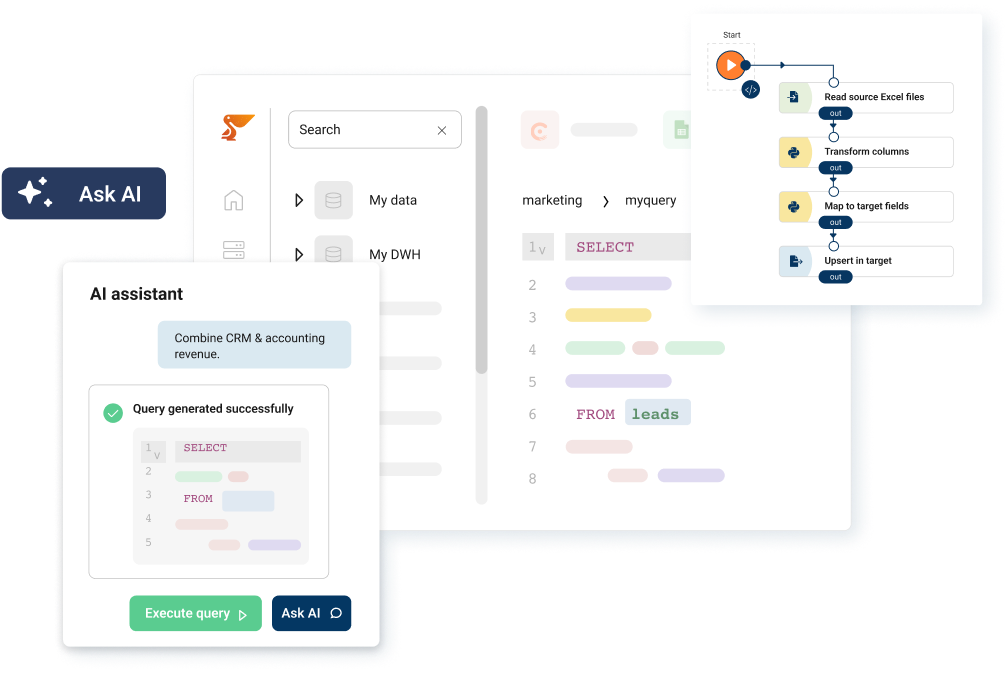
Peliqan is an all-in-one data platform that covers most of the steps above in one product. It has 300+ ready-made connectors for SaaS apps, databases and files. It also syncs each source on its own schedule, from near real time to daily.
The data lands in a built-in data warehouse: Postgres, with Trino as the query engine. Alternatively, you can use your own Snowflake, BigQuery, SQL Server or Redshift.
On top of the data, you write the shared definitions as SQL or low-code Python models. Updates can also flow back to the source apps through writeback. Writeback is on by default, and you can switch it off per connection.
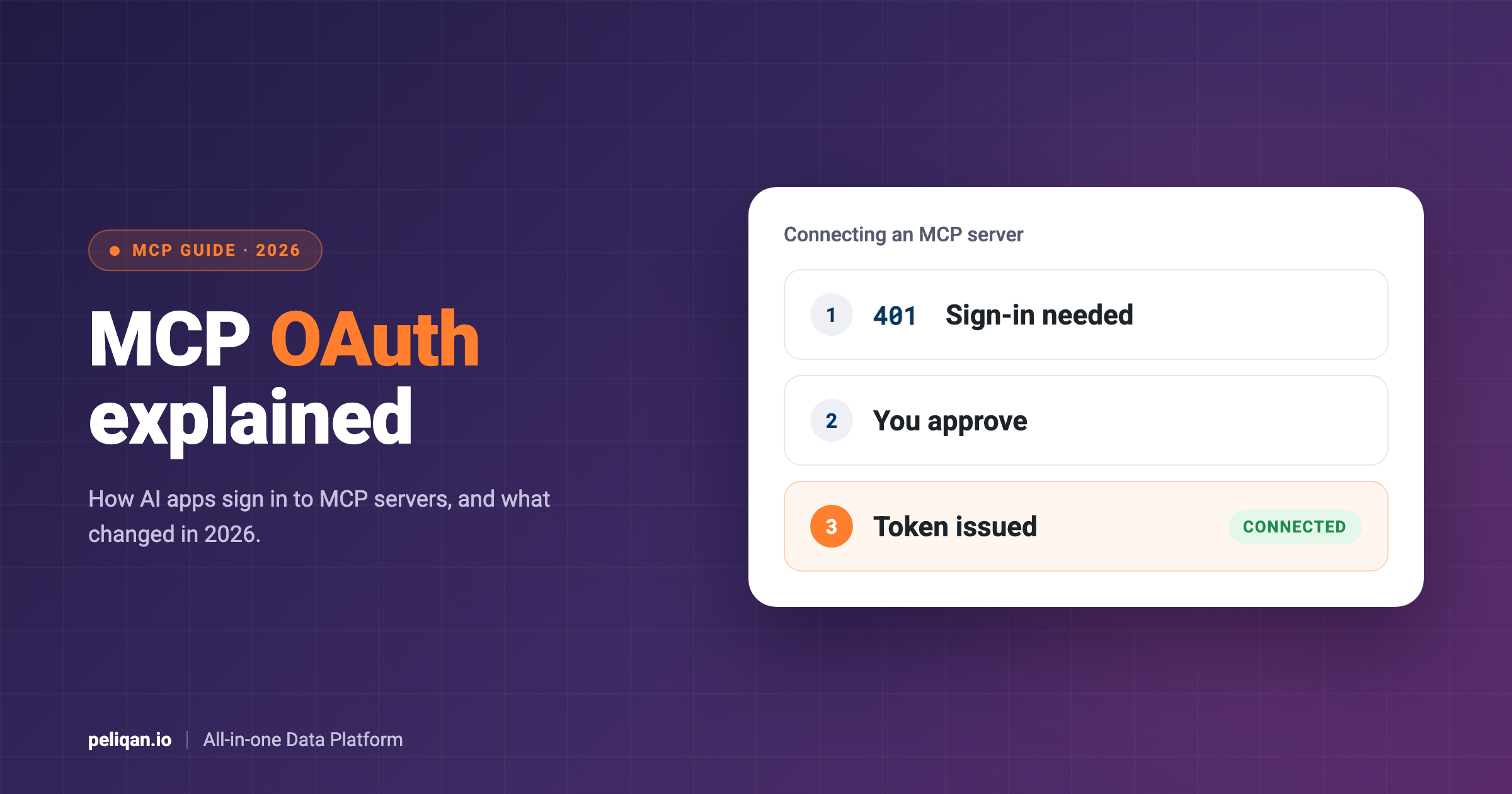
People then read the same numbers from Power BI or other BI tools, or from Excel. They can also ask AI assistants through Peliqan’s MCP server. In that case, questions run as SQL on the same synced data.
CIC Hospitality is a good example. The group brought data from 50+ sources together in Peliqan for board-level reporting. This replaced manual Excel consolidation, and the team now saves around 40 hours a month. You can read the case studies for more detail.
Conclusion
A single source of truth is less about technology than about agreement. It answers three questions: which app owns each fact, how you define each metric, and where everyone reads the result. The technology then makes that agreement stick, because it connects the apps, matches records, stores the data and keeps it fresh.
So start with the two or three numbers that cause the most arguments in your company. Give each one a system of record and a written definition, and then build from there. Once people trust those numbers, they stop exporting their own. In the end, the single source of truth grows with every new question it answers.