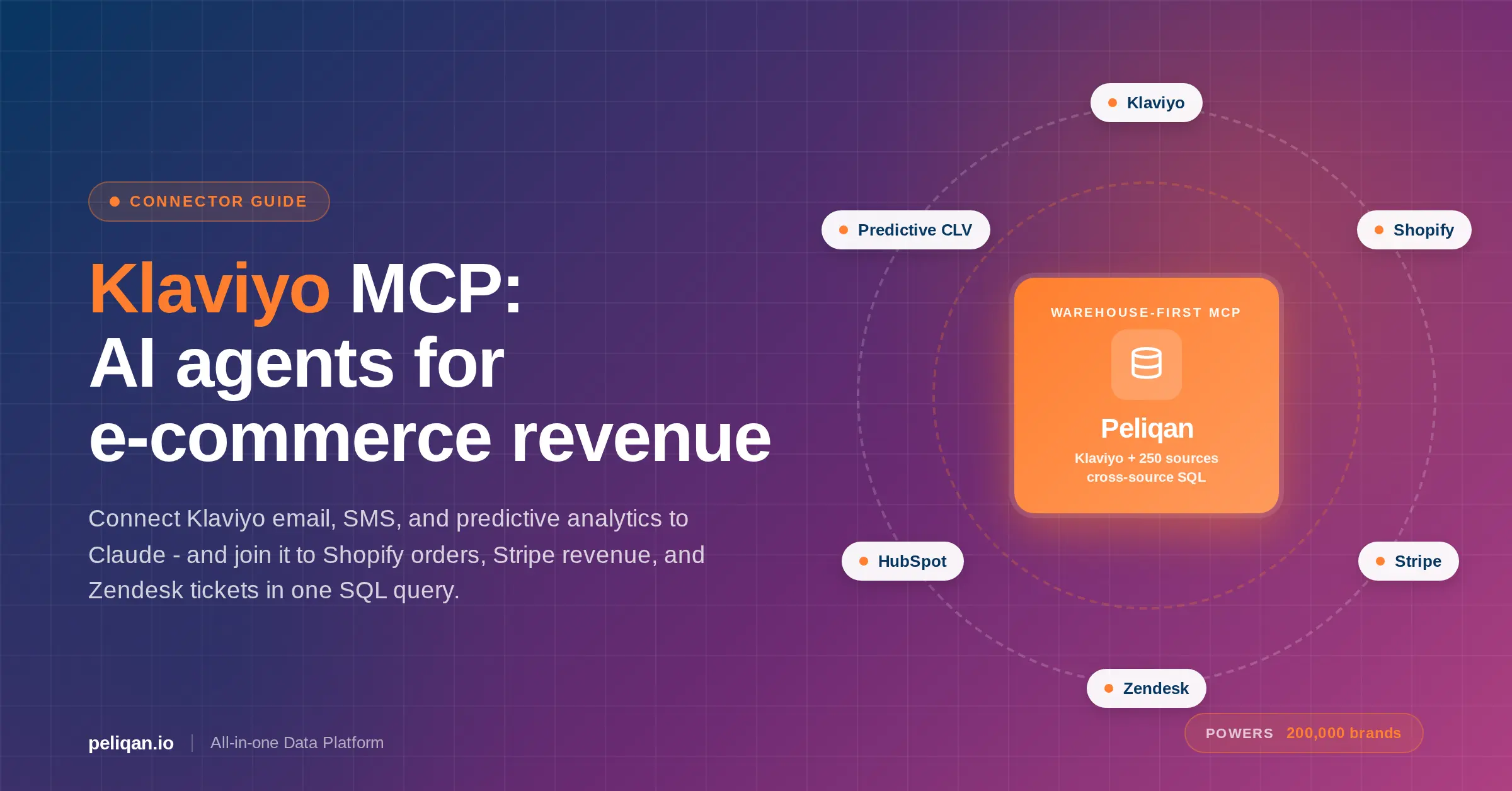





Klaviyo MCP is the integration layer that connects Claude and other AI agents to Klaviyo’s email, SMS, push, and predictive analytics data. Importantly, Klaviyo shipped its own native MCP server in partnership with Anthropic, giving Claude direct access to nearly 200,000 brands’ marketing data. However, the cross-source question – “which Klaviyo campaign actually drove Stripe revenue against Shopify orders for this cohort?” – sits outside the native MCP’s reach. This guide covers both layers, the API constraints to plan around, and the procurement decisions for e-commerce founders and agency partners in 2026.
Klaviyo is the dominant e-commerce marketing automation platform. Specifically, the company has 130,000+ customers as of mid-2023, now expanded to roughly 200,000 brands. Moreover, Klaviyo IPO’d in September 2023 at a $9.2 billion valuation and reported $750 million in 2023 revenue, with Q1 2024 revenue of $164.6 million (up 51% year-over-year). Roughly 95% of revenue comes from retail and e-commerce verticals.
The MCP story arrived in 2026 through a direct partnership with Anthropic. Indeed, Klaviyo’s hosted MCP server connects Klaviyo data to Claude, Cursor, ChatGPT, and other MCP-compatible AI clients. Furthermore, the integration spans Claude Chat and Cowork, making Klaviyo one of the first marketing automation platforms with a vendor-shipped MCP server at this scale.
That MCP is the right tool for in-Klaviyo work. However, the harder question is the cross-source one. Specifically, joining Klaviyo email and SMS engagement to Shopify orders, Stripe revenue, customer support tickets, and product usage in one Claude prompt is outside any single vendor’s MCP scope. Therefore, the architectural answer is warehouse-first MCP running alongside Klaviyo’s native server. This post explains how the two layers compose cleanly for the 2026 e-commerce stack.
What Klaviyo is and why it matters in 2026
Klaviyo dominates the Shopify-app-store category for marketing automation. Specifically, the company holds top installation share for email and SMS apps in the Shopify ecosystem. Moreover, Klaviyo’s deep Shopify integration is one reason most Shopify merchants standardise on it rather than HubSpot, Mailchimp, or ActiveCampaign for transactional and lifecycle marketing.
The product spans six surfaces that share the same customer-data layer:
The six Klaviyo product surfaces
The predictive analytics part deserves a closer look. Specifically, Klaviyo automatically builds a Customer Lifetime Value model using each brand’s historical purchase frequency, average order value, and engagement patterns. Furthermore, the model retrains weekly. Each profile also gets a churn risk percentage, calculated as the predicted probability the customer will not purchase again in the next 90 days. As a result, segmentation by predicted CLV and churn risk has become standard practice in the Shopify ecosystem.
Klaviyo’s native MCP server: what it does well
Klaviyo’s native MCP server, shipped in 2026 with Anthropic, gives Claude direct access to campaigns, flows, profiles, events, metrics, and templates. Specifically, the agent can create campaigns, edit templates, generate segments, pull engagement reports, and surface predictive insights inside one conversation. Furthermore, the partnership extends Klaviyo data into Claude Chat and Cowork for nearly 200,000 brands.
For in-Klaviyo agent workflows, the native MCP is the right tool. Indeed, prompts like “show me the performance of my email campaigns from the last 30 days” or “which flows are performing best in terms of conversions” return real answers from real Klaviyo data. Moreover, Klaviyo’s model-agnostic posture means the same MCP server works with Claude, ChatGPT, Cursor, and other AI clients without vendor lock-in.
However, the architectural boundary is the same one every vendor-native MCP hits. Specifically, the MCP speaks Klaviyo and only Klaviyo. The moment a question crosses to Shopify orders, Stripe payments, Zendesk tickets, or Mixpanel product usage, the native MCP cannot reach. That is not a limitation; it is the design. The complement is the warehouse-first MCP pattern.
The cross-source job Klaviyo’s MCP cannot reach
The questions that actually drive e-commerce growth span Klaviyo plus everything else. For instance, here are four representative examples:
“Which Klaviyo email campaign produced the highest Stripe-confirmed revenue per recipient by segment last quarter?” This joins Klaviyo campaign engagement to Stripe payment intents to Klaviyo predictive CLV segments. Three sources, one question.
“For Shopify customers who received the abandoned cart flow, what’s the actual recovery rate measured against Shopify cart data and Stripe payment success?” This joins Klaviyo flow delivery to Shopify cart events to Stripe payment intents.
“For each CLV cohort Klaviyo predicted in January, what’s the actual realised LTV from Stripe revenue six months later?” This compares Klaviyo’s predictive CLV against Stripe’s actual recurring revenue and one-off payments.
“Across our 30 client Shopify-Klaviyo accounts, which clients are over-sending and risking deliverability damage, ranked by sender reputation, complaint rate, and Shopify-side conversion trend?” This is the agency rollup question that wants the multi-customer pattern.
None of these is answerable inside Klaviyo’s MCP alone. Furthermore, none works through a workflow MCP like Pipedream or a unified-API MCP like Apideck either. Indeed, the Apideck MCP alternative analysis covers why unified APIs flatten away the per-connector depth that cross-source SQL needs. Each of the four questions above requires a SQL JOIN across at least two systems. That is the warehouse-first pattern’s home turf.
How Peliqan turns Klaviyo into a cross-source MCP surface
Peliqan syncs Klaviyo data into a Postgres + Trino warehouse alongside 250+ other connectors. Specifically, the warehouse holds profiles, events, metrics, campaigns, flows, templates, and predictive scores in their native Klaviyo schema. Moreover, Peliqan respects Klaviyo’s burst and steady rate-limit headers automatically during ingestion. As a result, the warehouse stays current without tripping rate limits.
Klaviyo through Peliqan’s MCP, end to end
Set-up is straightforward. First, generate a Klaviyo API key from the account settings. Then add Klaviyo as a connector through the Peliqan workspace and select which tables to sync. Finally, install the MCP server with pip install mcp-server-peliqan and point Claude at the endpoint.
Five Klaviyo MCP use cases that need cross-source SQL
Each use case below is one Claude prompt, one SQL statement, and one audit log entry. Furthermore, none of them is answerable inside Klaviyo’s native MCP alone.
1. Email campaign performance crossed with Stripe revenue per segment
The standing growth question: which Klaviyo campaigns actually drove revenue, not just opens. Specifically, Klaviyo holds the campaign engagement data, while Stripe holds the conversion event. The JOIN happens on customer email or external customer ID. As a result, the output ranks campaigns by realised revenue per recipient, segmented by Klaviyo’s predictive CLV bucket. Indeed, this is the answer that determines next month’s budget allocation.
2. SMS delivery crossed with Shopify post-purchase repeat rate
The retention question: does the post-purchase SMS flow actually drive repeat orders? Klaviyo tracks SMS delivery and click events. Meanwhile, Shopify MCP data holds the order history and customer cohorts. The cross-source view splits customers into “received post-purchase SMS” and “didn’t” cohorts. Then it reports the 30 / 60 / 90 day repeat-purchase delta. As a result, the agency or in-house growth team has hard evidence for the SMS programme’s ROI.
3. CLV cohort analysis: predicted vs actual
The board-level question: how accurate is Klaviyo’s predictive CLV against Stripe’s realised LTV six months later? Specifically, the agent pulls Klaviyo’s CLV score by acquisition cohort. Then it joins Stripe revenue by the same customer ID over the following six months. Furthermore, the agent surfaces the gap by cohort, channel, and product mix. Indeed, this is the cohort analysis that turns predictive analytics from a feature into a forecasting input the CFO trusts.
4. Cart abandonment cross-source: flow + cart + payment failures
This use case joins three systems. First, Klaviyo holds the abandoned-cart flow events. Then, Shopify holds the cart contents and abandonment metadata. Finally, Stripe holds any failed payment intents. The cross-source query surfaces customers where the flow fired, the cart was high-value, AND Stripe had a payment failure. As a result, the customer-success team can intervene with a payment-failure recovery email rather than another generic abandoned-cart reminder.
5. Customer 360 view across Klaviyo, Shopify, Stripe, and support
The customer-success question: full lifecycle view across every touchpoint. Specifically, the JOIN combines Klaviyo profile and engagement, Shopify order history, Stripe payment history, and Zendesk support tickets. The output is the customer 360 view that every CS lead asks for and almost no platform delivers on its own. Furthermore, this is the same pattern the MCP for the EU CFO playbook covers from the finance angle.
Six Klaviyo MCP options compared
The honest summary: Klaviyo’s native MCP wins inside Klaviyo. Composio wins for dev-tool agents. Furthermore, Pipedream wins for event-driven automation. Meanwhile, n8n wins for sovereign-cloud self-host. However, only Peliqan answers the cross-source revenue and CLV questions in a single SQL query with audit-logged writeback. As a result, most growth-focused Shopify brands end up running Klaviyo’s MCP plus Peliqan’s MCP together.
Klaviyo API rate limits to plan around
Klaviyo’s rate-limit architecture has two unusual features that matter for MCP rollouts. First, the burst plus steady model. Specifically, every endpoint enforces both a 1-second burst limit and a 1-minute steady limit. As a result, a chatty agent can trip the burst limit even when overall throughput is well under the steady ceiling.
Second, the per-endpoint tier system. Klaviyo classifies endpoints into XS, S, M, L, and XL tiers. For example, an XS endpoint allows 1 request per second and 15 per minute. Meanwhile, an XL endpoint allows 350 per second and 3,500 per minute. Therefore, the agent’s prompt pattern matters: bulk profile fetches use higher-tier endpoints, while metadata calls use lower-tier ones.
Furthermore, Klaviyo applies stricter rate limits when requests include the additional-fields or include parameters. Indeed, the cost of over-fetching is real. Therefore, the warehouse-first pattern shines here: sync the data once with rate-limit-aware ingestion, then run unlimited analytical queries against the warehouse copy without ever hitting the Klaviyo API again.
Compliance posture for GDPR and Article 26
E-commerce brands run into three compliance regimes simultaneously: GDPR, Article 17 (right to erasure plus suppression propagation), and the EU AI Act Article 26. For Klaviyo specifically, the suppression-list propagation problem matters most. Specifically, when a contact unsubscribes in Klaviyo, the suppression has to propagate to Shopify, the CRM, and the wider marketing stack. Otherwise, the brand books a GDPR Article 17 problem.
Peliqan’s reverse ETL handles this with audit logs on every row written. Furthermore, the platform is EU-hosted in Belgium, SOC 2 Type II certified, ISO 27001 in progress, with column-level masking by default. The Peliqan Trust Center publishes the SOC 2 report and the sub-processor list. As a result, the procurement review passes for GDPR and the EU AI Act Article 26 compliance checklist in the same motion.
For EU D2C brands specifically, this matters twice. First, Klaviyo’s hosted MCP is US-default (Klaviyo is HQ’d in Boston). However, Klaviyo offers EU hosting tiers. Second, Peliqan’s EU-hosted warehouse plus audit log layer means the cross-source MCP setup keeps customer data inside EU jurisdiction even when Klaviyo’s MCP itself sits in US regions for some brands.
ICP and pricing: who Klaviyo MCP plus Peliqan is built for
Three buyer profiles dominate this conversation in 2026. First, e-commerce founders running Shopify plus Klaviyo plus Stripe at $5M to $50M GMV. Second, EU D2C brands with GDPR-sensitive customer bases. Third, agencies managing 30+ Shopify-Klaviyo clients who need a multi-customer view.
For e-commerce founders, the value is the revenue-attribution question. Specifically, “which Klaviyo email actually drove Stripe revenue?” is the single most-asked question that no single platform answers natively. With cross-source SQL, the agent answers it in one query.
For EU D2C brands, the value is the EU jurisdiction plus audit trail combination. Indeed, the warehouse-first MCP keeps customer data inside EU control while still using Klaviyo’s marketing tooling.
For agencies, the value is multi-customer management. Specifically, one Peliqan workspace can serve 30 client Shopify-Klaviyo accounts through per-client RBAC. As a result, the agency lead gets cross-account analytics without exposing one client’s data to another. This is the same multi-customer pattern that powers other agency rollouts on the platform.
Peliqan’s pricing is fixed from €150/month annual. Moreover, the platform includes 250+ connectors, the Postgres + Trino warehouse, low-code Python and SQL workflows, reverse ETL, and the MCP server in one bundle. Therefore, the Klaviyo MCP capability does not add to the bill on top of the base subscription.
Real-world example from the RevOps and growth lane
Real-world example: Skindr
Skindr consolidated advertising and RevOps data across multiple ad networks, CRM, and analytics into Peliqan’s warehouse. As a result, the team runs faster channel-attribution analysis with fewer manual spreadsheet joins. The same pattern applies to e-commerce brands joining Klaviyo to Shopify to Stripe to customer support data. Read the full Skindr case study.
A 60-day rollout plan for Klaviyo MCP plus Peliqan
Most e-commerce brands and agencies can deploy a working cross-source Klaviyo MCP setup inside 60 days. Specifically, the plan breaks into three phases.
First, connect Klaviyo, Shopify, and Stripe to Peliqan over the first two weeks. Generate API keys for each, paste them into the connector setup, pick the tables to sync, and let the warehouse fill. Furthermore, configure the column-level masking rules for PII the agent should never see.
Second, install the MCP server and ask the first three cross-source questions. Typically that’s campaign-revenue attribution, post-purchase SMS effectiveness, and the CLV cohort analysis. Indeed, the first three queries usually reveal at least one budget reallocation opportunity that pays for the whole subscription.
Third, operationalise the audit log surface for SOC 2 evidence and Article 26 readiness. Specifically, train the marketing and CS teams on the prompt patterns that produce reliable answers. Then hand the audit log to the security team for plug-in to the existing compliance evidence cycle.
How this connects to the broader Peliqan MCP cluster
The Klaviyo MCP story sits inside a wider warehouse-first MCP architecture. Specifically, the same warehouse plus single MCP server pattern that joins Klaviyo to Shopify to Stripe also joins ERP, HR, accounting, and payments for the EU CFO. The cross-source SQL cornerstone covers the architectural framework in depth.
For e-commerce brands that also run Business Central or another ERP, the Business Central MCP playbook shows how the ERP layer composes with the marketing stack. Likewise, the HubSpot MCP guide covers the CRM-side equivalent for brands that use HubSpot rather than Klaviyo for the deeper customer lifecycle. The Postgres MCP overview covers the warehouse foundation that everything else lands on. Finally, the Peliqan platform page covers the connector library and federated query engine in detail.
The bottom line on Klaviyo MCP
Klaviyo shipped a serious native MCP in partnership with Anthropic. Indeed, it is one of the best vendor-native MCPs in the e-commerce stack right now. For in-Klaviyo agent work – campaigns, flows, segments, predictive insights – use it.
However, the cross-source question still lives outside any vendor-native MCP. Specifically, joining Klaviyo email and SMS engagement to Shopify orders, Stripe revenue, and support tickets in one Claude prompt needs the warehouse-first pattern. As a result, the cleanest 2026 e-commerce stack is both: Klaviyo’s native MCP for in-platform actions, Peliqan’s MCP for cross-source analytics and audit-logged writeback.
The architectural choice that compounds for the next three years is not which point tool to add. Rather, it is the substrate. Warehouse-first MCP plus EU jurisdiction plus audit-logged writeback plus per-connector depth is the pattern that survives the SOC 2 renewal, the GDPR audit, the Article 26 deadline, and the next agency rollup conversation simultaneously. That is what makes the procurement decision easy in 2026.