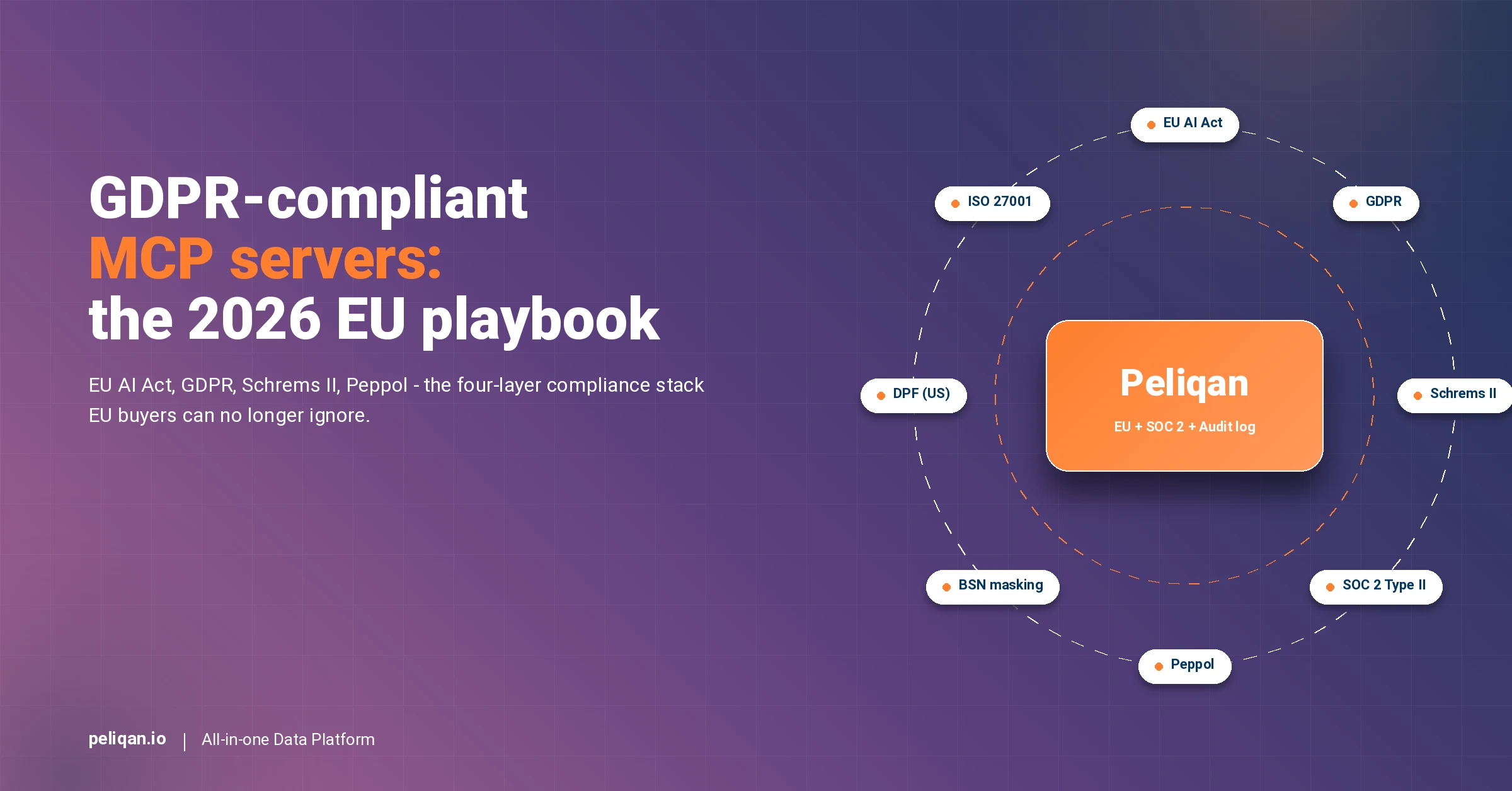





A GDPR-compliant MCP server has to satisfy six specific parts of the General Data Protection Regulation before it touches a single row of EU personal data. Those parts cover Article 5 (processing principles), Article 28 (processor obligations), and Article 30 (records of processing). They also cover Article 32 (security measures), Articles 33-34 (breach notification), and Articles 15-22 (data subject rights). Most MCP platforms shipped in 2025-2026 were built for the agentic-tooling problem first and the GDPR problem second. So EU buyers need this procurement reference before signing a contract.
The regulatory weight is real and growing. In 2025, CNIL imposed €486.8 million in fines across 83 sanctions. However, approximately 98% of that total came from two ePrivacy and cookie-consent decisions against Google (€325M) and SHEIN (€150M) rather than from GDPR enforcement narrowly defined. Meanwhile, Belgium’s APD, the Dutch AP, and Germany’s regional DPAs have stepped up enforcement on processor-side architecture. As a result, the MCP layer (not just the LLM) is squarely in the line of sight.
This guide is the GDPR-specific playbook for MCP procurement. Specifically, it covers what each of the six relevant GDPR articles requires of an MCP server. It also covers the Schrems II and Data Privacy Framework reality for EU-US transfers. Furthermore, it explains how data subject rights compound when AI agents are reading and writing. Finally, it includes the seven-vendor comparison built on GDPR posture rather than feature counts. For the EU AI Act side of the picture, see our dedicated EU AI Act and MCP Article 26 reference.
What “GDPR-compliant MCP server” actually means
The GDPR view of an MCP server at a glance
Indeed, the most common procurement mistake we see is buying an MCP server based on its connector count. Then the buyer discovers at SOC 2 renewal that the platform cannot produce a Records of Processing Activities document. It also cannot enforce a one-month Data Subject Access Request. Furthermore, it cannot reconstruct a personal-data lineage for a breach notification. Those gaps surface during the worst possible window, typically alongside a data-subject complaint or a DPA inquiry.
Why GDPR enforcement intensified for processor architecture in 2025-2026
Six enforcement signals every DPO is tracking
- €486.8M CNIL fines across 83 sanctions in 2025: Headline numbers include €325M against Google and €150M against SHEIN (1 September 2025, INFINITE STYLES SERVICES CO. LIMITED, Irish subsidiary). However, both rest on the French Data Protection Act and ePrivacy Directive (Article 82) rather than the GDPR proper.
- €50M Orange fine, November 2024: CNIL sanctioned Orange for displaying ads disguised as emails in user inboxes without consent. It also sanctioned the operator for continuing to read cookies after consent withdrawal.
- 331 corrective measures issued in 2024: Per CNIL’s annual report, 87 sanctions, 180 compliance orders, and 64 reminders of legal obligations, totalling more than €55 million in fines.
- Dutch AP focus on AI training data: Multiple investigations into how SaaS vendors source and process EU personal data for AI features without lawful basis.
- EDPB Opinion 28/2024 on AI models: Adopted 17 December 2024 in response to a request from the Irish Data Protection Commission. It addresses AI model anonymity, legitimate interest as a lawful basis for AI training, and the consequences of unlawful processing in the development phase.
- Cyber-insurance underwriting: Per Aon’s 2026 Cyber and E&O Market Report, carriers including Coalition, Travelers, Beazley, and Chubb have tightened scrutiny on vendor dependencies, AI use, and privacy controls. Documented controls can swing renewal premiums 20-40 percent in either direction.
Specifically, the enforcement landscape has shifted away from the headline LLM debates. Those are training data, hallucinations, and copyright. Instead, the focus has moved toward the boring but expensive question of processor architecture. As a result, MCP servers that hold EU personal data are inheriting the audit-and-fine exposure that used to land only on CRM or HRIS vendors. These MCP servers route data to an AI agent and write back to source systems.
GDPR Article 5: the six principles applied to MCP servers
Article 5(1) of GDPR lists six principles every processing operation must satisfy. A seventh (accountability) sits in Article 5(2). Furthermore, Article 5(2) puts the burden of proof on the controller and processor to demonstrate compliance. Therefore, an MCP server has to actively support each principle. Documentation alone is not enough.
The six principles, applied to MCP architecture
1. Lawfulness, fairness, and transparency
2. Purpose limitation
3. Data minimisation
4. Accuracy
5. Storage limitation
6. Integrity and confidentiality (security)
GDPR Article 28: the processor obligations the MCP DPA must cover
Article 28(3)(a)-(h) imposes eight specific processor obligations every DPA must contain. Indeed, the DPA between you (controller) and the MCP vendor (processor) is the contract that makes processor obligations enforceable. As a result, an MCP vendor without a solid DPA is not GDPR-compliant. That holds regardless of what their marketing page says.
Specifically, the sub-processor row is where most MCP vendors get caught short. By contrast, a vendor that publishes a current sub-processor list with jurisdiction and purpose (instead of “available on request”) is signalling mature processor governance. Furthermore, the audit rights row matters because some US-headquartered vendors gate the SOC 2 Type II report behind enterprise plans. As a result, that effectively breaks Article 28 for buyers on lower tiers.
Schrems II, Data Privacy Framework, and the EU-US transfer problem
The Court of Justice of the European Union invalidated the EU-US Privacy Shield on 16 July 2020 in Case C-311/18 (the Schrems II decision). Consequently, every transfer of EU personal data to a US-headquartered processor needs one of three legal mechanisms. The options are Standard Contractual Clauses (SCCs), Binding Corporate Rules (BCRs), or the EU-US Data Privacy Framework (DPF). However, each carries known risks.
Current DPF status (as of May 2026)
On 3 September 2025, in Case T-553/23 Latombe v Commission, the EU General Court dismissed the action for annulment and upheld the DPF. However, Philippe Latombe appealed the General Court’s decision on 31 October 2025. So the matter is now pending before the Court of Justice of the EU. As of May 2026, the DPF remains legally valid pending the CJEU’s ruling.
Why “EU region of a US cloud” does not solve Schrems II
- DPF appeal pending at the CJEU: The General Court upheld the DPF in September 2025, but the Latombe appeal is now before the CJEU. A future invalidation would unwind transfers retroactively.
- SCCs require transfer impact assessments: Per the CJEU’s Schrems II reasoning and EDPB Recommendations 01/2020, each EU-US transfer needs a documented TIA. The TIA must show the recipient country’s laws do not undermine the SCC protections. Furthermore, the TIA must be refreshed when surveillance laws change.
- BCRs only cover intra-group transfers: Under Article 47 GDPR, Binding Corporate Rules apply to transfers within a corporate group, not to transfers to an external processor.
- Three overlapping US legal regimes apply: FISA Section 702 (electronic surveillance of non-US persons by US-jurisdiction service providers), Executive Order 12333 (US signals intelligence collected abroad), and the CLOUD Act (compulsion of US-incorporated providers regardless of where the data physically sits). The CJEU specifically flagged FISA 702 and EO 12333 in Schrems II.
- EU-headquartered processors avoid the entire mechanism: Belgian, Dutch, German, French, and Irish HQs with EU-hosted infrastructure remove the transfer question entirely.
As a result, the practical answer for serious EU buyers is EU-headquartered MCP infrastructure with EU-only hosting. By contrast, US-default vendors (Composio, Pipedream, Zapier MCP) handle EU customer data through US-headquartered legal entities. That means SCCs plus TIA plus DPF-fragility plus FISA-702 exposure regardless of which “EU region” they spin up. Specifically, the conversation in 2026 procurement rooms is moving from “do you have an EU region” to “is your legal entity inside the EU.”
Article 30 Records of Processing Activities: what MCP must document
Article 30(1) requires every controller to maintain a Record of Processing Activities (ROPA). Article 30(2) imposes a similar requirement on processors. Article 30(5) carves out a narrow derogation for organisations with fewer than 250 employees. However, the derogation only applies if all three cumulative conditions are met. First, the processing must be occasional. Second, it must be unlikely to result in a risk to data subjects’ rights and freedoms. Third, it must not include special-category or criminal-conviction data. In practice, almost no organisation qualifies. So the ROPA is effectively universal.
What the MCP server should auto-document
Indeed, the ROPA is the single artefact that every DPA inquiry, every cyber-insurance underwriter, and every SOC 2 auditor will ask for. Therefore, your MCP server has to make ROPA generation possible rather than painful.
Specifically, MCP platforms that automate ROPA generation through metadata and lineage save the DPO 40-80 hours per year. That’s compared to maintaining the document by hand. Furthermore, the data lineage documentation shows how warehouse-first MCP architectures generate the ROPA artefact as a by-product of normal operation, not as a separate exercise.
The 7-vendor GDPR posture comparison
This table compares MCP vendors specifically on GDPR processor architecture rather than feature breadth. As a result, the columns map directly to the GDPR articles a DPO has to defend. Note that several US-headquartered vendors have strong security certifications. The issue is structural (Schrems II / FISA-702 exposure), not security maturity.
What the matrix actually shows
US-incorporated vendors split into two tiers. First, the US-default tier with no EU-only residency option (Composio, Pipedream, Zapier MCP). Second, the US-incorporated tier with documented EU residency (Workato, Boomi). However, both tiers remain CLOUD Act-reachable through the US corporate parent regardless of region. Apideck operates as a dual-entity vendor, with the founding Belgian SRL in Antwerp and a commercial US office. So which entity signs your EU customer DPA should be verified in the MSA. Furthermore, the deeper per-vendor analysis lives in our Apideck MCP alternative and Workato MCP alternative comparisons. Specifically, these breakdowns walk through TCO, EU posture, and the unique trade-offs each vendor presents.
Data Subject Rights when AI agents are in the loop
Articles 15-22 of GDPR give EU residents seven enforceable rights. Those rights are access (Article 15), rectification (Article 16), erasure (Article 17), and restriction of processing (Article 18). They also include data portability (Article 20), objection (Article 21), and the right not to be subject to a decision based solely on automated processing including profiling (Article 22). Combined with the right to be informed under Articles 12-14, this is commonly summarised as the GDPR’s eight data subject rights. As a result, the MCP server architecture has to support each of these. That’s because AI agents reading and writing through the MCP are doing the processing.
The one-month response window
Indeed, Article 12(3) requires response “without undue delay and in any event within one month of receipt of the request.” That period is extendable by two further months for complex requests. However, the controller must inform the data subject within the first month. Therefore, an MCP architecture has to do two things to hold up under volume DSAR pressure. First, it has to produce lineage on demand. Second, it has to support lifecycle operations (delete, restrict, port) without engineering tickets. The permissions and access control documentation covers the role-based model Peliqan ships for these operations.
Articles 33-34: 72-hour breach notification reality
Article 33 of GDPR requires controllers to notify the supervisory authority within 72 hours of becoming aware of a personal data breach. Furthermore, Article 33(2) requires processors to notify controllers “without undue delay.” So the 72-hour clock can start. As a result, an MCP server has to support breach detection, internal escalation, and forensic reconstruction fast enough to keep the controller inside the regulatory window.
The five-step breach response the MCP must enable
- 1. Detection: Anomaly detection on PII access patterns and unusual writeback frequency triggers Slack or email alerts
- 2. Containment: Per-tool RBAC supports immediate revocation so the agent loses access while investigation runs
- 3. Scope reconstruction: Audit log answers “which subjects, which fields, which time window” inside hours, not days
- 4. Controller notification: The processor (MCP vendor) notifies the controller via a documented channel within the contractual SLA
- 5. Authority notification: The controller files the Article 33 notification within 72 hours, supported by the MCP-generated evidence pack
Consequently, MCP servers without searchable audit logs cannot support step 3. As a result, the controller cannot meet the 72-hour deadline. By contrast, a warehouse-first MCP with structured logs supports forensic reconstruction inside hours. The cross-source MCP SQL cornerstone post covers the architectural pattern that makes this possible.
Peliqan’s GDPR posture, article by article
How Peliqan maps to the GDPR articles that matter
Furthermore, the multi-tenant deployment model uses the same posture across tenants. As a result, ISVs and partners running on Peliqan inherit the GDPR architecture for their downstream customers. The multi-customer management documentation covers this in detail. Moreover, the broader procurement framing lives in our MCP for the EU CTO and CIO reference for technical buyers.
Real-world example: CIC Hospitality
CIC Hospitality runs Peliqan as the EU-hosted data plane across 50+ data sources. Those include hotel guest records, POS transactions, and HR data. Specifically, the column-level masking redacts passport numbers and special-needs fields before any AI agent reads. The audit log supports Article 30 ROPA and any 72-hour breach reconstruction. As a result, the team saves more than 40 hours per month on board reporting. Read the full CIC Hospitality case study.
Common GDPR challenges with US-default MCP vendors
Challenge: vendor publishes sub-processors “on request” only
Specifically, Article 28(2) requires sub-processor authorisation. That’s hard to operate when the list is private. Therefore, ask for the public list before signing. Furthermore, if the vendor refuses, escalate to security review. Operational sub-processor management depends on visibility.
Challenge: DSAR response requires manual engineering work per request
Indeed, this is the common reality for connector-by-connector MCP platforms. As a result, when DSAR volume rises (typically 50-200 requests per year for mid-market EU companies), the engineering cost compounds. By contrast, warehouse-first MCPs with built-in lineage answer DSAR access requests with a single export.
Challenge: vendor claims “EU region” but parent is US-headquartered
Moreover, this is the structural Schrems II trap. Specifically, FISA 702 targets non-US persons through US-jurisdiction service providers. Furthermore, the CLOUD Act compels US-incorporated providers regardless of which AWS or GCP region the data sits in. That’s because the legal entity holding the contract is US-based. Therefore, ask for the legal entity HQ, not just the data-centre region.
Challenge: breach SLA is “without undue delay” with no specific window
Consequently, this language is technically GDPR-compliant but operationally unhelpful. Furthermore, push for a specific notification SLA (24-48 hours) inside the DPA. So your team has time to file the Article 33 notification inside 72 hours. Indeed, vendors with mature breach playbooks usually agree to a 24-hour or 48-hour processor-to-controller notification window.
Conclusion: GDPR posture is architecture, not paperwork
Indeed, the cheap GDPR win is to pick an MCP architecture that produces the artefacts every supervisory authority will eventually ask for. Those artefacts are the ROPA, the audit log, the DSAR exports, and the breach reconstruction. Specifically, warehouse-first MCP with native masking, structured logs, and EU-hosted infrastructure produces those artefacts as a by-product of normal operation. Therefore, the GDPR posture stops being a separate workstream. Instead, it becomes invisible plumbing.
By contrast, MCP architectures that hand-roll the GDPR posture on top of US-default infrastructure produce them under pressure. That usually happens during the worst possible window. Furthermore, the cyber-insurance underwriter, the SOC 2 auditor, and the supervisory authority each ask for the same artefacts in different formats. So investing once at the architecture level pays back across three procurement cycles.
Finally, you may want the EU-headquartered warehouse-first MCP architecture for your GDPR posture without retrofitting it onto US-default infrastructure. Peliqan starts at €75/month (Connect). The platform ships with EU-only Belgium hosting on AWS Frankfurt. It also includes SOC 2 Type II, ISO 27001 certified, native column-level masking, and Article 30 ROPA tooling out of the box. Therefore, book a demo. We will walk the DPA, the sub-processor list, and the SOC 2 report through with your DPO in one call.
This post is for informational purposes only and does not constitute legal advice. Article references reflect the consolidated text of Regulation (EU) 2016/679 (GDPR) and the EU-US Data Privacy Framework status as of May 2026. That status includes Case T-553/23 Latombe v Commission and the related CJEU appeal filed 31 October 2025. For advice specific to your deployment, consult qualified counsel.