




On 6 April 2026, the UK tax system changes. Making Tax Digital for Income Tax becomes mandatory for sole traders and landlords with qualifying income over £50,000 – roughly 780,000 taxpayers in scope on day one. By April 2027, the threshold drops to £30,000 and another 970,000 join. Quarterly digital updates to HMRC, in compatible software, become non-negotiable. If your bookkeeping practice runs on Xero, every one of those clients now needs a quarterly cadence rather than an annual one. However, the data layer that powers that cadence is structurally the same Xero you have today.
The question is what AI surface sits on top of it. A xero claude prompt that joins client invoices with bank feed reconciliations, Stripe payments, and VAT obligations in a single breath should be a Monday morning routine. In practice, it remains rare – because most xero mcp wrappers handle one organisation at a time, none of them survive the multi-client portfolio reality of an accountancy practice, and Xero’s own JAX assistant is Xero-only by design. Therefore, the shortest path from raw Xero data to a Claude-grade answer is a warehouse. That architectural decision is what separates a xero mcp server that demos well from one that runs a 200-client practice through the MTD-ITSA transition.
Three forces have converged on Xero-led practices in 2026. Firstly, MTD-ITSA flips the operating model from annual to quarterly for any client over £50,000 qualifying income. Secondly, the EU AI Act has opened enforcement at €35M or 7% of global turnover for ungoverned AI on customer data – and EU-resident Xero users (Ireland, Netherlands, Germany, Belgium) sit squarely inside the envelope.
Finally, the talent pipeline for junior bookkeepers has thinned so far that the firms growing fastest are quietly embedding AI into the workpaper rather than waiting for next year’s hires. Consequently, putting an MCP server in front of Xero that survives an HMRC audit, scales across a practice’s entire client portfolio, and joins Xero with payments and banking has become a 2026 priority. This blog is that playbook.
What Xero is, and why the architecture choice matters now
Xero at a glance
Why the accountancy practice use case is unique
Xero’s positioning matters because accountancy practices, not single SMBs, are the real centre of gravity for Xero AI workflows. A UK practice managing 200 sole-trader and landlord clients under MTD-ITSA suddenly has 200 quarterly submission deadlines instead of 200 annual ones. Meanwhile, the same firm typically also manages 50 limited-company clients on Xero, which adds another rhythm of VAT submissions, year-end accounts, and management reporting. None of this is new work; what is new is the cadence.
The questions a practice principal actually asks – which clients are behind on bank rec, which clients have unposted invoices, which clients have an upcoming MTD deadline they will miss – are not in Xero’s standard reports. Specifically, they require cross-client aggregates that Xero’s per-tenant API does not naturally produce. Consequently, those questions have to be modelled, materialised, and exposed through a warehouse-first MCP layer to become real AI workflows.
Why connecting Xero to Claude is harder than it looks
Six constraints every Xero AI project hits
Where the per-tenant model breaks at practice scale
Pulling a single invoice from Xero is easy – the API handles that elegantly. The hard part is everything a real practice prompt requires once it touches 50 clients at once, or once it crosses Xero with Stripe and a bank feed. Furthermore, wrapper-style MCPs proxy individual endpoints rather than composing analytic queries across a client portfolio; consequently, they cannot answer the questions that define a modern practice’s AI strategy.
The real cost of fragmented Xero reporting in the MTD era
What slow Xero reporting actually costs a UK or EU practice
The hidden cost is not the slow report itself. Instead, it is the operating model that builds up around it – the spreadsheets to reconcile, the deadline trackers in Notion, the client follow-ups that arrive a week late. By contrast, cross-source AI on top of Xero, hosted in the right jurisdiction, with auditable writeback, is the single highest-leverage investment a Xero-led practice can make in 2026.
6 ways to connect Xero to Claude
1. Xero’s own AI (JAX) and Practice Manager reports
JAX inside Xero is excellent for in-organisation tasks: generating invoices, drafting quotes, summarising cash-flow trends, and answering natural-language questions about one client’s data. Additionally, Xero Practice Manager provides cross-client visibility for accountancy firms. Together, they cover single-tenant AI well. However, JAX does not join Xero with non-Xero sources, and Practice Manager does not expose a Claude prompt surface.
Best for: Xero-only workflows inside a single client or single practice.
2. Direct Xero REST API with custom Python
Any data engineer can authenticate against the Xero REST API and pull Invoices, BankTransactions, Contacts, Accounts, JournalEntries, and the rest of the schema. Nevertheless, building a maintainable layer is unforgiving: 200 OAuth flows for a 200-client practice, rate-limit math per organisation, schema drift handling, and the cross-client aggregation that Xero does not provide natively. Weeks of engineering precede the first useful AI prompt.
Best for: Practices with a dedicated data engineer and a narrow extract scope.
3. Community Xero MCP servers on GitHub
Several open-source Xero MCP servers wrap the public API as MCP tools. They handle single-organisation reads and basic writes; furthermore, they are free and self-hostable. On the other hand, they are read-mostly, single-tenant by design, US-hostable by default, and require DIY OAuth + .env management. The audit trail for writeback is whatever you build on top.
Best for: Engineering teams prototyping a Claude/Cursor workflow against the core Xero entities for one organisation.
4. Action-based MCP wrappers (Zapier MCP, Pipedream MCP)
Zapier MCP and Pipedream MCP expose Xero actions to MCP clients. Specifically, they excel at event-driven workflows like “when a Xero invoice is overdue 14 days, post to Slack and create a follow-up task”. However, neither is an analytical platform – no warehouse beneath, no cross-source SQL, and Zapier MCP in particular is task-quota-capped, which limits how aggressively an AI workload can run across a 200-client practice.
Best for: Event automations and lightweight prototypes, not cross-client analytics.
5. Composio and broader unified-API MCPs
Composio’s Xero integration exposes core Xero operations as MCP tools across a broader catalog of SaaS apps. Likewise, similar unified-API wrappers cover the same surface. Both are useful as starting points; however, neither stores data in a warehouse, neither supports cross-source SQL with non-Xero systems, and both are US-hosted by default – a structural gap for EU buyers under GDPR and EU AI Act.
Best for: Prototyping cross-app workflows where Xero is one of many SaaS actions, not the analytical core.
6. Warehouse-first MCP platform (Peliqan)
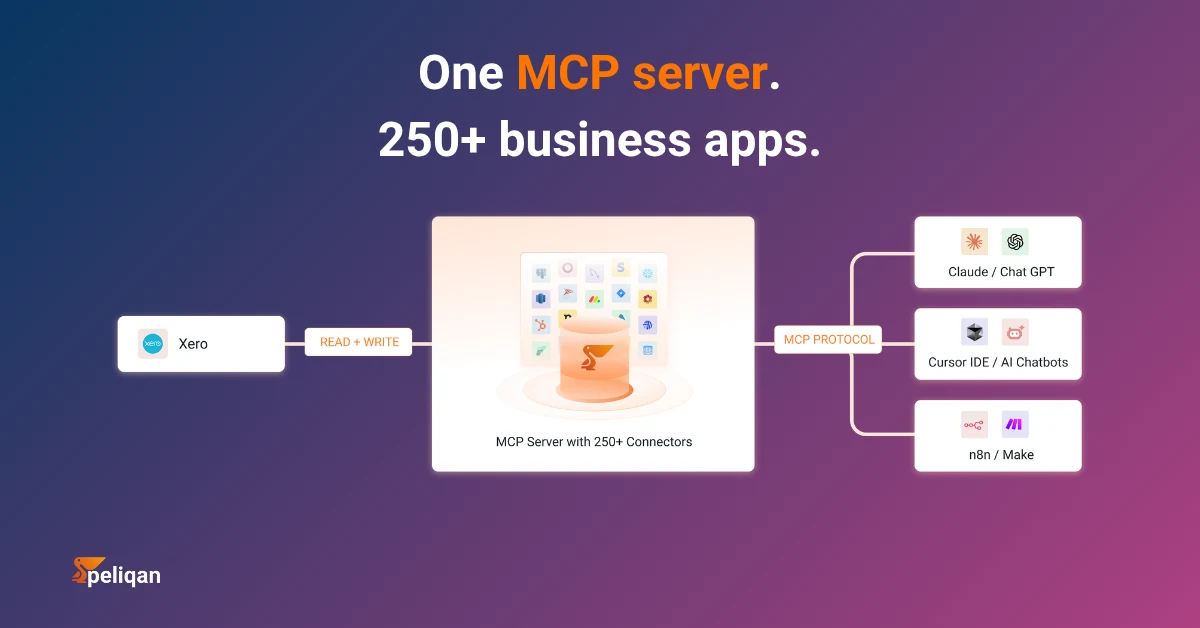
Peliqan syncs every Xero organisation a practice manages – Invoices, BankTransactions, Contacts, Accounts, JournalEntries, Items, Payments, Reports – into a managed EU-hosted Postgres + Trino warehouse, queues all calls inside per-organisation rate limits, and exposes the cleaned tables to Claude, ChatGPT, Cursor, or any MCP client through the Peliqan MCP server.
Claude writes real Postgres SQL with full JOINs, window functions, and analytics across the entire client portfolio. Moreover, writeback flows back through reverse ETL with a full audit log. Cross-source SQL joins Xero with Stripe, HubSpot, banks, and 240+ other connectors. EU-hosted, SOC 2 Type II, GDPR-native.
Best for: UK and EU practices running Xero across dozens to hundreds of clients, especially through the MTD-ITSA transition. See the Xero connector.
Comparison: 6 ways to connect Xero to AI
| Method | Real SQL JOINs | Multi-tenant | Cross-source | Auditable writeback | EU-hosted MCP |
|---|---|---|---|---|---|
| JAX + Practice Manager | No | Per-organisation | Xero ecosystem only | In-Xero | Xero hosting |
| Direct API + Python | Hand-rolled | Hand-rolled fan-out | Hand-rolled | Custom-built | Depends on host |
| Community GitHub MCPs | No | Single-tenant | No | Read-mostly | Self-host |
| Zapier / Pipedream MCP | No | Per-flow setup | Event-only | Task-quota-capped | US-default |
| Composio / unified-API | No | Single-tenant | Per-action | Partial | US-default |
| Peliqan MCP | Full Postgres SQL | All organisations unified | SQL across 250+ apps | Full audit log | EU, SOC 2 Type II |
The Xero entities that matter most for practice AI
| Xero entity | What it powers | Practice AI use case |
|---|---|---|
| Invoices | Sales and purchase invoices | Debtor briefings, late-payer triage, DSO |
| BankTransactions | Bank feed lines, matched + unmatched | Reconciliation assistant, anomaly detection |
| Contacts | Customer and supplier master | Customer 360, churn signal, supplier concentration |
| Accounts | Chart of accounts | COA harmonisation, P&L mapping |
| JournalEntries | Manual + automated postings | Anomaly detection, audit trail review |
| Items | Product / service catalogue | Margin analysis, sales mix |
| Payments | Invoice payments, allocations | Cash collection priority, payment timing |
| Reports | Built-in P&L, balance sheet, trial balance | Management reporting, KPI tracking |
Decision framework: which Xero architecture fits your practice shape
Match the architecture to the practice shape
The practice playbook: 5 Xero + Claude workflows that change the cadence
The temptation is to bolt JAX onto each client and call it transformation. However, the actual value comes from compressing the workflows that recur weekly across the entire client portfolio. Five workflows repeat across the Xero-led practices we have seen running this architecture.
1. Daily debtor briefings across the practice
“Across all 200 clients, show me every invoice 30+ days overdue, ranked by value, with the customer name, last contact date, and any recent dispute flags.” That is one Postgres SQL query against the warehouse, with a UNION across all client tenants. By contrast, the same prompt against raw Xero is 200 paginated calls. Cross-source joins in Peliqan handle the cross-tenant aggregation while preserving per-client isolation.
2. MTD-ITSA pre-submission VAT and income checks
“For every MTD-ITSA client whose quarterly submission is due in the next 14 days, show me unreconciled bank transactions, unposted invoices, and any VAT-coded items that look anomalous.” Specifically, this is the workflow that protects penalty-point exposure under the new HMRC regime. Data quality monitoring handles the alerting layer for the patterns the practice principal wants surfaced automatically before each deadline.
3. Bank reconciliation assistant
“For client X, show me every unreconciled bank transaction in the last 60 days, with my best guess at the matching Xero invoice or expense based on amount, date proximity, and contact name.” This is the workflow JAX handles for single-organisation reconciliation. With a warehouse-backed MCP, on the other hand, the same prompt runs across the entire client portfolio simultaneously and flags the highest-priority reconciliations first.
4. Multi-client portfolio reporting
“Show me practice-wide KPIs: total revenue across all clients, average DSO, bank rec backlog days, MTD submission status by client – with month-over-month deltas.” That is the board pack a practice partner reviews weekly. Multi-customer management in Peliqan handles the fan-out architecture and the cross-client aggregation in a single MCP context.
5. Cross-source: Xero invoices + Stripe revenue + bank feed
“For our top-20 SaaS clients running Xero + Stripe, build a cash-flow forecast joining open Xero invoices, expected Stripe collections, and the actual bank feed reconciliation.” Specifically, this is the cross-source story no single-system MCP can answer. The warehouse holds Xero, Stripe, and bank data side-by-side; the Claude prompt returns the consolidated forecast and the suggested follow-ups. Building AI agents in Peliqan covers the implementation pattern.
How Peliqan handles Xero
What you get with the Xero MCP server on Peliqan
Why warehouse-first matters specifically for MTD-ITSA
UK practices under MTD-ITSA suddenly have quarterly deadlines for thousands of clients. Consequently, a per-tenant MCP wrapper that handles one client at a time is structurally unfit. A warehouse-backed MCP, by contrast, sees the entire client portfolio as one dataset and answers practice-level questions in seconds. The general Claude MCP overview covers the protocol details for engineering teams evaluating the move.
Where Xero + Claude fits in the broader accountancy stack
For practices that run Exact Online for larger clients, the Exact Online CFO playbook covers the multi-division ERP pattern in the same MCP context – Xero handles the smaller-SMB tier of the practice, Exact handles the mid-market tier, both feed the same warehouse.
The main MCP hub covers the cross-source architecture and the ROI math for a typical UK or EU practice navigating the MTD-ITSA transition alongside its existing limited-company workload.
For practices serving Belgian clients with B2B invoicing
Belgian B2B Peppol invoicing went live on 1 January 2026. Although Xero is not the primary tool for Belgian-resident SMBs, UK or Irish practices with Belgian clients on Billit or Yuki encounter the same regulatory dimension. The Billit Peppol AI playbook covers the Belgian-side pattern that joins to Xero via the customer master when cross-border invoicing is in scope.
Implementation primitives that power the workflows
Materialized tables show how to stage Xero data once and serve it to Claude in milliseconds – critical for the conversational latency a practice principal expects in a Monday morning briefing.
Furthermore, reverse ETL in Peliqan is the writeback engine that pushes AI-recommended actions back into Xero with the audit log attached – every mutation records the originating prompt and the responsible user.
Additionally, alerting and messaging handles the proactive layer – upcoming MTD deadlines, bank rec backlog spikes, debtor concentration changes – that should post to Slack or email before they become a client phone call.
For engineering teams building their own
For engineering teams that prefer to roll their own MCP layer on top of Xero, the build MCP server guide covers the protocol details. However, for most Xero-led practices, the Peliqan-managed Xero connector is the faster path – the per-tenant OAuth, the rate-limit handling, the audit trail, and the cross-source joins all ship pre-wired.
Moreover, the Xero AI page shows the live agent patterns for debtor briefings, bank rec, and MTD readiness – the three workflows that most often justify the architecture in the first quarter of use.
What practice principals should do before April 6, 2026
Three steps turn a Xero + Claude conversation from a slide into an operating model before MTD-ITSA goes live.
Firstly, pick one cross-client question that has been stuck in spreadsheets for a quarter – portfolio-wide debtor view, bank rec backlog, MTD readiness – and prove it can be answered from a single Claude prompt against a warehouse-backed Xero.
Secondly, audit your current AI tooling against ICAEW or AAT compliance posture. Any US-hosted MCP serving an EU client is a future GDPR exposure; any wrapper without an audit log is a future ICAEW review risk.
Thirdly, document the MTD-ITSA quarterly cadence requirement for each client now – rather than scrambling on April 6.
UK accountancy is moving from annual to quarterly cadence, and Xero is the data layer that backs most of it for SMB-focused practices. Putting a warehouse and an MCP server between the practice management layer and the prompt surface is not optional anymore – it is the difference between a practice that survives MTD-ITSA gracefully and one that loses clients to firms that automated faster. The xero claude stack is the next operating-model change, and it is one short architectural decision away.