




Every PE-backed CFO running NetSuite has the same Monday morning question. “Across all 12 subsidiaries, what was last week’s revenue, by entity, with intercompany eliminated, and how does it track against the quarter?” In theory, that is one consolidated report. However, in practice, it takes a controller two days, three exports, and a saved search per subsidiary – and by the time the answer lands, the quarter has moved on.
Oracle NetSuite serves more than 43,000 customers across 219 countries and dependent territories, with particular dominance in US mid-market and IPO-prep companies. The product is excellent at multi-entity consolidation. Yet a netsuite claude prompt that joins the consolidated revenue with Salesforce pipeline, Stripe payments, and HubSpot marketing in one breath remains rare.
The gap is architectural. SuiteScript governance caps usage at the script level, SuiteQL caps queries at 100,000 rows, and a typical account has 25 concurrent API threads shared across every integration that touches the tenant. Heavy AI workloads run into the same ceiling that protects your nightly close. Therefore, the shortest path from raw NetSuite data to a CFO-grade answer is a warehouse – and that decision is what separates a netsuite mcp server that demos well from one that runs production.
Three forces have converged on mid-market and PE-backed finance teams in 2026. Firstly, the EU AI Act enforcement window is open at €35M or 7% of global turnover for ungoverned AI, and US-headquartered NetSuite customers with EU subsidiaries are inside the same regulatory envelope. Secondly, PE-owned portfolio companies are being asked for daily KPIs rather than monthly, and the SuiteAnalytics layer was not designed for that cadence.
Finally, the cross-source questions a CFO needs to answer in the same meeting – revenue × pipeline × payments × marketing spend – have moved from quarterly board pack to weekly sync. Consequently, putting an MCP server in front of NetSuite that survives an audit and answers cross-source questions has become a 2026 priority. This blog is that playbook.
What NetSuite is, and why the architecture choice matters
NetSuite at a glance
Why the mid-market multi-subsidiary use case is unique
NetSuite’s positioning matters because nothing else in the MCP catalog is shaped quite like a multi-subsidiary mid-market ERP. Salesforce centers on the opportunity stage. HubSpot centers on the marketing-to-sales handoff. NetSuite, on the other hand, centers on a unit that other platforms barely model at all: the consolidated multi-entity ledger, with intercompany elimination, currency translation, and subsidiary-level segmentation as first-class concerns.
The questions a CFO actually asks – consolidated revenue by subsidiary, intercompany imbalances by entity pair, working capital by segment, vendor concentration risk – are not in the standard MCP toolkits. Therefore, they have to be modelled, materialised, and exposed through a warehouse-first MCP layer to become real AI workflows. Without that layer, the AI agent is limited to whatever a single SuiteQL query can return – which, in a multi-subsidiary group, is usually not enough.
Why connecting NetSuite to Claude is harder than it looks
Six constraints every NetSuite AI project hits
Pulling a single invoice from NetSuite is the easy part. NetSuite’s API handles that elegantly. The hard part is everything a real CFO prompt requires once it touches multiple subsidiaries, multiple modules, or multiple non-NetSuite sources. Furthermore, wrapper-style MCPs proxy individual endpoints rather than composing analytic queries; consequently, they cannot answer the questions that justify the architecture in the first place.
The real cost of fragmented NetSuite reporting in the AI era
What slow NetSuite reporting actually costs a PE-backed mid-market CFO
The hidden cost is not the slow report itself. Instead, it is the operating model that builds up around it – the meetings to triage, the spreadsheets to reconcile, the board updates that arrive a day late. In contrast, cross-source AI on top of NetSuite, hosted in the right jurisdiction, with auditable writeback, is the single highest-leverage CFO investment in 2026.
6 ways to connect NetSuite to Claude
1. SuiteAnalytics and manual exports
SuiteAnalytics offers saved searches, reports, and the Workbook tool for ad-hoc analysis inside NetSuite. Additionally, CSV exports are one click away. SuiteAnalytics is excellent for in-NetSuite analytics by a controller who knows the schema. However, it cannot answer cross-source questions, it cannot drive a Claude prompt that spans multiple systems, and it is not designed for daily PE-grade cadence.
Best for: Standard month-end reporting inside a single-subsidiary NetSuite tenant.
2. Direct REST/RESTlet API with custom Python
Any data engineer can authenticate against the NetSuite REST API and pull Customers, Invoices, Journal Entries, Subsidiaries, and the rest of the schema. However, the math is unforgiving: 25 concurrent threads, usage-unit governance, 100,000-row SuiteQL ceiling, and the multi-subsidiary fan-out problem. Building a maintainable production layer is weeks of engineering before you write the first AI prompt.
Best for: Teams with a dedicated NetSuite data engineer and a narrow set of fixed extracts.
3. Boomi, Workato, and traditional iPaaS
Boomi, Workato, and similar iPaaS platforms have mature NetSuite connectors. Furthermore, they are excellent for moving data between NetSuite and other systems on a schedule. Their MCP support, on the other hand, is recent and varies in depth. Neither was designed as an analytical warehouse, and neither offers cross-source SQL at the Claude prompt level.
Best for: Established integration pipelines where ETL is the primary requirement and AI is secondary.
4. Action-based MCP wrappers (Zapier MCP, Pipedream MCP)
Zapier MCP and Pipedream MCP expose NetSuite actions to MCP clients. They work for event-driven workflows like “when a sales order closes in NetSuite, post to Slack and create a HubSpot deal”. Nevertheless, they are not analytical platforms – no warehouse beneath, no cross-source SQL, and Zapier MCP in particular is task-quota-capped.
Best for: Event automations and lightweight prototypes, not consolidated reporting.
5. Composio NetSuite MCP and community wrappers
Composio’s NetSuite integration exposes payments and CRM-style operations as MCP tools across its broader catalog. Similarly, community GitHub repos wrap the same surface with comparable shapes. Both are useful starting points. However, neither stores data in a warehouse, neither supports cross-source SQL with non-NetSuite systems, and both are US-hosted by default – a structural gap for EU buyers under GDPR and EU AI Act.
Best for: Prototyping Claude/Cursor workflows against core NetSuite entities, not analytical production.
6. Warehouse-first MCP platform (Peliqan)
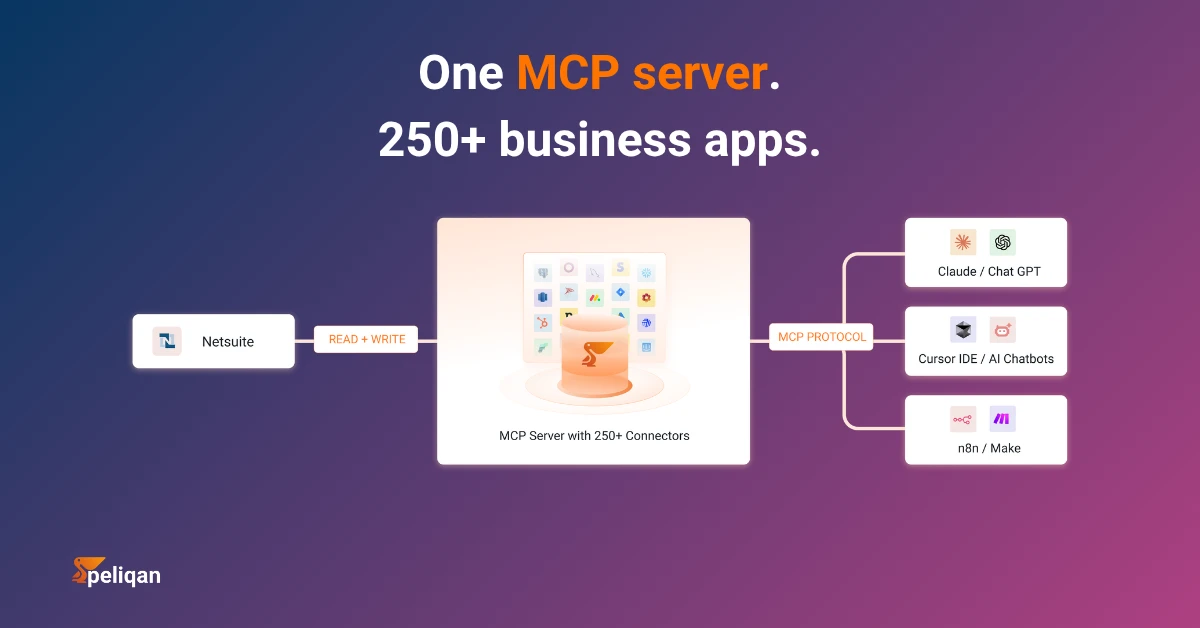
Peliqan syncs every NetSuite entity across every subsidiary – Customers, Vendors, Invoices, JournalEntries, Subsidiaries, Items, SalesOrders, PurchaseOrders, Employees, Projects, Departments – into a managed Postgres + Trino warehouse, queues all calls inside the governance framework, and exposes the cleaned tables to Claude, ChatGPT, Cursor, or any MCP client through the Peliqan MCP server.
Claude writes real Postgres SQL with full JOINs, window functions, and analytics. Moreover, writeback flows back through reverse ETL with a full audit log. Cross-source SQL joins NetSuite with Salesforce, HubSpot, Stripe, Exact Online, and 240+ other connectors. EU-hosted, SOC 2 Type II, GDPR-native.
Best for: PE-backed and mid-market CFOs running multi-subsidiary NetSuite at audit-grade cadence. See the NetSuite connector.
Comparison: 6 ways to connect NetSuite to AI
| Method | Real SQL JOINs | Multi-subsidiary | Cross-source | Auditable writeback | EU-hosted MCP |
|---|---|---|---|---|---|
| SuiteAnalytics + exports | SuiteQL only | Native | No | In-NetSuite | NetSuite hosting |
| Direct API + Python | Hand-rolled | Hand-rolled fan-out | Hand-rolled | Custom-built | Depends on host |
| Boomi / Workato | No | Per-flow setup | ETL-grade | Connector-dependent | Tenant-dependent |
| Zapier / Pipedream MCP | No | Per-flow setup | Event-only | Task-quota-capped | US-default |
| Composio / community MCP | No | Limited | Per-action | Partial | US-default |
| Peliqan MCP | Full Postgres SQL | All subsidiaries unified | SQL across 250+ apps | Full audit log | EU, SOC 2 Type II |
The NetSuite entities that matter most for CFO AI workflows
| NetSuite entity | What it powers | CFO AI use case |
|---|---|---|
| Subsidiaries | Legal entity master, currency, COA | Consolidation perimeter, currency translation, intercompany pairs |
| Customers + Vendors | Trading partner master | Concentration analysis, AR/AP triage |
| Invoices + Sales Orders | Revenue recognition, billing | Revenue rollup, DSO, deferred revenue |
| Journal Entries | GL postings with subsidiary + class | Anomaly detection, audit trail, segment P&L |
| Purchase Orders | Procurement commitments | Cash forecast, vendor concentration, AP timing |
| Items | SKU and product master | SKU profitability, inventory turn analysis |
| Employees + Projects | HR + project ledger | Utilisation, project margin, realization rate |
| Departments + Classes | Cost-center segmentation | Segment P&L, departmental cost analysis |
Decision framework: which NetSuite architecture fits your finance shape
Match the architecture to the company shape
The mid-market CFO playbook: 5 NetSuite + Claude workflows that change the cadence
The temptation with NetSuite + AI is to bolt a chatbot onto the dashboard and call it done. However, the actual value comes from compressing the workflows that recur every Monday, every close, every quarter-end. Five workflows repeat across the CFOs running this architecture.
1. Consolidated multi-subsidiary close
“Across all 12 subsidiaries, give me consolidated revenue, gross margin, and operating expense by entity, with intercompany eliminated, for the most recent close period.” That is one Postgres SQL query against a materialised consolidation table. In contrast, the same prompt against raw SuiteQL is multiple paginated calls per subsidiary and a manual elimination step. Cross-source joins in Peliqan handle the subsidiary-level rollup with currency translation preserved.
2. Cross-source: NetSuite revenue + Salesforce + Stripe
“For our top-100 customers by ARR, show me NetSuite invoice revenue, Salesforce pipeline coverage, Stripe payment health, and any Zendesk Sev-2 tickets, ranked by renewal risk.” That is a four-source join no single-system MCP can answer. Specifically, the warehouse holds all four sources side-by-side; therefore, the Claude prompt returns a prioritised retention list. Building AI agents in Peliqan covers the implementation pattern.
3. Anomaly detection on journal entries
“Flag any journal entry posted in the last 14 days that meets any of these: amount above $50k, manual post outside the close cycle, posting to an unusual GL account for the source subsidiary, or duplicate-looking entries within 24 hours.” This is exactly the workflow internal audit teams burn weeks on annually. Moreover, data quality monitoring handles the alerting layer for the patterns the controller wants surfaced automatically.
4. Vendor spend and concentration analysis
“For the trailing 12 months, show me total spend by vendor across all subsidiaries, with concentration ratios, payment terms, and any vendor whose spend has grown more than 30% YoY.” Vendor concentration is a quality-of-earnings dimension; consequently, PE owners and audit teams ask for it routinely. A warehouse-backed prompt returns it in seconds rather than days.
5. Working capital and cash forecast
“Build a 13-week cash forecast by subsidiary, joining open Invoices, open Purchase Orders, and Stripe payment timing for our SaaS subsidiaries.” That is the treasury workflow most mid-market CFOs do in Excel today. With a warehouse-backed NetSuite plus Stripe, on the other hand, it becomes a recurring prompt that refreshes daily.
How Peliqan handles NetSuite
What you get with the NetSuite MCP server on Peliqan
Why the warehouse-first architecture matters specifically for PE-backed CFOs
PE owners increasingly run portfolio-level dashboards. Consequently, a NetSuite tenant that takes hours to refresh a SuiteAnalytics workbook is no longer fit for purpose. A warehouse-backed MCP, by contrast, refreshes overnight (or on demand) and serves Claude in milliseconds. The general Claude MCP overview covers the protocol details for engineering teams evaluating the move.
Meanwhile, the main MCP hub covers the cross-source pattern across the entire connector catalog – including the ROI math for a typical PE-backed mid-market group and the comparison framing against Composio, Boomi, and Workato.
Where NetSuite + Claude fits in the broader revenue stack
For companies whose marketing runs in HubSpot, the HubSpot MCP write-up shows the marketing-to-revenue join in the same MCP context – CAC, MQL conversion, and revenue all flow into one Claude prompt.
Likewise, for European subsidiaries on Exact Online, the Exact Online MCP landing page covers the EU finance-side pattern that consolidates with NetSuite at the group level. The cross-source story (referenced in the decision framework above) scales directly when subsidiaries run different ERPs.
Implementation primitives that power the workflows
Materialized tables show how to stage NetSuite data once and serve it to Claude in milliseconds – critical for the conversational latency a CFO expects in a board call.
Similarly, multi-customer management covers the fan-out architecture for PE firms running NetSuite across portfolio companies with consolidated reporting at the portfolio level. Per-portfolio-company isolation and cross-portfolio aggregation both flow through a single MCP context.
Reverse ETL in Peliqan is the writeback engine that pushes AI-recommended corrections back into NetSuite with the audit log attached.
Additionally, alerting and messaging handles the proactive layer – journal-entry anomalies, vendor spend spikes, cash forecast deltas – that should post to Slack or email before they become exec-briefing problems.
For engineering teams that want to build their own
For engineering teams that prefer to roll their own MCP layer on top of NetSuite, the build MCP server guide covers the protocol details. However, for most mid-market and PE-backed CFOs, the Peliqan-managed NetSuite connector is the faster path – the schema, the governance-aware sync, the audit trail, and the cross-source joins all ship pre-wired.
Furthermore, the NetSuite AI page shows the live agent patterns for consolidation, anomaly detection, and vendor analysis – the three workflows that most often justify the architecture in the first quarter of use.
What CFOs and controllers should do this quarter
Three steps turn a NetSuite + Claude conversation from a slide into an operating model.
First, pick one cross-source question that has been stuck between finance and RevOps for a quarter – consolidated subsidiary reporting, vendor concentration, or working capital forecasting – and prove it can be answered from a single Claude prompt against a warehouse-backed NetSuite.
Second, audit your current MCP tooling against SOC 2 and EU AI Act requirements. Any US-hosted MCP serving an EU subsidiary is a future compliance gap; any wrapper without an audit log is a future deal-desk risk.
Third, document the audit log requirement now if you are PE-backed or in the IPO-prep window. The Big-4 audit team will ask, and the AI agent has to be defensible by design.
Finance operations is moving from monthly to daily decisioning, and NetSuite is the system of record that backs most of it for mid-market and PE-backed companies. Putting a warehouse and an MCP server between the ERP and the prompt surface is not optional anymore – it is the difference between a CFO who can answer cross-source questions in 60 seconds and one who promises an update by next Friday. The netsuite claude stack is the next operating-model change, and it is one short architectural decision away.