




The board question every Benelux CHRO and CFO will be asked in 2026 sounds simple: “Which of our project teams are most profitable, and how does that correlate with sick leave, attrition, and unfilled vacancies?” In a typical Dutch enterprise, the answer takes three departments and a week. HR opens AFAS. Finance opens AFAS. Sales opens AFAS. They each export, they each filter, they each merge in Excel, and by the time the answer reaches the boardroom it is already out of date.
AFAS is the only ERP in the Benelux that contains all of those answers natively – HR, payroll, finance, projects, CRM, workflow, all in one product – and yet it is the single most under-leveraged AI surface in the Dutch enterprise. This is exactly where afas claude, afas mcp, afas ai agent, and ai voor afas stop being slides and start being operating model. The shortest path from a multi-module AFAS environment to a Claude-grade answer is a warehouse – and the design choice now sits on the CHRO and CFO desks together.
More than 14,000 Benelux organisations run AFAS, and 3.8 million employees receive their monthly payslip through it. That is the largest single concentration of HR + finance data in the Dutch enterprise market. Three pressures converged in 2026 that turn AFAS from a system of record into a strategic AI surface. The EU AI Act enforcement window is open with fines of up to €35M or 7% of global turnover.
The Dutch Autoriteit Persoonsgegevens has been escalating BSN-related enforcement – the citizen service number is treated as exceptionally sensitive data even where standard GDPR allows broader processing. And the cross-source questions a CHRO and CFO need to answer in the same conversation have moved from quarterly to weekly. The blog you are reading is the playbook for getting AFAS into Claude without breaking BSN rules, without rebuilding the Get Connector layer for every new question, and without paying for a connector that only covers the HRIS slice of the platform.
What AFAS is, and why it sits at the center of every Benelux HR + finance stack
AFAS Profit at a glance
The single most under-stated thing about AFAS is the breadth of the platform. A Dutch mid-market company running AFAS for 1,200 employees has its payroll, its sales invoices, its project ledger, its CRM, and its case-management workflow all in the same tenant. That is the data integration story that every other enterprise had to build with five different vendors. The implication for AI is enormous: the cross-source questions a CHRO would ask of a Workday + NetSuite + Salesforce stack are already in one place in AFAS. The blocker is the API model and the BSN rules, not the data itself.
Why connecting AFAS to Claude is harder than it looks
Five constraints every AFAS AI project hits
The hidden engineering cost of an AFAS AI project is not pulling a single employee record. It is the sum of all five constraints above. A custom script that defines 30 Get Connectors for one team is fragile and unmaintainable when the next team needs 30 more. Apideck’s AFAS MCP server normalises the HRIS slice across providers but does not cover the finance, project, CRM, or workflow modules that make AFAS uniquely valuable in the first place. The CFO question “show me which clients are unprofitable AND understaffed” has no answer inside an HRIS-only connector.
The real cost of AFAS data silos
What slow AFAS reporting actually costs a Dutch enterprise
The hidden cost is not the time to run one report. It is the conversations that never happen because the data lived in three departments. The same planning often extends to international workforce expansion, where an EOR Pricing Guide can help finance and HR teams estimate employment costs before hiring across new markets. Cross-source AI on top of AFAS is the single highest-leverage change a Dutch CHRO and CFO can make together in 2026 – and the architecture decision is the same one both of them have to sign off on.
5 ways to connect AFAS to Claude
1. Manual exports from AFAS Profit
Run an existing Get Connector or built-in report inside AFAS, export to CSV or Excel, paste into a master sheet, send to the controller. It works for a single quarterly headcount review. It does not work for daily cross-source questions, it carries no BSN masking by default, and it never works for a Claude prompt.
Best for: One-off audits or single-module questions in small organisations.
2. Direct AFAS REST API with custom Python
Any data engineer can authenticate against the AFAS REST API and call GetConnectors and UpdateConnectors. The catch is the Get Connector tax: every new question needs a corresponding Get Connector defined inside AFAS first, with the right filter and field projection. A team that wants AI to answer 50 different cross-module questions is a team that needs 50 Get Connectors maintained by an AFAS admin – which is the exact role that is hardest to scale in Dutch mid-market.
Best for: A small fixed set of well-defined extracts.
3. Power BI or Tableau custom connectors
Dutch enterprises already running Power BI can hit AFAS via the same Get Connector mechanism and build dashboards. The model breaks the moment the question is anything outside the pre-built filters – cross-source joins fail, BSN masking is on the user to handle, and there is no Claude interface. Heavy refreshes still hammer the AFAS API and slow down workflows.
Best for: Static HR or finance dashboards for a single legal entity.
4. Apideck or CData MCP servers
Apideck ships an AFAS MCP server that normalises AFAS data into a unified HRIS schema. Same pattern from CData. Both are useful for pure HRIS use cases – employees, departments, time off – but neither covers the finance, GL, AR, project, CRM, or workflow modules that make AFAS uniquely valuable. They are also US-hosted by default, which is a non-starter for BSN-grade data residency.
Best for: Pure HRIS prototypes against the employee + payroll layer only.
5. Warehouse-first MCP platform (Peliqan)
Peliqan syncs every AFAS module – HR, payroll, absence, contracts, finance, GL, AR, AP, projects, CRM, workflow – into a managed EU-hosted Postgres + Trino warehouse, with column-level masking on BSN and salary fields. Get Connectors are abstracted: you sync once, query forever. The Peliqan MCP server exposes the cleaned tables to Claude, Cursor, ChatGPT, or any MCP client, and reverse ETL handles auditable writeback back to AFAS UpdateConnectors. Cross-source SQL joins AFAS with Exact Online, Teamleader, Billit, HubSpot, and 240+ other connectors in one query.
Best for: Benelux enterprises and holdings running AFAS as the all-in-one platform. See the AFAS MCP server.
Comparison: 5 ways to connect AFAS to AI
| Method | Module coverage | Get Connector overhead | BSN masking | Cross-source joins | EU-hosted MCP |
|---|---|---|---|---|---|
| Manual CSV exports | Any module manually | Per export | On the user | No | N/A |
| Direct API + Python | All modules | One Get Connector per question | Custom-built | Hand-rolled | Depends on host |
| Power BI / Tableau | Whatever you define | High | On the user | Limited | Microsoft tenant |
| Apideck / CData MCP | HRIS only | Provider-managed | Limited | No | US-default |
| Peliqan MCP | HR + finance + CRM + projects + workflow | Abstracted, sync once | Column-level masking | SQL across 250+ apps | EU, SOC 2 Type II |
The AFAS entities that matter most for cross-source AI
The entire AFAS surface is too wide for any single AI workload. For a CHRO + CFO playbook on a holding running Profit, eight entity families carry roughly 80% of the value.
| AFAS entity | What it powers | Cross-source AI use case |
|---|---|---|
| Employees + Contracts | Headcount, FTE, role, contract type | Capacity by team, attrition, span of control |
| Payroll + Compensation | Salary, allowances, payroll lines | Compensation drift, payroll cost by project |
| Absence + Sick leave | Leave records, sick days, reasons | Burnout signals, team-level absence trends |
| SalesInvoices + GLTransactions | Revenue, journals, ledger | Revenue per FTE, Peppol cross-check |
| Debtors + Receivables | Open AR, customer master | DSO, collections priority, churn risk |
| Accounts (CRM) | Customer relationship, ownership | Account health, partner workload |
| Projects + Activities | Project ledger, billable activity | Project margin, realization rate, WIP |
| Workflow + Tasks | Case management, approvals | Bottleneck detection, SLA breach risk |
Decision framework: which AFAS architecture fits your organisation
Match the architecture to the AFAS shape
The cross-source playbook: 5 AFAS + Claude workflows that change the operating model
The temptation is to bolt a chatbot onto AFAS and call it a programme. The value comes from the workflows that span modules and span entities – the questions the CHRO and CFO ask together but never get to answer together because the data is in three reports.
1. Sick leave × project profitability × pipeline in one prompt
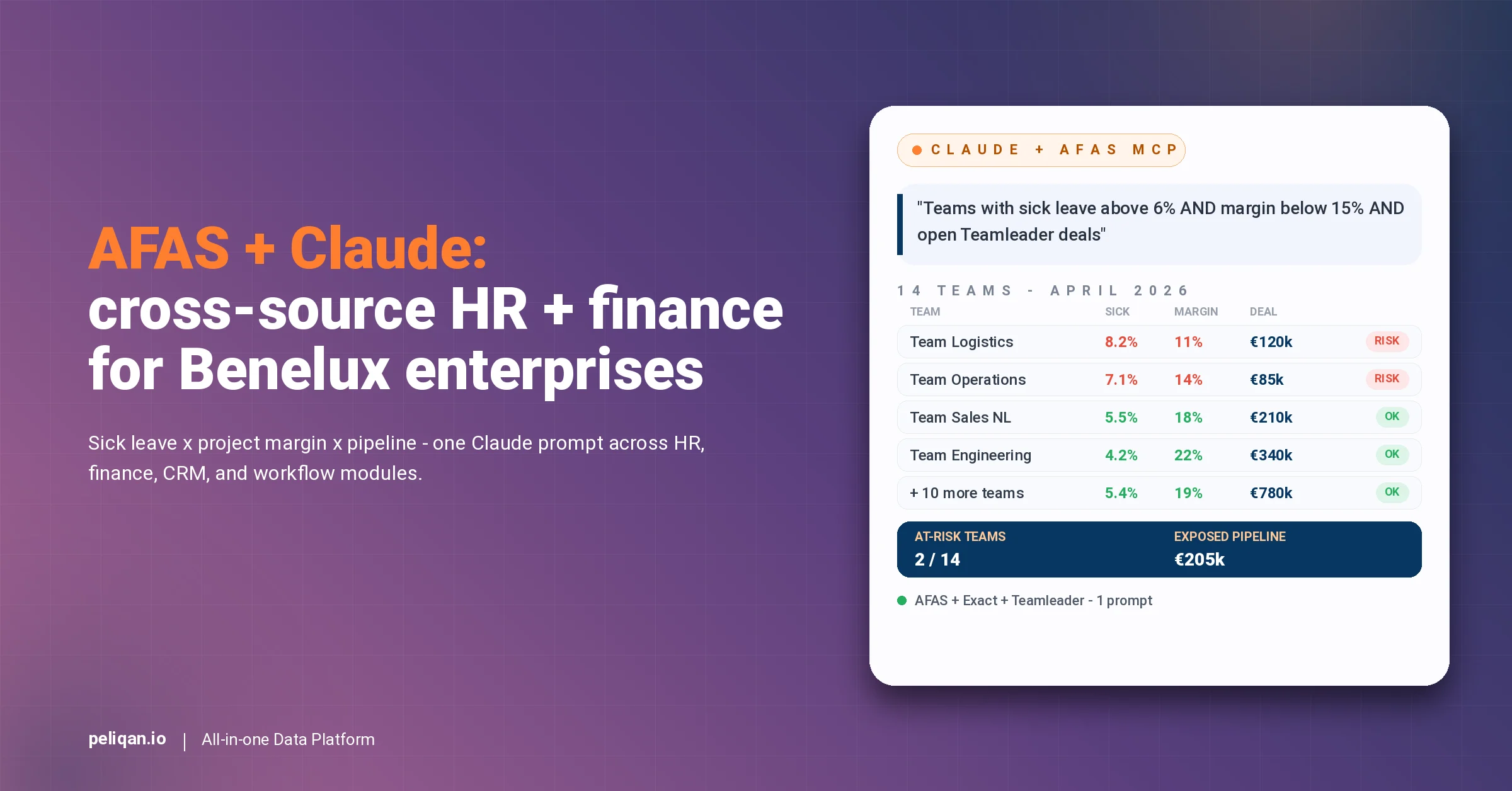
“Show me which project teams have sick leave above 6% AND project margin below 15% AND have open Teamleader opportunities at the same client.” This is the killer cross-source query. In a raw AFAS flow it is three exports and a manual merge. In a warehouse-backed Claude flow, it is one SQL statement. AFAS Absence joins to Projects joins to Employees joins to Teamleader Deals via the customer master. The CHRO sees burnout risk in the same prompt the CFO sees margin risk. Cross-source joins in Peliqan are the architectural unlock; no HRIS-only MCP can answer this.
2. Realization rate by team and by partner
“Across our practice, which teams are below 65% billable utilisation, and which client engagements have actual hours more than 20% above budget?” That joins AFAS Projects + AFAS Time + AFAS Employees with the original budget records. A Claude agent grouped by team and partner returns the prioritised review list, and the same agent can post a workflow task back to AFAS for the responsible partner.
3. Multi-entity HR consolidation across all AFAS environments
“Give me consolidated headcount, average tenure, and sick-leave rate across all 14 entities for April.” Each entity has its own AFAS environment. Each environment has its own Get Connectors. Peliqan’s multi-customer management fan-out covers all of them in one workspace and one MCP context, so the group CHRO can answer at the holding level in one prompt instead of 14.
4. BSN-safe AI for HR analytics
“Which departments have above-average sick leave this quarter, and who are the top 10 employees by sick days?” This is a legitimate HR analytics question – except that BSN, full names, and salary are exposed in the raw AFAS data, and the Dutch DPA has no patience for either careless exposure or vendor-side processing. Peliqan applies column-level masking on BSN and PII before the data is ever exposed to Claude. The AI agent sees a stable internal ID and the analytical fields it needs, never the BSN.
5. Peppol + AFAS reconciliation for cross-border Dutch sellers
Dutch enterprises selling into Belgium now have to clear Peppol for B2B invoices. AFAS GL knows what was issued; Billit (or another Peppol Access Point) knows what was delivered and acknowledged. A Claude agent with access to both can reconcile in real time and flag mismatches before they become VAT exposure. The Silverfin MCP playbook covers the audit-side join for accountancy firms doing the same work.
How Peliqan handles AFAS
What you get with the AFAS MCP server on Peliqan
The Peliqan AFAS MCP server is the shortest path from a multi-module AFAS environment to a CHRO + CFO operating model that uses AI in production rather than in pilot. The warehouse handles the slow, queued, audit-grade sync. BSN masking sits at the data layer, before any AI ever sees a row. The MCP server exposes the clean tables to Claude and any client. The reverse ETL closes the loop so writebacks flow into AFAS UpdateConnectors with a defensible audit log. And the cross-source layer means that when the CHRO and CFO want to ask a question together that spans AFAS, Exact Online, Teamleader, and the bank, that is one query. The Claude MCP overview covers the protocol details for engineers.
For Dutch enterprises already running Yuki for bookkeeping alongside AFAS, the same warehouse covers both. The Yuki Claude MCP write-up shows the bookkeeper-side pattern that joins natively to AFAS HR and payroll in the same MCP context. For groups whose Belgian subsidiaries use Silverfin for compliance workpapers, the cross-entity story extends seamlessly into the Silverfin layer.
The main MCP hub covers the cross-source pattern across EU SaaS, the ROI math for a typical Benelux mid-market enterprise, and the cost-of-doing-nothing framing that boards are asking for in 2026 budget conversations.
The materialized tables guide shows how to stage AFAS data once and serve it to Claude in milliseconds – critical for the conversational latency a CHRO expects when running cross-module questions in a leadership meeting.
For the Belgian leg of cross-border operations, Dutch enterprises invoicing Belgian buyers must clear Peppol on the Belgian side. The AFAS GL + Billit Peppol reconciliation is the same architectural pattern as the AFAS + Exact Online cross-source join – one warehouse, one MCP context, one Claude prompt that crosses both ledgers and the Peppol Access Point.
For deeper module-by-module coverage, the AFAS connector page lists every entity Peliqan syncs, the writeback matrix per endpoint, and the BSN masking rules that ship by default.
The AFAS AI page shows the live agent patterns for cross-source HR analytics, project margin reviews, and multi-entity consolidation – the three workflows that most often justify the architecture in the first quarter of use.
For Dutch enterprises that want to roll their own MCP server on top of AFAS, the build MCP server guide covers the protocol details. For most teams, the Peliqan-managed AFAS MCP server is the faster path – the connector and the BSN masking layer already exist.
Building AI agents in Peliqan covers the implementation pattern for the cross-source CHRO + CFO workflows – how to wire AFAS, Exact Online, Teamleader, and the bank into a single Claude context.
Reverse ETL in Peliqan is the writeback engine that pushes corrections back to AFAS UpdateConnectors with the audit log attached. Each write records the originating prompt, the user who authorised it, the source data, and the AFAS response – the exact trail an EU AI Act assessor or a Big-4 audit team will ask for.
Data quality monitoring covers the alerting layer for HR-side anomalies – sudden spikes in sick leave, contract drift, payroll variances – that should trigger a Slack or email alert to the CHRO before they become a problem.
What CHROs and CFOs should do this quarter
Three steps turn an AFAS + Claude conversation from a slide into an operating model.
First, pick one cross-source question that has been stuck between HR and finance for a quarter – sick leave by project profitability, partner realization rate, or multi-entity headcount consolidation – and prove it can be answered from a single Claude prompt against a warehouse-backed AFAS.
Second, audit your current AI tooling for BSN exposure. Any tool that touches AFAS data without column-level masking is a future Autoriteit Persoonsgegevens fine.
Third, classify your AFAS use case against EU AI Act risk tiers and document the audit log requirement now – not after the assessor arrives.
The CHRO and CFO functions in Dutch and Belgian enterprises are moving from monthly to weekly cadence, and AFAS is the data layer that backs most of it. Putting a warehouse and an MCP server between the platform and the prompt surface is not optional – it is the difference between a CHRO and CFO who can answer cross-source questions in 60 seconds, and one who promises an update by next Friday. The afas claude stack is the next operating-model change, and it is one short architectural decision away.