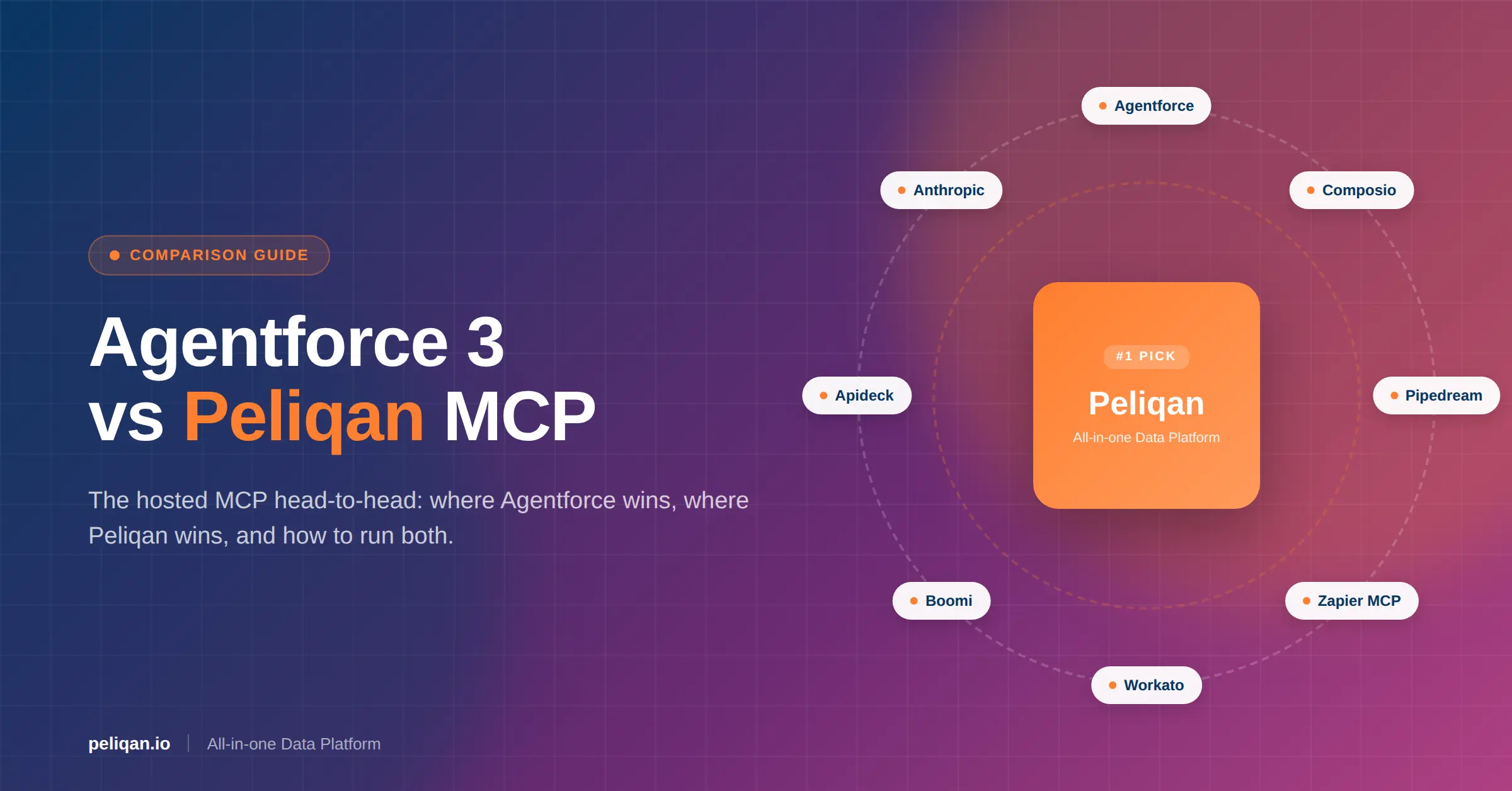





On April 29, 2026, Salesforce shipped its hosted MCP server to general availability. Ten months earlier, on June 23, 2025, Agentforce 3 launched with a native MCP client. Salesforce is now both an MCP host and an MCP server. So the comparison every EU CTO, CIO, and RevOps leader has to make in 2026 just changed. This post is the fair-frame head-to-head: where Agentforce wins, where Peliqan wins, and why most enterprises end up running both.
The SERP for “Agentforce vs MCP” is wide open in May 2026. Most ranking pages are Salesforce’s own developer documentation, a handful of partner setup guides, and customer-service-bot listicles that frame Agentforce as a chatbot category rather than an MCP architecture. So there’s no vendor-grade pillar that puts the hosted Salesforce MCP and a warehouse-first MCP side-by-side with pricing math, governor limits, and multi-org reality. That’s the gap this post closes.
The honest answer is cooperative. Agentforce is the natural incumbent inside Salesforce CRM. Peliqan is the cross-source layer that joins Salesforce data to everything else. Run both, layer them, and let each tool do what it was built for. Furthermore, the same cooperative pattern already shows up in our HubSpot MCP playbook.
The news hook: Salesforce is now an MCP host and an MCP server
Two announcements bracket the architecture shift.
Agentforce 3: June 23, 2025
Agentforce 3 launched with a native MCP client built in. Salesforce’s official press release: “Agentforce will include a native MCP client, enabling Agentforce agents to connect to any MCP-compliant server, no custom code required.” The same release introduced a unified agent gateway engineered by MuleSoft, the Command Center observability layer (GA August 2025), and AgentExchange expansion with AWS, Box, Cisco, Google Cloud, IBM, Notion, PayPal, Stripe, Teradata, and WRITER.
Salesforce Hosted MCP Servers: April 29, 2026
The hosted MCP server reached GA after a year of pilot and beta. Per the official Salesforce Developers blog: “Salesforce Hosted MCP Servers are now generally available, enabling AI agents to securely access your Salesforce data across every Enterprise Edition org and above.” The capability started as pilot in spring 2025 and beta in October 2025. Setup runs through Setup → API Catalog → MCP Servers, with an External Client App requiring the mcp_api and refresh_token scopes and OAuth 2.0 + PKCE.
Both modes now run simultaneously
So Salesforce has both modes. Agentforce can call out to external MCP servers (the client mode). Claude, ChatGPT, Cursor, and any other MCP-compliant client can call into Salesforce data through the hosted server. Both modes inherit the authenticated user’s CRUD, field-level security, and sharing rules. For a deeper setup walkthrough, see our existing Salesforce + Claude MCP cornerstone.
The April 2026 Salesforce MCP timeline at a glance
Where Agentforce wins
Agentforce is the strong, native, governed answer when the AI agent’s job stays inside Salesforce. The list of “inside Salesforce” use cases is real and non-trivial. For example, Service Cloud automation with deflection and case-summary bots, sales agents acting on opportunities and quotes, internal copilots for reps inside the Lightning UI, and customer-facing chatbots tied to Service Cloud identity.
The conversational AI layer is Einstein-grade
Salesforce ships a polished conversational stack out of the box. Atlas Reasoning Engine reaches 50% lower latency compared to January 2025 (Salesforce’s own benchmark, June 23, 2025). Response streaming is built in for real-time UX. The agent inherits Salesforce identity, field-level security, and sharing rules automatically. So you don’t rebuild the permission layer. For a pure-SFDC shop, that’s a real time-saver.
The Data Cloud + Agentforce 3 unified surface
Data Cloud (now Data 360) plus Data Cloud One gives Salesforce its multi-org story. Per Salesforce Admins: “With Data Cloud One, you can now connect multiple orgs to a central Data Cloud home org via a companion connection.” Each companion org gets a view of shared data spaces. It can also trigger AI, automation, and analytics through Agentforce. Furthermore, this works well for a single corporate brand running a few Salesforce orgs that already share data sovereignty rules.
$2/conversation pricing fits the existing SFDC budget
Agentforce pricing went through three iterations in 18 months. As of May 2026, three commercial models run simultaneously. First, conversations at $2 per customer-facing conversation with a 24-hour window. Second, Flex Credits at $500 per 100,000 credits (most actions consume 20 credits, so roughly $0.10 per action). Third, per-user add-ons starting at $125/user/month. Salesforce Foundations (Enterprise Edition or higher) includes 200,000 Flex Credits, 250,000 Data Cloud credits, and the first 1,000 service conversations free.
For a Salesforce shop with budget already allocated to the platform, that consumption model often fits the existing renewal cycle without separate procurement. The buyer signs an Agentforce add-on, not a new vendor.
When Agentforce is clearly the right answer
Where Peliqan wins
Peliqan wins everywhere Salesforce doesn’t reach. The lane is structural, not competitive. Indeed, Salesforce’s design centre is one Salesforce org plus tightly-coupled Data Cloud sources. Peliqan’s design centre is the warehouse-first cross-source pattern.
Cross-source SQL through one MCP endpoint
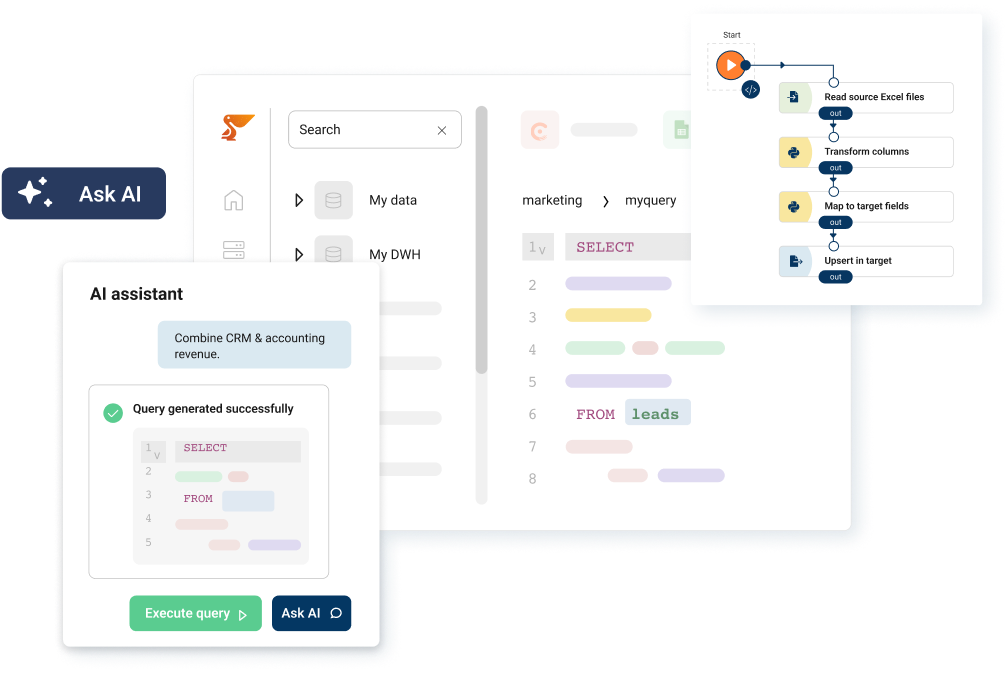
Peliqan syncs every source into a managed Postgres + Trino warehouse. Salesforce production, sandboxes, acquired orgs, Zendesk, Stripe, NetSuite, HubSpot, and 240+ others all land in one analytical layer with consistent foreign keys. The Peliqan MCP server then exposes the whole warehouse as a SQL surface to Claude, ChatGPT, Cursor, or even Agentforce itself. So a four-source JOIN becomes one SQL query, not a MuleSoft orchestration.
The SQL on anything documentation covers the federated-query pattern that makes this possible.
Furthermore, the warehouse materialization guide shows how heavy analytical workloads are pre-built rather than computed live against the source API.
EU-hosted, SOC 2 Type II, ISO 27001 certified
EU jurisdiction is structural in Peliqan, not optional. The platform is Belgian-headquartered, hosted on AWS Frankfurt, SOC 2 Type II certified, ISO 27001 certified, and GDPR-native by design. So Schrems II, FISA 702, and CLOUD Act exposure don’t apply to the cross-source layer. For financial services, healthcare, public sector, and any EU enterprise reading the new GDPR-compliant MCP servers reference, that’s a hard procurement requirement.
Multi-CRM consolidation in one query
Multi-CRM is the common reality, not the edge case. After acquisitions, mergers, regional autonomy, or simply different sales teams choosing different tools, most mid-market and enterprise companies run two or more CRMs. Salesforce plus HubSpot. Salesforce plus Pipedrive. Salesforce plus a legacy ACT! or Sugar instance the acquired company brought in.
Peliqan treats each CRM as a connector. The MCP server exposes the union. So an AI agent answers “show me every active opportunity across our Salesforce and HubSpot pipeline, ranked by ACV, last 60 days” as one SQL query. There’s no need for two API round-trips manually joined in the LLM context window.
Warehouse-first architecture means writeback to anything
The MCP server supports read and write (full writeback) across all 250+ connectors. So when the AI agent decides to update a Salesforce opportunity stage, it can also post a Slack message, create a NetSuite invoice, and update a HubSpot deal. All of those actions happen through the same audit-logged MCP endpoint. Reverse ETL handles the writeback layer.
For the broader architectural pattern, see our Postgres MCP setup guide.
Flat-rate pricing instead of per-action token explosion
Peliqan’s pricing is per-workspace, not per-conversation. Connect starts at €75/month for one user. Pro is €500/month for ten users. Enterprise is custom. The warehouse, all 250+ connectors, reverse ETL, and the MCP server are included. So the cost of a heavy analytical workload (the kind that runs 10,000 SQL queries against the warehouse for a board report) is the same as the cost of light usage. There’s no per-action meter that scales with AI agent volume.
When Peliqan is clearly the right answer
Run both, layer them: the cooperative architecture
The honest recommendation is to run both. Agentforce handles inside-Salesforce autonomous actions. Peliqan handles cross-source analytics that JOIN Salesforce data to everything else. The two layers don’t compete. They sit at different positions in the AI stack.
How the architecture actually looks
Agentforce 3 lives inside Salesforce. It runs service automation, in-app copilots, customer-facing chatbots. It reads Salesforce data through SOQL and writes back through Apex actions. It can call out to Peliqan as an external MCP server when a workflow needs cross-source data (“look up the customer’s last 30 days of Stripe payments before responding”). So Agentforce becomes the in-Salesforce surface, with Peliqan as one of the external MCP sources it consumes.
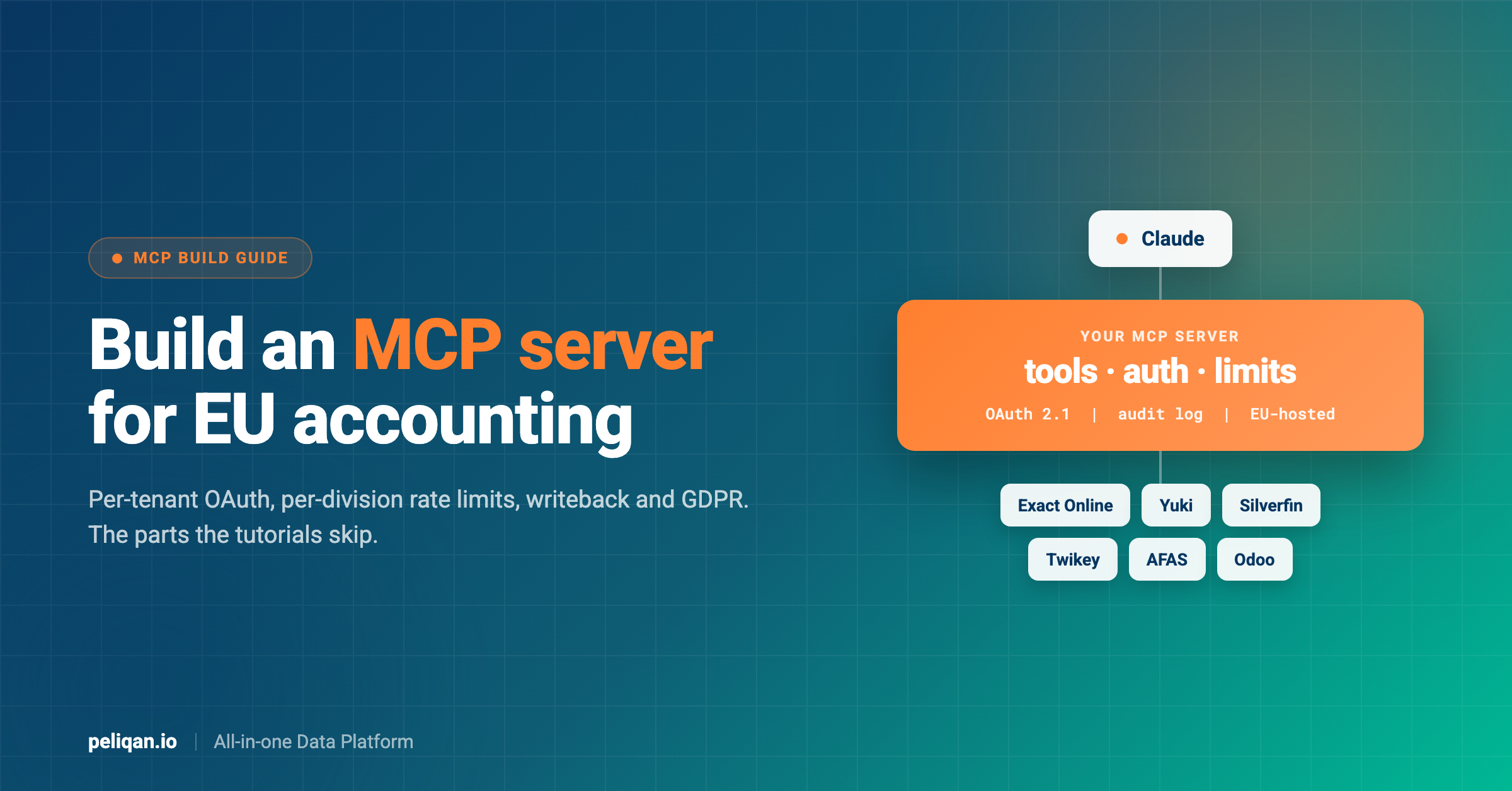
Peliqan lives at the cross-source layer. It exposes the consolidated warehouse to Claude, ChatGPT, Cursor, n8n, Make, and Agentforce itself through the MCP protocol. So the same Peliqan MCP server serves a Salesforce admin running a churn-risk analysis in Claude and an Agentforce action that needs Stripe history mid-conversation. One server, multiple clients.
The killer cross-source query Agentforce can’t do natively
Here’s the proof point. Suppose a CFO asks the following after Q1 board prep starts looking concerning: “Show me top-100 Salesforce accounts × open Zendesk Sev-1 tickets × Stripe failed payments × NetSuite multi-subsidiary revenue in last 60 days.”
In Agentforce, that query has three possible paths. First, MuleSoft turns each external API into an MCP-compatible action; per-call latency stacks up and there’s still no SQL JOIN, so the LLM has to reconstruct the JOIN in its context window. Second, Data Cloud / Data 360 connectors ingest external data; this works, but each source adds connector licensing, ingestion lag, and consumption costs that scale with row volume. Third, Salesforce Connect external objects expose external data through SOQL, but cross-object SOQL on external objects is shape-limited and joins across multiple external sources aren’t supported natively.
Furthermore, the Atlas engine has to make multiple sequential tool calls per source inside the Apex transaction budget. Per Atrium’s analysis of Agentforce limitations: “Synchronous Apex transactions triggered by an agent are limited to 100 SOQL queries and 150 DML statements… Agentforce enforces a strict 60-second action timeout; if a workflow exceeds this window, the action fails.” So a four-source JOIN on a 60-day window across thousands of accounts will time out. The alternative is a custom MuleSoft orchestration that effectively rebuilds the warehouse pattern by hand.
In Peliqan, the same query is one SQL statement against the warehouse with full window functions. The AI agent emits the SQL through the MCP endpoint, Trino executes it, results come back in milliseconds, and one audit-log entry captures prompt, user, payload, and source-system response. The cross-source MCP SQL cornerstone walks through this pattern with real query examples.
Pricing reality: per-conversation vs flat-rate
The pricing models are different shapes, which makes a direct comparison tricky. So let’s frame it as “what does it cost to answer the same volume of questions per month.”
Per Clientell’s independent 2026 analysis, typical mid-market Agentforce deployment lands at $6,650 to $18,800/month, including Data Cloud once Einstein 1 Studio licensing is layered on. Peliqan stays at €75 to €500/month for similar functional scope. Enterprise tier is custom for very large deployments. Furthermore, the MCP server pricing 2026 guide walks through the full TCO math across the vendor landscape. Salesforce’s pricing changed three times in 18 months, so verify rates with the Salesforce AE before any procurement decision.
SOQL governor limits: the structural ceiling on Agentforce analytics
Salesforce platform governor limits constrain how heavy an Agentforce workload can be against production CRM. The numbers come from the official Salesforce Developer Limits and Allocations Quick Reference, not from third-party speculation.
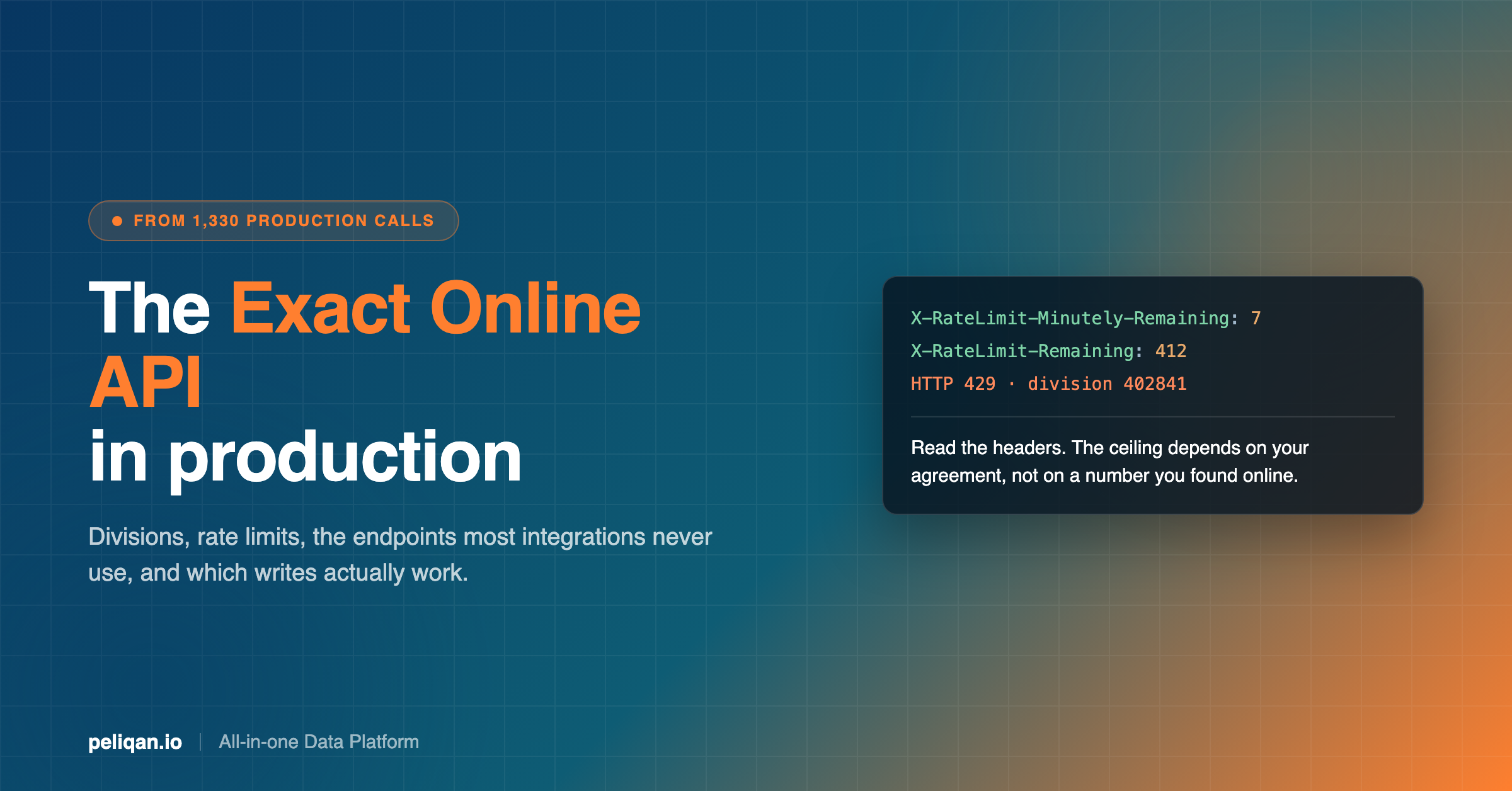
So the practical ceiling on heavy in-Salesforce AI analytics is real. Furthermore, the MCP rate limits guide covers the full set of governor and quota constraints across the major SaaS APIs that AI agents touch. For most read-heavy analytical work, the Peliqan pattern is to sync once into the warehouse and query Trino, leaving the Salesforce API budget for production Apex jobs and real-time integrations.
Multi-org Salesforce consolidation: where Peliqan unlocks scale
Multi-org is the killer Peliqan unlock. Indeed, Agentforce agents in a companion org can reach Data Cloud data shared from the home org through Data Cloud One. However, Agentforce itself is still scoped to one Salesforce org per agent. So a PE-backed parent with five acquired subsidiaries each running their own SFDC org cannot natively run one Agentforce agent that joins live pipeline across all five orgs.
The three official Salesforce options
First, consolidate orgs. Per CloudKettle and LeanData estimates, that’s a 4-to-8-month project with six-figure to seven-figure consulting costs depending on data complexity. Second, set up Data Cloud One with the home-org/companion-org model. This works for governed multi-org data sharing but each non-Salesforce source still needs its own Data Cloud connector and ingestion path. Third, layer an external warehouse-first MCP on top.
Why option three is the Peliqan pattern
In Peliqan’s architecture, every Salesforce org is just another connector. Production, sandbox, and each acquired subsidiary land in the warehouse with per-org isolation. Cross-org SQL (“show me every Opportunity stuck more than 30 days in Negotiation, ranked by ACV, across production and our two acquired orgs”) runs as a single Postgres query with UNION. The Peliqan MCP server exposes the consolidated view through one endpoint, with audit-logged writeback going back to the correct source org via reverse ETL.
Real-world example: CIC Hospitality
CIC Hospitality unified 50+ data sources across its multi-property portfolio (PMS, channel managers, POS, accounting, CRM) into Peliqan’s EU-hosted Postgres + Trino warehouse. The team eliminated manual Excel consolidation, saving more than 40 hours per month on automated board reporting. The architecture is the multi-property analog of the multi-org Salesforce problem. Each property’s stack is just another connector, every entity rolls up to one analytical layer, and the AI agent answers cross-property questions in a single SQL JOIN. Read the full CIC Hospitality case study.
Five buyer profiles and the right answer for each
The recommendation isn’t universal. So here’s the decision framework, organised by the most common buyer shape we see in 2026 deals.
For more on the SaaS scale-up pattern, see the Snowflake MCP governance reference.
Furthermore, the EU AI Act and MCP Article 26 reference covers the regulatory layer for the EU-jurisdiction-required profile.
The honest map of the MCP vendor landscape
Peliqan isn’t the only third-party MCP option. So here’s the fair-frame one-liner for each major player a Salesforce buyer might evaluate.
The MCP vendor map, fair-framed
- Anthropic Claude: The MCP protocol’s creator and the model layer most enterprise AI agents are built on. Anthropic donated MCP on December 9, 2025 to the Linux Foundation’s Agentic AI Foundation, co-founded with Block and OpenAI.
- Salesforce Agentforce 3: The incumbent inside Salesforce CRM. Native MCP client (July 2025 pilot) plus hosted MCP server (GA April 2026), enterprise-grade governance through MuleSoft and Data Cloud One. The right answer when the agent’s job stays inside Salesforce.
- Composio toolkit: US-headquartered agent tooling layer offering 1,000+ toolkits and 20,000+ tools via MCP or direct APIs, plus a Rube universal MCP gateway. Strong for dev-tool agents (Cursor, Claude Code). US-default hosting, no warehouse beneath.
- Pipedream MCP: Event-driven workflow automation with 3,000+ connectors and 5,000+ customers, becoming a Workday subsidiary (acquisition announced November 19, 2025). Strong for triggered workflows, not for cross-source SQL.
- Zapier MCP: The broadest SaaS catalog for workflow automation. US-headquartered, task-quota-capped, no EU-only data residency. Perfect for lightweight integrations and notifications, not analytical workloads.
- Peliqan MCP: Belgian, EU-hosted warehouse-first MCP. 250+ connectors land into a Postgres + Trino warehouse, one MCP server exposes the whole warehouse as a SQL surface to any MCP client, with audit-logged writeback through reverse ETL. The right answer when the agent’s job joins Salesforce to everything else.
For a deeper architectural breakdown of the third-party MCP options, see our 8-way MCP architecture comparison.
Furthermore, the Claude MCP setup playbook covers the protocol-level details every buyer should understand before signing a contract.
Peliqan’s posture on Salesforce specifically
Peliqan was built EU-hosted, warehouse-first, and cross-source from day one. So the procurement-checklist questions for a Salesforce buyer all have prebuilt answers.
How Peliqan handles the Salesforce-specific questions
The Peliqan Salesforce connector page covers the technical specifics.
For the full platform architecture, see the feature list and architecture documentation.
The bottom line on Agentforce vs Peliqan MCP
The Salesforce Hosted MCP GA in April 2026 didn’t end the third-party MCP market. Instead, it clarified the lanes. Agentforce 3 is the strong native answer inside Salesforce. The cross-source layer, the multi-org consolidation, the EU jurisdiction, and the predictable flat-rate pricing all sit outside Agentforce’s design centre. That’s where Peliqan was built to operate.
So the procurement question isn’t “Agentforce or Peliqan.” It’s “where does each one fit in our architecture.” For a pure-SFDC shop, the answer is mostly Agentforce. For a multi-CRM mid-market with EU jurisdiction, the answer is Peliqan plus optional Agentforce inside Salesforce. For a PE-backed group with five acquired subsidiaries, the answer is Peliqan as the consolidation layer with Agentforce running inside whichever orgs already have it deployed.
The cooperative architecture is the cheap procurement decision. Agentforce handles inside-Salesforce work. Peliqan handles the cross-source layer. Both speak MCP, both talk to Claude, ChatGPT, and Cursor, and both inherit the auth model of the system they’re reading from. So the next year of agentic work compounds on whatever architecture you set in May 2026. This is one of the few cases where the right answer is “use both, in the right places.”
This post is for informational purposes only. Salesforce Agentforce pricing has changed three times in 18 months; verify current rates with the Salesforce AE before any procurement decision. Article references reflect the consolidated Salesforce documentation and partner analysis as of May 2026.