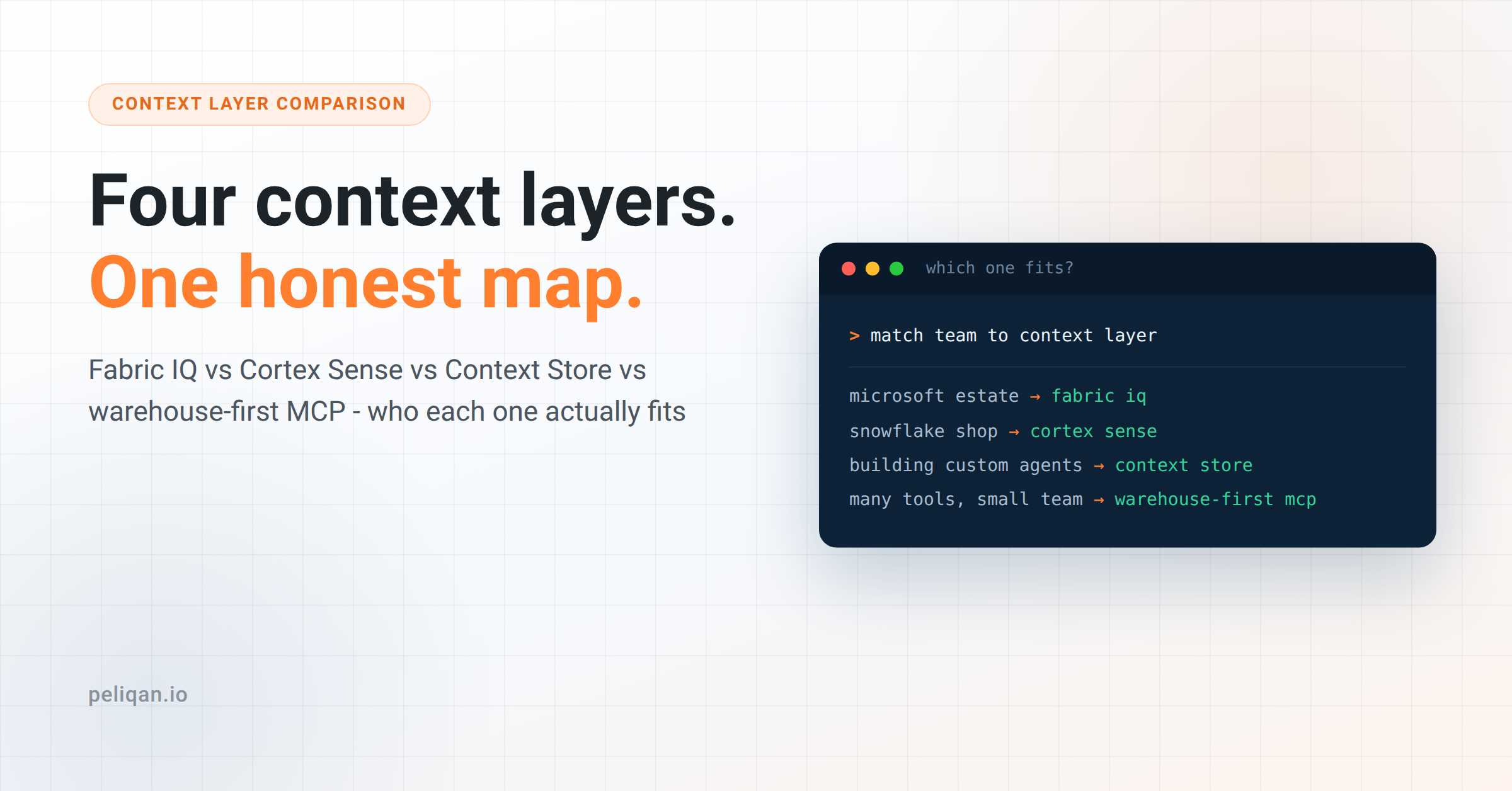





Three vendors launched a “context layer” within eight weeks: Microsoft’s Fabric IQ, Snowflake’s Cortex Sense and Airbyte’s Context Store. A fourth pattern – warehouse-first MCP – was already doing the same job under a different name. This context layer comparison explains what each one actually is, how they differ in architecture, and who each option honestly fits. Including when the answer is not us.
Between early May and mid-June 2026, the data industry agreed on something with unusual speed: AI agents fail on business data because they lack context, and the fix deserves its own product category.
Microsoft made Fabric IQ generally available at Build. Snowflake announced Cortex Sense at Summit the same week, alongside its acquisition of Natoma, an enterprise MCP platform. Airbyte had launched its Context Store a month earlier. Same idea, three architectures, one confusing set of pricing pages.
If you’re trying to choose, the marketing won’t help you – every vendor describes their option as the obvious one. So here is a context layer comparison built the other way around: what each thing actually is, and which situation it genuinely fits. We covered why agents need context at all in a separate post; this one is about picking.
The context layer comparison in one table
Now each one honestly, strengths first.
Microsoft Fabric IQ: the deepest, if you live there
Fabric IQ is the most ambitious of the four. It adds an ontology layer on top of Fabric’s semantic models: business entities, their relationships, the rules that govern them, and actions – connected to live operational signals, with Operations Agents working against that shared context. It went GA at Build in early June, so it is real, not a roadmap slide.
The honest fit: if your data estate runs on Microsoft – OneLake, Power BI, Dynamics – Fabric IQ is probably your answer, and a mid-market platform like ours is not going to argue otherwise. Ontologies plus live signals is genuinely the richest context model announced so far.
The equally honest caveat: that richness assumes someone authors and maintains the ontology, and the value concentrates inside the Microsoft perimeter. If your data lives in twenty SaaS tools and a Postgres database, Fabric IQ solves a problem you don’t have yet, at a price of adopting a platform you don’t run.
Snowflake Cortex Sense: the clever bet, not yet in your hands
Cortex Sense takes the opposite approach to Fabric: instead of asking humans to author context, it mines context automatically from your data estate, then runs a self-correcting loop to find gaps in its own understanding. Snowflake says standing up context this way took a day where manual authoring took months – their claim, but a plausible one, and they published the accuracy numbers that started this whole conversation: roughly 25% agent accuracy without a context layer, with Anthropic independently measuring 21%.
The honest fit: if Snowflake is already your warehouse, this is the path of least resistance – and you don’t have to wait to start, because Semantic Views are available now and Cortex Sense builds on that foundation.
The caveat: Cortex Sense was announced, not shipped. Verify availability before you plan a quarter around it. And like Fabric IQ, the value lives inside one vendor’s walls – the mining works on what’s in Snowflake, which means the real project is getting everything into Snowflake first.
Airbyte Context Store: the engineer’s pattern, early
Airbyte’s version is architecturally the most distinct: replicate data from your tools into a search-optimized index, so agents query a pre-assembled copy instead of orchestrating live API calls at runtime. Airbyte claims this cuts tool calls by around 40% and token usage by up to 80% – their numbers, not independently verified, though the direction makes sense: pre-assembled context is cheaper than runtime assembly.
The honest fit: teams with engineers building custom agent products, who want the data layer solved without adopting a full platform. It launched May 5 with 50 connectors, and credit where due – the CEO openly calls the product early rather than pretending otherwise.
The caveat is the same fact from the other side: early means the connector coverage, the tooling and the pricing model (metered Agent Operations) are all still moving. Metered agent pricing also deserves scrutiny before you commit – we wrote up how usage meters behave in our data pipeline pricing teardown, and agent operations are a new meter with the same old dynamics.
Warehouse-first MCP: the boring pattern that was already here
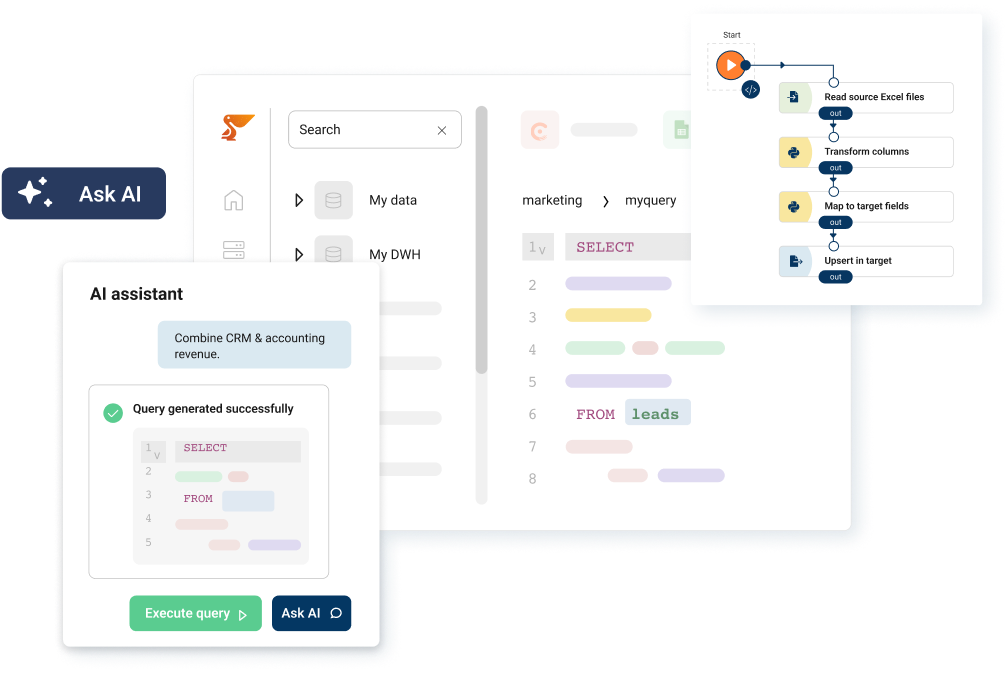
The fourth option predates the “context layer” label. Sync your sources into one warehouse, curate the tables, attach the metadata – descriptions, relationships, definitions – and expose the whole thing to AI over MCP with real SQL. The agent gets one queryable surface plus the meaning of what’s in it. We’ve written about this warehouse-first MCP pattern before; it is what Peliqan is.
In Peliqan’s case that means 300+ connectors feeding a built-in Postgres warehouse, so cross-source joins are a SQL statement, not an integration project.
The meaning travels with the data: a semantic model layer holds table and column descriptions, definitions and relationships, so agents work from curated tables plus what they mean.
Role-based permissions decide what each agent can see and do, and every read and write is logged.
Writes are supported too, through the staged, audited approach from our AI writeback post.
Hosted in the EU, with fixed per-connection pricing and no usage meter.
The honest fit: mid-market teams with data spread across SaaS tools, ERPs and databases, no data platform team, and a this-quarter timeline.
The equally honest caveats: the context here is curated tables and metadata, not Fabric-style ontologies with live operational signals – for a 50,000-person enterprise running on Microsoft, that is a real difference and Fabric wins it. And curation is still work: the platform gives you the place to put definitions, but someone on your team has to write them down. No entry in this context layer comparison removes that step, whatever the launch video implies.
How to actually decide
The context layer comparison collapses to four questions, asked in order:
- Is your estate already Microsoft or Snowflake? Then your context layer decision was made when you chose the estate. Fabric IQ or Cortex Sense respectively – fighting your own platform is a losing strategy.
- Are you building a custom agent product with engineers? Evaluate the replicated-index pattern with eyes open about its maturity – or build your own MCP server on infrastructure you already trust.
- Is your data in many tools and your team small? Warehouse-first MCP is the pattern built for exactly that shape.
- Is your data actually in one clean system? Then you may need no context layer yet – a documented schema and good prompts go further than any vendor will tell you.
And one rule that beats the whole comparison: write down your 20 core metric definitions before buying anything. That single document improves every option on this list, costs nothing, and tells you within a week whether your problem is tooling or unwritten knowledge.
What we’d watch next
This category is eight weeks old, so hold every conclusion in this context layer comparison loosely, including ours. The things worth tracking: whether Cortex Sense ships as described, how fast the Context Store’s coverage grows, whether Fabric IQ’s ontologies get adopted outside flagship accounts – and whether the category converges on MCP as the common interface, which the Natoma acquisition suggests even Snowflake believes.
If the warehouse-first pattern fits your shape, the fastest way to test it is with your own data: book a demo, connect two real sources, and ask the question your team asked yesterday. A context layer comparison on paper is useful; the one that matters runs on your tables.