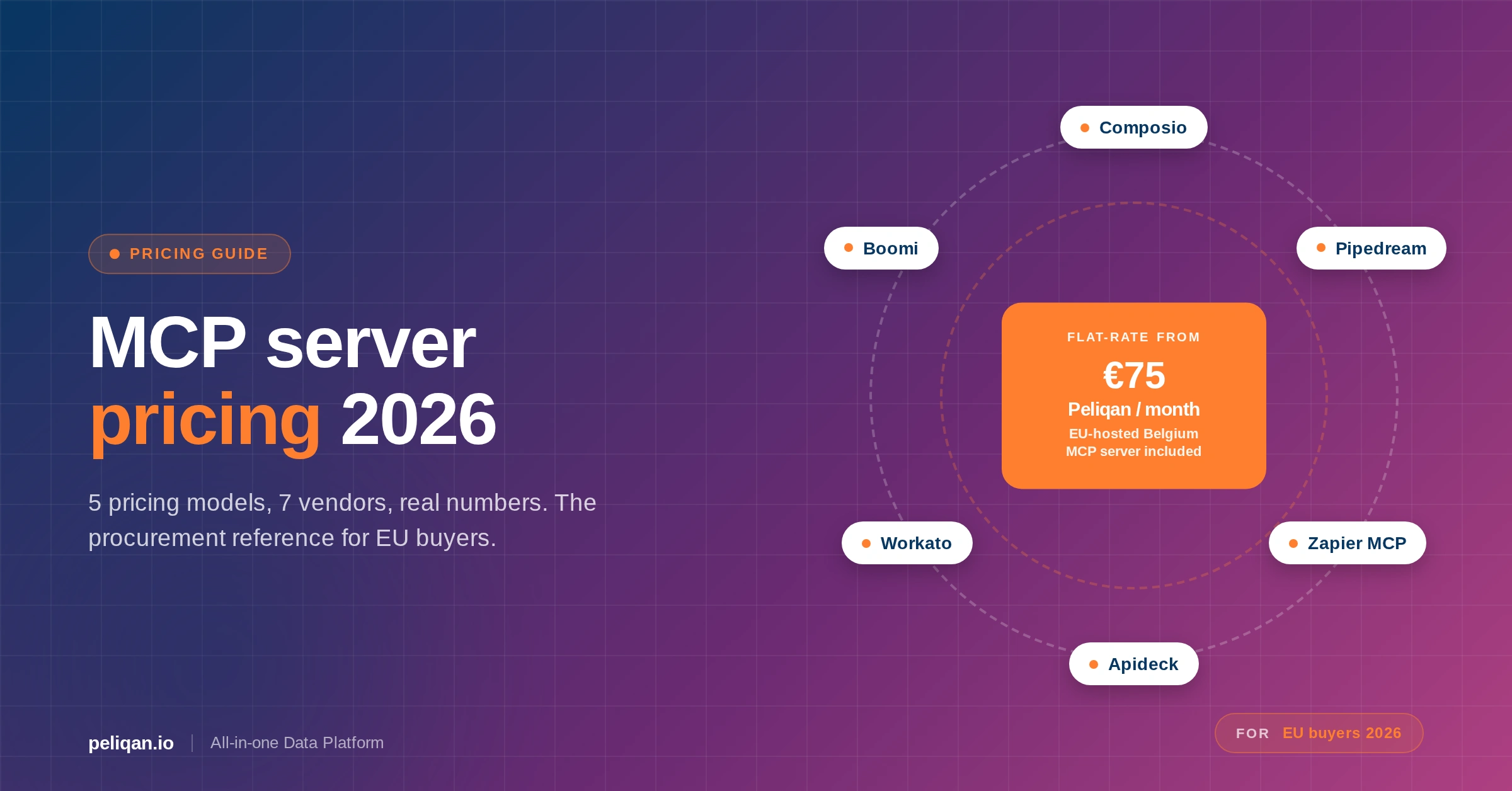





MCP server pricing is the most opaque line item in the 2026 AI agent stack. Five different vendors price five different ways – per tool, per call, per seat, per workspace, or flat-rate with warehouse included – and the headline sticker rarely matches what EU buyers actually pay after token costs, EU-hosting premiums, and overage charges land in the renewal invoice.
This guide is the procurement reference we wish existed when teams started budgeting Model Context Protocol (MCP) infrastructure. Furthermore, it pulls every public pricing signal we could verify (Vendr benchmarks, official pricing pages, G2, customer interviews) into one definitive comparison across seven vendors, layers the total cost framework most CFOs miss, and shows the buyer profiles that map cleanly to each pricing model.
Specifically, you will find real numbers: the $50,000-$130,000 Workato annual range Vendr publishes for mid-market, Boomi’s $1,200/month entry and $50k-$190k+ enterprise ceiling, Pipedream’s credit math at 10,000 monthly operations, Zapier’s 5-10x cost overhang on multi-step workflows at 50k tasks/month, and Peliqan’s €150/month annual flat-rate. Therefore, if you are comparing pricing before vendor calls, this is the spreadsheet you actually need.
What “MCP server pricing” actually means in 2026
The pricing question at a glance
Indeed, the headline pricing keyword “MCP server cost” hides a measurement problem. Specifically, you are pricing the platform, the connectors, the tokens, the storage, the dev time, and the maintenance window as if they were a single number. As a result, the only honest answer to “how much does MCP cost” is “it depends on which four of those six dimensions matter most to you this year.”
Why pricing models matter more than sticker prices
Five forces shaping MCP pricing this year
- Agentic loops scale unit costs: A single Claude conversation now averages 8-15 tool calls, so per-call and per-task pricing scale roughly 4x faster than headcount
- Token cost dwarfs platform cost: Mid-market teams running Sonnet across 12 connectors regularly burn €20k-€80k/year in Anthropic alone, before the MCP licence
- EU residency premiums: Most US-headquartered MCP vendors bolt 15-40% surcharges onto EU-region tenants when they offer the option at all
- Vendor lock-in via credits: Credit-pack pricing (Pipedream, Zapier) makes year-over-year cost forecasting nearly impossible compared to flat-rate models
- Procurement timing: Vendr data shows three-year commitments on Workato achieve 35-53% discounts versus annual contracts, but lock you into one architecture before MCP standards stabilise
Consequently, the pricing-model conversation matters more than the sticker price. By contrast, a $29/month workspace plan can cost $80,000/year at production volume, while a €150/month flat-rate can cost €1,800/year at the same volume. Therefore, get the pricing-model fit right first, then negotiate.
The 5 MCP pricing models, with named vendors
First, here are the five pricing models in the market today. Indeed, every MCP vendor uses one of these, sometimes blended. Furthermore, the model determines how your bill scales as agent traffic grows.
Model 1: per-tool (Composio)
Model 2: per-call / per-credit (Pipedream, Apideck)
Model 3: per-seat (Zapier MCP)
Model 4: per-workspace / per-recipe (Workato, Boomi)
Model 5: flat-rate with warehouse included (Peliqan)
The 7-vendor MCP pricing matrix
Furthermore, here is the apples-to-apples comparison. As a result, you can take this table into your next procurement meeting. All numbers reflect public pricing pages, Vendr benchmarks, or industry-reported ranges as of May 2026.
Note the 100x range between entry tiers and enterprise contracts on the same workload. As a result, the cheapest sticker is rarely the cheapest two-year total cost – because the cheap tier hits an overage ceiling or a feature wall inside the first six months. We unpack the per-vendor TCO calculation in our Apideck MCP alternative comparison.
The total cost of MCP: 5 line items most buyers miss
Specifically, the platform fee is one of five cost lines. Therefore, here is the framework we walk every CFO through when they ask “what does this actually cost?”
As a result, the platform fee is often 10-25% of total MCP cost at mid-market scale. Indeed, the token bill plus dev time dwarfs everything else. Furthermore, that math is the reason warehouse-first caching matters so much – it collapses the token line by 60-90% for read-heavy workloads. We detail the caching architecture in our cross-source MCP SQL cornerstone post.
Token economics: how a 100-tool MCP balloon kills your Anthropic bill
Specifically, every MCP tool definition consumes context-window tokens before Claude generates a single output token. Consequently, a connector pack that exposes 100 tools (Salesforce, HubSpot, Stripe, Slack, Zendesk, Notion, Linear, Klaviyo across multiple endpoints each) can chew 8,000-15,000 input tokens just listing the schemas. Furthermore, that fixed overhead fires on every single conversation.
Apideck’s own engineering team published a clean writeup on this dynamic in 2025 – the “MCP server eating the context window” problem. By contrast, the warehouse-first pattern collapses 100 connector-specific tools into 1-2 SQL tools that accept any source via federated query. Therefore, the same agent capability fits into a 200-token tool schema instead of 12,000 tokens. As a result, token cost per turn drops 80-95%, and Claude has more headroom to actually answer the question.
Moreover, the deeper rate-limit economics that compound with token spend live in our MCP rate limits guide. In short, if your MCP server makes 5 retry loops on a 429 cascade, you pay for 5 doomed Sonnet calls plus the eventual successful one.
Hidden costs: where MCP bills surprise EU buyers
The renewal-invoice landmines
- Per-seat creep: Year one you license 5 seats. By year two, 35 employees use Claude through MCP and the renewal is 7x higher with no architectural change.
- Overage charges: Per-task and per-credit plans bill 1.5-3x the per-unit rate on usage above the bundled quota. Furthermore, this hits hardest in months 9-11 when AI usage spikes before annual renewal.
- Support tier upcharges: Enterprise-tier SLAs, dedicated CSM, and 1-hour response times often add 15-25% to the base contract. As a result, your DORA evidence pack costs more than the platform.
- EU hosting premium: 15-40% surcharge from US-headquartered vendors for EU-region deployment when they offer it at all. By contrast, Peliqan ships EU-only Belgium hosting with no surcharge.
- SOC 2 evidence access: Some vendors gate the SOC 2 Type II report and DPA behind enterprise plans, which costs another 30-40% on top of pro tier.
- Writeback caps: Many MCP servers bill writes at 2-5x the read rate. Therefore, an agent that reconciles invoices and updates ledger entries hits cost ceilings 4x faster than a read-only equivalent.
Indeed, the EU hosting premium is the surprise that hits hardest. By contrast, Peliqan offers EU-hosted MCP with no surcharge as the default, with SOC 2 Type II and ISO 27001 in progress. The multi-customer management documentation covers the architecture for ISVs and partners running multi-tenant deployments.
The 4-question MCP procurement checklist
Ask every vendor these four questions before signing
- 1. What is the price unit? Per-tool, per-call, per-seat, per-workspace, per-recipe, or flat-rate. Furthermore, get the unit-economics math on a sample workload of 50,000 monthly tool calls across 8 connectors.
- 2. What triggers a tier scaling event? Specifically, find out the seat count, task count, or recipe count where the next tier auto-engages. Therefore, you can model the year-two renewal honestly.
- 3. Is there an EU residency surcharge? And what regions are available? In addition, ask for the exact data centre location, sub-processor list, and DPA terms.
- 4. What is the writeback rate vs read rate? Moreover, does the platform throttle or bill writes differently? Many vendors price writes at 2-5x the read rate.
As a result, the four answers give you a sample TCO that holds up under board scrutiny. Specifically, sample workload: 50,000 monthly tool calls, 8 connectors, 20 users, 60% reads / 40% writes, EU residency required, 6-month log retention. Indeed, run that workload through each vendor’s pricing model and the spread will surprise you. The deeper CFO framing lives in our MCP for the EU CFO persona post.
When the cheapest MCP costs the most
Three scenarios where the sticker price lies
- Free tier with tool gating: The platform is free, but the 3 connectors you actually need are enterprise-tier-only at $1,000+/month each.
- Per-task plan at scale: $19.99/month starter becomes €4,000+/month at 50,000 tasks. As a result, this is the canonical Zapier-vs-flat-rate trap teams discover in month 7.
- Custom enterprise quote: “Reach out for a custom price” usually means $50k-$130k/year for Workato or $50k-$190k/year for Boomi. Specifically, the negotiation tax adds 6-12 weeks to procurement before deployment can start.
Consequently, the cheap-on-day-one vendor frequently becomes the expensive-on-day-365 vendor. Therefore, build the two-year TCO before you compare stickers. Furthermore, the best MCP server comparison walks through head-to-head TCO at three different team sizes.
5 buyer profiles and their pricing fit
By contrast, the wrong profile-to-pricing fit is the source of most renewal surprises. Specifically, an EU mid-market team on a per-seat plan crosses the 30-seat line in year two and discovers the per-seat plan now costs 4x what the flat-rate alternative would. Furthermore, an ISV on Workato discovers the per-recipe meter charges differently for each customer tenant deployment. Therefore, model the worst-case workload twelve months out before you sign.
How Peliqan prices for MCP
What is included in the flat €150/month annual
Furthermore, the Article 26 logging and rate-limit buckets ship out of the box. As a result, your security team has a SOC 2 evidence pack ready for the next audit without extra contract negotiation. The EU AI Act and MCP compliance post covers the regulatory side. Moreover, the MCP for the EU CTO and CIO reference walks through the build-vs-buy framework most procurement teams need.
Real-world ROI: Ziggu
Ziggu, the Belgian proptech, runs Peliqan as their plug-and-play data marketplace across multiple SaaS sources and saves 200+ hours per integration on engineering time alone. Specifically, at a fully-loaded engineering cost of €80-€120/hour, that is €16,000-€24,000 in saved dev time per integration – which dwarfs the platform fee within the first integration. Furthermore, the same flat-rate covers every additional integration with no per-recipe meter.
Common pricing challenges and how to handle them
Challenge: vendor refuses to give a price without a discovery call
Specifically, this is a Workato and Boomi tactic. Therefore, push back with the Vendr benchmark range ($50k-$130k mid-market for Workato, $50k-$190k+ for Boomi) as your reference point. As a result, the vendor either confirms or beats the benchmark, which gives you the negotiating floor.
Challenge: per-credit plans make annual budgeting impossible
Indeed, this is the structural problem with Pipedream and Apideck pricing. Furthermore, model your worst-case month at 4x your typical volume, multiply by 12, and use that as the budget request. Consequently, you usually find a flat-rate alternative is cheaper at the worst-case ceiling, even when it looks expensive at typical volume.
Challenge: free tier looks attractive but enterprise tools are gated
By contrast, this is the Composio trap. Specifically, the free tier is fine for prototypes, but production SOC 2 and RBAC require custom-priced enterprise plans. Therefore, ask early about the price of the enterprise tier so you know what production looks like before you invest engineering time.
Challenge: EU residency premium is 30%+ on the headline price
Moreover, this is industry-wide for US-headquartered vendors. As a result, EU-native MCP platforms like Peliqan ship EU-only deployment at no premium because the architecture was built for it. Furthermore, the connect to data documentation covers how the EU-hosted setup actually works.
Conclusion: pay for the architecture, not the sticker
Indeed, MCP server pricing is genuinely confusing in 2026 because the market is in motion. Specifically, every vendor is repricing as MCP standardises, and the headline numbers will shift again in 2027. Therefore, the most defensible procurement decision is to anchor on the pricing model that fits your workload, not the sticker that fits your prototype budget.
First, the flat-rate-plus-warehouse model wins for predictable EU mid-market workloads. Second, the per-tool model fits dev prototyping. Third, the per-seat model fits small ops teams with simple automation. Fourth, the per-workspace iPaaS model fits large enterprises with dedicated integration teams. Finally, the per-call model fits ISVs embedding MCP into their own product. Furthermore, get the model fit right and the negotiation becomes routine.
Finally, if you want the flat-rate-plus-warehouse model for your EU MCP deployment without the per-tool, per-seat, or per-credit math, Peliqan starts at €150/month annual with 250+ connectors, EU-hosted Belgium, SOC 2 Type II, and ISO 27001. Therefore, book a demo and we will price-model your sample workload against your shortlist before the procurement meeting.