


MCP for CTO and CIO leaders is the architectural conversation that moved up the org chart in 2026. The Model Context Protocol (MCP) is no longer a side-project a senior engineer ships in a weekend – it is a Tier-1 dependency that has to pass security review, FinOps review, and EU regulatory review before it touches a customer-facing workflow.
The EU AI Act enters its Article 26 deployer phase on 2 August 2026. DORA went live for financial entities on 17 January 2025. NIS2 transposition deadlines have already passed in most member states. As a result, every EU CTO inherits three overlapping regulatory regimes at the same moment the engineering team wants to ship 10+ MCP servers across RevOps, Finance, Support, and Marketing.
This guide is the build-vs-buy reference we wish the MCP vendor websites would write. It covers the seven standing questions your board will ask, the five workflows that need your sign-off before production, the three failure modes that get CTOs fired, and the six-vendor comparison your security team will actually accept. Written for VP Engineering, Head of Platform, CTO, and CIO at €10M-€500M EU companies.
What MCP architecture for enterprise really means
MCP at a glance for CTOs
The phrase “MCP architecture for enterprise” hides a choice most teams make accidentally. The choice is whether your MCP layer owns the data path (queries land in a warehouse and Claude reads through SQL) or the action path (Claude triggers workflows that act inside one SaaS at a time). The production answer is almost always “both, layered” – but you need to decide which one your platform team owns and which one each business unit owns.
The shortest version: cross-source reads belong in a single data-plane MCP, in-system writes belong in workflow-plane MCPs, and the SSO plus audit-log surface has to live at the gateway, not the tool. We expand on this design pattern in our cross-source MCP SQL cornerstone post.
Why MCP matters for CTOs in 2026
Six forces converging on the CTO desk
- EU AI Act Article 26: Deployer obligations go live 2 August 2026 – human oversight, automatic 6-month logs, transparency to affected persons
- DORA live since Jan 2025: Articles 6 and 28 require ICT third-party mapping, RTO/RPO targets, sub-processor lists for every Tier-1 vendor
- NIS2 transposed: Article 21 raised the bar on access management, MFA, and incident reporting for essential and important entities
- Token cost lines: Power users running Claude across 12 connectors burn €400-€800/month each; no per-team attribution means no FinOps story
- Vendor sprawl: Enterprises end 2026 running 8-15 vendor-native MCP servers plus 1-2 horizontal platforms – unified observability is rare
- The build-vs-buy moment: A two-year build TCO often hits 2.6 engineer-months of fully-loaded effort per integration when the team scopes “one engineer-month”
The Article 26 question is not “did Claude run.” It is “show me the exact MCP tool call, parameters, source rows, prompt version, and model version for this customer decision dated 14 March 2026.” If your stack cannot reconstruct that in under 60 seconds, you have a gap. Our deeper EU AI Act and MCP compliance post walks through the logging schema that satisfies the regulator.
The 7 standing CTO/CIO questions about MCP
Every MCP architecture review we attend hits the same seven gates. Get the answers ready before the meeting, not during it. Each gate maps to one or more of the EU regimes above, which is why a single coherent architecture is cheaper than seven point answers.
1. Vendor sprawl: how many MCP servers do we actually need?
The platform question, not the procurement question
2. FinOps: who pays for the tokens, and how do we forecast?
A single power-user running Claude Sonnet across 12 connectors can burn €400-€800 per month in tokens. Multiply that by 80 employees and you have a six-figure line item that did not exist 18 months ago. Therefore, the CTO needs per-team, per-tool, per-workflow attribution by Q3 2026, or the CFO will cap AI spend across the board.
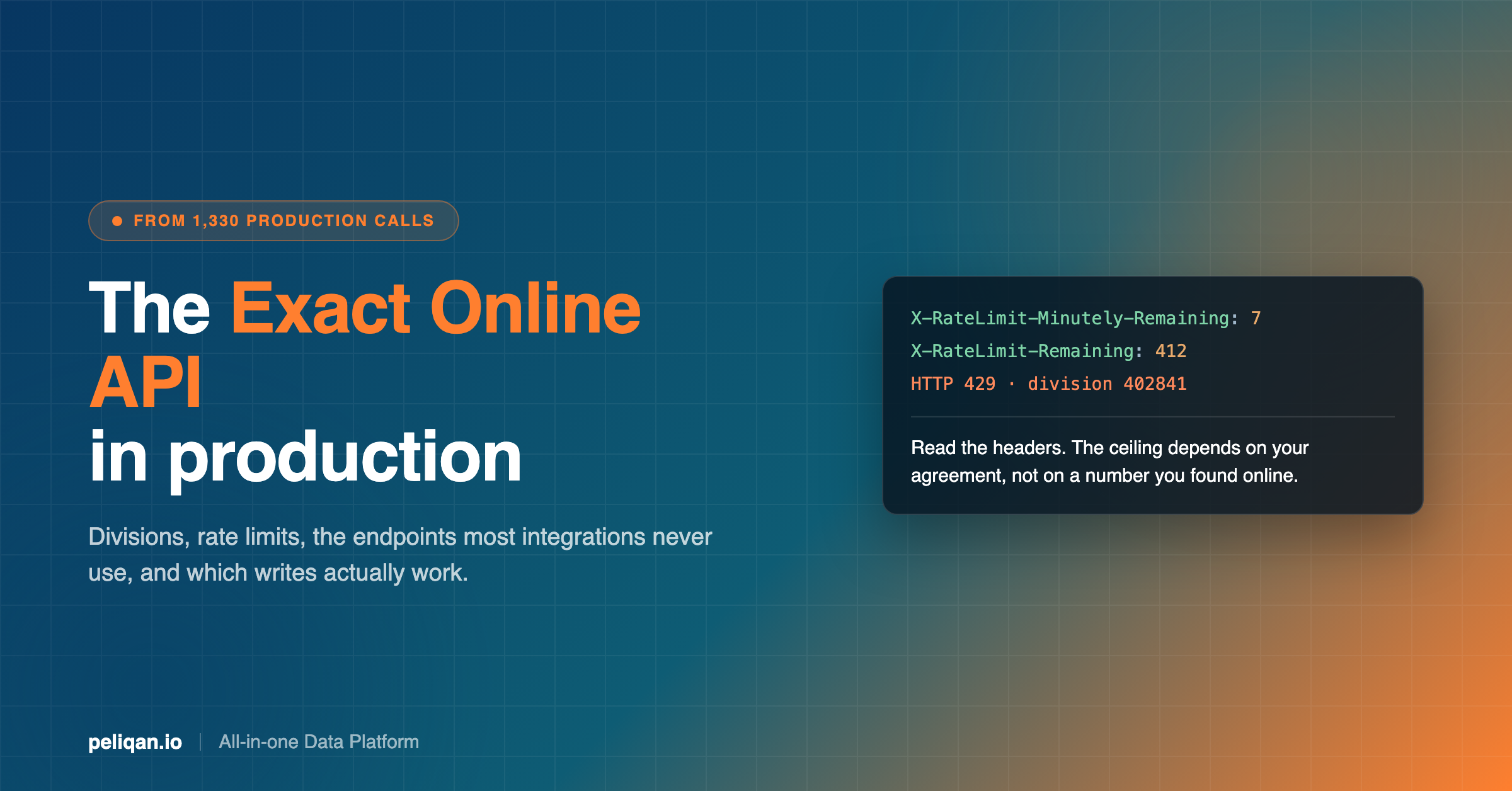
The FinOps controls that work are simple. Per-team budgets with hard caps. Alerting at 60%, 80%, and 100% of monthly budget. Warehouse-first caching for high-volume reads so that you pay each underlying SaaS API once per cache cycle, not per Claude turn. We catalogue the 12+ SaaS API ceilings and the caching pattern in our MCP rate limits guide.
3. Observability: can we trace a Claude answer back to its source rows?
Article 26(6) of the EU AI Act requires deployers to keep automatically generated logs for six months. The auditor’s question is not “did Claude run.” It is “show me the exact MCP tool call, parameters, source rows, prompt version, and model version for this decision.” If your stack cannot answer that in under 60 seconds, you have a gap.
The fix is structured logs per tool call. Tenant ID, tool name, parameters, source-rows hash, prompt version, model version, latency, cache-hit status. Peliqan emits these by default and pipes them to the customer’s existing observability stack. The data lineage documentation covers how each Claude answer ties back to the warehouse table and the source connector.
4. EU data residency: does the MCP server land EU customer data outside the EU?
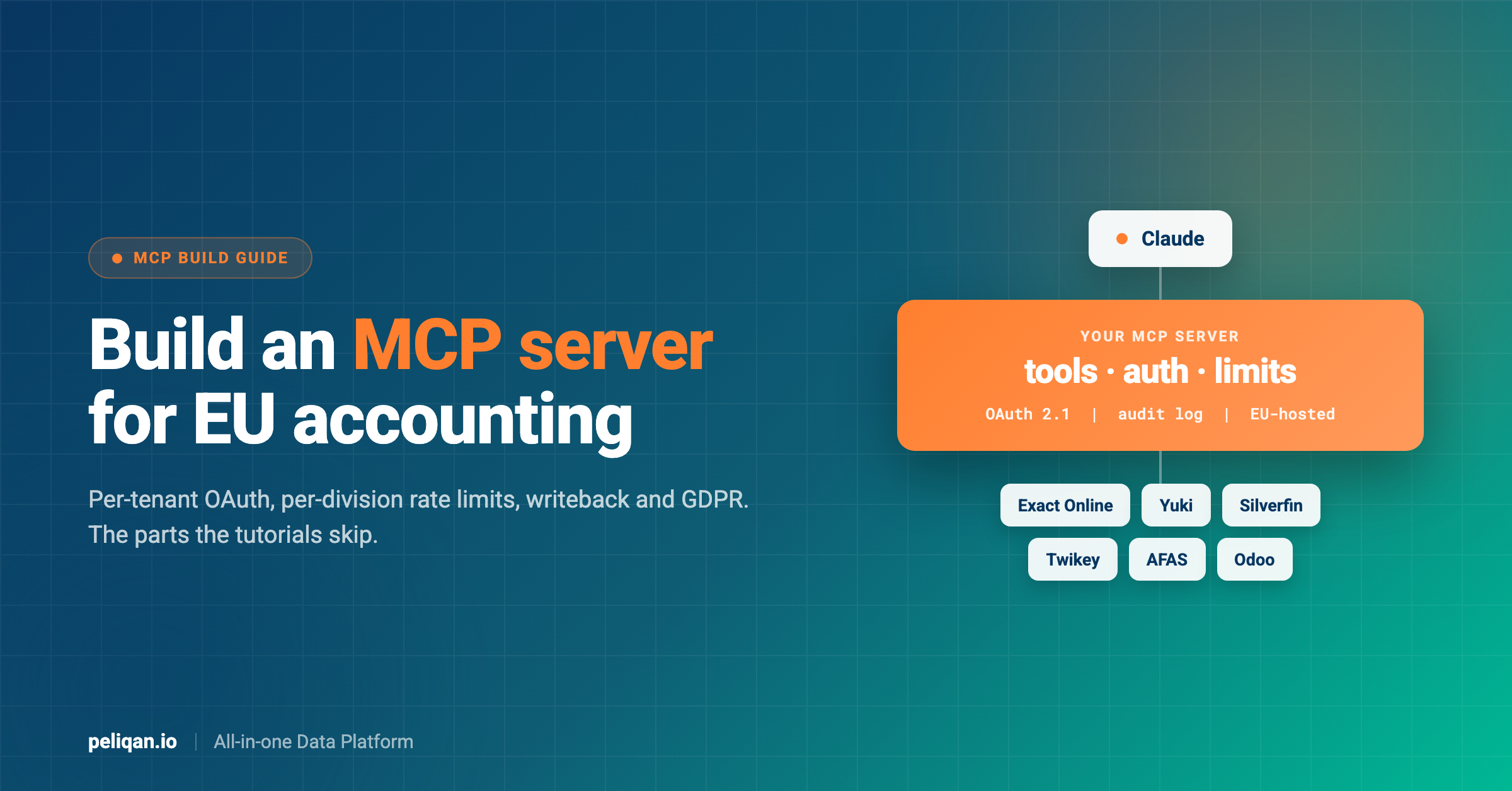
DORA Article 28 and Schrems II still apply. Most US-headquartered MCP vendors run on US-region infrastructure and ship data through US control planes. EU-hosted MCP platforms – Peliqan is Belgium-hosted – keep customer data in EU regions and offer DPAs that reference the right sub-processors. Ask for the sub-processor list and the data-flow diagram before you sign.
5. Writeback safety: how do we prevent Claude from writing the wrong thing?
The four-control writeback minimum
- Per-tool RBAC: Tools that write are tied to specific IdP groups, not the same group as read-only tools
- Dry-run mode: Every writeback tool ships a dry-run variant that returns the diff without committing
- Confirmation on destructive operations: Refunds, deletions, bulk updates require a second turn with a confirmation token
- Audit trail beyond the chat: Writes are logged outside the Claude conversation so they survive a context window reset
6. SLA and uptime: what happens when the MCP server goes down?
DORA Article 6 requires financial entities to map ICT third-party dependencies and define recovery time objectives. Your MCP platform is a Tier-1 dependency the moment Claude is in a customer-facing workflow. Therefore, demand 99.9% SLA, a public status page, incident postmortems, and a documented failover path. If your vendor cannot show those, your DORA submission has a hole.
7. Auth model: OAuth, SCIM, SSO, secrets – who holds what?
NIS2 raised the bar on access management for in-scope entities. The answer your security team expects: OAuth 2.0 for every SaaS, SCIM provisioning from Okta or Entra, SSO at the MCP gateway, secrets in HashiCorp Vault or AWS Secrets Manager, never in environment variables. If a vendor offers “long-lived API tokens” as the default, treat that as a red flag. The permissions and access control documentation covers the model Peliqan ships out of the box.
5 cross-functional workflows that need CTO sign-off
These are the five workflows we see hit a CTO’s desk before production. Treat them as the launch checklist. Each one fails differently when skipped, and each one is easier to design upfront than to retrofit after the first 200 employees are using Claude.
3 failure modes that get CTOs fired
We have triaged enough post-mortems to share the pattern. Each of these is recoverable if caught early. Each is career-defining if missed for a quarter.
Failure mode 1: vendor sprawl with no consolidated audit
Failure mode 2: no observability, cannot reproduce a Claude answer
Failure mode 3: token cost explosion from no caching layer
Cooperative architecture: data plane vs workflow plane
The single most useful mental model we have published for CTOs is the data plane / workflow plane split. They are not competing categories. The best architectures we ship run both, layered through one gateway.
Data plane (warehouse-first MCP)
Workflow plane (Composio, Pipedream, Zapier MCP, vendor-native)
The pattern matters for procurement. Buying a workflow-plane MCP without a data-plane MCP means every cross-source question becomes brittle pagination glue. Conversely, buying a data-plane MCP without a workflow plane means writebacks happen through SQL UPDATE statements that are harder to audit than vendor-native actions. As a result, both planes earn their seats.
The 3-regime EU convergence: AI Act + DORA + NIS2
By August 2026 every EU CTO inherits three overlapping regulatory regimes. Treat them as one program, not three. The artefacts overlap by design: data-flow diagram, sub-processor list, structured tool-call logs, RBAC, MFA, incident response plan, RTO/RPO target. Therefore an MCP architecture that satisfies Article 26 mostly satisfies DORA and NIS2 by construction.
For pan-EU operators dealing with Peppol e-invoicing in 2026 (Belgium January, France September, Italy SDI live, Germany 2027-2028), the same architectural artefacts power the e-invoice reconciliation flow. We dig into that overlap in our Pan-EU Peppol MCP post.
6-way MCP vendor comparison on CTO dimensions
The deeper per-vendor analysis lives in our Apideck alternative and Workato alternative breakdowns, with vendor-specific TCO and EU residency notes.
The CTO MCP maturity model
Where is your organisation on the curve? We use this maturity model in every CTO conversation. It helps the team agree on what “good” looks like 12 months out, instead of arguing about which vendor to pilot this week.
Most EU mid-market enterprises are sitting between Stage 1 and Stage 2 in mid-2026. The Stage 3 jump (adding the data plane) is where the architecture stabilises and audit becomes routine. We see this jump pay back inside two quarters because cross-source reads stop costing engineering tickets. The build AI agents documentation walks the technical setup end-to-end.
The CTO 90-day playbook
If MCP just landed on your roadmap
- Days 1-30: Inventory the SaaS estate. Identify the 5-8 systems that show up in every cross-functional question. Pick the data-plane vendor. Pilot with RevOps or Finance (most cross-source questions).
- Days 31-60: Wire structured logs into your observability stack. Stand up per-team token attribution. Run the security audit against SOC 2 plus AI Act checklists. Lock OAuth and SCIM through your IdP.
- Days 61-90: Add the workflow-plane MCP for action-heavy paths. Scale to three teams. Lock in per-team budgets. Publish the data-flow diagram for DORA and NIS2 evidence.
- Days 91+: Quarterly red-team exercise on MCP. Annual SOC 2 and ISO 27001 evidence refresh. Continuous deprecation tracking as vendors evolve schemas.
This sequence works because each phase produces a tangible artefact your board recognises. Phase 1 produces a pilot win and a data-plane vendor choice. Phase 2 produces an evidence pack for your SOC 2 auditor and CFO. Phase 3 produces the multi-team production rollout that justifies the investment. Skipping a phase usually means redoing it under audit pressure.
How Peliqan supports MCP for CTOs and CIOs
What ships out of the box for the technical buyer
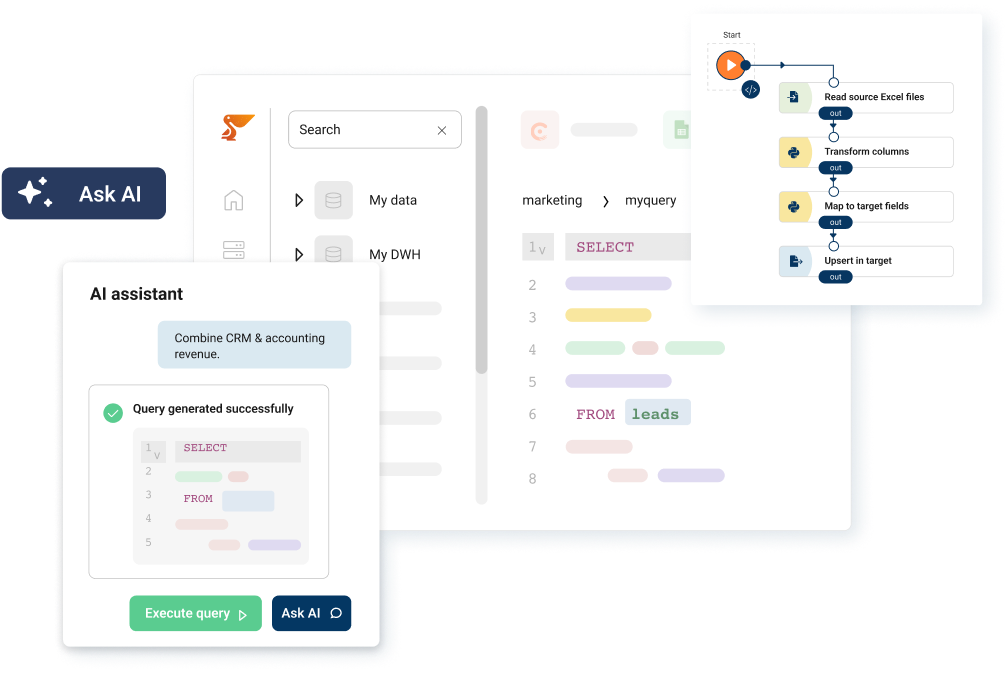
Peliqan was founded by Niko Nelissen and Piet-Michiel Rappelet, the team that previously built Blendr.io (acquired by Qlik). The platform combines a built-in data warehouse, low-code Python and SQL, reverse ETL, and an MCP server published as `pip install mcp-server-peliqan`. Open source connector-specific MCP repos for Exact Online, Teamleader, AFAS, Odoo, and PowerOffice live on GitHub. The feature list and architecture documentation covers the full surface in depth.
For multi-region and multi-tenant deployments the multi-customer management documentation shows the model that holds up under SOC 2 audit. Operations-heavy teams use the data quality monitoring patterns to alert on schema drift before it reaches a Claude conversation.
Real-world example: CIC Hospitality
CIC Hospitality runs 50+ data sources across multiple properties on Peliqan, saving 40+ hours per month on board report automation. The multi-property CTO story is exactly the cross-source pattern this guide describes – one data plane, many sources, audit-ready logs. Read the full case study.
Common challenges and how to handle them
Challenge: the security team blocks every new vendor by default
Start with the data-flow diagram and the sub-processor list. Most blocks come from “we do not know where the data goes.” A pre-prepared evidence pack with SOC 2 letter, ISO 27001 status, DPA, and a Trust Center URL shortens the cycle from six weeks to two. For Peliqan-specific evidence, the security team can request the SOC 2 Type II report and DPA from the sales contact.
Challenge: the platform team wants to build, not buy
Run the TCO honestly. A “one engineer-month” estimate for a custom MCP runtime is closer to 2.6 engineer-months of fully-loaded effort over two years (per industry benchmarks). Multiply by every integration on the roadmap. The build option is correct sometimes – usually when the data model is proprietary and the SLA is tighter than any vendor offers – but it is rarely correct for the SaaS-API plumbing that vendors already abstract.
Challenge: the CFO wants a hard cap on AI spend
Give them one. Per-team token budgets with hard limits at 100%, soft alerts at 60% and 80%, monthly chargeback report. The warehouse-first caching pattern (see the sibling MCP for the EU CFO post) turns most read-heavy workloads into a flat infrastructure cost instead of a variable token cost. The CFO usually accepts a hard cap once they see the cap actually holds.
Challenge: deprecation when a SaaS vendor changes a tool schema
This is the silent killer. A vendor renames a field, the MCP tool keeps returning data, but Claude’s interpretation drifts. The fix is contract tests against every MCP tool on every release, plus a regression suite that compares Claude’s answer to a known-good answer on a small set of golden prompts. The MCP for the EU RevOps leader post walks through how RevOps teams catch these drifts in production.
Build vs buy: the honest framework
When to build, when to buy, when to layer
- Build the workflow: If the workflow is your differentiator and the data model is proprietary, build it. Custom UX, custom logic, custom outputs.
- Buy the runtime: Auth lifecycle, credential vault, RBAC matrix, audit pipeline, observability. These are non-differentiating and time-consuming to build well.
- Buy the connectors: The N-to-N integration problem is what vendors exist to solve. Building a Stripe connector that survives schema changes is a quarter of engineering work you do not need.
- Layer the planes: Data plane (warehouse-first MCP) plus workflow plane (vendor-native or workflow platform MCP) plus your custom logic on top. Three layers, clean seams.
The summary version: buy the boring parts, build the differentiated parts. Engineering hours spent on auth lifecycle or token rotation are engineering hours not spent on customer-facing AI capabilities. Buy the plumbing, own the experience.
Conclusion: the CTO mandate in 2026
If MCP is on your roadmap and you are reading this, you have already accepted that the architecture conversation is the strategy conversation. The seven questions above are not a checklist – they are the lens through which every MCP procurement decision should pass. The five workflows are not theoretical – they are the launch path. The three failure modes are not hypothetical – we have triaged each of them this year.
The shortest path to a defensible MCP architecture in 2026 is the cooperative one. A warehouse-first data plane that handles cross-source reads, EU-hosted and audit-ready. A workflow plane that handles in-system writes, vendor-native or horizontal. One gateway for SSO and structured logs. Per-team FinOps from day one. A 90-day playbook that produces an evidence pack your auditor, your CFO, and your board recognise.
If you want to see the data-plane half of that architecture in production, Peliqan is purpose-built for it. EU-hosted, SOC 2 Type II, Article 26 logging out of the box, 250+ connectors, Trino-backed federated SQL, fixed pricing from €150/month annual. Book a demo with our team to walk through the data-flow diagram with your security lead in the same call.