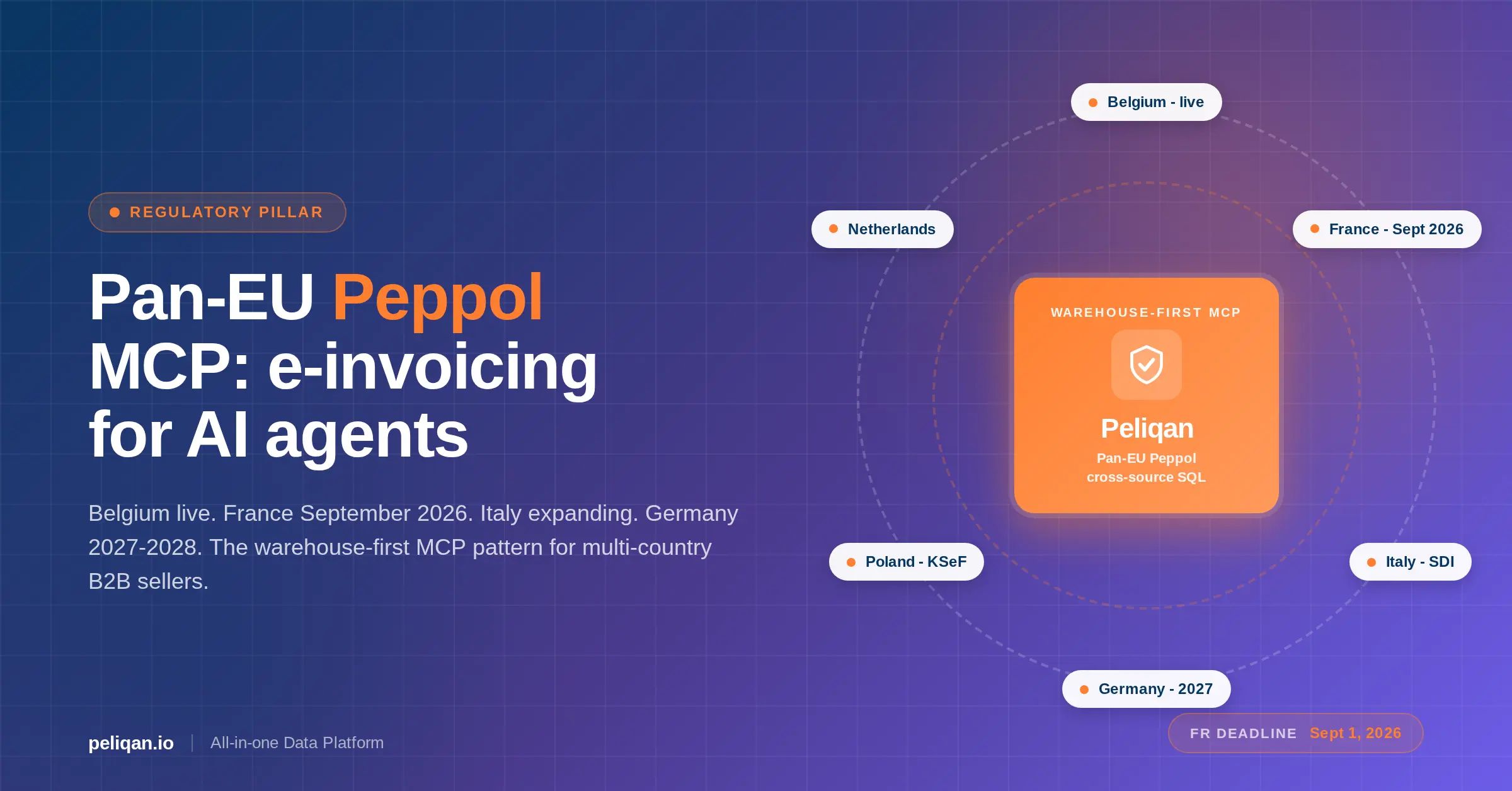





Belgium switched on B2B Peppol in January 2026. France switches on in September 2026. Italy is expanding SDI to inbound Peppol. Germany is finalising 2027-2028. Most EU B2B sellers face at least one mandatory e-invoicing regime per country by Q3 2026 – and any AI agent that reads or writes to those invoices needs an architecture that survives the regulatory audit. This is the third regulatory pillar in the Peliqan MCP cluster, after GDPR and the EU AI Act. It covers the pan-EU Peppol timeline, the AccessPoint plus SML plus SMP architecture, and the cross-source MCP pattern that joins Peppol delivery status to ERP, CRM, and payments data in one Claude prompt.
The pan-EU Peppol timeline matters more than most CFOs realise. Specifically, Belgium’s mandatory B2B Peppol went live on January 1, 2026 with a conditional three-month tolerance period. Furthermore, France’s mandate hits September 1, 2026 for receiving and for large-to-mid enterprises sending. Moreover, Italy’s SDI has been mandatory since 2019 and is now expanding to inbound Peppol. As a result, multi-country EU B2B sellers face overlapping regimes with different formats, different validation rules, and different acknowledgement layers.
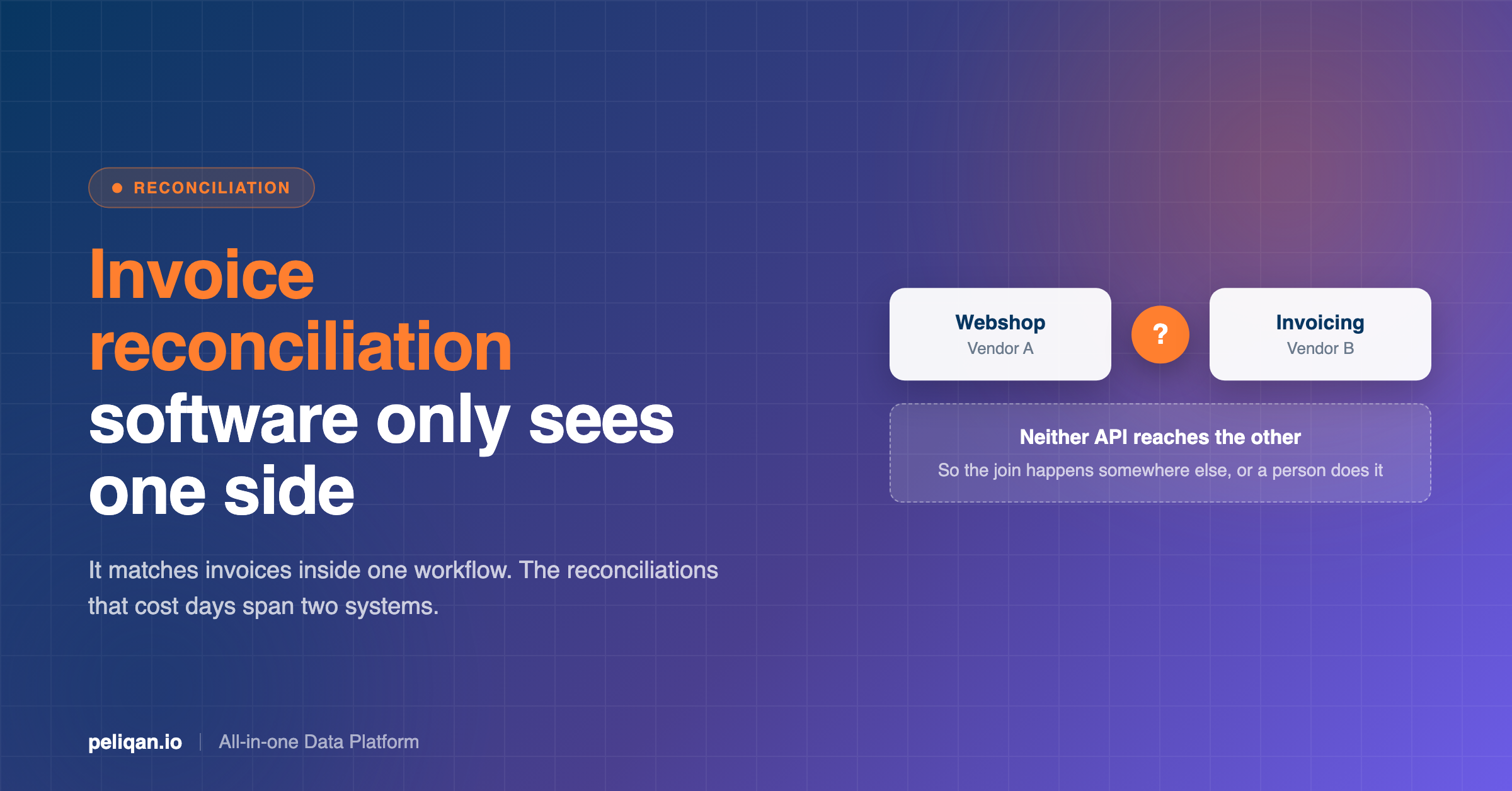
Existing AI agent tooling around Peppol is sparse. Indeed, e-invoice.be shipped 12 read-only MCP tools for Claude, Cursor, and VS Code that let agents inspect invoices and look up Peppol participants. However, no vendor has shipped a pan-EU MCP pillar that covers the cross-source question: “which invoices did not deliver across all our AccessPoints, by country, this month?” That is the warehouse-first MCP pattern’s home turf, covered in detail in the cross-source MCP cornerstone.
This is the post that closes the gap. It anchors on the existing Belgian-specific Billit Peppol playbook published earlier in this cluster, then expands to every EU country with a 2026-2028 mandate. Furthermore, it covers the AccessPoint architecture every EU SMB needs to understand by Q3 2026.
The pan-EU Peppol timeline every CFO needs in 2026
Country-by-country Peppol mandate dates
Two practical points stand out. First, Belgium’s penalties are real. Specifically, fines run €1,500 to €5,000 per offence plus 60-100% proportional to VAT. Furthermore, both sender and recipient face the obligation. Second, France’s “Y-model” architecture differs from Belgium’s. Indeed, France routes invoices through certified Partner Dematerialization Platforms (PDPs) while the Public Portal (PPF) acts as a directory and data concentrator. As a result, multi-country sellers must understand both architectural patterns.
The five Peppol entities every AI agent must understand
Peppol’s distributed architecture has five components that determine how invoices flow and how AI agents track them. Each one has a specific function.
1. AccessPoints (APs). AccessPoints are the certified gateways that connect to the Peppol network. Specifically, the sender’s AP converts the native invoice into Peppol BIS Billing 3.0 format. Then it routes the invoice to the recipient’s AP through the Peppol network. Furthermore, the AP returns the delivery acknowledgement to the sender. Billit is dominant in Belgium with 120,000+ businesses and 2 million+ invoices per month. Storecove serves 40+ countries from the Netherlands. Pagero, Tradeshift, and EDICOM cover larger enterprise scope.
2. SML (Service Metadata Locator). The SML is the discovery layer that points to where a participant’s metadata is stored. Specifically, when an AP needs to send an invoice, it first queries the SML to find the recipient’s SMP.
3. SMP (Service Metadata Publisher). The SMP provides the actual delivery address and the document types the recipient can accept. Furthermore, it advertises which Peppol BIS specifications the recipient supports. Together, SML and SMP make participants discoverable across the Peppol network.
4. UBL 2.1 / Peppol BIS 3.0. Peppol BIS Billing 3.0 sits on top of UBL 2.1 with a CIUS (Core Invoice Usage Specification) over EN 16931. Specifically, this is the canonical invoice format the AP converts to. Moreover, per-country validation rules apply on top.
5. Message Level Response (MLR). The MLR is the delivery acknowledgement layer. Specifically, the recipient AP returns a signed receipt after accepting the document. Furthermore, the buyer optionally sends an Application Response (Invoice Response) to communicate processing status. For AI agents, the MLR is critical because Peppol delivery is asynchronous – send-then-MLR-comes-back. Indeed, agents that do not track MLR cannot know if an invoice actually delivered.
Why MCP matters for Peppol e-invoicing
Three architectural realities make MCP a natural fit for Peppol-related AI agents in 2026.
First, asynchronous delivery requires state tracking. Specifically, the agent that sent the invoice must come back later to check the MLR. Furthermore, sequence matters: send, wait, check MLR, optionally check Application Response. Therefore, the MCP server needs persistent state, not just stateless tool calls. The warehouse layer beneath the MCP solves this naturally.
Second, multi-country sellers run multiple AccessPoints. For instance, a Belgian holding with French and Dutch subsidiaries probably uses Billit for Belgium, Storecove for cross-EU, and one PDP for France. Indeed, “show me every invoice not acknowledged within 48 hours across all our APs and all our entities” is the question no per-AP MCP can answer alone.
Third, the reverse-ETL writeback path matters. Specifically, when an invoice rejection comes back with a UBL validation error (BR-CO-25, UBL-CR-414, or similar), the AI agent needs to fix the issue and re-send through the AP. Furthermore, every fix and re-send needs an audit log entry. As a result, the EU AI Act’s Article 26 obligations layer naturally on top of the Peppol workflow.
How Peliqan adds the pan-EU MCP layer for Peppol
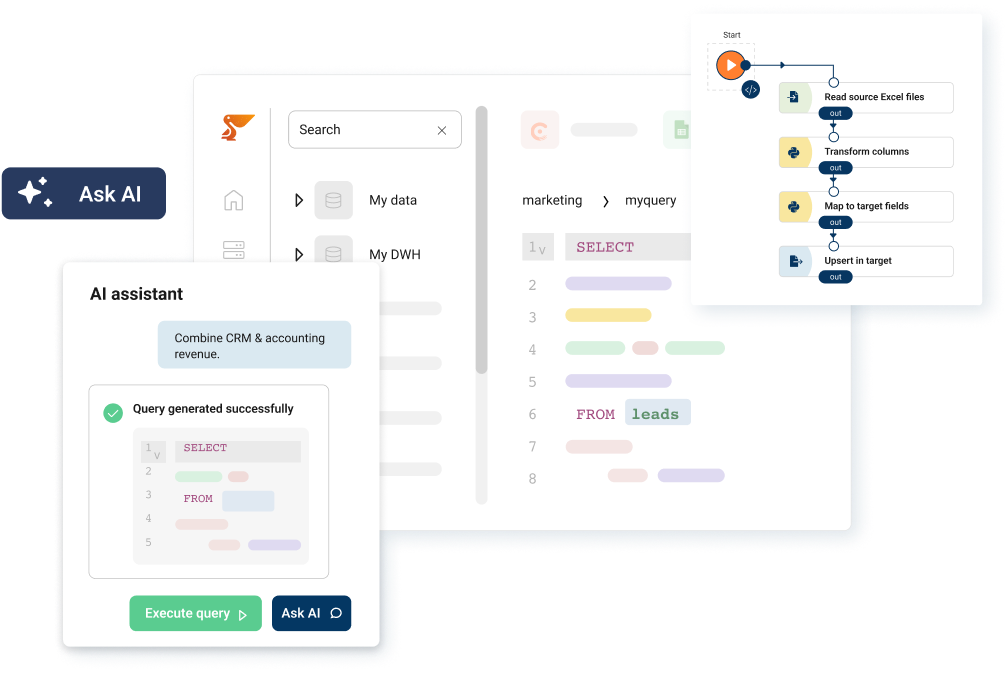
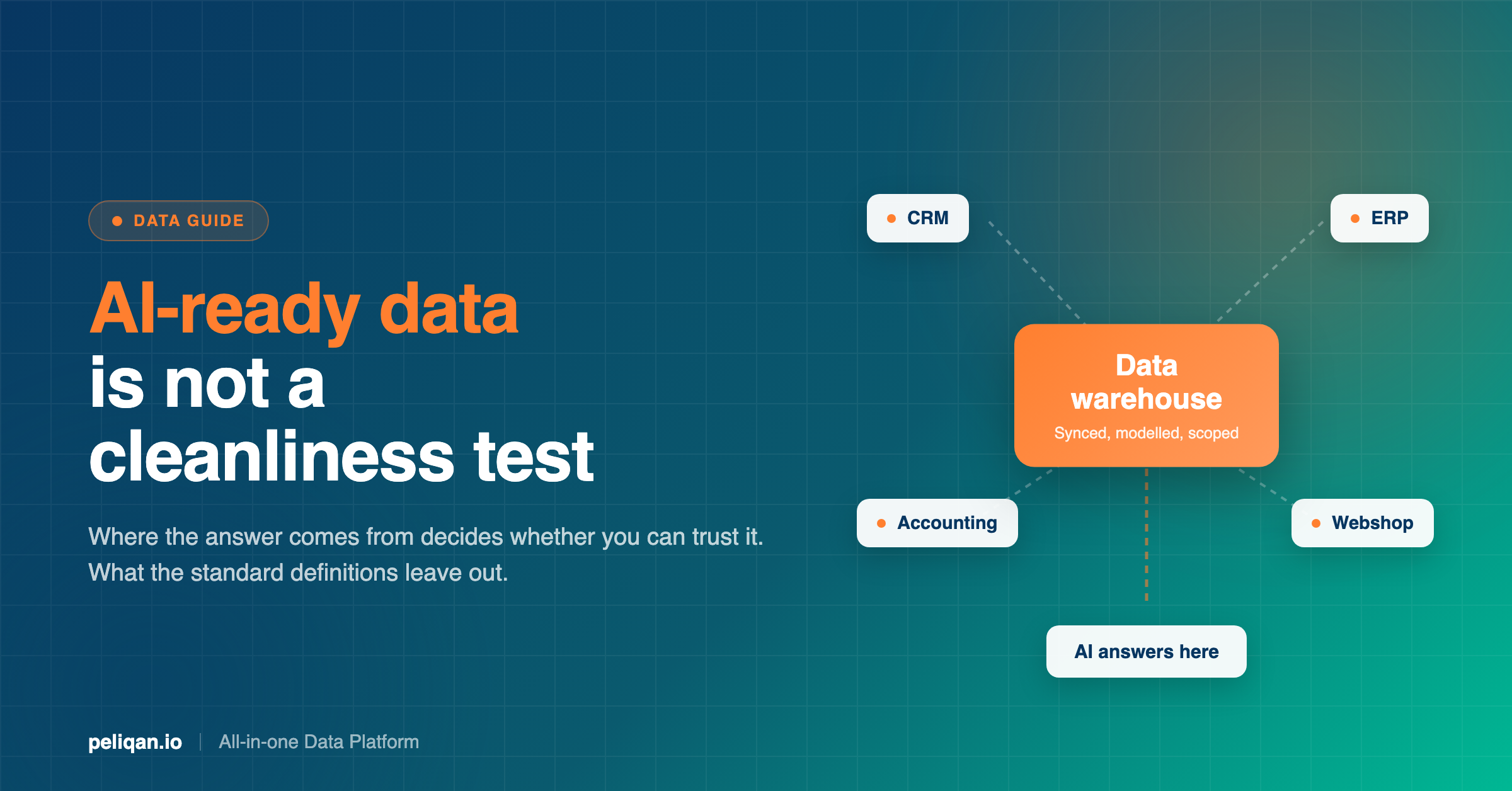
Peliqan syncs invoice and Peppol delivery data into a Postgres + Trino warehouse alongside the rest of the ERP and CRM stack. Specifically, the connectors for Billit, Exact Online, AFAS, Yuki, Silverfin, Xero, NetSuite, Odoo, and Business Central all land into the same warehouse. Furthermore, the MCP server exposes the whole warehouse as a SQL surface. As a result, cross-source Peppol questions become single SQL JOINs.
Pan-EU Peppol through Peliqan’s MCP, end to end
The existing Billit Peppol blog is the Belgian-specific predecessor to this pillar. Furthermore, this post is the pan-EU expansion that anchors the cross-country use cases.
Five cross-source Peppol use cases that need pan-EU SQL
1. Pan-EU undelivered-invoice triage
The standing Monday-morning question for any multi-country EU B2B seller. Specifically, the agent joins Billit MLR status (Belgium) plus Storecove MLR status (Netherlands, France, multi-EU) plus ERP invoice headers across Exact Online, AFAS, Yuki, and NetSuite. Then it surfaces every invoice not acknowledged within 48 hours, grouped by country and AccessPoint. As a result, the AR team gets one unified exception list rather than three separate dashboards.
2. Country-specific compliance dashboard
The question CFOs of multi-country B2B SaaS actually ask. Specifically, the agent compiles France PPF compliance status, Italy SDI inbound status, Belgium Peppol delivery status, and German Receipt audit log. Then it surfaces gaps where the country-specific requirements are not met. Furthermore, this is the dashboard that satisfies the next external audit’s “are we e-invoice-compliant across our footprint?” question. The persona-level expansion sits in the MCP for the EU CFO playbook.
3. UBL validation root-cause analysis
The standing accounting partner question. Specifically, the agent groups failed invoices by Peppol error code (BR-CO-25, UBL-CR-414, BII-T10-R040, and similar) with the suggested fix. Furthermore, it joins the validation errors to Exact Online journal entry mismatches and customer master-data gaps. As a result, the partner gets a root-cause report instead of a list of one-off errors.
4. Reverse-ETL writeback for invoice re-submission
The end-to-end auto-recovery use case. Specifically, Claude reads the rejection, identifies the UBL field that failed validation, generates the fix (correct VAT identifier, missing line reference, malformed currency code), updates the invoice in the source ERP, and re-sends through the AP. Furthermore, every step lands in the audit log. As a result, what used to be a manual two-hour process per rejection becomes a 30-second Claude prompt.
5. MTD-ITSA adjacency for UK accountancy practices
UK accountancy partners with EU exposure run this query. Specifically, UK Making Tax Digital for Income Tax Self Assessment becomes mandatory from April 2026 for many self-employed and landlords. Furthermore, EU Peppol mandates are heading the same direction. Therefore, the architectural pattern – structured filings plus AccessPoint delivery plus audit log – transfers cleanly. The Xero practice-wide cross-source pattern covers the UK side of the same architecture.
Six Peppol MCP options compared
The honest summary: e-invoice.be’s 12 read-only MCP tools are excellent for developer inspection of Belgian Peppol participants. Billit’s native API is the right Peppol gateway for Belgian SMBs. Storecove covers the pan-EU developer-first lane. Pagero and Tradeshift serve large enterprise. However, only Peliqan joins Peppol delivery status to the rest of the ERP stack in one SQL query with audit-logged writeback. As a result, the cleanest 2026 pan-EU Peppol stack runs an AP for actual delivery plus Peliqan for cross-source intelligence. The fuller comparison context sits in the Composio + Pipedream + Peliqan MCP comparison and the best MCP server listicle.
Compliance posture: Peppol plus Article 26 plus GDPR together
Three regulatory regimes intersect at the Peppol MCP layer in 2026. Specifically, GDPR governs the personal data in invoices (customer names, addresses, VAT IDs). Furthermore, the EU AI Act Article 26 deployer obligations apply to any AI agent acting on high-risk financial data from August 2, 2026. Moreover, country-specific e-invoicing regimes (Belgium fines €1,500-€5,000 per offence plus 60-100% VAT proportional) add direct enforcement teeth.
For deployers running AI agents on Peppol data, the procurement checklist maps directly onto Article 26 obligations. Specifically, the audit log must capture every read, every reverse-ETL writeback, and every prompt-to-AP routing decision with the AI session ID. Furthermore, the six-month log retention requirement applies. The full breakdown sits in the EU AI Act and MCP compliance pillar referenced earlier. Likewise, the broader GDPR-compliant MCP servers pillar covers the data-residency and column-level masking layer.
Peliqan ships EU-hosted infrastructure in Belgium, SOC 2 Type II certified, ISO 27001 in progress, with column-level masking and audit-logged reverse ETL by default. As a result, the procurement review passes for Belgium’s Peppol mandate, France’s PPF onboarding, German receipt obligations, Italy’s SDI expansion, GDPR, and Article 26 in one evidence pack.
ICP: who pan-EU Peppol MCP plus Peliqan is built for
Six buyer profiles dominate this conversation in 2026. First, EU CFOs at B2B-heavy companies running multi-country footprints. Second, multi-country EU SMBs operating across at least two mandate regimes. Third, Belgian accountancy firms compounding the Silverfin plus Yuki plus Billit cluster. Fourth, French accounting partners preparing clients for the September 2026 PPF mandate. Fifth, German Mittelstand B2B sellers facing 2027-2028 sending obligations. Finally, Dutch and Belgian agencies advising clients on Peppol readiness across countries.
For each profile, the value compounds the same way. Specifically, Peppol delivery is asynchronous, multi-AP, and audit-heavy. Indeed, no single AP gives you visibility across the others. Furthermore, no ERP shows delivery status from the Peppol network. As a result, the warehouse-first MCP layer beneath turns Peppol from a compliance burden into an operational signal.
For Belgian accountancy partners specifically, the Silverfin plus Yuki plus Billit triangulation compounds well. Indeed, Silverfin holds the workpapers, Yuki holds the bookkeeping, and Billit handles the Peppol gateway. Peliqan joins all three plus the client’s ERP. As a result, the partner runs cross-client Peppol monitoring at firm scale.
Peliqan’s pricing is fixed from €150/month annual (€1,800/year). Furthermore, the platform includes 250+ connectors covering every major EU AP and ERP, the Postgres + Trino warehouse, reverse ETL, and the MCP server in one bundle. Therefore, adding pan-EU Peppol visibility does not increase the bill on top of the base subscription.
How this connects to the broader Peliqan MCP cluster
The pan-EU Peppol pillar sits as the third regulatory umbrella in the cluster after GDPR and the EU AI Act. Furthermore, it anchors every accounting and ERP connector blog because Peppol delivery status is the missing layer the ERP alone cannot expose. Specifically, the Billit Peppol playbook earlier in this cluster covered the Belgian-specific story. This pillar generalises the pattern across France, Italy, Germany, the Nordics, Spain, and Poland.
For broader architectural context, the main Peliqan MCP page covers the warehouse foundation and read-write surface. Moreover, the Peliqan Trust Center publishes the SOC 2 report and sub-processor list that EU procurement teams need for the next audit cycle.
The bottom line on pan-EU Peppol MCP
Belgium switched on B2B Peppol in January 2026. France switches on in September 2026. Italy is expanding SDI. Germany is finalising 2027-2028. Most EU B2B sellers face at least one mandatory e-invoicing regime per country by Q3 2026.
For Peppol delivery itself, use the AccessPoint that fits your country and scale: Billit for Belgian SMB, Storecove for multi-country developer-first, Pagero or Tradeshift for large enterprise. Furthermore, e-invoice.be’s 12 read-only MCP tools are useful for developer inspection of Belgian participants. For pure compliance gateway functionality, those tools are the right answer.
However, the cross-source question lives outside any single AP. Specifically, “show me every undelivered invoice across all our APs and entities, grouped by country and validation error” needs a SQL surface beneath every AP and every ERP at once. That is the warehouse-first MCP pattern’s home turf. As a result, the cleanest 2026 pan-EU Peppol stack runs an AP per country plus Peliqan’s MCP for cross-source intelligence and audit-logged writeback.
The procurement decision that compounds is not which AP to pick. Indeed, you will probably use multiple. Rather, it is whether you have a warehouse layer beneath every AP and every ERP that can answer the cross-source compliance question. For EU companies under Article 26, DORA, NIS2, and country-specific Peppol regimes simultaneously, that layer needs to be EU-hosted, SOC 2 Type II, and audit-logged. That is the architectural choice that survives the next three audit cycles and the ViDA 2030 deadline at the same time.