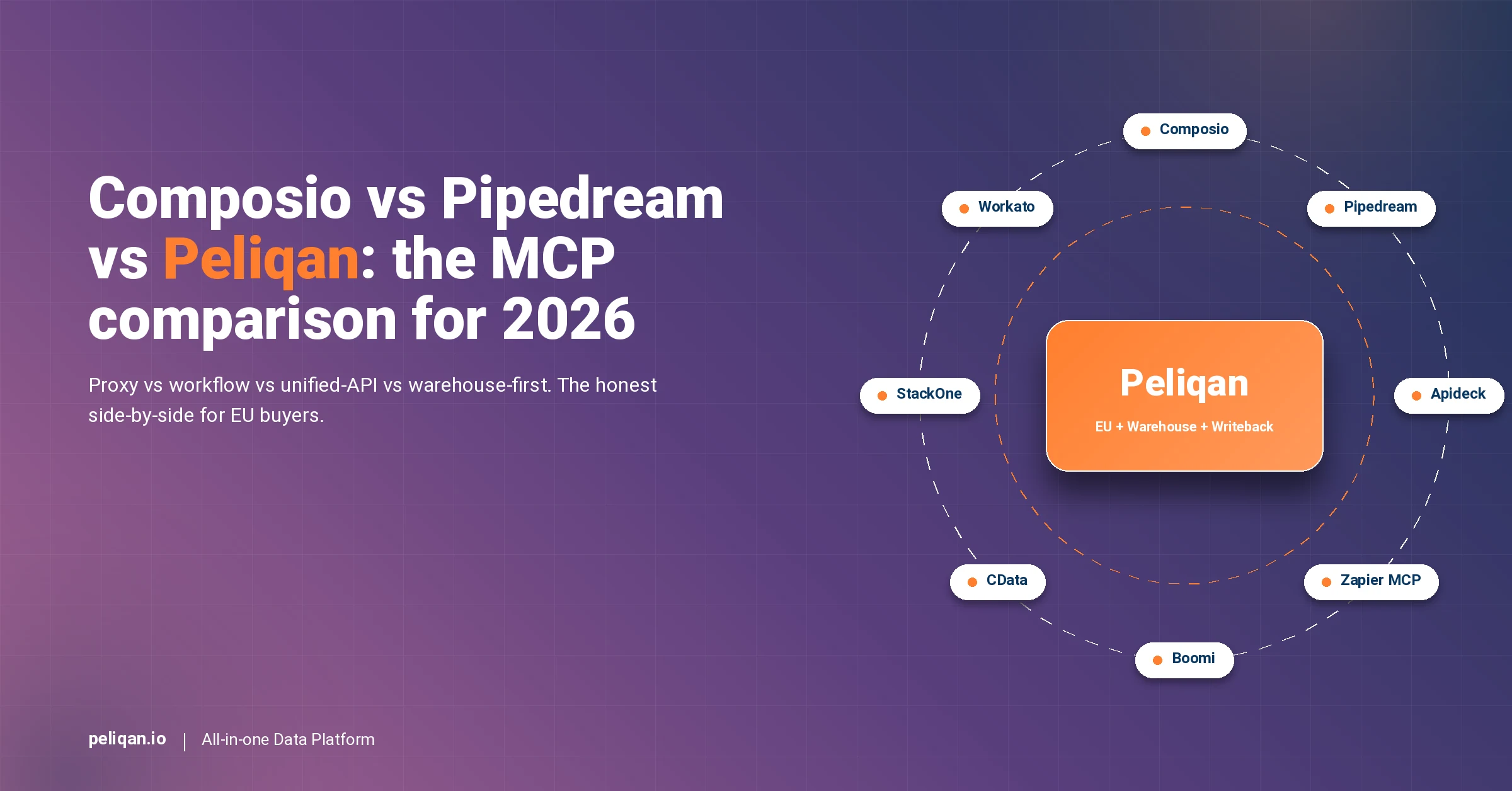





“What’s the best MCP server” became a top-of-funnel question for any data, RevOps, or engineering team in early 2026. Composio shipped its MCP Gateway with enterprise SSO. Pipedream’s MCP Chat exposes 10,000+ tools across 2,700+ apps. Apideck launched its 229-tool unified-API MCP on Product Hunt on 13 May 2026.
Peliqan ships an EU-hosted warehouse-first MCP with 250+ connectors and full writeback. The honest answer is that the right MCP depends on what you are actually trying to build – and that the four leading platforms occupy structurally different architectural slots.
This post is the side-by-side. It is fair to Composio and Pipedream where they shine, fair to Apideck where its unified-API roots make sense, and honest about where Peliqan wins decisively for EU buyers, cross-source analytics, and vertical SMB depth in BE/NL accounting, UK/EU CRM, and hospitality. If you are searching “Composio alternative” or “Pipedream MCP vs Composio” or “best MCP for Europe”, this is the comparison you can send to your team without editing.
The MCP server landscape in 2026: why architecture matters
Most MCP server comparisons online are written for the developer prototyping use case – which apps are supported, how fast is the OAuth flow, what is the price per call. Naturally, those questions matter. However, they miss the structural question that drives the actual buying decision: what kind of work is the MCP server doing under the hood?
An MCP server that proxies one API call per tool invocation is structurally different from one that runs cross-source SQL against a managed warehouse. In practice, both ship as “MCP servers” and both work with Claude, ChatGPT, and Cursor. Yet, they answer very different questions and serve very different teams.
Why this comparison post exists
EU teams searching for “Composio alternative” want a clear, fair view of the trade-offs – especially around hosting jurisdiction, GDPR posture, and whether the MCP can actually answer cross-source analytical questions. Similarly, US teams comparing Pipedream MCP and Composio want to understand when each makes sense.
Therefore, this comparison frames the entire market through four architectural lenses, names every major player, and gives a decision framework instead of a winner-takes-all verdict.
The 4 MCP server architectures (and which players occupy each)
The 4 architectural patterns shaping the MCP market
Why the architectural slot matters for your use case
Pick the wrong architecture and you spend six months rebuilding. Pick the right one and the integration cost compounds in your favour as you add sources.
For instance, a proxy MCP is perfect for “create a Salesforce contact when this lead arrives”. The same proxy MCP is structurally incapable of answering “show me every Salesforce opportunity stuck more than 30 days with Stripe payment failures and Zendesk tickets at the same account” – because that question crosses three systems and needs a JOIN that no source API provides natively.
Similarly, a workflow MCP excels at event-driven automation across many tools. However, it cannot serve as the analytical surface for a CFO dashboard or a renewal-risk model. Consequently, choosing the architecture matters more than choosing the brand.
When Composio wins
Composio is the developer-favourite proxy MCP. Specifically, its MCP Gateway ships SOC 2 Type II, ISO 27001, action-level RBAC, SSO via SAML/OIDC, SCIM 2.0, and zero data-retention by default. In addition, the catalog covers 500+ pre-built MCP server integrations across major SaaS apps like Slack, GitHub, Jira, Salesforce, Notion, and Google Workspace.
Where Composio is the right call
Firstly, single-app developer workflows. If you are building a coding agent that needs reliable GitHub, Linear, or Notion access, Composio’s tooling and TypeScript-first SDK are excellent.
Secondly, dev-tool centric AI agents. Composio’s catalog leans into the developer ecosystem – GitHub, Linear, Sentry, PostHog, Vercel – which makes it the default for AI coding assistants.
Thirdly, enterprise security-first deployments where you need RBAC and SSO over a generic catalog. Composio’s compliance posture is mature, and the Gateway pattern is well-suited to engineering teams who want centralised authentication for AI agents.
Where Composio’s architecture limits the use case
Composio is US-default. For EU buyers under GDPR or EU AI Act with employee or customer data residency requirements, the hosting jurisdiction is a structural gap that no amount of feature parity closes.
Additionally, the proxy architecture means there is no warehouse beneath. Cross-source SQL is not in scope – you cannot join Salesforce opportunities with Exact Online invoices in one query. Similarly, deep vertical SMB depth in BE/NL accounting (Yuki, Silverfin, AdminPulse, Billit) is not Composio’s focus. The catalog is broad and US-tilted.
When Pipedream wins
Pipedream is the workflow MCP at scale. Its MCP Chat product exposes 10,000+ tools across 2,700+ apps.
Notably, Pipedream was a Y Combinator alum (S20 batch) and was acquired by Workday in November 2025. The acquisition positions Pipedream as a Workday-backed workflow platform with deep enterprise distribution into HR and Finance.
Where Pipedream is the right call
Firstly, event-driven automation. If your AI agent needs to react to “when X happens in tool A, do Y in tool B”, Pipedream is structurally the best fit. The workflow primitives, the OAuth management, and the long-tail SaaS catalog (2,700+ apps) are unmatched.
Secondly, cross-app workflows that don’t need SQL. Pipedream excels when the question is “trigger a sequence of actions across many tools” rather than “answer an analytical question that spans multiple data sources”.
Thirdly, teams already on Workday infrastructure. The Workday acquisition will likely deepen Pipedream’s integration with the broader Workday HR + Finance stack – useful for enterprise customers standardising on that ecosystem.
Where Pipedream’s architecture limits the use case
Pipedream’s workflow architecture is not analytical. There is no warehouse beneath, no cross-source SQL, and no real JOINs across providers. Therefore, the platform cannot serve as the analytical surface for a CFO dashboard or a multi-tenant practice AI cockpit.
Additionally, US-hosted by default. For EU buyers, the hosting jurisdiction is the same compliance gap as Composio. Furthermore, vertical SMB depth in BE/NL accounting is not Pipedream’s focus – the catalog is global and event-led rather than analytics-led.
When Apideck wins (the unified-API approach)
Apideck launched its MCP server on Product Hunt on 13 May 2026 with a generic “200+ apps” positioning. The architecture is unified-API: 229 auto-generated tools across 9 unified-API categories (accounting, CRM, HRIS, file storage, etc.) deployed at mcp.apideck.dev.
Per the Apideck engineering write-up, the entire MCP was auto-generated from an OpenAPI spec via Speakeasy and deployed on Vercel.
Where Apideck is the right call
Firstly, vertical SaaS builders who need a normalised schema across many providers. If you are building a fintech app that needs to write to “any accounting system”, Apideck’s unified API pattern is structurally elegant.
Secondly, embedded integration use cases. Apideck’s Vault product handles the embedded OAuth UX that vertical SaaS teams need when their customers connect their own CRM or accounting tool.
Thirdly, multi-provider portability. If you want to write integration code once and have it work against Xero, Sage Intacct, NetSuite, and Exact Online without per-provider conditionals, unified-API is the way to go.
Where Apideck’s architecture limits the use case
The unified schema is a feature for multi-provider portability but a constraint for deep per-provider analytics. Specifically, the unified-CRM schema captures the common fields across Salesforce, HubSpot, and Pipedrive – but loses the per-tool depth that makes each platform unique.
Additionally, Apideck is action-focused rather than analytical. There is no warehouse beneath the unified API. Cross-source SQL is not in scope. The MCP is essentially a thin layer over the unified API tools, which is great for action workflows and weaker for analytics.
When Peliqan wins
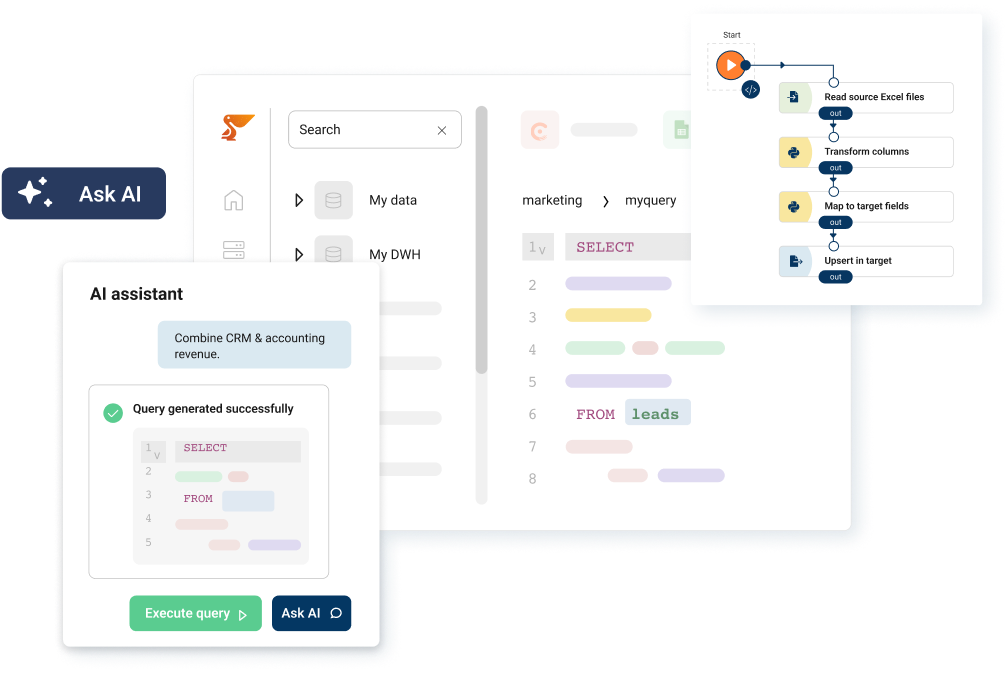
Peliqan is the warehouse-first MCP and the only EU-headquartered player in the comparison. Specifically, the architecture is structurally different: every connected source syncs into a managed Postgres + Trino warehouse, the MCP server exposes real SQL with full JOINs and window functions to Claude or any MCP client, and writeback flows back through reverse ETL with a prompt-to-API audit log.
Where Peliqan is the right call
Firstly, cross-source analytics across multiple SaaS apps. The warehouse layer means an AI prompt like “show every Salesforce opportunity with Stripe payment failures and Zendesk Sev-2 tickets at the same account” is one SQL statement, not three API calls plus a manual merge. Specifically, SQL on anything is the architectural feature that makes this possible.
Secondly, EU buyers with GDPR, EU AI Act, or data-residency requirements. Peliqan is EU-hosted, SOC 2 Type II, GDPR-native, with ISO 27001 in progress. For BE/NL/DE/FR buyers, this is non-negotiable, and US-default platforms cannot match it without compromise.
Thirdly, vertical SMB depth in EU accounting, CRM, and hospitality. Peliqan’s connector catalog covers Yuki, Silverfin, Billit, Exact Online, AFAS, Teamleader, Visma e-conomic, MEWS, and the rest of the Benelux + EU SMB stack. US-default catalogs treat these as edge cases.
Where Peliqan’s writeback audit trail matters
For PE-backed, SOC 2-audited, or IPO-prep companies, AI mutation needs to be defensible. Peliqan’s writeback via reverse ETL records the originating prompt, the authorising user, the source data, and the destination API response on every write. This is the trail that Big-4 audit teams and EU AI Act assessors ask for – and that wrapper-style MCPs do not produce by default.
Where vertical SMB depth makes the difference
For Belgian accountancy firms, the Yuki + Silverfin + Billit cluster is the operating stack. Specifically, the Yuki Claude MCP playbook covers Dutch bookkeeping at multi-tenant practice scale.
Similarly, the Silverfin MCP playbook covers Belgian compliance workpapers. Composio and Pipedream do not have native depth into these tools; in contrast, Peliqan is built for the use case.
Likewise, for UK accountancy firms preparing for HMRC’s Making Tax Digital cadence change in April 2026, the per-tenant Xero fan-out across an entire client book is a structural requirement that proxy MCPs cannot satisfy.
Real-world example: Rezolv (Odoo partner)
This is exactly how Rezolv consolidated reporting across 50+ Odoo client environments using Peliqan’s multi-customer management. Composio and Pipedream cannot answer the multi-tenant cross-database questions a modern partner practice asks weekly. Read the full case study.
Where Peliqan is not the right call
Honesty matters. If your only use case is a coding agent triggering GitHub actions, you do not need a warehouse. Composio is structurally simpler and probably faster for that workflow. Similarly, if you need a long-tail catalog of 2,700+ consumer-grade SaaS tools for event-driven automation, Pipedream is structurally the right call.
Peliqan is built for cross-source analytics, EU compliance, vertical SMB depth, and audit-grade writeback. If those are not your use case, the other architectures may serve you better.
Head-to-head matrix: 7 MCP platforms compared
Decision framework: which MCP server fits your shape
Match the MCP architecture to your actual use case
Migration paths: when to switch from Composio or Pipedream to Peliqan
Most teams don’t pick an MCP platform once and stick with it forever. The use case evolves. A startup that began with Composio for prototyping often needs to add cross-source analytics by year two. A Pipedream-led automation footprint often needs a warehouse layer once finance and revenue leaders start asking weekly questions.
Signals that you have outgrown your current MCP
Firstly, you find yourself writing per-app scripts to fetch data, dump it to a CSV, merge in Excel, and then asking Claude to summarise. That is a sign your MCP is proxy-only and you need a warehouse beneath it.
Secondly, your finance or RevOps lead asks the same cross-source question (renewal risk, cash forecast, MRR drift) weekly, and the answer is always assembled manually. The pattern means an analytical MCP would compress hours into seconds.
Thirdly, your AI tooling is US-hosted and your CTO or DPO flags an EU AI Act or GDPR exposure. Moving to an EU-hosted MCP is then a compliance decision, not a feature decision.
Finally, you are PE-backed or in the IPO-prep window and the Big-4 audit team asks for a defensible audit trail of which prompt triggered which mutation in a customer’s CRM or ERP. Wrapper MCPs cannot produce that log; warehouse-first MCPs can.
What breaks when you migrate
The good news: MCP is an open standard. Your Claude prompts, your Cursor workflows, your custom AI agents work with any compliant MCP server. Switching MCP providers does not break the AI client integration.
What does break: per-tool action workflows you built on Composio or Pipedream do not automatically port to Peliqan. The Composio tool that calls “create Salesforce contact” maps to the Peliqan equivalent through writeback via building AI agents in Peliqan, but the implementation is different. Plan a parallel-run period of two to four weeks if you depend on the workflow MCP for production automations.
The migration sequence Peliqan recommends
Start by syncing your top three to five sources into the Peliqan warehouse. Verify the data is queryable, then test a cross-source SQL prompt that none of your current MCP platforms can answer. Once that prompt works, gradually migrate analytical workloads off the proxy MCP. Keep the workflow MCP for event automation – it is structurally better at that than Peliqan claims to be.
For implementation specifics, the joining-data guide covers the cross-source SQL patterns that most migrations rely on day one.
Additionally, the materialized tables documentation covers the pre-aggregation patterns – critical for serving Claude prompts in milliseconds across multi-tenant client portfolios.
How the cluster fits together for EU buyers
For EU teams, the warehouse-first MCP unlocks a category of cross-source analytics that wrapper or workflow MCPs cannot reach. The main MCP hub covers the architecture details, the ROI math for typical mid-market deployments, and the comparison framing for buyers comparing options.
For the protocol-level details on how MCP works end-to-end, the general Claude MCP overview walks through the architecture for engineering teams evaluating the move.
Verticals where Peliqan owns the EU SMB stack
Benelux finance teams can refer to the Exact Online CFO playbook for the multi-division ERP pattern in the same MCP context.
Belgian and Dutch SMBs on the quote-to-cash side will find the Teamleader Claude MCP playbook directly relevant – covering the EU SMB CRM angle through the same warehouse-first architecture.
Global RevOps teams running Salesforce should start with the Salesforce MCP playbook, which covers the cross-source pattern joining pipeline with payments and support.
SaaS revenue teams should pair that with the Stripe Claude MCP write-up for the payments-side cross-source story.
Compliance and EU AI Act considerations
For EU buyers specifically, the GDPR posture and EU AI Act audit trail requirements are not optional. A planned cornerstone post at GDPR-compliant MCP servers covers the regulatory dimension in depth – useful when defending the architecture choice to a DPO or a compliance reviewer.
For engineering teams building their own MCP
For engineering teams that prefer to roll their own MCP layer rather than adopt a managed platform, the build MCP server guide covers the protocol details. The trade-off is the standard one: more control, more maintenance burden, and slower time-to-value compared with a managed warehouse-first platform.
What to do this quarter
If you are searching “Composio alternative” or “Pipedream MCP vs Composio”, the right next step is not to pick a brand. It is to pick an architecture – and then evaluate the best player in that architectural slot for your geography and use case.
Firstly, identify whether your primary use case is event automation, cross-source analytics, embedded multi-provider integration, or single-app developer tooling. The four architectures map directly to those four use cases.
Secondly, factor in your compliance posture. If you serve EU customers, US-hosted MCP introduces a structural GDPR risk that no feature parity closes. EU-hosted MCP is then a baseline requirement.
Thirdly, evaluate the vertical depth of your connector catalog needs. Global generic catalogs serve generic use cases. Vertical EU SMB depth in Benelux accounting, UK practice management, and EU hospitality is where Peliqan owns the category.
Ultimately, the MCP server you pick this quarter is the AI operating system you live with for the next 18 months. The architectural fork – proxy vs workflow vs unified-API vs warehouse-first – matters more than any single feature comparison.