




Every Belgian sales manager running on Teamleader Focus has the same Monday morning ritual. Open the Deals view, filter by stage, export to Excel, cross-check Exact Online for whether the quote already turned into an invoice, then check Billit for whether that invoice cleared Peppol on the buyer’s side. Three tabs, three exports, and the answer to “what’s the state of my pipeline right now” arrives by Tuesday afternoon.
Teamleader is the EU SMB-native CRM – founded in Ghent in 2012, now part of the Visma group, with more than 15,000 businesses across Europe running quotes, invoices, projects, and time tracking through it. The product is excellent at its job. What it does not do is answer a teamleader claude prompt that joins the deal pipeline with the actual cash collection on the other side of Belgian Peppol. That gap is exactly where teamleader mcp, teamleader focus mcp, and teamleader ai agent stop being slides and start being margin. The shortest path from a multi-source Belgian SMB stack to a Claude-grade answer is a warehouse – and the design choice now sits on the founder and sales lead desks together.
The pressure on Belgian and EU SMB sales-ops in 2026 is not theoretical. Belgium’s mandatory B2B Peppol e-invoicing went live on January 1, 2026, with fines of €1,500-€5,000 per offence plus proportional VAT penalties of 60-100% on non-compliant invoices. The three-month grace period closed on April 1. The EU AI Act is open for enforcement at €35M or 7% of global turnover for ungoverned AI on customer data.
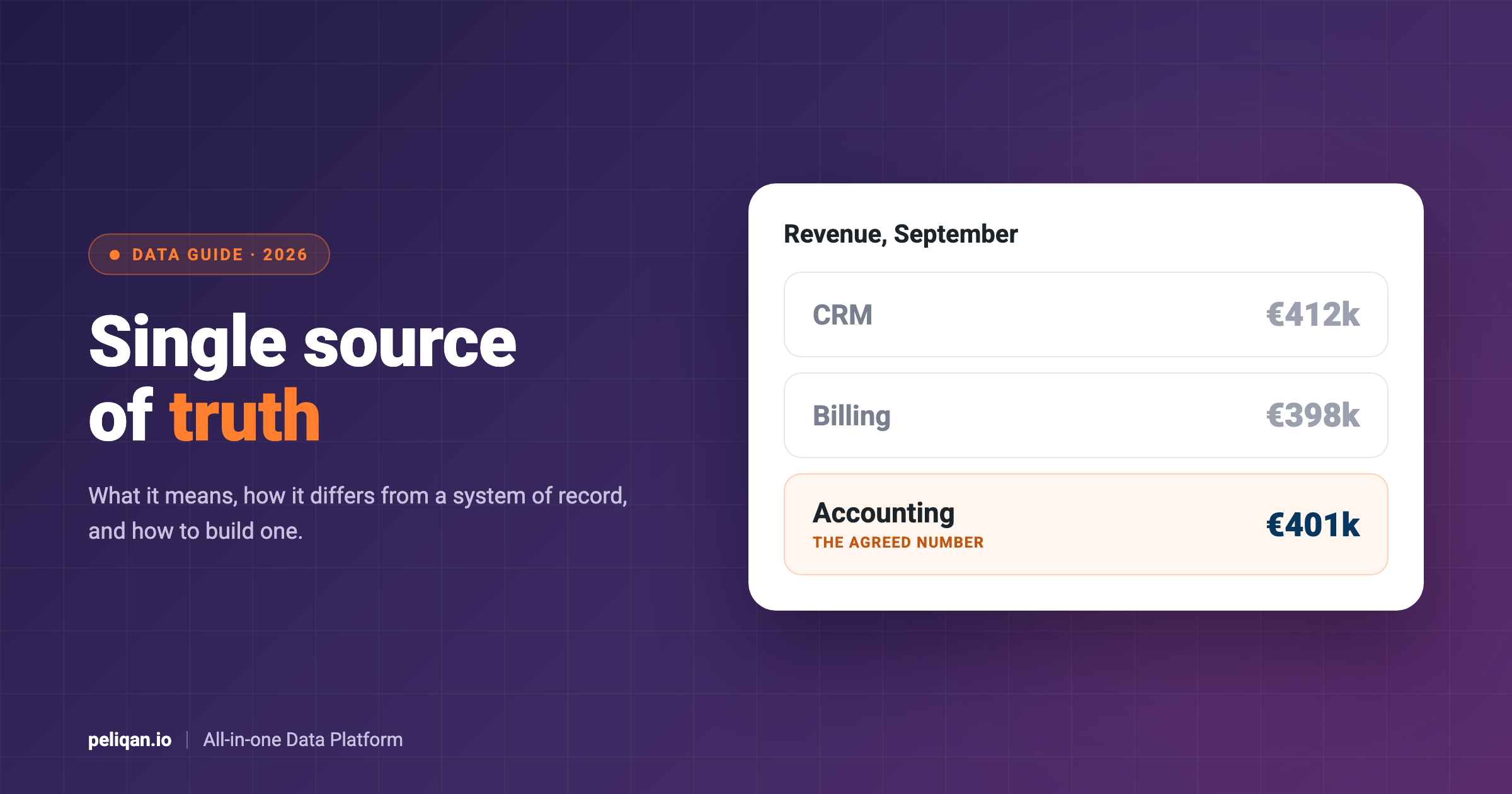
And the typical Belgian SMB stack – Teamleader for CRM + invoicing, Exact Online for accounting, Billit for Peppol, Mollie or Ponto for payments – has never been integrated through a single AI surface that crosses all four. The blog you are reading is the playbook for closing that gap without rebuilding the Teamleader API integration for every new question, without losing the audit trail your accountant needs, and without paying for a wrapper-style MCP that only covers half the surface.
What Teamleader is, and why it sits at the center of every Belgian SMB stack
Teamleader Focus at a glance
The Teamleader positioning matters because nothing else in the MCP catalog occupies the same slot. Salesforce is the US enterprise CRM. HubSpot is the US marketing-first CRM. Pipedrive is global SMB without the EU invoicing layer. Teamleader is the only platform that ships CRM, quoting, invoicing, projects, and time tracking together for the Belgian and Benelux SMB – and through the Visma acquisition, it now sits inside the same group as the Dutch and Belgian accounting brands that complete the quote-to-cash loop. That product positioning is what makes the warehouse-first MCP architecture genuinely valuable here, rather than nice-to-have.
Why connecting Teamleader to Claude is harder than it looks
Six constraints every Teamleader AI project hits
The painful part is not pulling a single deal record from Teamleader. The API handles that elegantly. The painful part is everything a real sales-ops or founder prompt requires once it touches more than one entity, more than one source, or more than one customer’s language. Action-based MCP wrappers can never answer those questions, no matter how many tools they ship.
The real cost of fragmented Teamleader reporting
What slow Teamleader reporting actually costs a Belgian SMB
The hidden cost is not the time to run a single report. It is the operating model that builds up around fragmented reporting – the weekly forecast meetings, the manual cross-checks, the collection calls that arrive a week late. Cross-source AI on top of Teamleader, hosted in the right jurisdiction, with auditable writeback, is the single highest-leverage investment a Belgian sales-led SMB can make in 2026.
6 ways to connect Teamleader to Claude
1. Manual exports from Teamleader Focus
Export deals, contacts, invoices, or quotations to CSV from the Teamleader UI, drop into Excel, send to the team. Works for a single quarterly review in a small SMB. Does not answer cross-source questions, cannot reconcile with Peppol delivery, and never becomes the answer to a Claude prompt.
Best for: One-off pipeline reviews in very small teams.
2. Direct REST API v2 with custom Python
Any data engineer can authenticate against the Teamleader Focus API v2 and pull deals, companies, contacts, quotations, invoices. The catch is the cost of building a maintainable layer: queueing for the 200-per-minute limit, OAuth refresh, schema drift handling, and the cross-entity join logic. Belgian SMBs rarely have a dedicated data engineer – and the moment the script breaks, sales-ops grinds to a halt.
Best for: Teams with in-house data engineering and a narrow, well-defined extract set.
3. Action-based MCP wrappers (Zapier MCP, Pipedream MCP, viaSocket)
Zapier MCP, Pipedream MCP, and viaSocket expose Teamleader actions to MCP clients. They work for event automations – “when a deal moves to Won, post to Slack and create a Mollie payment link” – and they ship fast. They are not analytical platforms. No warehouse beneath, no cross-source SQL, and Zapier MCP in particular is task-quota-capped which limits how aggressive an AI workload can run.
Best for: Event automations and lightweight prototypes, not sales-ops analytics.
4. Composio’s Teamleader integration
Composio offers MCP integrations across hundreds of SaaS tools, including Teamleader. The architecture is action-focused (create contact, create deal, update task) and US-hosted by default. For a Belgian or EU buyer subject to GDPR + EU AI Act + Peppol audit trails, the US-default hosting is a structural compliance gap. There is also no warehouse, no cross-source SQL, and no multi-portal consolidation.
Best for: US-based teams running Teamleader as a secondary tool, not EU SMBs running it as the primary CRM.
5. Open-source community Teamleader MCP servers (GitHub)
Multiple community MCP servers wrap the Teamleader Focus API: globodai-group/mcp-teamleader covers contacts, companies, deals, tasks, events, and invoices; the Tailormade and Weichie repos add time tracking and projects with broadly the same shape. They are useful starting points and free. They are also read-mostly, single-account by design, require DIY OAuth + .env + self-hosting, and have no warehouse, no cross-source layer, no audit log, and no multi-language handling.
Best for: Engineering teams prototyping a Claude/Cursor workflow against the core CRM entities.
6. Warehouse-first MCP platform (Peliqan)
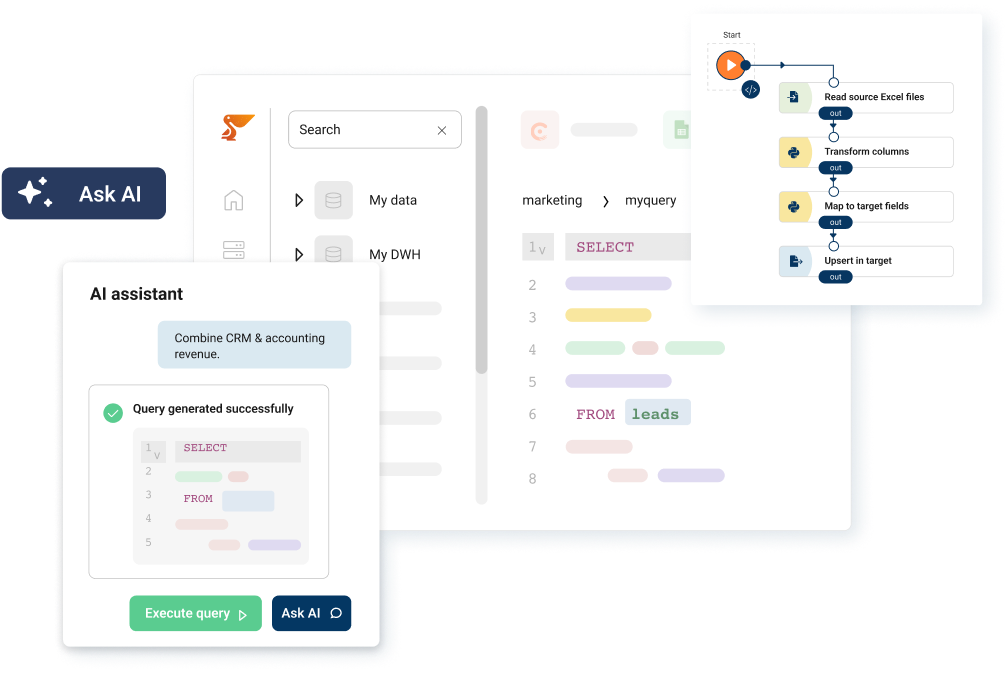
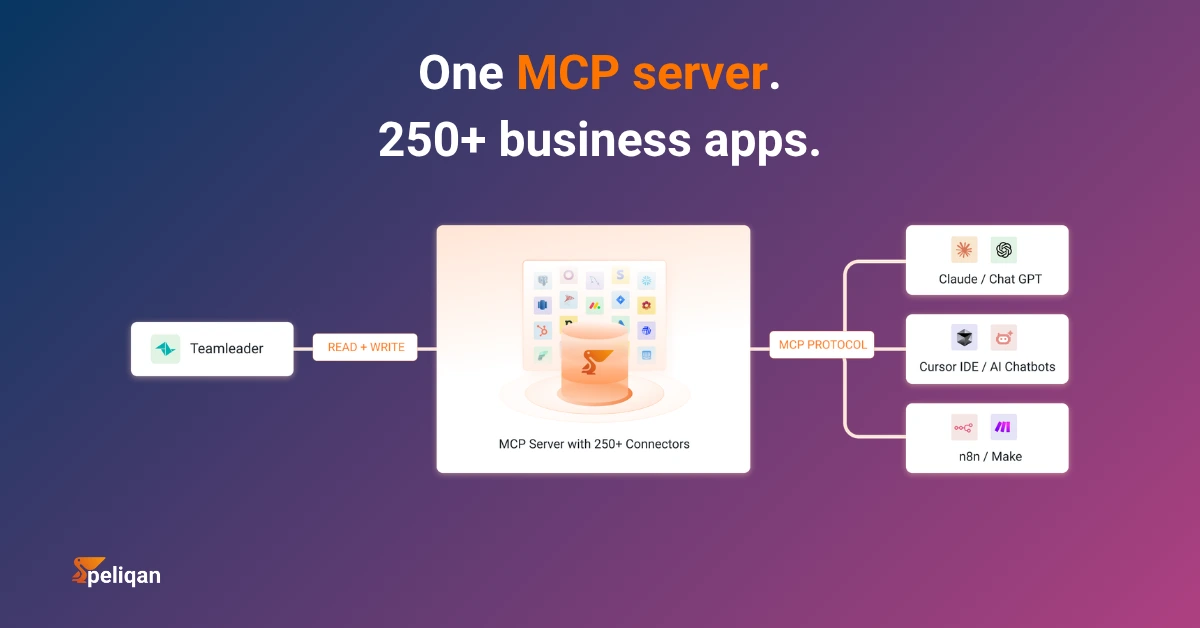
Peliqan syncs every Teamleader Focus entity – deals, companies, contacts, quotations, invoices, projects, tasks, time tracking, activities, departments – into a managed EU-hosted Postgres + Trino warehouse, queues all calls inside the 200-per-minute budget, and exposes the cleaned tables to Claude, ChatGPT, Cursor, or any MCP client through the Peliqan MCP server. Claude writes real Postgres SQL with full JOINs, window functions, and analytics. Writeback flows back through reverse ETL with a full audit log. Cross-source SQL joins Teamleader with Exact Online, Billit, Yuki, Silverfin, Mollie, Ponto, and 240+ other connectors. EU-hosted, SOC 2 Type II, GDPR-native.
Best for: Belgian and EU SMBs running Teamleader Focus as the system of record. See the Teamleader Focus connector.
Comparison: 6 ways to connect Teamleader to AI
| Method | Cross-source joins | Auditable writeback | Peppol cross-check | EU-hosted MCP | Rate-limit handling |
|---|---|---|---|---|---|
| Manual exports | No | No | No | N/A | N/A |
| Direct API + Python | Hand-rolled | Custom-built | Hand-rolled | Depends on host | Hand-rolled |
| Zapier / Pipedream / viaSocket MCP | Event-only | Task-quota-capped | Limited | US-default | Per-flow |
| Composio | No | Partial | No | US-default | Generic |
| Community GitHub MCPs | No | Read-mostly | No | Self-host | DIY |
| Peliqan MCP | SQL across 250+ apps | Full audit log | Native Billit join | EU, SOC 2 Type II | Built-in queue |
The Teamleader Focus entities that matter most for sales-ops AI
| Teamleader entity | What it powers | Sales-ops AI use case |
|---|---|---|
| Deals | Pipeline, stages, value, owner | Stuck-deal triage, forecast cleaning |
| Companies + Contacts | Account and contact master | Account health, expansion signals |
| Quotations | Sent quotes, status, line items | Quote velocity, discount analysis, stalled quotes |
| Invoices | Issued invoices, status, customer link | DSO, late-payer triage, Peppol cross-check |
| Projects | Project ledger, budget vs actual | Profitability, overrun detection |
| Tasks + Activities | Rep and team activity | Activity-to-revenue correlation |
| TimeTracking | Billable hours by project + employee | Realization rate, capacity, project margin |
| Departments | Multi-team / multi-region structure | Department-level pipeline view, regional forecasts |
Decision framework: which Teamleader architecture fits your shape
Match the architecture to the firm shape
The sales-ops playbook: 5 Teamleader + Claude workflows that change the cadence
The temptation is to bolt a chatbot onto the Teamleader sidebar and call it done. The actual value comes from compressing the workflows that recur every Monday, every renewal, every quote-to-cash cycle. Five workflows repeat across the Belgian and EU SMBs we have seen running this architecture.
1. Daily pipeline review across departments and languages
“Show me deals stuck more than 30 days in Negotiation, ranked by value, with last activity date and last note – across both our NL and FR sales teams.” That is one Postgres SQL query against the warehouse, with window functions for stage duration and a UNION across departments. The same prompt against the raw Teamleader API is multiple paginated calls per department. Joining data in Peliqan is the architectural unlock.
2. Cash collection with Peppol delivery cross-check
“Which Teamleader invoices are 30+ days overdue across our top-50 customers by revenue, and which of them never cleared Peppol on the buyer’s side?” The cross-source query joins Teamleader Invoices with Billit Peppol acknowledgements with Mollie or Ponto payment status. The Claude agent returns a prioritised collections list and (with founder approval) writes a follow-up task back into Teamleader Focus.
3. Quote-to-cash velocity and stalled quotations
“Show every quotation sent in the last 60 days that has not been accepted, ranked by ACV, with the last customer-side activity from CRM notes.” This is the deal-desk review every Friday, automated. The same prompt can flag quotations where the customer opened the link but did not respond – the warehouse stores the activity history that the live API truncates.
4. Project profitability and overrun detection
“Which Teamleader projects have actual hours more than 20% above quoted budget AND a customer in the top-100 by lifetime revenue?” That joins Projects + TimeTracking + Companies in one prompt. Materialized tables in Peliqan stage the hour-budget rollups so the AI agent answers in milliseconds rather than re-aggregating on every query.
5. Cross-source quote-to-cash for the founder dashboard
“Across our entire customer base, give me a quote-to-cash funnel: quotations sent → quotations accepted → Teamleader invoices issued → Exact Online journal entries → Billit Peppol delivered → bank payment received – with conversion rates at each step and stuck items highlighted.” This is the founder dashboard that nobody can build today because it crosses five systems. Building AI agents in Peliqan covers the implementation pattern.
The closing leg is the writeback layer. Reverse ETL pushes the AI agent’s recommendations – a follow-up task, a quotation status change, a customer-segment update – back into Teamleader Focus with the originating prompt, the authorising user, and the API response logged for audit.
How Peliqan handles Teamleader
What you get with the Teamleader MCP server on Peliqan
The Peliqan Teamleader MCP server is the shortest path from a Belgian or EU SMB stack to an AI operating model that uses Claude in production rather than in pilot. The warehouse handles the slow, queued, rate-limit-aware sync. The MCP server exposes clean tables to any client. Reverse ETL closes the loop so writeback flows into Teamleader Focus with a defensible audit log. And the cross-source layer means that when a founder wants to ask a question spanning Teamleader, Exact Online, Billit, and the bank, that is one query. The general Claude MCP overview covers the protocol details for engineers.
The Teamleader MCP server page shows the architecture diagram, the four-step setup, the writeback matrix, and the live demo – the operational detail behind the warehouse-first pattern described above.
The main MCP hub covers the cross-source pattern, the ROI math for a typical Belgian SMB, and the comparison framing against Composio, viaSocket, and the action-based MCPs – useful when defending the architectural choice to a founder or a board.
For Belgian and Dutch finance teams already running Exact Online alongside Teamleader, the same warehouse covers both. The Exact Online CFO playbook covers the finance-side pattern that joins natively to Teamleader pipeline in the same MCP context – quote, invoice, journal, payment all reconcile in one Claude prompt.
For Visma-group sibling brands – Yuki for Dutch bookkeeping, Silverfin for Belgian compliance workpapers – the cross-entity story extends seamlessly. The Yuki Claude MCP write-up covers the bookkeeper-side pattern that joins natively to Teamleader Focus in the same MCP context.
For Dutch enterprises running AFAS Profit for HR and finance alongside Teamleader for sales, the AFAS + Claude playbook covers the cross-source HR + finance + CRM pattern – useful when sick leave and headcount data need to land in the same prompt as the pipeline view.
For teams that also need Power BI on top of the same Teamleader warehouse, the Power BI + Teamleader page covers that combination – the warehouse serves both Claude prompts and BI dashboards from a single sync, without paying the API cost twice.
For deeper module-by-module coverage, the Teamleader Focus AI page shows the live agent patterns for pipeline review, quote velocity, and quote-to-cash analysis – the three workflows that most often justify the architecture in the first quarter of use.
Multi-customer management in Peliqan covers the fan-out architecture for accountancy firms and consultancies running dozens of client Teamleader tenants – per-tenant isolation with cross-tenant aggregation through a single MCP context.
For engineering teams that want to roll their own MCP layer on top of Teamleader, the build MCP server guide covers the protocol details. For most Belgian SMBs, the Peliqan-managed Teamleader connector is the faster path – the schema, the audit trail, and the cross-source joins ship pre-wired.
What founders and sales leads should do this quarter
Three steps turn a Teamleader + Claude conversation from a slide into an operating model.
First, pick one cross-source question that has been stuck between sales-ops and finance for a quarter – cash collection priority, quote-to-cash velocity, project profitability – and prove it can be answered from a single Claude prompt against a warehouse-backed Teamleader.
Second, audit your current Peppol position for any Belgian B2B invoices flowing through Teamleader Focus. The grace period is over; the FOD Financien penalty schedule attaches to the supplier side, and the cross-check against the Access Point is now an audit dimension.
Third, document the AI tooling you already run against Teamleader against EU AI Act risk tiers – the auditable log is what makes the architecture defensible when the assessor arrives.
The Belgian and EU SMB sales-ops function is moving from monthly reporting to daily decisioning, and Teamleader Focus is the system of record that backs most of it. Putting a warehouse and an MCP server between the CRM and the prompt surface is not optional – it is the difference between a founder who can answer cross-source questions in 60 seconds, and one who promises an update by next Friday. The teamleader claude stack is the next operating-model change, and it is one short architectural decision away.