





Keboola is a capable component-based data operations platform, but a learning curve for non-engineers, usage-based pricing that can be hard to forecast, a smaller connector catalog than the largest vendors, and the need to wire components together push many teams to evaluate Keboola alternatives. Here is a current comparison of the top 10 Keboola alternatives and competitors for 2026.
Keboola is a cloud data operations platform that combines ELT, transformation, orchestration, a data catalog, and data sharing in a component-based, API-first architecture. You assemble extractors, transformations, orchestrations, and writers into pipelines, with both low-code and developer paths, Git integration, and usage-based pricing that includes a free tier. For engineering-led teams that want end-to-end data ops with version control, that flexibility is a genuine strength.
It is also a platform you compose rather than one you simply switch on. Reviewers note the component model has a learning curve, that it is less intuitive for non-engineers, and that usage-based pricing can be hard to predict at scale. The connector catalog is smaller than the largest vendors, and analytics or dashboards usually mean connecting a separate BI tool. This guide compares the 10 best Keboola alternatives across managed ELT, open-source, and all-in-one platforms, so you can match the right one to your team and budget.
Why consider alternatives to Keboola?
Keboola is a strong fit for data teams that want an all-in-one ops platform with both low-code and code paths. But a few recurring limits send growing teams looking elsewhere.
Common reasons teams move off Keboola
- Learning curve: the component-based model is powerful but takes time to learn, and it is less intuitive for analysts and non-engineers.
- Pricing predictability: usage-based billing can be hard to forecast as pipelines and data volumes grow.
- Connector breadth: the catalog is smaller than the largest ingestion vendors, so some sources need custom work.
- Assembly overhead: you wire extractors, transformations, orchestrations, and writers together rather than getting a single pre-built flow.
- No built-in BI front-end: Keboola handles data ops, but dashboards and analytics usually mean connecting a separate BI tool.
- Team fit: teams that want a simpler, fixed-price experience for mixed analyst and engineer groups often look for something lighter.
The top Keboola alternatives for 2026
Each entry below covers what the tool is, how it differs from Keboola, and the team profile it fits best, starting with the most consolidated option.
1. Peliqan
Keboola and Peliqan are both all-in-one platforms, but they take different approaches. Keboola gives engineering teams a component-based system to assemble, while Peliqan ships a pre-built, unified stack with a built-in warehouse, dashboards, and fixed pricing, so mixed analyst and engineer teams get to results with less wiring and a flatter learning curve.
It pairs 250+ pre-built connectors across databases, APIs, SaaS tools, and files with a built-in Postgres and Trino warehouse, so ingestion and storage are handled in one place. A federated query engine runs SQL across cloud and on-prem sources without standing up separate infrastructure.
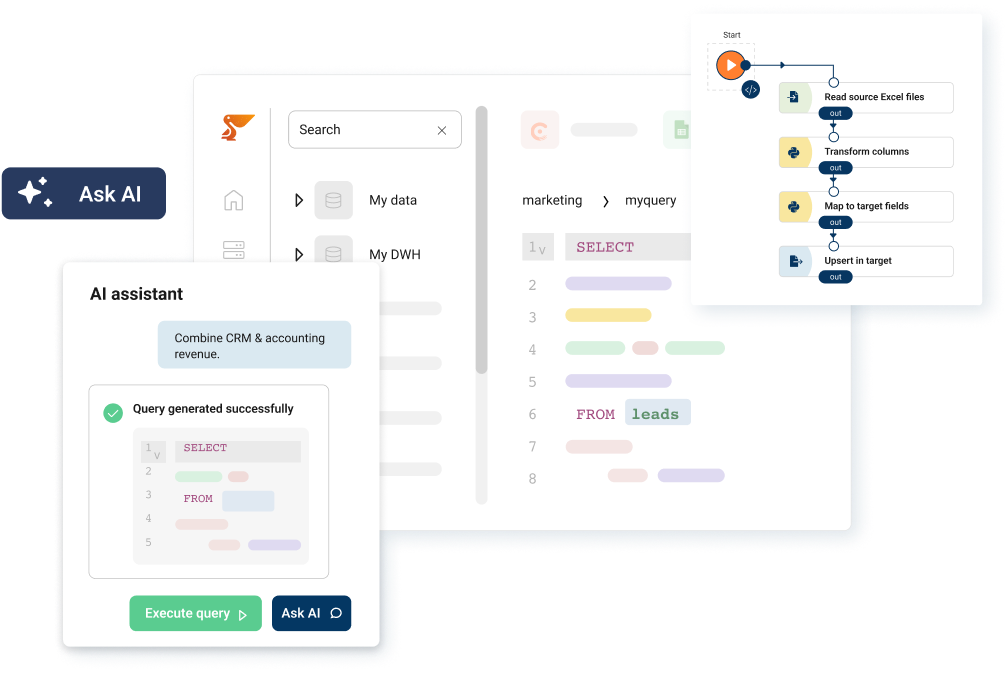
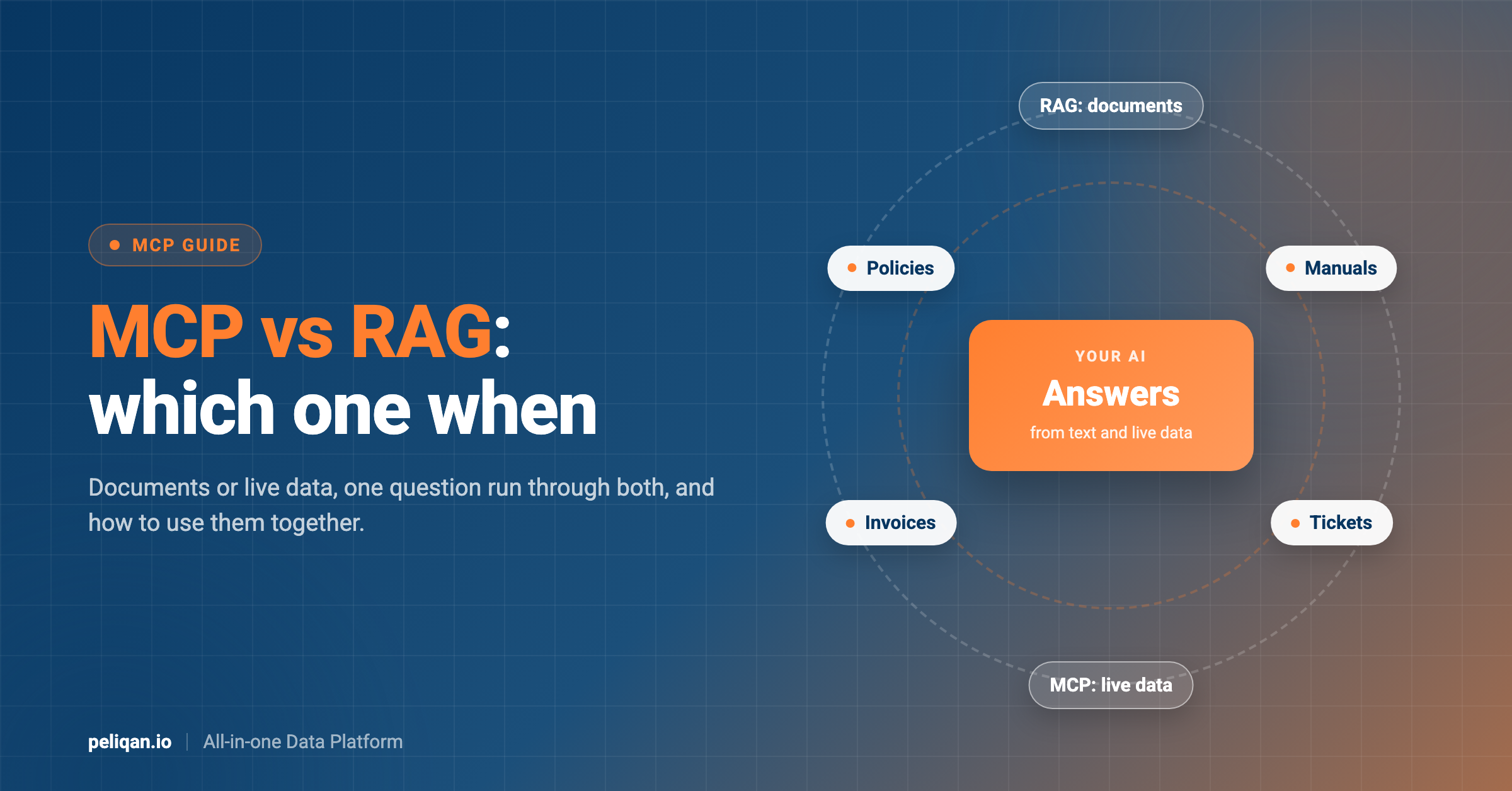
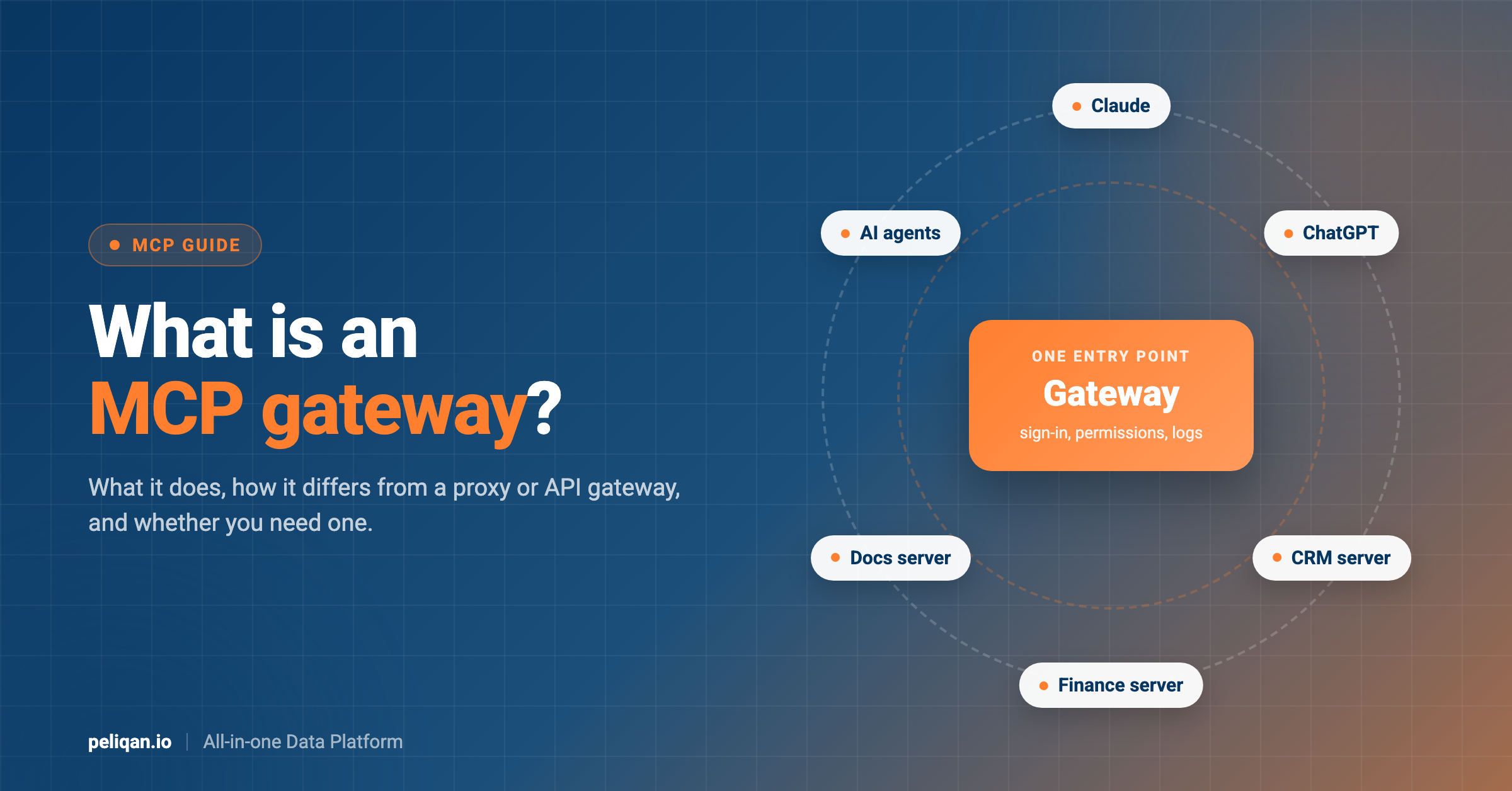
Where Keboola leans on its component model, Peliqan offers SQL and low-code Python transformations with an AI-assisted assistant, plus built-in dashboards, reverse ETL, and API publishing, including the BI front-end Keboola leaves to a separate tool. A native MCP server exposes governed data to LLMs with row-level permissions.
Pricing is transparent and fixed rather than usage-based, with current tiers on the pricing page. Peliqan is SOC 2 Type II, ISO 27001, GDPR, HIPAA, and CCPA certified, EU-hosted on AWS Frankfurt, builds custom connectors within 2 weeks when a source is missing, and supports white-label, multi-customer management for consultancies.
Real-world example: CIC Hospitality
CIC Hospitality unified data from 50+ sources into Peliqan and now saves 40+ hours per month by fully automating board reports that were previously built by hand, without wiring together separate components for ingestion, transformation, and reporting. Read the case studies.
Best for: teams that want a pre-built, unified ELT, warehouse, BI, and reverse ETL stack with predictable pricing and a flatter learning curve, rather than a component-based platform they assemble. The trade-off is that engineering teams who specifically want to compose and own every component may prefer Keboola’s model.
2. Fivetran
Fivetran is the premium managed-ELT option, with 700+ connectors, automated schema drift handling, change data capture, and near-zero maintenance. Following its completed 2026 merger with dbt Labs, it now spans ingestion and transformation, where Keboola keeps transformation inside its own component model.
Setup is easy and reliability is high, but its Monthly Active Rows pricing scales quickly and there is less low-level control than Keboola’s components give. Best for: teams that want zero-maintenance ingestion and can absorb volume-based pricing.
3. Airbyte
Airbyte is the open-source data integration leader, with 600+ connectors, an AI connector builder, and both self-hosted and cloud deployment. Like Keboola it appeals to engineering teams, but it centers on ingestion with no vendor lock-in rather than a full data ops platform.
It is highly customizable with a large community, but self-hosting needs DevOps effort and you assemble transformation and orchestration separately. Our Airbyte alternatives guide compares the field. Best for: engineering teams that want open-source ingestion and long-tail connectors.
4. Matillion
Matillion is a cloud-native ELT platform that optimizes processing inside warehouses like Snowflake, BigQuery, and Redshift, with a visual builder, pushdown execution, and its newer Data Productivity Cloud and Maia agentic AI assistant. It overlaps with Keboola on visual transformation but is more tightly warehouse-coupled.
It delivers warehouse-native performance with an intuitive UI, but it is tied to specific warehouses and its credit-based pricing can get complex. Our Matillion alternatives guide goes deeper. Best for: teams standardized on a cloud warehouse that want visual, pushdown ELT inside it.
5. Hevo Data
Hevo is a no-code, fully managed pipeline platform with real-time syncing from 150+ sources, automated schema handling, and dbt-based transformations, all through a web UI. Where Keboola asks you to assemble components, Hevo is point-and-click for non-engineers.
It is quick to deploy with a free tier, but event-based pricing can be hard to forecast and there is no built-in warehouse. Our Hevo Data alternatives guide goes deeper. Best for: teams that want no-code managed ingestion with real-time syncing.
6. Integrate.io
Integrate.io is a low-code platform covering ETL, ELT, CDC, reverse ETL, and API management, with 150+ connectors, sub-60-second CDC, and a fixed-fee pricing model. It is a more approachable, pipeline-focused alternative to Keboola’s component architecture.
Its drag-and-drop builder and fixed-fee model appeal to teams that dislike usage-based bills, but it lacks a built-in warehouse or BI and costs can climb at higher volumes. Best for: mid-sized teams that want low-code ETL, CDC, and reverse ETL in one tool.
7. Estuary
Estuary Flow is a real-time data integration platform built around streaming and change data capture. Where Keboola is oriented toward batch component runs, Estuary captures changes once and delivers them to multiple destinations with low latency, combining streaming and batch.
It is a strong fit when real-time freshness matters most, though its connector catalog is narrower than the largest platforms. Best for: teams that need real-time CDC and streaming rather than batch data ops.
8. Dagster
Dagster is a modern, asset-oriented orchestration platform that overlaps with the orchestration side of Keboola. It models pipelines as data assets with lineage, typing, and rich observability, and integrates with dlt, Sling, and dbt for the extract-load step.
It is code-first and Python-native with a strong orchestration and observability layer, but it is not itself a connector catalog, so you bring the ingestion piece. Best for: engineering teams that want asset-based orchestration and observability.
9. Stitch
Stitch, owned by Talend (now part of Qlik), is a developer-friendly ETL tool for small to medium teams, with 130+ connectors, Singer-standard extensibility, batch loads to cloud warehouses, and a simple cloud UI. It is far lighter than Keboola’s full data ops platform.
It is quick to onboard and affordable, with a free tier and paid plans from around $100/month, but the connector catalog is smaller and there is no built-in transformation engine. Best for: small to medium teams that want simple, affordable batch ingestion.
10. Informatica
Informatica is the enterprise platform for data integration, quality, governance, and master data management, with 500+ connectors and the CLAIRE AI engine. Acquired by Salesforce in late 2025, it suits large, regulated organizations well beyond Keboola’s mid-market and engineering-team focus.
It is proven at enterprise scale with deep governance, but it is expensive, complex to implement, and brings long rollout timelines. Best for: large enterprises that need governance and MDM well beyond data ops.
Keboola alternatives compared
A quick side-by-side of the 10 Keboola alternatives on type, strengths, pricing model, and limitations. Confirm current pricing with each vendor before deciding.
How the data ops landscape is shifting in 2026
Three shifts are reshaping the space Keboola competes in. First, ownership is consolidating: Fivetran completed its merger with dbt Labs, Informatica was acquired by Salesforce, and Stitch sits inside Qlik via Talend, so the lines between ingestion, transformation, and governance keep blurring.
Second, buyers are splitting into two camps: engineering teams that want to compose and own every component, and mixed teams that want a pre-built platform with fewer moving parts and predictable pricing. Third, AI agents and Model Context Protocol endpoints are becoming a first-class workload, which rewards platforms that expose governed SQL over a warehouse rather than scattering logic across separate components. The practical effect is that data integration platforms are converging on the all-in-one pattern, and the differentiator becomes how simple and predictable that platform is to run.
How to choose the right Keboola alternative
Match the choice to how much you want to assemble yourself, how technical your team is, and how predictable you need pricing and the learning curve to be.
Quick decision guide
- A pre-built all-in-one platform with fixed pricing and built-in BI: Peliqan
- Zero-maintenance managed ingestion: Fivetran
- Open-source flexibility and long-tail connectors: Airbyte
- Pushdown ELT inside a cloud warehouse: Matillion
- No-code managed pipelines with a free tier: Hevo Data
- Low-code ETL, CDC, and reverse ETL in one tool: Integrate.io
- Real-time CDC and streaming: Estuary
- Asset-based orchestration and observability: Dagster
- Simple, affordable batch ingestion: Stitch
- Enterprise governance and MDM: Informatica
Keboola vs a pre-built all-in-one platform: what changes
The biggest practical difference is assembly. Keboola gives you a component-based system: you configure extractors, transformations, orchestrations, and writers, wire them into flows, and manage usage-based costs as you scale. That control is the point for engineering teams who want to own the architecture, and it is overhead for teams that just need analytics-ready data and dashboards.
A pre-built all-in-one platform collapses that into one place where ingestion, the warehouse, transformation, dashboards, and writeback are already connected, with fixed pricing instead of usage meters. The trade-off is composability: if your team specifically wants to assemble and own each component, Keboola’s model gives more granular control. When evaluating, audit what your Keboola project actually does, separate the ingestion from the transformation, orchestration, and reporting around it, and pressure-test the alternative on a representative pipeline before committing.
Conclusion
Keboola is a capable component-based data ops platform, and for engineering teams that want to assemble and own every part of their stack with version control, it still earns its place. But the component model, usage-based pricing, and learning curve are decisive for many teams. Fivetran, Hevo, Stitch, and Integrate.io lead the managed-ingestion bucket, Airbyte and Dagster cover open-source and orchestration, Estuary owns real-time CDC, Matillion handles warehouse-native ELT, Informatica covers enterprise governance, and Peliqan offers the most pre-built all-in-one path.
For teams whose Keboola usage is mostly moving data into a warehouse, transforming it, and reporting on it, a pre-built platform that bundles ingestion, storage, modeling, dashboards, and activation with fixed pricing removes the most moving parts at once. To see what that looks like compared to assembling components, you can try Peliqan free or book a demo to walk through your specific pipelines.