




Hevo Data is a popular no-code data pipeline platform, but event-based pricing that is hard to forecast, limited transformation, and no built-in data warehouse, BI, or downstream activation push many teams to evaluate Hevo Data alternatives. Here is a current comparison of the top 10 Hevo Data alternatives and competitors for 2026.
The data integration landscape keeps shifting, with teams looking for better value, broader capabilities, or less complexity than traditional ELT tools provide. Hevo Data is a solid mid-market option, but it now faces strong competition from platforms that offer more predictable pricing, a more complete feature set, or greater flexibility.
Whether you want to reduce costs, gain more control over your pipelines, or add capabilities like data activation and AI-assisted transformations, the alternatives below give you a clear set of options. We compare 10 leading Hevo Data alternatives across all-in-one platforms, managed ingestion, and open-source tools, with strengths, pricing models, and ideal use cases for each.
Why consider alternatives to Hevo Data?
Hevo Data is a no-code pipeline platform used to move data from 150+ sources into cloud data warehouses, with real-time syncing, automated schema handling, and dbt-based transformations. It is genuinely easy to start with, but a few recurring limits send growing teams looking elsewhere.
Common reasons teams move off Hevo Data
- Pricing complexity: event-based billing is hard to forecast, and costs can climb quickly as data volumes and pipeline counts grow.
- Transformation limits: Hevo handles ingestion and basic transforms well, but heavier modeling usually means adding dbt or another tool.
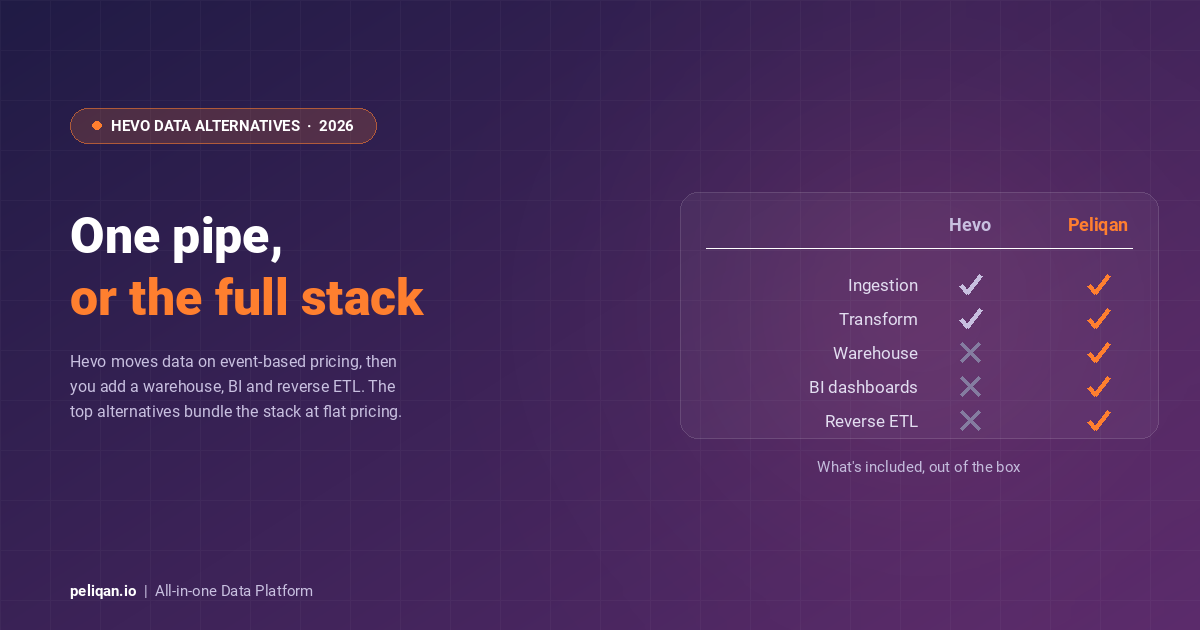
- No built-in data warehouse, BI, or activation: Hevo moves data into a data warehouse you bring, with no native storage, dashboards, or reverse ETL, so the stack still needs several more tools.
- Connector coverage: 150+ sources is solid for common SaaS and databases, but narrower than ingestion-first platforms with 250+ or open-source catalogs.
- Control and flexibility: as pipelines grow more complex, teams often want either deeper orchestration or a more consolidated platform than a managed pipe alone.
The top Hevo Data alternatives for 2026
Each entry below covers what the tool is, how it differs from Hevo, and the team profile it fits best, starting with the most consolidated option.
1. Peliqan – the complete modern data stack in one platform
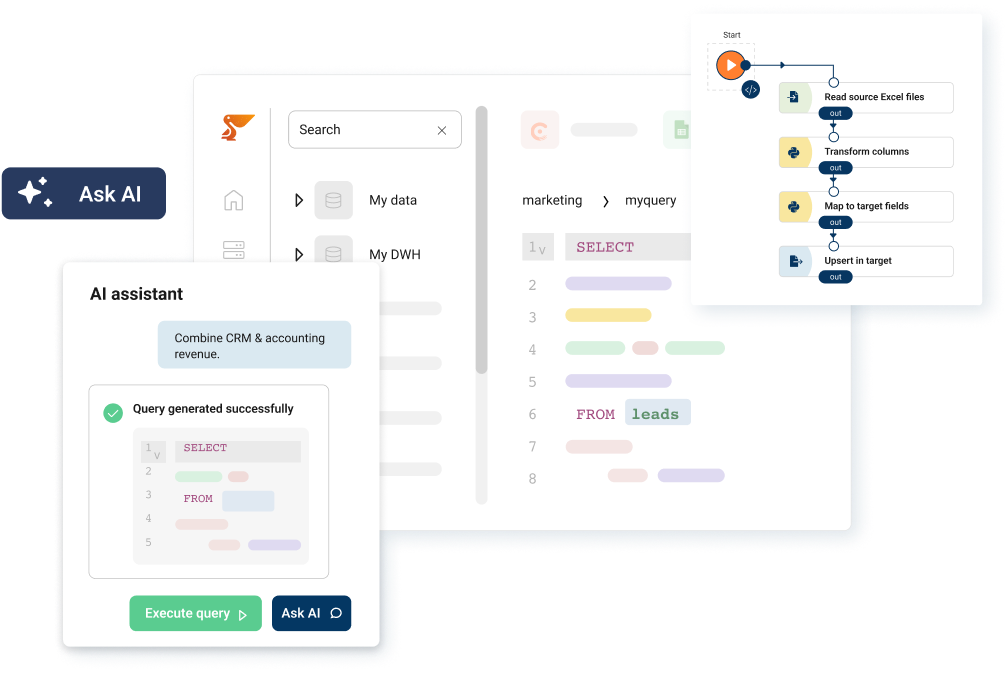
Peliqan is the strongest Hevo Data alternative for teams that want more than a pipeline. Where Hevo moves data into a data warehouse you bring and expects you to add transformation, BI, and reverse ETL separately, Peliqan consolidates the entire modern data stack into one platform built for fast setup.
It pairs 250+ pre-built connectors across databases, APIs, SaaS tools, and files with a built-in Postgres and Trino data warehouse, so ingestion and storage are handled in one place without a separate contract. A Trino-powered federated query engine runs SQL across cloud and on-prem sources in real time.
SQL and low-code Python transformations with an AI-assisted “Magical SQL” assistant cover the modeling work, and built-in visual analytics and dashboards mean you do not need a separate BI tool.
On the output side, data activation with reverse ETL and API publishing pushes curated data back to business apps, the exact downstream step Hevo leaves out.
Pricing is transparent and fixed rather than event-based, which removes the budget surprises that come with usage billing; current tiers are on the pricing page. Peliqan is SOC 2 Type II, ISO 27001, GDPR, HIPAA, and CCPA certified, EU-hosted on AWS Frankfurt, with role-based access and audit logging, and builds custom connectors within 2 weeks when a source is missing.
Real-world example: CIC Hospitality
CIC Hospitality unified data from 50+ sources into Peliqan and now saves 40+ hours per month by fully automating board reports that were previously built by hand, replacing what would otherwise be a pipeline plus a data warehouse plus a separate BI layer. Read the case studies.
Best for: teams that want a unified ELT, data warehouse, BI, and reverse ETL stack with predictable pricing and fast onboarding, rather than a managed pipeline plus a stack assembled around it. The trade-off is that Peliqan is newer than legacy vendors and optimized for cloud-native workflows.
2. Skyvia
Skyvia is a no-code data integration platform with 200+ connectors across SaaS apps, databases, file storage, and cloud data warehouses. It supports ETL/ELT, reverse ETL, data sync, workflow automation, and live data access from one platform, with volume-based pricing and unlimited users on every plan.
It is easy to adopt and broad enough to cover both data warehouse and operational integration scenarios, though it is less focused on low-latency streaming CDC than specialist platforms. Best for: data-driven teams that want fast no-code setup and multiple integration options without managing infrastructure.
3. Fivetran
Fivetran is the premium managed-ELT option, offering fully automated pipelines with minimal maintenance, 700+ connectors, automated schema evolution, change data capture, and reliable syncing into cloud data warehouses. Following its completed 2026 merger with dbt Labs, it now spans ingestion and transformation.
Setup is easy and maintenance minimal with strong uptime and support, but its Monthly Active Rows pricing scales quickly and customization is limited by the fully automated approach. Our data integration comparison guide covers the broader field. Best for: teams that want zero-maintenance ingestion and can absorb volume-based pricing.
4. Airbyte
Airbyte offers one of the largest connector catalogs in the industry (600+) through an open-source model, with an AI connector builder, support for structured and unstructured data, vector database integration for AI/ML use cases, and both self-hosted and cloud deployment.
It gives complete customization and control with transparent capacity-based pricing, but self-hosting needs DevOps expertise and community-built connector quality varies. Best for: technical teams that want open-source flexibility and long-tail connectors over a fully managed experience.
5. Microsoft Azure Data Factory
Azure Data Factory provides enterprise data integration with deep Microsoft ecosystem ties, 90+ connectors, visual ETL/ELT design, hybrid cloud support, and a serverless architecture, now also offered as Data Factory in Microsoft Fabric.
It integrates tightly across Azure with no infrastructure to manage, but consumption-based pricing can climb at scale, complex transformations need extra skills, and it is Microsoft-centric. Our Azure Data Factory alternatives guide goes deeper. Best for: Microsoft-stack teams that want managed integration across the Azure ecosystem.
6. Apache Airflow
Apache Airflow leads workflow orchestration with a code-first approach, 200+ operators and hooks, rich web-based monitoring, and scalable execution. It is not a traditional ELT tool but the foundation many teams build complex pipelines on.
It offers unlimited flexibility and no vendor lock-in, but carries a steep learning curve, real setup and maintenance effort, and no built-in connectors or data warehouse. Our Airflow alternatives guide compares the field. Best for: engineering teams that need code-first orchestration and can own the infrastructure.
7. AWS Glue
AWS Glue provides serverless data integration with AI-assisted code generation and deep AWS ties, built on Apache Spark for large-scale processing, with 100+ connectors, a data catalog with automatic discovery, and multi-engine support.
It scales to enterprise data volumes and reduces development effort with AI assistance, but it locks you into AWS, has a learning curve for non-AWS teams, and can get expensive for continuous workloads. Best for: AWS-centric teams that want serverless, Spark-based integration across the AWS stack.
8. Apache NiFi
Apache NiFi excels at visual, flow-based data movement with a drag-and-drop interface, 200+ built-in processors, comprehensive data provenance, and real-time plus batch processing, with strong security controls.
Its visual interface reduces coding and its provenance tracking is excellent, but it is resource-intensive and carries real infrastructure and maintenance overhead. Best for: teams that need real-time, flow-based movement across on-prem, edge, and cloud systems.
9. Meltano
Meltano is a comprehensive open-source ELT platform built on Singer standards, with 600+ connectors, CLI-first development, native dbt integration, built-in orchestration, and version control for GitOps workflows.
It delivers commercial-grade ELT capabilities without licensing costs and a strong developer experience, but it needs technical expertise to run and favors command-line over a GUI. Best for: engineering teams that want open-source, Git-native ELT with dbt at the center.
10. Informatica
Informatica offers enterprise data management spanning integration, quality, governance, and master data management, with 500+ connectors, the CLAIRE AI engine, and cloud and on-prem options. Acquired by Salesforce in late 2025, it has been a market leader for over a decade.
It is proven at enterprise scale and covers the full data management lifecycle, but it is expensive, has a complex licensing structure, and brings long implementation timelines. Best for: large, regulated enterprises that need governance and MDM well beyond pipeline ingestion.
Hevo Data alternatives compared
A quick side-by-side of the 10 Hevo Data alternatives on strengths, pricing model, and limitations. Confirm current pricing with each vendor before deciding.
How to choose the right Hevo Data alternative
Match the choice to how much of the stack you want in one place, how technical your team is, and how predictable your costs need to be. If pushdown ELT inside a single cloud data warehouse is the priority, our Matillion alternatives guide covers that segment in more depth.
Quick decision guide
- One platform for ETL, a data warehouse, BI, and reverse ETL with fixed pricing: Peliqan
- No-code ETL/ELT, reverse ETL, data sync, and workflow automation: Skyvia
- Zero-maintenance managed ingestion: Fivetran
- Open-source flexibility and long-tail connectors: Airbyte or Meltano
- Microsoft-stack integration: Azure Data Factory
- Code-first orchestration of complex workflows: Apache Airflow
- Serverless, Spark-based processing on AWS: AWS Glue
- Real-time, flow-based movement on-prem or at the edge: Apache NiFi
- Enterprise governance and master data management: Informatica
Hevo vs an all-in-one platform: what changes
The biggest practical difference is scope. Hevo is an ingestion layer: it moves data into a data warehouse you provide, so a working setup usually means Hevo plus a data warehouse contract, plus a transformation tool for anything beyond basic models, plus a BI tool, plus a separate reverse ETL product. Each piece has its own pricing and its own console to monitor, and the event-based meter on the ingestion layer makes the total hard to predict.
Moving to a unified platform collapses that into one bill and one place to build and watch pipelines, with ingestion, the data warehouse, transformation, dashboards, and writeback included rather than assembled. The trade-off is that a consolidated platform is less specialized than a best-of-breed streaming pipeline, so teams whose single hard requirement is sub-second CDC at very high volume may still prefer a dedicated tool. When evaluating, audit what you actually run in Hevo, separate the ingestion from the data warehouse and activation around it, and pressure-test the alternative on a representative pipeline before committing.
Conclusion
Hevo Data has helped many teams stand up no-code pipelines quickly, but it is not always the most cost-effective or complete option. If you are hitting event-based pricing ceilings, missing connectors, or assembling a data warehouse, transformation, BI, and reverse ETL around it, the platforms above are worth a serious look.
For an easy-to-use, modern solution that combines ELT, a data warehouse, BI, and reverse ETL in one place with transparent pricing, Peliqan is the most consolidated alternative. Fivetran and Airbyte lead on ingestion, Informatica on enterprise governance, and Meltano on open-source ELT, while Skyvia is a strong fit for teams that want no-code ETL/ELT, reverse ETL, data sync, and workflow automation in one platform. Airflow, Glue, and NiFi are better suited to orchestration and flow-based movement. Explore your options based on your team’s technical skills, data stack, and integration needs, and the right platform can save real engineering time while delivering analytics-ready data faster.