




Airbyte’s open-source ELT platform works well for engineering teams comfortable managing Kubernetes clusters, maintaining community connectors, and bolting on external transformation tools. For everyone else, the operational overhead adds up fast. This guide compares 10 Airbyte alternatives across connectors, transformations, pricing, deployment, and total cost of ownership – with current data from 2026.
Airbyte has grown rapidly since its 2020 launch, now claiming 500+ source connectors and a large developer community. The open-source model appeals to teams that want zero licensing costs and full control over their infrastructure. But in production, the reality is more nuanced: only about 15% of connectors are officially Airbyte-managed (the rest are community-maintained with variable reliability), Cloud syncs are capped at hourly frequency on the Standard tier, schema changes often trigger full re-syncs, and the platform has no built-in transformation engine – requiring external tools like dbt at additional cost.
Self-hosted deployments require Kubernetes expertise, with infrastructure costs running $500-3,000+/month on AWS or GCP plus 5-10 hours of engineering maintenance time per month. Airbyte Cloud pricing starts at $10/month but scales with volume ($2.50 per credit), and there is a significant gap between the Standard tier and the Plus tier ($25,000/year) with no mid-range option.
These trade-offs don’t make Airbyte a bad tool – they make it a tool with a specific profile that doesn’t fit every team. The alternatives below serve different profiles: fully managed platforms for teams that want zero operational overhead, all-in-one platforms that bundle warehouse and transformations alongside connectors, real-time streaming tools for sub-second latency requirements, and open-source options that take a different approach to the same problem Airbyte solves.
Why teams switch from Airbyte
- Connector reliability: Community-maintained connectors break on upstream API changes. Teams report data gaps with no error messages on connectors like Pinterest and TikTok.
- No built-in transformations: Airbyte is extract-and-load only. You need dbt (starting at $100/developer/month for Cloud) or another tool for the T in ELT.
- Hourly sync ceiling on Cloud Standard: Real-time use cases (fraud detection, live dashboards, operational analytics) need sub-minute latency that Airbyte Cloud doesn’t offer at base pricing.
- DevOps overhead for self-hosting: Kubernetes management, Docker container orchestration, monitoring, and security configuration require dedicated platform engineering resources.
- Pricing unpredictability: Credit-based Cloud pricing makes budgeting hard, and there is no mid-range tier between $10/month and $25,000/year.
- Weak reverse ETL: Airbyte’s data activation capabilities were only introduced recently and remain less mature than dedicated reverse ETL tools.
Airbyte competitors & alternatives in 2026
Airbyte alternatives: Top 10
1. Peliqan – all-in-one data platform
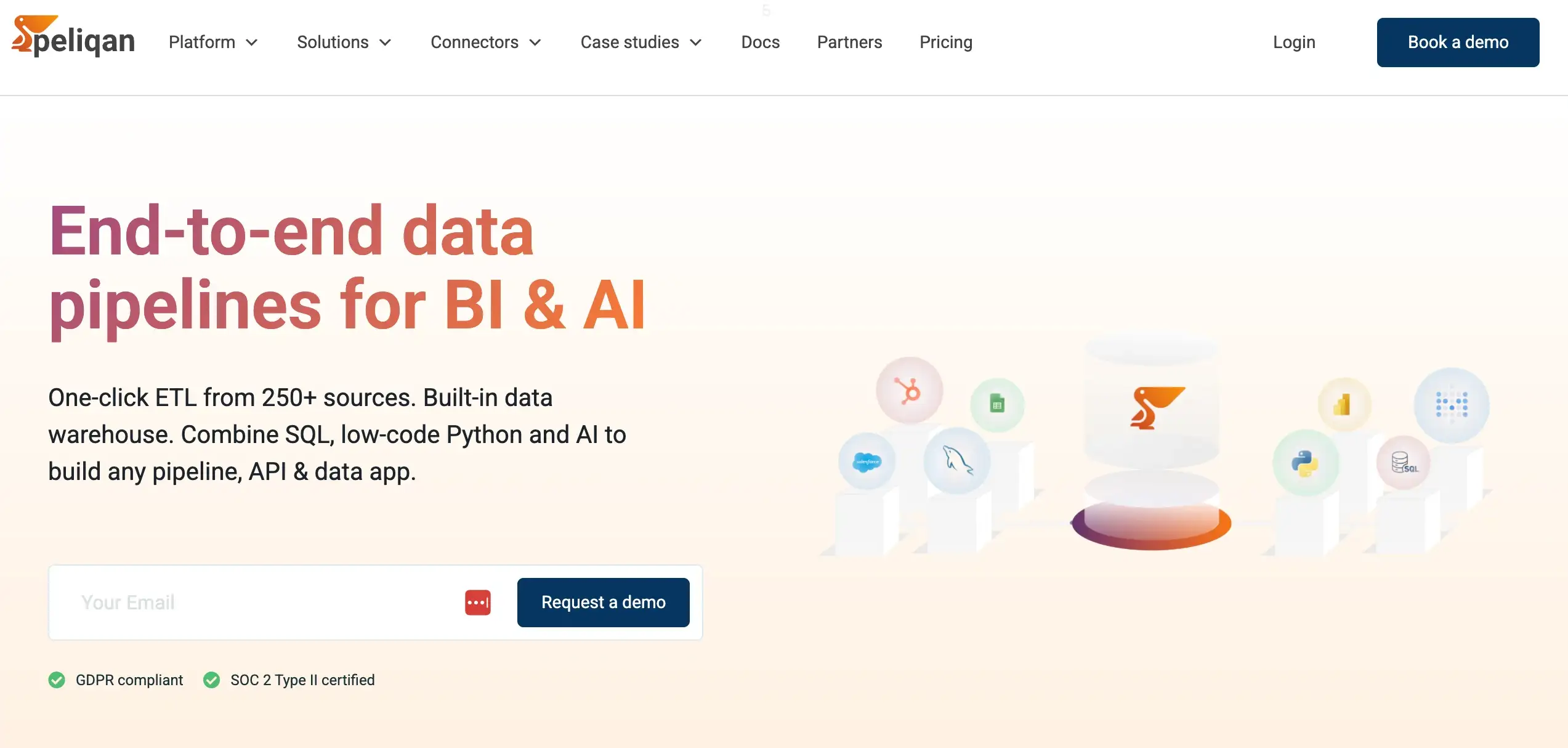
Peliqan at a glance
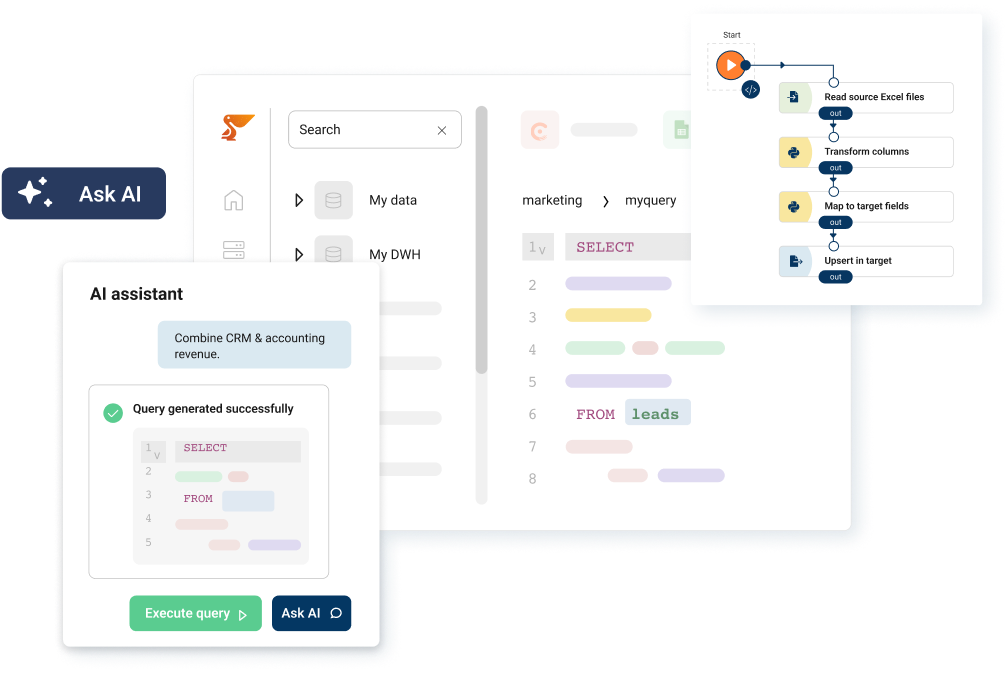
Peliqan takes a fundamentally different approach than Airbyte. Where Airbyte is one component in a multi-tool stack (you need a separate warehouse, a separate transformation tool, a separate BI layer, and a separate reverse ETL tool), Peliqan combines all of these into a single platform. This means fewer integration points, less infrastructure to manage, and one vendor relationship instead of five.
The practical difference is deployment speed: teams go from zero to a working data warehouse with live dashboards in under an hour, compared to the days or weeks required to configure Airbyte + dbt + warehouse + BI tool. For organizations without dedicated data engineering teams – consultancies, mid-market SaaS companies, ERP partners – this collapse of complexity is the primary value.
Peliqan also includes capabilities Airbyte doesn’t offer: white-label and multi-customer management for agencies and service providers, AI-powered data operations including natural language to SQL, and a federated query engine (Trino) for querying across sources without moving data.
Real-world example: OdooExperts
OdooExperts consolidated reporting across 50+ client environments using Peliqan’s multi-customer management and automated ELT pipelines – a use case that would require custom engineering with Airbyte since it has no multi-tenant capabilities.
Choose Peliqan over Airbyte when: You want a single platform instead of assembling a multi-tool stack, your team is not engineering-heavy, you need predictable fixed pricing, or you need white-label/multi-customer capabilities.
2. Fivetran – fully managed ELT

Fivetran at a glance
Fivetran is the polar opposite of Airbyte’s philosophy: zero operational overhead, zero self-hosting, zero community connector variability. Every connector is vendor-maintained with SLAs. The dbt Labs and Fivetran merger in 2025 was the largest deal in data infrastructure this decade, creating an integrated ingestion + transformation platform.
The trade-off is cost. Fivetran’s MAR-based pricing becomes expensive fast – teams consistently report bills 3-5x higher than expected once data volumes grow. No on-premises deployment (cloud-only with a hybrid runner in beta), and no built-in warehouse.
Choose Fivetran over Airbyte when: You want zero operational overhead, need enterprise-grade SLAs and connector reliability, and budget is secondary to reliability.
3. Hevo Data – real-time no-code ELT
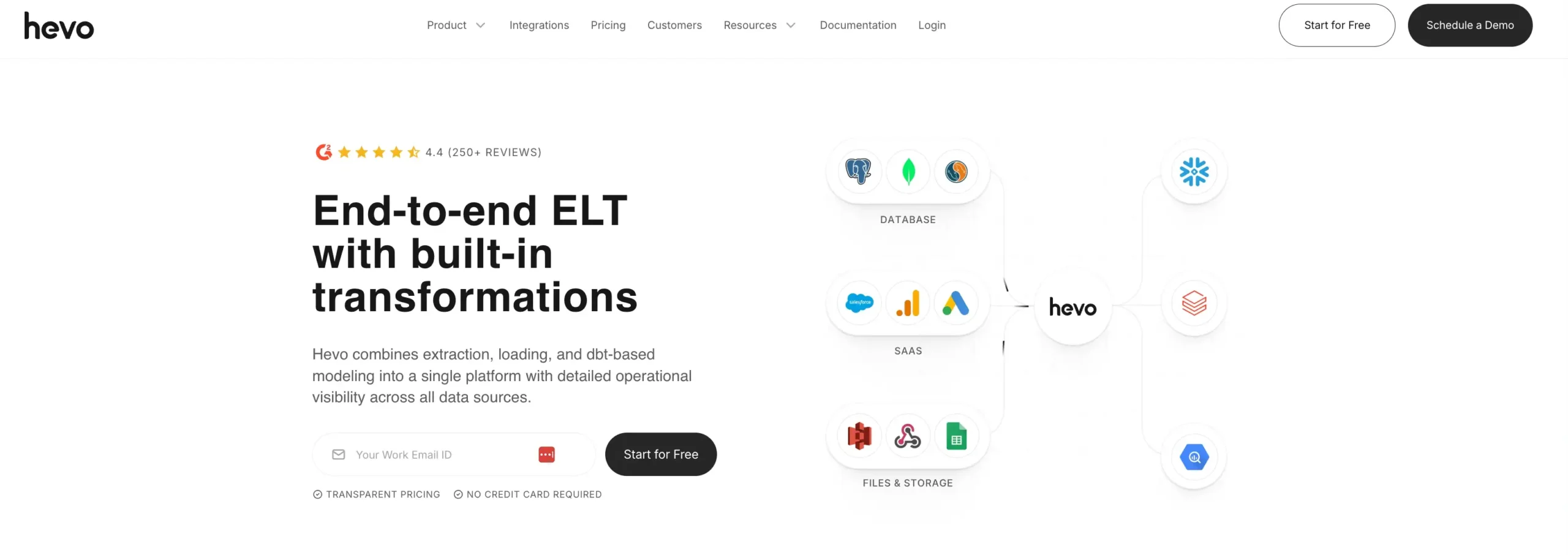
Hevo Data at a glance
Hevo is the strongest alternative for teams that need real-time streaming pipelines without engineering overhead. Its no-code interface handles CDC, schema drift, and automatic retries – capabilities that require significant configuration in Airbyte. Built-in transformations (Python, SQL, dbt) mean you don’t need an external tool for the T in ELT.
The connector catalog (150+) is smaller than Airbyte’s, and scalability beyond 5M rows/month has been flagged as a concern.
Choose Hevo over Airbyte when: You need real-time CDC out of the box, your team is non-technical, and you want built-in transformations without adding dbt.
4. Meltano – open-source, code-first ELT
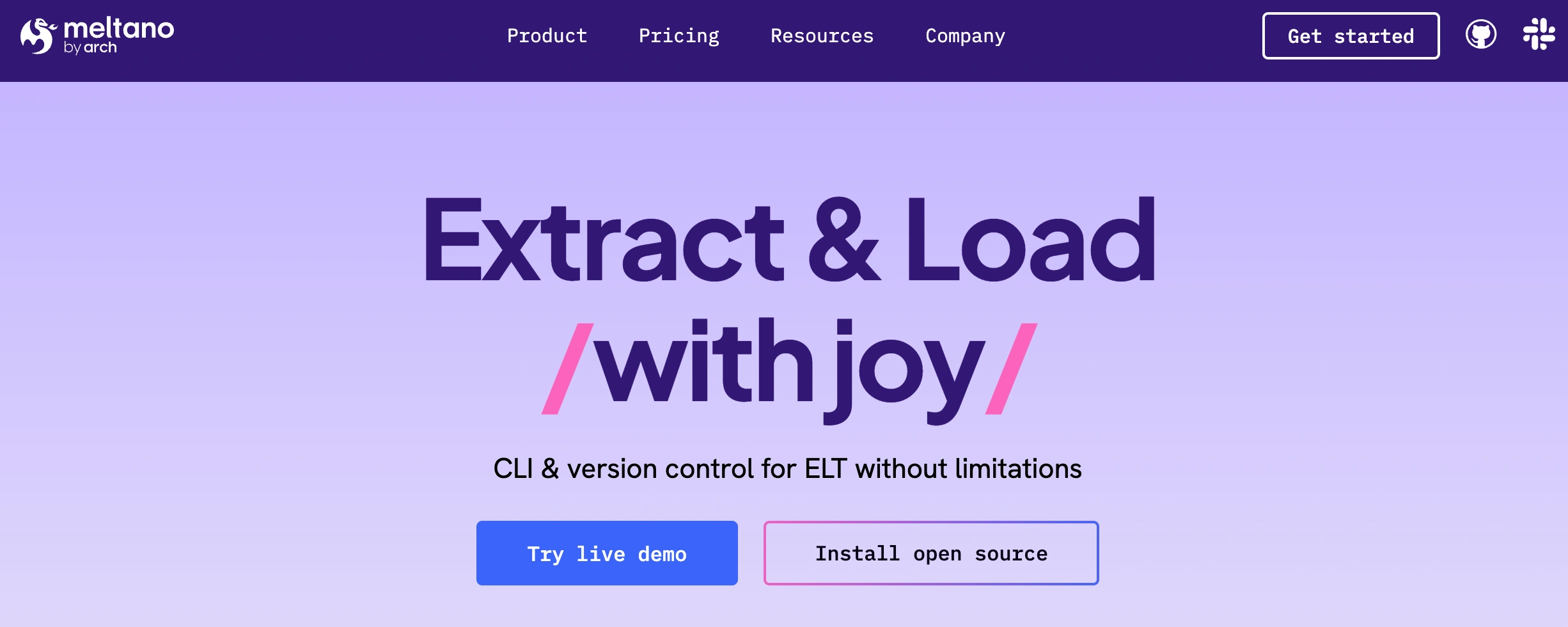
Meltano at a glance
Meltano (originally from GitLab, now acquired by Matatika) uses YAML configuration and CLI tooling, making pipelines fully version-controllable in Git. It builds on the Singer standard rather than Docker containers, which simplifies connector development for Python-native teams. Integrates with Airflow and Dagster for orchestration.
Choose Meltano over Airbyte when: You want a code-first, Git-native approach to pipeline management, prefer Singer taps over Docker connectors, or need CLI-based automation.
5. Estuary Flow – real-time streaming and CDC
Estuary Flow at a glance
Estuary Flow is purpose-built for real-time data movement. While Airbyte Cloud caps at hourly syncs, Estuary delivers sub-100ms latency with exactly-once delivery. Supports both batch and streaming, with hybrid deployment options (SaaS or private cloud).
Choose Estuary over Airbyte when: Real-time CDC and sub-second latency are non-negotiable – fraud detection, live inventory, or operational dashboards.
6. Stitch (Talend/Qlik) – simple managed ELT
Stitch at a glance
Stitch is the simplest managed ELT option on this list. Setup takes minutes, enterprise security (SOC 2, HIPAA) is built in, and there is a free tier for smaller workloads. Now part of Qlik via the Talend acquisition.
Smaller connector catalog, no built-in transforms, no on-prem option. Development has slowed post-acquisition.
Choose Stitch over Airbyte when: You need the simplest possible managed ingestion and are already in the Qlik/Talend ecosystem.
7. Matillion – visual transformation engine

Matillion at a glance
Matillion’s strength is transformation, not extraction. Its visual drag-and-drop engine is the most powerful on this list. Supports AWS, Azure, GCP, and on-prem. Best understood as a transformation-first tool with ingestion capabilities.
Choose Matillion over Airbyte when: Complex data transformations are your primary need and you want a visual interface rather than writing dbt code.
8. Integrate.io – low-code ETL with fixed pricing
Integrate.io at a glance
Integrate.io stands out for fixed-price unlimited data volume and 60-second CDC – two areas where Airbyte’s pricing and hourly sync cap create friction. Both ETL and ELT modes with drag-and-drop interface. Strong e-commerce and marketing data focus.
Choose Integrate.io over Airbyte when: You want predictable fixed pricing regardless of data volume, need sub-minute CDC, or have non-technical users building data pipelines.
9. Rivery – no-code ELT with reverse ETL
Rivery at a glance
Rivery combines ELT and reverse ETL in one platform with reusable templates for fast deployment. 24/7 support and native Python for custom transforms.
Choose Rivery over Airbyte when: You need ELT and reverse ETL in one tool without separate components, or your team benefits from starter templates and guided onboarding.
10. Portable – long-tail niche connectors
Portable at a glance
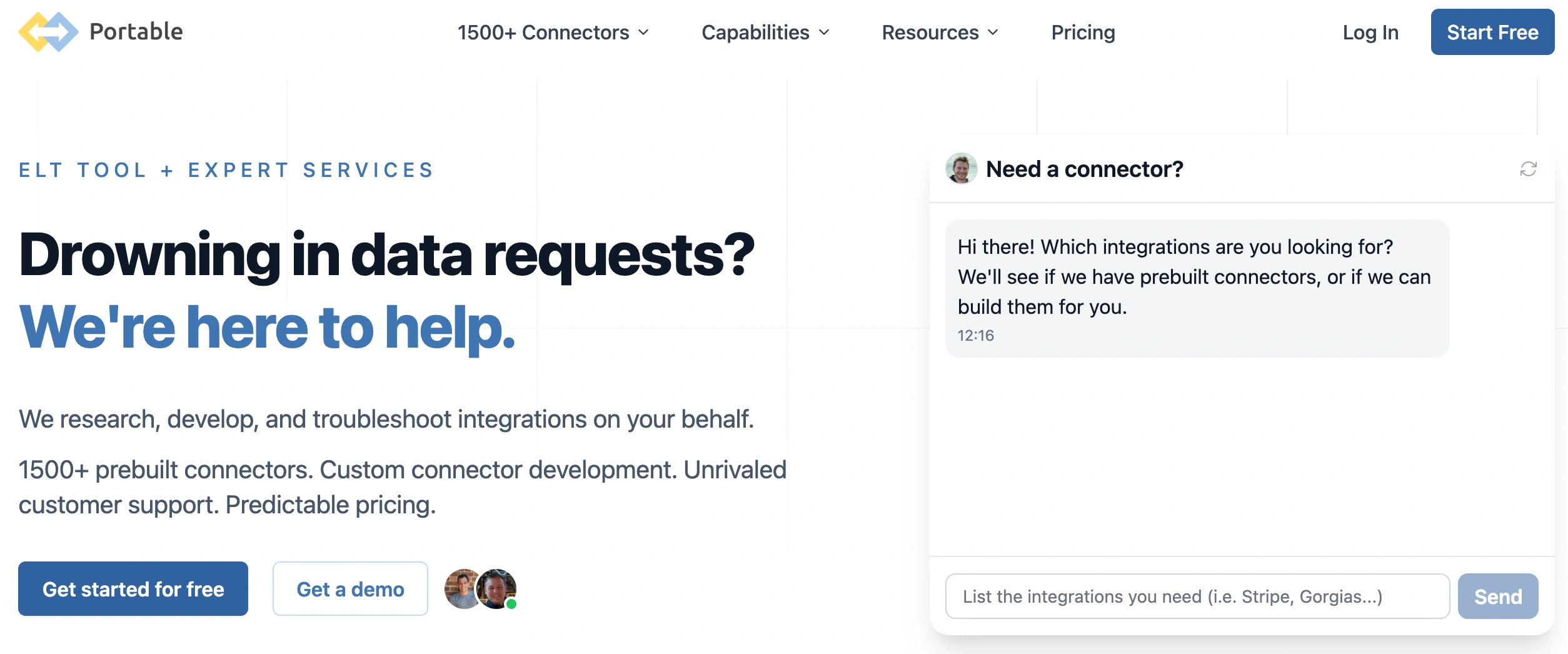
Portable solves a specific problem: connecting to niche, industry-specific, or proprietary SaaS apps that Airbyte’s catalog doesn’t cover. 300+ long-tail connectors with on-demand custom development. Flat-rate per-connector pricing with unlimited data volume makes costs predictable.
Choose Portable over Airbyte when: You need data from unusual or proprietary SaaS applications that other platforms don’t support.
Comparison table: all 10 alternatives at a glance
Decision framework: which alternative fits your team?
Match your profile to a platform
- No data engineers, need a full stack: Peliqan (connectors + warehouse + transforms + reverse ETL in one)
- Enterprise, zero-ops, budget flexible: Fivetran (fully managed, largest connector catalog, dbt included post-merger)
- Real-time CDC, non-technical team: Hevo Data (no-code, streaming, built-in transforms)
- Engineering team, want full control: Meltano (open-source, Git-native, CLI-first) or self-hosted Airbyte
- Sub-second latency required: Estuary Flow (purpose-built real-time streaming)
- Complex transformations are the priority: Matillion (visual transformation engine)
- Predictable cost at high volume: Integrate.io ($1,999/mo unlimited) or Peliqan (fixed pricing)
- Niche/proprietary data sources: Portable (300+ long-tail connectors)
- Agency/consultancy managing multiple clients: Peliqan (multi-customer management, white-label)
Market context: the 2025-2026 shift in data integration
Two developments have reshaped the competitive landscape:
The dbt Labs + Fivetran merger combined the most popular ingestion tool with the most popular transformation tool, creating an integrated ELT platform. This puts pressure on standalone ingestion tools like Airbyte that require external transformation tools.
AI-powered data integration is reducing engineering barriers. Natural language to SQL, automated schema mapping, and AI-assisted connector building (Airbyte’s CDK improvements, Peliqan’s AI copilot, Matillion’s AI transforms) enable business analysts to manage pipelines that previously required 2-3 data engineers. This trend favors platforms that bundle more capabilities and reduce tool count.
Both shifts favor all-in-one platforms – the direction that Peliqan, Keboola, and post-merger Fivetran+dbt are moving, and the trend that pure ingestion tools must adapt to.
Conclusion
Airbyte remains a strong choice for engineering teams that want open-source flexibility, can manage Kubernetes infrastructure, and are comfortable assembling external tools for transformations, warehousing, and activation. For teams that prioritize operational simplicity, cost predictability, or built-in transformations, the alternatives above offer trade-offs that may fit better.
If the goal is to minimize tool count and go from raw data to insights fast, Peliqan collapses the modern data stack into a single platform – 250+ connectors, built-in warehouse, SQL + Python transformations, reverse ETL, and AI copilot – with fixed pricing and SOC 2 Type II security.