




The Fivetran dbt merger completed on June 1, 2026, putting data ingestion and transformation under one company. This post is a plain, balanced read on what actually changed, what stayed the same, and what it means if you are a mid-market team rather than a large enterprise – including the parts worth watching.
When two big tools in your stack become one company, the honest first reaction is a question, not a panic: does this change anything for me?
For most teams the six-month verdict on the Fivetran dbt merger is “not yet, but keep an eye on it.” That is less dramatic than the takes on both sides, and closer to the truth. Here is what happened and what it means, without the vendor spin or the doom.
What the Fivetran dbt merger actually changed
On June 1, 2026, Fivetran and dbt Labs completed an all-stock merger first announced in October 2025. Fivetran does data ingestion – moving data from your sources into your warehouse. dbt does transformation – turning that raw data into clean, business-ready tables. The two halves of a pipeline, now one company, led by Fivetran’s George Fraser as CEO with dbt’s Tristan Handy as President.
Their stated goal is a single path from raw data to what they call AI-ready data. By their own count the combined company serves more than 100,000 data teams, so this is a large part of the market consolidating, not a niche deal.
What shipped with it
The merger came with real product news, not just a logo change. Three pieces matter.
dbt Core v2.0, with the Fusion engine, open-sourced. dbt rebuilt its engine in Rust for speed and released it as dbt Core v2.0 (alpha) under the Apache 2.0 license – genuinely open source. This is a real engineering upgrade, and the openness commitment is more than words: separately, Fivetran donated SQLMesh, a competing transformation framework it owned, to the Linux Foundation. That is a company signalling it intends to compete on openness, which is worth acknowledging plainly.
Agents Schema. An open standard that puts metric definitions, semantic models and lineage into one warehouse schema, as ordinary SQL tables, for AI agents to read. If that sounds familiar, it is the same idea as the context layer every major vendor launched this year – we compared those in our context layer comparison.
The merger is a bet that owning ingestion plus transformation is the right place to build the context layer.
A paid/free split to understand. The Fusion engine is free to install and run, including in production. The costs appear in the features around it – some advanced capabilities need a free login, others need a paid dbt platform account. Worth reading closely before assuming “open source” means “entirely free for your setup”.
The case for the Fivetran dbt merger
Being fair to it: the logic holds together. Ingestion and transformation are two steps in one job, and having them designed together can genuinely reduce the seams a team maintains by hand. The Fusion engine is a real performance gain. And keeping dbt Core open under Apache 2.0, plus the SQLMesh donation, are concrete moves, not press-release language.
There is also a strategic read. The big all-in-one platforms – Snowflake, Databricks, Microsoft Fabric – have been pulling ingestion and transformation into their own walled gardens. A merged Fivetran and dbt is a bet that some teams would rather have an open layer that works across any warehouse than get locked into one cloud. For teams that value that, it is a reasonable bet.
The concerns worth taking seriously
Being equally fair the other way: the data engineering community has raised concerns that are not hard to understand.
- Vendor neutrality. dbt used to be tool-agnostic – it worked with Fivetran, Airbyte, Stitch, anything. As a Fivetran-owned product, that neutrality is now a fair question rather than a given, even if nothing has changed in practice yet.
- Bundling pressure. Expect the roadmap and pricing to reward using both tools together. That is normal after a merger, and it is also exactly what reduces your freedom to mix best-of-breed pieces later.
- Core versus Cloud. The open-source worry is that dbt Core gets maintenance while the paid platform gets the innovation, until running Core in production quietly becomes impractical. dbt’s licensing commitments push against this, but it is the concern to actually watch, because it plays out slowly.
None of these are settled facts. They are the honest risks a careful team weighs before leaning further into the Fivetran dbt merger, and they matter more the more of your stack sits on these two tools.
What it means if you’re not an enterprise
Most of the coverage is written for large data teams with dedicated platform engineers. If that is not you, the practical takeaways are simpler.
Nothing breaks today. Existing pipelines and models keep working – tighter integration and bundled pricing come over time, not overnight. So there is no fire to fight this week.
But the direction of travel is the real signal. Consolidation is the theme of 2026 across the whole data industry, not just here – Snowflake, Databricks and Microsoft are each pulling more of the stack into their own ecosystems. The merger is one more move in that pattern. The question it should prompt is not “do I switch tools” but “how much of my stack do I want under one roof, and how easily could I change my mind later?”
The consolidation question, plainly
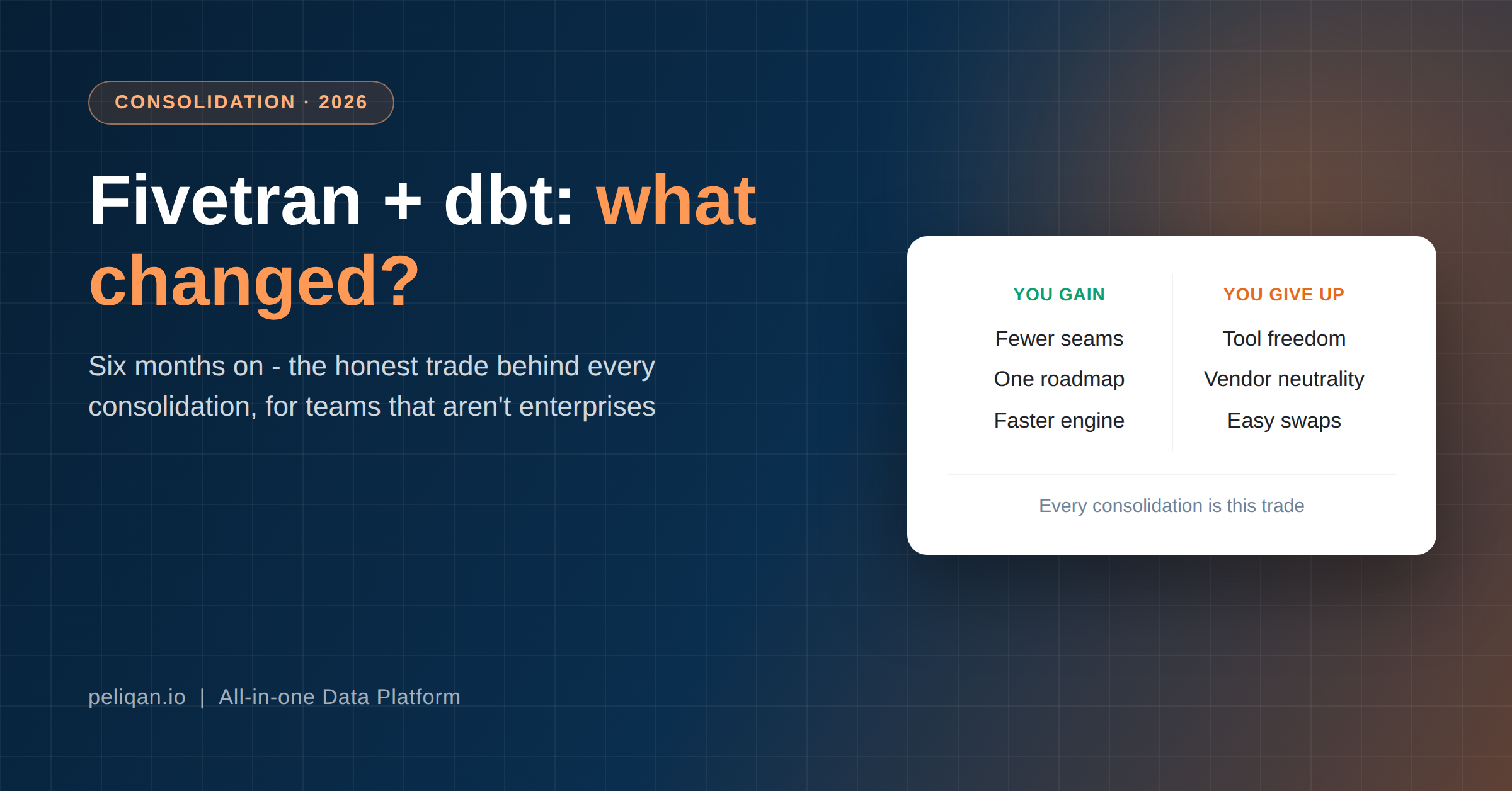
Every consolidation trade is the same shape: fewer seams to manage, in exchange for less freedom to swap parts. Neither side is free.
An all-in-one approach – whether it is Fivetran plus dbt, a cloud platform, or a mid-market platform like Peliqan – reduces the number of tools you wire together and maintain. The cost is that more of your setup depends on one vendor’s roadmap and pricing. A best-of-breed approach keeps your freedom to pick the best piece for each job, at the cost of being the one who integrates and maintains the seams.
The Fivetran dbt merger has no universally right answer. There is only the answer that fits your team’s size and appetite for maintenance – and the merger is a good moment to ask the question deliberately rather than drift into whichever bundle is most convenient.
Where Peliqan sits in this
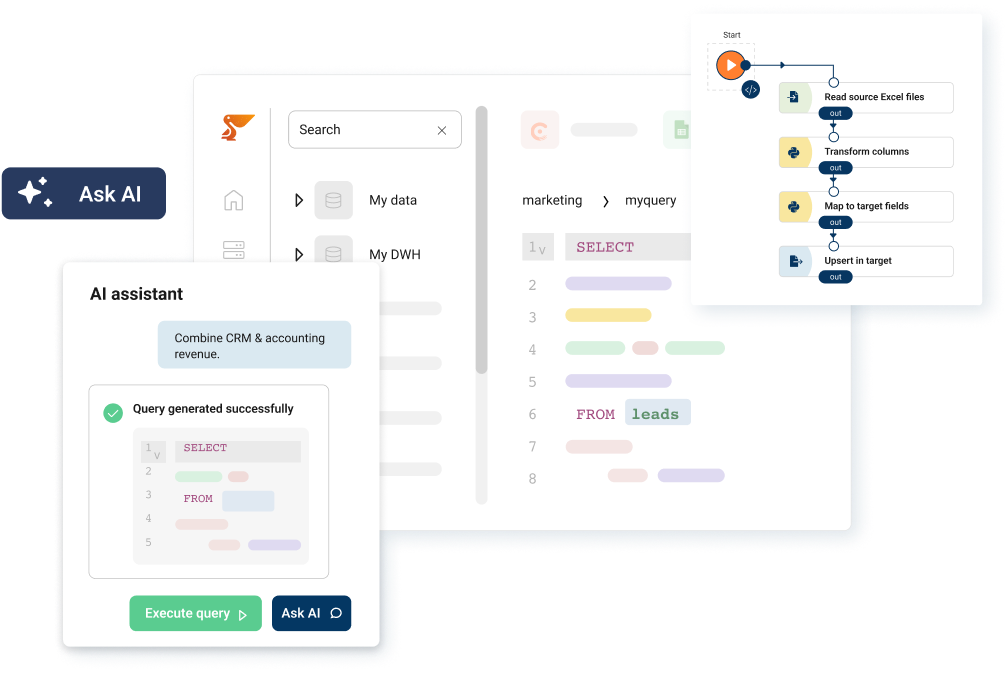
Honesty first, because it is the whole point of this post: Peliqan is also a consolidation play. Ingestion, a built-in warehouse, transformation, reverse ETL and an MCP layer in one platform.
It runs across 300+ connectors. So if your objection to the Fivetran dbt merger is “I don’t want my stack under one roof”, that objection applies to us too, and we would rather say so.
The difference is who it is built for. The merged Fivetran and dbt is aimed at large data teams with engineers to run it. Peliqan is built for mid-market teams that want the seams handled for them, with SQL and Python transformations in the same place the data lands.
It runs on fixed per-connection pricing rather than usage meters – which, after a merger that will bundle pricing over time, is a difference worth weighing.
If you are a large enterprise with a platform team that wants an open, warehouse-agnostic layer, the merged Fivetran and dbt is a serious option and we would not pretend otherwise. Different tools for different team shapes.
If you’re weighing consolidation for a mid-market team and want to see the all-in-one shape without an enterprise setup, book a demo – bring your current stack and we will map which seams disappear and which stay.