




dbt (data build tool) defined SQL-based transformation for the modern data stack. But with the Fivetran-dbt Labs merger now complete as of June 2026, consumption-based pricing that has caught teams off guard, and growing lock-in concerns, many teams are weighing dbt alternatives. Here is a current, honest comparison of the top dbt alternatives and competitors for 2026.
dbt has been the backbone of modern ELT workflows since its launch, letting analytics engineers version-control, test, and modularize SQL transformations inside cloud data warehouses. More than 100,000 data teams now use dbt, and it earned its place as the default transformation layer in the modern data stack.
But on June 1, 2026, Fivetran and dbt Labs completed their all-stock merger, first announced in October 2025, creating a combined entity built around “open data infrastructure for AI.” Alongside it came dbt Core v2.0, which open-sources the new Fusion engine. That consolidation, combined with dbt Cloud’s consumption-based pricing and an engineering-heavy learning curve, has pushed many organizations to explore alternatives that better fit their team’s skills, budget, and infrastructure.
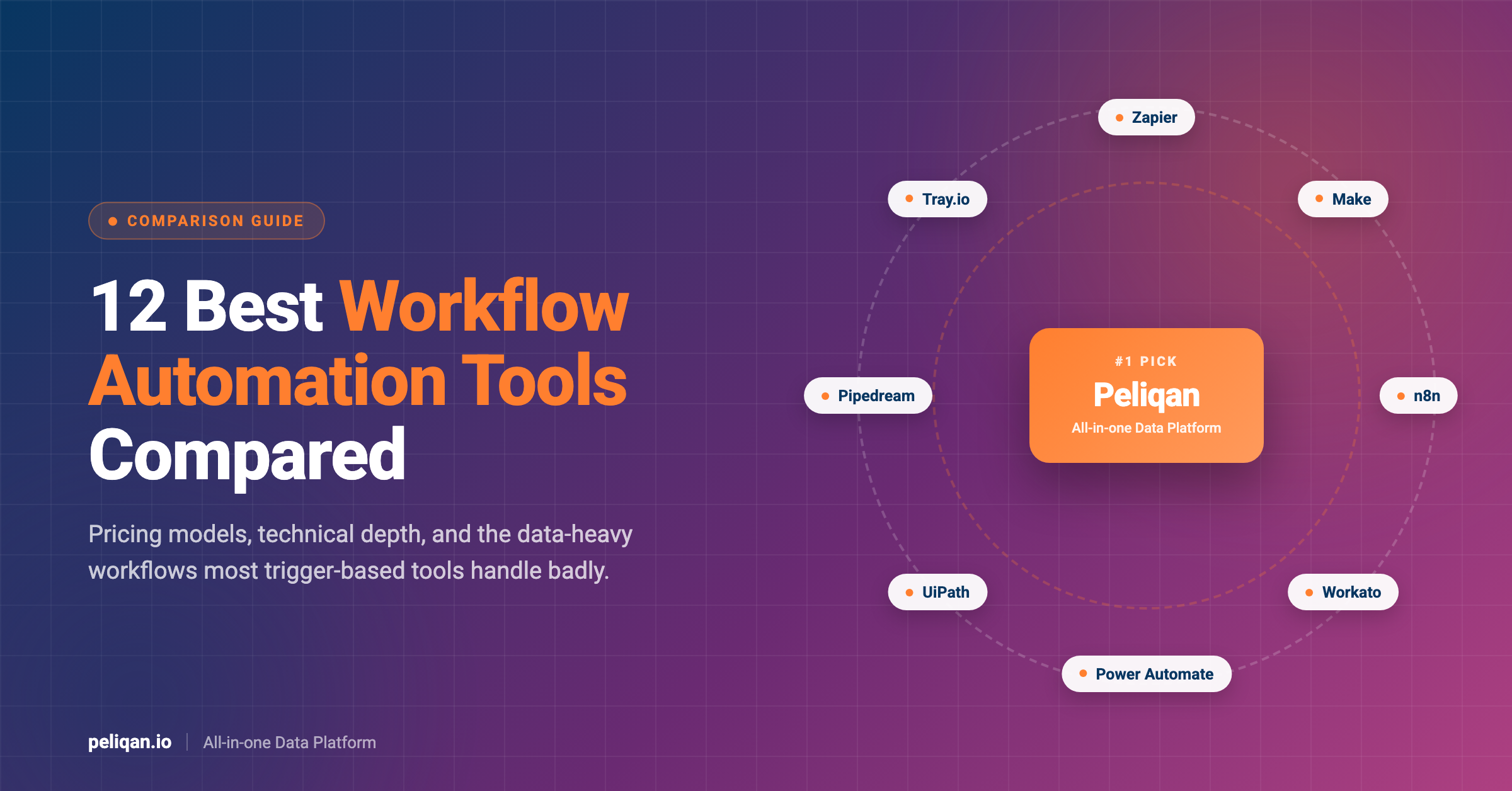
This guide compares dbt and its leading competitors in 2026, including Peliqan, Coalesce, SQLMesh, Dataform, Matillion, Dagster, Alteryx, Informatica, Hevo Data, and Datacoves, so you can choose the right transformation tool, or all-in-one platform, for your data stack.
What is dbt (data build tool)?
dbt is an open-source data transformation tool that focuses exclusively on the “T” in ELT. It lets data teams write modular SQL models, test data quality, document pipelines, and deploy transformations using software engineering practices: version control via Git, CI/CD workflows, and automated testing. With dbt Core v2.0, the Fusion engine brings a faster, Rust-based runtime to that same workflow under an Apache 2.0 license.
dbt at a glance
- Focus: SQL-based data transformation (the “T” in ELT)
- Editions: dbt Core (open-source, now v2.0 with the Fusion engine) and dbt Cloud (managed SaaS)
- Warehouse support: Snowflake, BigQuery, Databricks, Redshift, Postgres, and more
- Pricing: Core free; Cloud Starter from $100/user/mo plus consumption; Enterprise custom
- Ownership: Part of Fivetran + dbt Labs after the June 2026 merger
- Key capabilities: SQL models, Jinja templating, testing, documentation, CI/CD, semantic layer
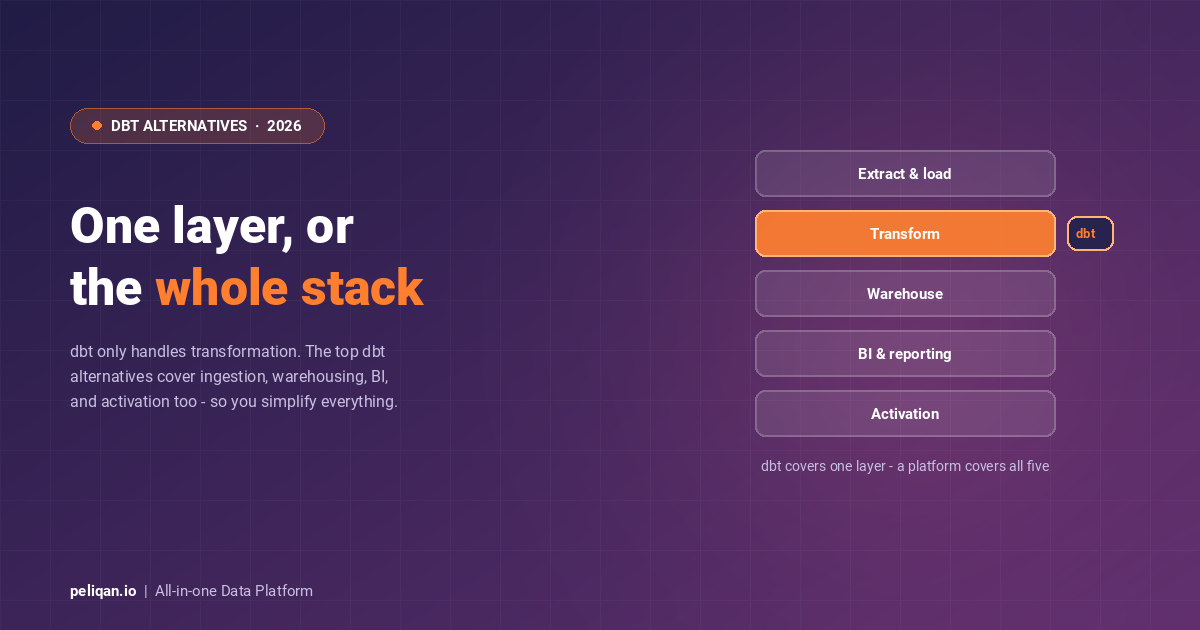
Critically, dbt does not handle data ingestion or storage. It operates only on data already loaded into your warehouse, so teams typically need separate ETL tools for movement, plus an orchestrator for scheduling, which adds cost and complexity to the overall stack.
By contrast, all-in-one platforms let you connect to data sources and transform in one place, removing the orchestration and glue work that dbt leaves to you.
Why consider dbt alternatives?
dbt is genuinely powerful for teams with dedicated analytics engineers. The problem is that most teams do not have them, and several factors are driving even those who do to evaluate alternatives.
Common reasons teams seek dbt alternatives
- Steep learning curve: dbt requires Git workflows, YAML configuration, and Jinja templating, skills that are not common among all analysts.
- Pricing unpredictability: dbt Cloud’s consumption-based pricing (per successful model build) has caught teams off guard, with reported cost increases that scale sharply with usage.
- Vendor lock-in concerns: The completed Fivetran-dbt merger ties dbt’s roadmap to Fivetran’s commercial priorities, and Fivetran now owns both dbt and its open-source rival SQLMesh.
- No data ingestion: dbt only transforms, so you still need separate tools for ETL, orchestration, BI, and data activation to complete the stack.
- Batch-only processing: dbt is optimized for batch and lacks native support for real-time or streaming data.
- Limited visual tools: dbt’s code-first approach offers no visual interface, creating barriers for mixed-skill teams.
The top dbt alternatives and competitors in 2026
1. Peliqan – all-in-one data platform that replaces dbt plus five other tools
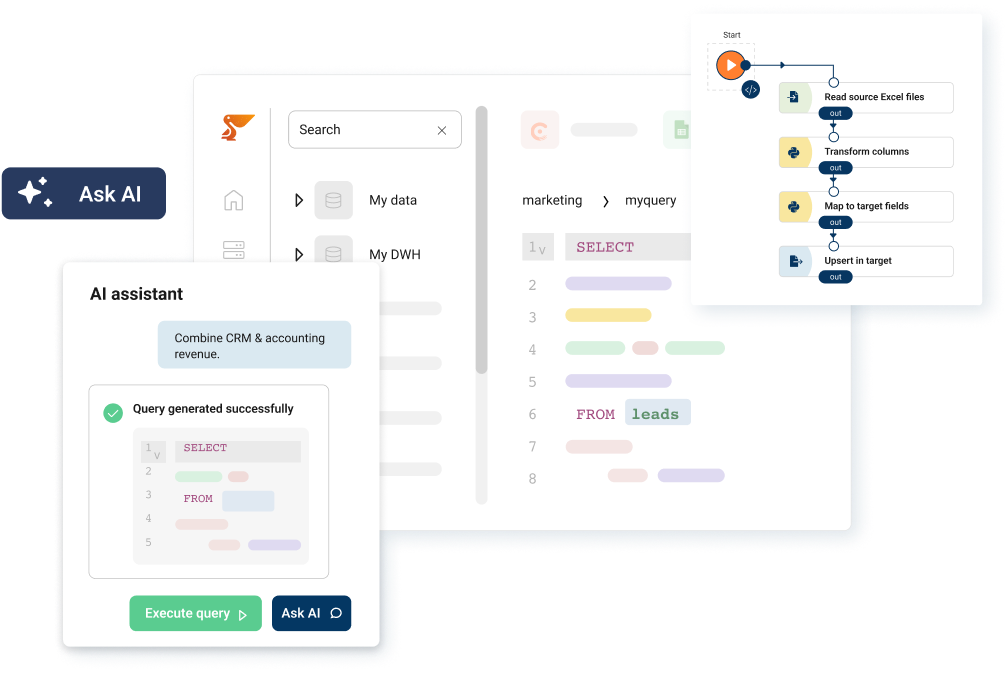
Peliqan takes a fundamentally different approach to the transformation problem. Instead of being a standalone transformation tool like dbt, it consolidates the whole pipeline into one platform, removing the need to stitch together dbt, Fivetran, Airflow, Looker, and Hightouch.
That single platform spans ETL pipelines, a built-in data warehouse, transformations, BI, reverse ETL, and data activation, so one tool covers what previously took a stack of them.
Where dbt requires SQL files, Git repos, YAML, and Jinja, Peliqan offers a low-code Python IDE alongside SQL, a spreadsheet-like UI for business users, and AI-assisted “Magical SQL” that writes queries automatically. This makes transformation accessible to both engineers and non-technical users, which dbt’s code-first philosophy does not support.
Peliqan vs dbt: key differences
- Scope: Peliqan covers the full stack (ETL, warehouse, transform, BI, activation); dbt is transform only
- Built-in warehouse: Peliqan yes (Postgres/Trino); dbt no (bring your own)
- Connectors: Peliqan 250+ built-in; dbt none (needs a separate ETL tool)
- Pricing model: Peliqan transparent and fixed; dbt Cloud per-seat plus consumption overages
- User access: Peliqan low-code, SQL, and spreadsheet UI; dbt code-first SQL and Jinja only
With 250+ pre-built connectors and Trino-powered federated queries across sources, Peliqan delivers the complete modern data stack experience that dbt users typically need five to ten tools to assemble. It is SOC 2 Type II, ISO 27001, GDPR, HIPAA, and CCPA certified, EU-hosted on AWS Frankfurt, supports white-label deployment for consultancies, and delivers custom connectors within 2 weeks when a source is missing.
Its key strengths include a built-in data warehouse (Postgres/Trino) with no separate Snowflake or BigQuery needed, SQL and low-code Python transformations with AI assistance, and a spreadsheet-like UI for business-user self-service. For EU buyers in particular, the EU hosting and full compliance posture are a meaningful contrast to the now-consolidated, US-based dbt and Fivetran stack.
It also includes reverse ETL and data activation, so transformed data flows straight back to the tools that use it, with transparent, fixed pricing rather than per-seat or consumption surprises. Best for: teams that want to replace a fragmented stack (dbt plus Fivetran plus Airflow plus a BI tool) with a single platform accessible to engineers and business users alike.
2. Coalesce – metadata-driven transformation for governed data
Coalesce has become dbt’s primary competitor in the transformation-only space. Unlike dbt’s blank code editor, it offers a visual, column-aware workspace where metadata and context are embedded directly into development. Its metadata-driven approach codifies best practices into reusable templates, enforces architectural consistency, and delivers full column- and object-level lineage automatically.
Coalesce supports Snowflake, Databricks, BigQuery, Redshift, and Microsoft Fabric, and combines GUI-driven workflows with code-first SQL for mixed-skill teams. It includes built-in scheduling, CI/CD integration, and automated documentation, features dbt Cloud charges separately for. The trade-off is that it is transformation-only, with no ingestion and no built-in warehouse. Best for: teams that want dbt-level transformation power with a visual experience and stronger automatic governance, especially on Snowflake or Databricks.
3. SQLMesh – open-source DataOps framework for scalable pipelines
SQLMesh, acquired by Fivetran in 2025, is an open-source transformation framework designed to fix dbt’s biggest scaling pains. It offers virtual data environments (development environments need no warehouse compute), built-in state tracking, automated change detection, and SQL parsing that catches errors at compile time rather than runtime.
Benchmarks show roughly 9x faster execution than dbt Core, with meaningful savings on warehouse compute, and it is dbt-compatible so existing projects import with minimal changes. The caveat is significant in 2026: SQLMesh now sits under the same Fivetran umbrella as dbt, so it is no longer an independent competitor. Best for: engineering-heavy teams that want dbt’s SQL-first philosophy with faster execution and cheaper development environments, who are comfortable with Fivetran ownership.
4. Google Dataform – BigQuery-native transformation
Dataform, acquired by Google and tightly integrated into BigQuery, is the closest dbt alternative for GCP-native teams. It provides modular SQL-based pipelines, dependency management similar to dbt’s ref() function, built-in testing, documentation, and scheduling in a clean web interface, with version control via GitHub or GitLab.
Dataform has no licensing cost, so teams only pay for BigQuery compute, making it the most cost-effective option for organizations already on Google Cloud. The limitation is that it is exclusive to BigQuery and lacks the multi-cloud flexibility of dbt or Coalesce. Best for: teams fully committed to Google Cloud who want a dbt-like experience with zero setup overhead and no licensing cost.
5. Matillion – low-code ETL/ELT with visual pipeline design
Matillion takes the opposite approach to dbt: visual, low-code pipeline design with drag-and-drop interfaces. It supports ingestion, transformation, and orchestration in one platform, with connectors for Snowflake, BigQuery, Redshift, and Databricks, and even includes a native dbt Core component so teams can embed dbt models in broader visual workflows.
Matillion has added “Maia,” an agentic AI assistant that builds validated pipelines automatically, and holds a 4.4/5 G2 rating with praise for usability, though some users note pricing rises with data volume. Best for: teams that prefer visual development over code, or that want a single platform for both ingestion and transformation.
6. Dagster – Python-native data orchestration platform
Dagster is a data orchestration platform that can run dbt models as part of broader workflows, or replace them. Unlike dbt’s SQL-only approach, Dagster is Python-native and supports modular, asset-based pipelines with built-in observability, testing, and scheduling.
It positions itself as the control plane for the modern data stack, with first-class dbt integration that lets teams keep dbt models while gaining orchestration and monitoring that dbt Cloud alone does not provide. It ships an open-source core with a managed Dagster+ option. Best for: engineering teams building complex, multi-step data and ML pipelines that go beyond transformation, especially those needing Python alongside SQL.
7. Alteryx – no-code analytics and data preparation
Alteryx is the leading no-code analytics platform for teams that need to automate data preparation, blending, and predictive modeling without writing SQL or Python. Its visual workflow designer covers everything from simple cleaning to advanced statistical analysis and machine learning, with 200+ connectors and pre-built tools.
Unlike dbt’s SQL-first approach, Alteryx prioritizes accessibility for business analysts who are not comfortable with code, which makes it valuable where transformation work is done by analysts rather than engineers. Best for: business analysts who need powerful data preparation without writing SQL, Python, or managing Git.
8. Informatica – enterprise data integration and governance
Informatica is the established enterprise leader in data integration, transformation, quality, and governance. Acquired by Salesforce for roughly $8B in late 2025, it offers a comprehensive platform covering the full data lifecycle, from ingestion and transformation to quality, governance, and API management, with AI-powered automation via its CLAIRE engine.
Informatica is the go-to for Fortune 500 companies that need enterprise-grade compliance and data quality features that dbt and newer tools do not provide, though it comes with significantly higher cost and implementation complexity. Best for: large enterprises with complex governance, quality, and compliance requirements well beyond what a code-first tool can offer.
9. Hevo Data – no-code real-time ELT with built-in transformation
Hevo Data offers a no-code, real-time ETL platform with a built-in transformation layer that includes native dbt Core integration, so teams can run dbt transformations inside Hevo’s managed infrastructure without paying for dbt Cloud separately. Its free Transformer feature makes this the most budget-friendly way to access dbt-like capabilities.
With 150+ connectors, real-time CDC replication, and a no-code pipeline builder with observability, Hevo bundles ingestion, scheduling, and transformation in one managed service. Best for: teams that want to keep using dbt models but need affordable, managed infrastructure around them.
10. Datacoves – managed dbt development environment
Datacoves is the best option for teams that want to keep using dbt but need a better development and deployment experience than dbt Cloud provides. It offers a managed VS Code IDE in the browser, built-in Apache Airflow orchestration, and full private cloud or VPC deployment, so code, credentials, and pipeline execution stay inside your own network.
Critically, it is engine-agnostic and can run dbt, SQLMesh, and Bruin, so teams are not locked into a single vendor’s ecosystem, with enterprise security including SSO, SAML, and secrets management. Best for: teams that love dbt Core but need a better-managed environment with private deployment and freedom from lock-in.
dbt alternatives compared
This table summarizes how the ten alternatives compare on scope, transformation, interface, and pricing model. Pricing and features change, so confirm current details with each vendor before deciding.
The Fivetran-dbt merger: what it means for your stack
The Fivetran and dbt Labs merger, first announced in October 2025, officially completed on June 1, 2026, and it is the most significant event in the transformation landscape since dbt’s creation. The all-stock deal combines two category-defining platforms under one roof, led by CEO George Fraser and President Tristan Handy, serving more than 100,000 data teams.
What launched alongside the merger
- dbt Core v2.0 (alpha): open-sources the Fusion engine runtime under Apache 2.0, keeping core transformation technology open
- dbt State (preview): a caching layer that builds only what changed, cutting infrastructure cost by 30% or more
- dbt Wizard: an AI assistant for model authoring, debugging, and refactoring
- Agents Schema: an open standard that stores semantic models, metrics, and lineage in SQL tables as a shared context layer for AI agents
The combined entity is a genuine data-movement-plus-transformation powerhouse, but the consolidation also makes the lock-in question concrete: a single commercial entity now controls dbt Cloud pricing, the Fusion engine roadmap, and SQLMesh, the leading open-source rival it also owns. That is the main driver behind teams evaluating independent options. Our full breakdown of the dbt Labs and Fivetran merger goes deeper into what changed.
On the ingestion side of the combined platform, our Fivetran alternatives guide covers the options worth weighing.
dbt Cloud pricing: the hidden cost problem
dbt Core is free, but most production teams end up on dbt Cloud, where costs can surprise you. The free Developer tier covers one seat and a few thousand model builds a month before jobs pause. The Starter plan begins at $100/user/month with a monthly model-build allowance and per-model overage charges, and Enterprise is custom with advanced governance and SSO.
The bigger issue is that warehouse compute is billed separately, so Snowflake or BigQuery costs rise with dbt usage. A mid-size team of five developers can easily reach a five-figure annual total once seats, consumption overages, and warehouse compute are combined. dbt State’s selective builds may ease compute costs over time, but the per-seat and consumption model still makes budgeting hard. Teams self-hosting dbt Core save on licensing but absorb real engineering time for orchestration and infrastructure.
Choosing the right alternative: a quick framework
dbt alternatives fall into three groups: tools that replace dbt’s transformation, tools that extend beyond it, and platforms that remove the need for a standalone transformation tool entirely. Match the choice to your goal.
Quick decision guide
- Replace your entire data stack (dbt plus ETL plus warehouse plus BI)? Peliqan
- Visual, governed transformation to replace dbt Cloud? Coalesce
- Faster, cheaper open-source transformation? SQLMesh (now Fivetran-owned)
- Using BigQuery exclusively with zero licensing cost? Dataform
- Low-code visual ETL/ELT with dbt compatibility? Matillion
- Python-native orchestration beyond transformation? Dagster
- No-code analytics for business analysts? Alteryx
- Enterprise governance and data quality at scale? Informatica
- Affordable ELT with built-in dbt Core? Hevo Data
- Keep dbt but deploy privately with better tooling? Datacoves
Real-world example: CIC Hospitality
Replacing a fragmented stack is not just theory. CIC Hospitality unified data from 50+ sources into one platform and now saves 40+ hours per month by fully automating board reports that used to be built by hand. Read the full case study.
Conclusion
dbt remains a powerful, widely adopted transformation tool with a massive community and a faster Fusion engine. But the completed Fivetran merger, consumption-based pricing, and the complexity of running five to ten separate tools are driving many teams to evaluate alternatives. For teams that want to simplify the whole stack, Peliqan stands out as the most comprehensive option, replacing dbt, your ETL tool, your warehouse, and your BI layer with one platform that engineers and business users can both use, at transparent, fixed pricing.
For transformation-only needs, Coalesce is the strongest independent alternative to dbt Cloud, while SQLMesh and Dataform offer open-source and GCP-native options, and Matillion and Alteryx serve visual, low-code teams. The real question is no longer just which transformation tool to use, but whether you still need a standalone one at all, as unified platforms replace the fragmented modern data stack that made dbt necessary in the first place.