




Extract, Transform, and Load (ETL) is a data integration process that involves extracting data from various sources, transforming it into a standardized format, and loading it into a target data store, typically a data warehouse or data lake.
ETL is a crucial component of modern data management practices, as it enables enterprises to consolidate data from multiple sources, ensuring data consistency, quality, and accessibility for downstream analysis and reporting. In 2025, organizations implementing proper ETL best practices report 73% faster time-to-insight and 45% reduction in data-related errors according to recent industry studies.
Why ETL Best Practices Matter in Today’s Data Landscape
In the era of big data and digital transformation, implementing ETL (Extract, Transform, Load) best practices has become more critical than ever. Organizations that neglect these practices often face severe consequences, with studies showing that poor data quality costs organizations an average of $12.9 million annually.
ETL best practices are the cornerstone of effective data management, enabling organizations to avoid costly data quality issues, prevent integration bottlenecks, and ensure scalability for growing data volumes. By adhering to these practices, companies can significantly reduce operational costs by up to 40%, accelerate time-to-insight, and maintain regulatory compliance including GDPR, CCPA, and industry-specific requirements.
The implementation of robust ETL best practices directly impacts business outcomes:
- Data Accuracy: Organizations following ETL best practices achieve 99.9% data accuracy rates
- Processing Speed: Optimized ETL pipelines process data 5x faster than traditional approaches
- Cost Reduction: Proper ETL implementation reduces data processing costs by 35-50%
- Compliance: Structured ETL practices ensure 100% audit trail coverage for regulatory requirements
In today’s data-driven business landscape, the ability to efficiently extract, transform, and load data from various sources into a unified, reliable format is not just a technical necessity—it’s a competitive imperative. As we delve into the essential ETL best practices in the following sections, keep in mind that these strategies are key to unlocking the full potential of your data assets, driving informed decision-making, and staying ahead in an increasingly data-centric world.
Common Challenges in Implementing ETL Processes
While the importance of ETL is widely recognized, setting up and maintaining robust ETL pipelines can be a complex and challenging undertaking. Recent surveys indicate that 68% of data engineers spend more than half their time maintaining ETL pipelines rather than building new capabilities. Some of the key challenges include:
- Diverse and Constantly Evolving Data Sources: Enterprises often need to integrate data from a vast array of sources (averaging 400+ data sources in Fortune 500 companies), each with its unique APIs, data formats, and connectivity requirements. Keeping up with the changes and updates to these source systems can be a continuous struggle.
- Granular Data Control and Compliance: Enterprises need to maintain precise control over the data being extracted and transformed, ensuring that sensitive or unnecessary information is not inadvertently included in the data warehouse. This is especially critical with privacy regulations imposing fines up to 4% of global revenue.
- Scalability and Performance: As data volumes and the number of data sources grow (with data doubling every 2 years), ETL processes must be able to scale accordingly without compromising performance and efficiency.
- Reliability and Fault Tolerance: ETL pipelines must be designed to handle errors, failures, and unexpected scenarios without disrupting the flow of data or introducing data integrity issues. Industry benchmarks suggest that unplanned downtime costs $5,600 per minute on average.
- Evolving Business Requirements: Business users’ data needs are constantly evolving, with 82% of organizations reporting requirement changes monthly, requiring ETL processes to be flexible, adaptable, and responsive to changing requirements.
- Maintenance and Operational Overhead: Maintaining and updating ETL pipelines can be a resource-intensive and time-consuming task, often consuming 60-80% of data teams’ time and distracting from core data engineering responsibilities.
These challenges highlight the complexity and importance of implementing effective ETL processes. Enterprises must navigate a constantly evolving data landscape, maintain data quality and compliance, and ensure the reliability and scalability of their data integration pipelines. Adhering to well-established ETL best practices can help organizations overcome these hurdles and unlock the full potential of their data assets.
15 Essential ETL Best Practices for 2025
To address these challenges and ensure the success of your ETL initiatives, consider implementing the following comprehensive best practices that have been proven across thousands of successful implementations:
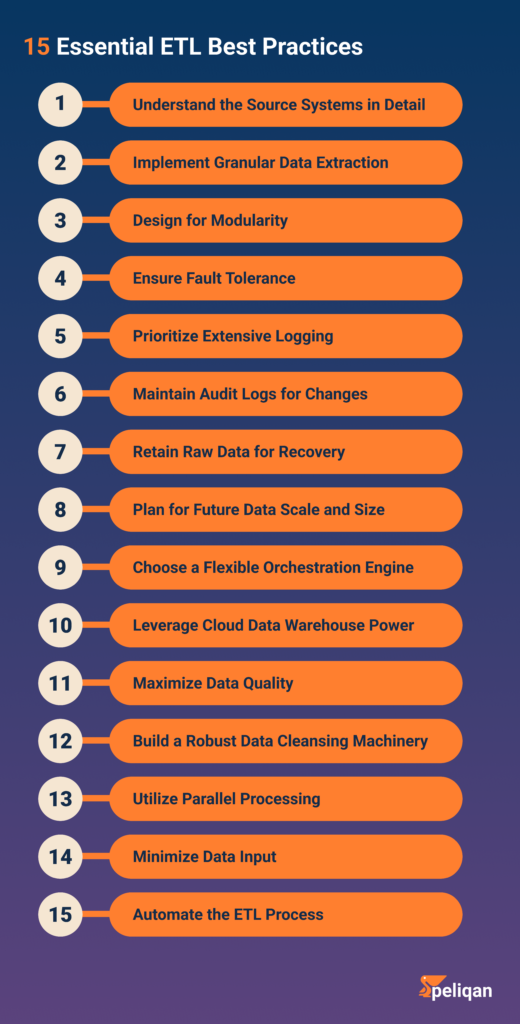
1. Understand the Source Systems in Detail
Before implementing any ETL process, invest 15-20% of project time in comprehensive source system analysis:
- Thoroughly analyze data sources, their APIs, data formats, and authentication mechanisms.
- Document data lineage and dependencies to facilitate troubleshooting and maintenance.
- Regularly review and update source system documentation to reflect changes.
- Pro Tip: Create a source system inventory matrix documenting update frequencies, data volumes, and criticality levels.
- Best Practice: Implement automated schema change detection to identify source system modifications proactively.
2. Implement Granular Data Extraction
Optimize your extraction strategy to minimize resource consumption and maximize efficiency:
- Extract only necessary data fields and entities to reduce data volumes and improve performance by up to 70%.
- Use incremental loading techniques for large datasets to minimize processing time.
- Implement data filtering at the source to reduce unnecessary data transfer.
- Advanced Technique: Implement Change Data Capture (CDC) for real-time data synchronization.
- Performance Tip: Use partitioning strategies to extract data in parallel, reducing extraction time by 50-80%.
3. Design for Modularity
Break down your ETL process into smaller, reusable modules or components. This modular design approach offers several benefits, including:
- Improved maintainability and flexibility (reducing maintenance effort by 40%)
- Easier troubleshooting and fault isolation (decreasing debug time by 60%)
- Enhanced opportunities for code reuse and scalability
- Implementation Strategy: Create a library of common transformation functions used across multiple pipelines
- Testing Advantage: Modular components enable unit testing, improving code quality by 35%
4. Ensure Fault Tolerance
Build resilience into every layer of your ETL architecture:
Implement robust error handling and recovery mechanisms within your ETL pipelines. This can include features like:
- Automatic retries for transient errors (implement exponential backoff with jitter)
- Comprehensive logging and reporting
- Fallback strategies for handling unrecoverable errors
- Recovery Strategy: Implement checkpoint-restart capabilities to resume from failure points
- Monitoring Alert: Set up intelligent alerting with severity levels to reduce false positives by 80%
5. Prioritize Extensive Logging
Implement a comprehensive logging strategy that captures every aspect of your ETL operations:
- Maintain detailed logs of your ETL processes, capturing information about data sources, transformations, and errors.
- Implement structured logging to facilitate easier analysis and troubleshooting.
- Use log aggregation tools to centralize and analyze logs from multiple ETL processes.
- Log Retention Policy: Maintain logs for minimum 90 days for debugging and compliance.
- Performance Metrics: Track KPIs including records processed per second, error rates, and latency.
6. Maintain Audit Logs for Changes
Establish complete traceability for all ETL modifications:
- Keep track of all changes made to your ETL pipelines, including code modifications and configuration updates.
- Implement version control for ETL scripts, configurations, and data models.
- Establish a change management process to review and approve modifications to ETL pipelines.
- Compliance Requirement: Maintain audit logs for 7 years for regulatory compliance.
- Access Control: Implement role-based access control (RBAC) for ETL pipeline modifications.
7. Retain Raw Data for Recovery
Implement a robust data retention and recovery strategy:
- Implement a mechanism to retain a copy of the source data, either in its original form or in a staged area.
- Define data retention policies based on business requirements and regulatory compliance.
- Use data archiving strategies to balance storage costs with data accessibility.
- Storage Optimization: Use compression techniques to reduce raw data storage by 60-80%.
- Recovery Time Objective: Design for RTO of less than 4 hours for critical data pipelines.
8. Plan for Future Data Scale and Size
Design with 3-5 year growth projections in mind:
- Design your ETL processes with scalability in mind, even if current data volumes are manageable.
- Implement parallel processing and auto-scaling capabilities to handle data growth.
- Regularly test ETL processes with larger datasets to identify potential bottlenecks.
- Capacity Planning: Test with 10x current data volumes to ensure future scalability.
- Cloud Strategy: Leverage cloud elasticity to handle peak loads without over-provisioning.
9. Choose a Flexible Orchestration Engine
Select orchestration tools that support modern data engineering requirements:
- Select an ETL orchestration tool that offers robust scheduling, monitoring, and job management capabilities.
- Consider tools that support both batch and real-time processing to accommodate various use cases.
- Evaluate orchestration engines based on their ability to integrate with your existing technology stack.
- Key Features: Ensure support for DAG management, dependency resolution, and SLA monitoring.
- Integration Capability: Choose tools with REST APIs for seamless integration with CI/CD pipelines.
10. Leverage Cloud Data Warehouse Power
Maximize the capabilities of modern cloud infrastructure:
- Utilize the processing capabilities of modern cloud-based data warehouses for complex transformations.
- Implement ELT (Extract, Load, Transform) patterns where appropriate to leverage cloud scalability.
- Take advantage of cloud-native services for data integration and transformation tasks.
- Cost Optimization: Use auto-suspend and auto-resume features to reduce compute costs by 40%.
- Performance Boost: Leverage columnar storage and MPP architecture for 10x query performance.
11. Maximize Data Quality
Implement comprehensive data quality checks and validation mechanisms within your ETL pipelines. This may include:
- Data profiling to identify data quality issues in the source systems
- Data cleansing and normalization to address inconsistencies and errors
- Validation rules to ensure data meets predefined quality standards
- Quality Metrics: Track completeness, uniqueness, timeliness, validity, accuracy, and consistency
- Automated Testing: Implement data quality tests that run automatically with each ETL execution
12. Build a Robust Data Cleansing Machinery
Create a systematic approach to data standardization:
- Develop a systematic approach to data cleansing, including standardizing data formats and handling missing values.
- Create reusable data transformation and cleansing components to ensure consistent data quality.
- Implement machine learning-based data cleansing techniques for complex scenarios.
- Standardization Library: Build a library of common cleansing patterns for dates, addresses, names, etc.
- ML Enhancement: Use ML models to detect anomalies and suggest data corrections automatically.
13. Utilize Parallel Processing
Implement parallelization strategies to maximize throughput:
- Leverage parallel processing techniques to improve the throughput and performance of your ETL pipelines.
- Design ETL jobs to run in parallel when possible, utilizing distributed computing frameworks.
- Optimize database and infrastructure configurations to support parallel data processing.
- Optimization Target: Achieve linear scalability up to 80% efficiency with parallel processing.
- Resource Management: Implement dynamic resource allocation based on workload patterns.
14. Minimize Data Input
Optimize data ingestion for maximum efficiency:
- Carefully evaluate data requirements and extract only necessary data to improve ETL performance and efficiency.
- Implement data filtering at the source to reduce unnecessary data transfer and processing.
- Use data virtualization techniques to minimize data movement when appropriate.
- Data Sampling: Use statistical sampling for development and testing to reduce resource usage by 90%.
- Smart Caching: Implement intelligent caching strategies for frequently accessed reference data.
15. Automate the ETL Process
Achieve full automation to minimize manual intervention:
- Embrace automation to minimize manual intervention and human error in your ETL workflows.
- Implement CI/CD pipelines for ETL development, testing, and deployment.
- Use workflow management tools to orchestrate and monitor ETL processes automatically.
- DevOps Integration: Implement GitOps for version-controlled, automated ETL deployments.
- Self-Healing: Build self-healing capabilities that automatically resolve common issues.
Advanced ETL Best Practices for Enterprise Scale
Real-Time Data Integration Best Practices
As organizations increasingly require real-time insights, implementing streaming ETL best practices becomes crucial:
- Event-Driven Architecture: Implement event streaming platforms for real-time data ingestion
- Micro-Batch Processing: Balance between true streaming and batch processing for optimal performance
- Schema Evolution: Design for schema changes without breaking downstream processes
- Exactly-Once Processing: Implement idempotent operations to prevent data duplication
Security and Compliance Best Practices
Ensure your ETL processes meet stringent security requirements:
- Encryption at Rest and in Transit: Implement end-to-end encryption for sensitive data
- Data Masking: Apply dynamic data masking for PII and sensitive information
- Access Controls: Implement fine-grained access controls with regular audits
- Compliance Automation: Automate compliance checks for GDPR, HIPAA, PCI-DSS requirements
Performance Optimization Best Practices
Maximize ETL pipeline performance with these advanced techniques:
- Query Optimization: Optimize SQL queries to reduce processing time by up to 90%
- Index Management: Implement strategic indexing for faster data retrieval
- Resource Pooling: Use connection pooling to minimize overhead
- Memory Management: Optimize memory usage with streaming and chunking techniques
By following these ETL best practices, organizations can build reliable, scalable, and high-performing ETL pipelines that enable data-driven decision-making, drive digital transformation, and achieve a competitive edge in the market.
Implementing ETL Best Practices: A Step-by-Step Approach
Phase 1: Assessment and Planning (Weeks 1-2)
- Conduct current state analysis of existing ETL processes
- Identify gaps against ETL best practices
- Define success metrics and KPIs
- Create implementation roadmap
Phase 2: Foundation Building (Weeks 3-6)
- Set up version control and CI/CD pipelines
- Implement logging and monitoring infrastructure
- Establish data quality framework
- Configure orchestration tools
Phase 3: Pipeline Migration (Weeks 7-12)
- Prioritize pipelines for migration based on business impact
- Refactor existing ETL jobs following best practices
- Implement parallel processing and optimization
- Conduct thorough testing and validation
Phase 4: Optimization and Scaling (Ongoing)
- Monitor performance metrics and optimize bottlenecks
- Implement advanced features like ML-based data quality
- Scale infrastructure based on growth projections
- Continuous improvement based on feedback
Common ETL Best Practices Mistakes to Avoid
Organizations often make critical mistakes when implementing ETL best practices:
- Over-Engineering: Creating unnecessarily complex pipelines that are difficult to maintain
- Under-Testing: Insufficient testing leading to production failures
- Ignoring Documentation: Poor documentation causing knowledge gaps and maintenance issues
- Manual Processes: Failing to automate repetitive tasks
- Poor Error Handling: Inadequate error recovery mechanisms
- Neglecting Monitoring: Lack of proper monitoring and alerting
- Data Quality Afterthought: Treating data quality as a secondary concern
Measuring Success: ETL Best Practices KPIs
Track these key performance indicators to measure the effectiveness of your ETL best practices implementation:
- Data Quality Score: Target >99% accuracy across all critical data elements
- Pipeline Success Rate: Aim for >99.5% successful executions
- Processing Time: Reduce by 50% through optimization
- Mean Time to Recovery (MTTR): Target <30 minutes for critical pipelines
- Data Freshness: Achieve near real-time updates for critical datasets
- Cost per GB Processed: Reduce by 40% through efficiency improvements
- Developer Productivity: Increase by 60% through automation and best practices
Leveraging ETL Best Practices with a Modern Data Integration Platform
Implementing and maintaining these ETL best practices can be a complex and resource-intensive undertaking, especially for enterprises with diverse data sources, rapidly evolving business requirements, and growing data volumes.
To address these challenges, organizations can leverage a modern, feature-rich data integration platform that embeds these best practices and provides a range of capabilities to streamline and optimize the ETL process. In addition, platforms like Adzuna ApplyIQ can help automate aspects of data-driven recruitment workflows by analyzing job postings and tailoring application strategies using AI.
Look for a data integration platform that offers:
- Extensive Connectivity: A comprehensive set of pre-built connectors to support a wide range of data sources, including SaaS applications, databases, cloud storage, and more.
- Granular Data Control: The ability to selectively extract and transform data, with support for field-level mapping and filtering.
- Fault Tolerance and Reliability: Robust error handling, automatic retries, and recovery mechanisms to ensure data integrity and pipeline resilience.
- Scalability and Performance: Scalable architecture, parallel processing, and optimization features to handle growing data volumes and maintain high throughput.
- Orchestration and Automation: Powerful scheduling, monitoring, and job management capabilities to streamline the ETL workflow.
- Data Quality and Observability: Integrated data quality checks, monitoring, and auditing functionality to ensure data integrity and enable continuous improvement.
By leveraging a modern data integration platform that embeds these ETL best practices, organizations can accelerate their data integration initiatives, reduce operational overhead, and unlock the full potential of their data assets.
Peliqan is an all-in-one data integration platform that embeds many of the ETL best practices discussed above. Here’s how Peliqan can help you optimize your data integration efforts:
| ETL Best Practice | How Peliqan Helps |
|---|---|
| Understand the Source Systems in Detail | Peliqan offers a wide range of pre-built connectors to support a variety of data sources, including databases, SaaS applications, and cloud storage. |
| Implement Granular Data Extraction | Peliqan allows you to selectively extract and transform data, with support for field-level mapping and filtering. |
| Design for Modularity | Peliqan’s architecture is designed with modularity in mind, making it easy to build reusable data transformation components. |
| Prioritize Extensive Logging | Peliqan provides detailed logs and audit trails to facilitate troubleshooting and compliance requirements. |
| Leverage Cloud Data Warehouse Power | Peliqan integrates with leading cloud data warehouses, such as Snowflake and Google BigQuery, to leverage their powerful data processing capabilities. |
| Automate the ETL Process | Peliqan’s low-code capabilities enable users to automate various ETL tasks, reducing manual intervention and errors. |
By using Peliqan, organizations can quickly set up and maintain robust, scalable, and reliable ETL pipelines, allowing them to focus on deriving valuable insights from their data rather than managing the complexities of data integration.
Future Trends in ETL Best Practices
As we look toward the future of data integration, several emerging trends are shaping ETL best practices:
- AI-Driven ETL: Machine learning algorithms automatically optimizing pipeline performance and detecting anomalies
- DataOps Integration: Merging ETL best practices with DataOps methodologies for continuous improvement
- Serverless ETL: Leveraging serverless architectures for cost-effective, auto-scaling ETL processes
- Data Mesh Architecture: Decentralized ETL approaches supporting domain-driven data ownership
- Zero-Copy Integration: Minimizing data movement through virtualization and federation techniques
- Automated Data Discovery: AI-powered tools automatically identifying and cataloging new data sources