




Snowflake alternatives come in three flavors: cheaper warehouses, smarter lakehouses, and consolidated platforms that replace the whole stack. Here is a practitioner-grade comparison of the 15 options that actually matter in 2026, real pricing numbers, a migration framework, and honest trade-offs – no “10x faster” claims.
Snowflake is a genuinely great warehouse. It separates compute and storage cleanly, scales, and handles semi-structured data without pain. It is also the reason a lot of teams are now searching for alternatives. The consumption model that looks flexible in the demo ends up unpredictable at scale. Credit costs sit at roughly $2 per credit for Standard, $3 for Enterprise, and $4 for Business Critical as of March 2026. Storage runs $23-40 per TB per month depending on region. The median Snowflake buyer pays $96,594 per year based on 622 verified purchase transactions, and companies routinely report bills 200-300% higher than forecast. Instacart reportedly spends over $50 million annually on Snowflake alone.
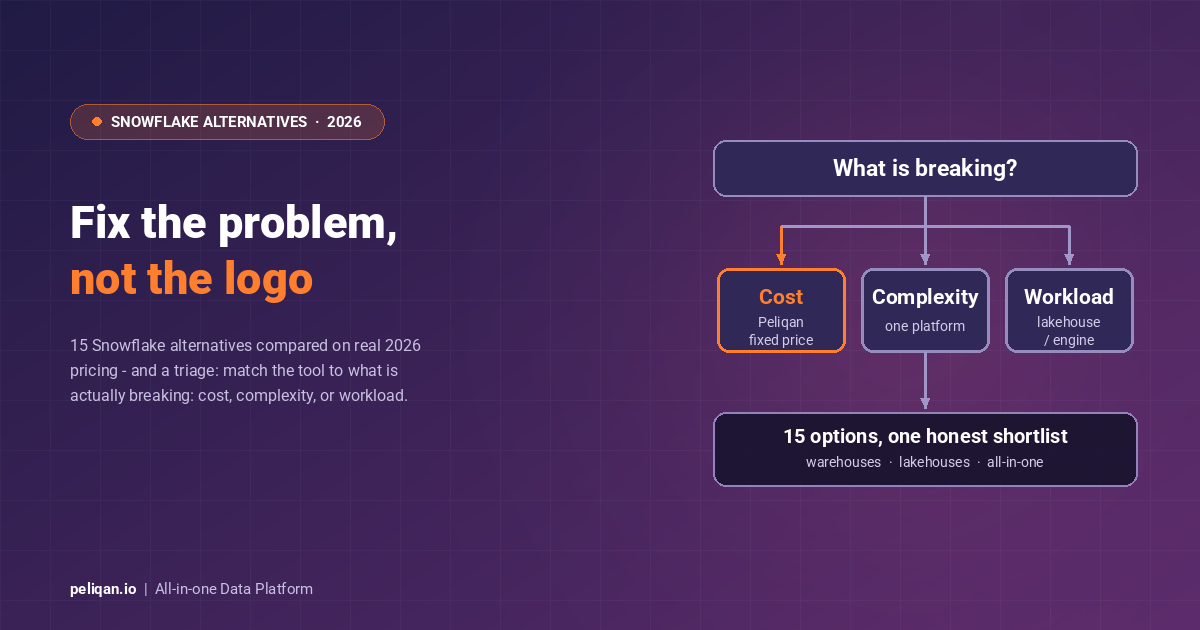
That does not mean Snowflake is wrong for everyone. It means the question “what should I use instead” depends on what is actually breaking: cost, simplicity, ecosystem fit, or capability. This guide covers the 15 alternatives that matter in 2026, what each one trades off against Snowflake, realistic pricing, and a framework for picking the right cloud data warehouse or platform for your actual workload.
Why teams leave Snowflake in 2026
The reasons fall into four categories, and knowing yours determines which alternative fits. Most “Snowflake is too expensive” complaints are actually architecture problems that no warehouse can fix. Be specific about the real driver before you shortlist anything.
The four real reasons to switch
Cost unpredictability: compute dominates 60-80% of the bill, and a single oversized warehouse or a poorly written query with table scans can 10x your credit burn overnight. If finance cannot forecast within 20% each month, this is your driver.
Stack complexity: Snowflake is a warehouse. You still need Fivetran or Airbyte for ingestion, dbt for transformation, Looker or Power BI for visualization, and Census or Hightouch for reverse ETL. Four to seven tools, four to seven contracts.
Deployment constraints: Snowflake runs on AWS, Azure, and GCP, not on-premises. Regulated industries and sovereignty requirements sometimes need hybrid or on-prem options that Snowflake simply does not offer.
Workload mismatch: machine learning and unstructured data work better on a lakehouse. Sub-second customer-facing queries need a different engine. Time-series telemetry has its own category. Snowflake is not optimized for any of these.
The 2026 Snowflake alternatives landscape
The alternatives split into categories, and the category matters more than the individual product. Once you know whether you need a warehouse, a lakehouse, a consolidated platform, a specialist engine, or an open-source option, the shortlist writes itself.
- Consolidated data platforms: Peliqan – replace the whole stack with one tool
- Cloud-native warehouses: BigQuery, Redshift, Azure Synapse, Microsoft Fabric – same category as Snowflake, different ecosystem fit
- Lakehouses: Databricks, Dremio – unified data lake plus warehouse for ML-heavy work
- Specialist engines: Firebolt, ClickHouse, Apache Druid, TimescaleDB – purpose-built for specific workloads
- Enterprise legacy: Teradata, Vertica, IBM Db2 Warehouse – proven for hybrid and on-prem deployments
- Query federation: Starburst – query data where it lives without moving it
- Open source and embedded: DuckDB – local and embedded analytics
1. Peliqan – consolidated platform replacing the whole stack
Peliqan at a glance
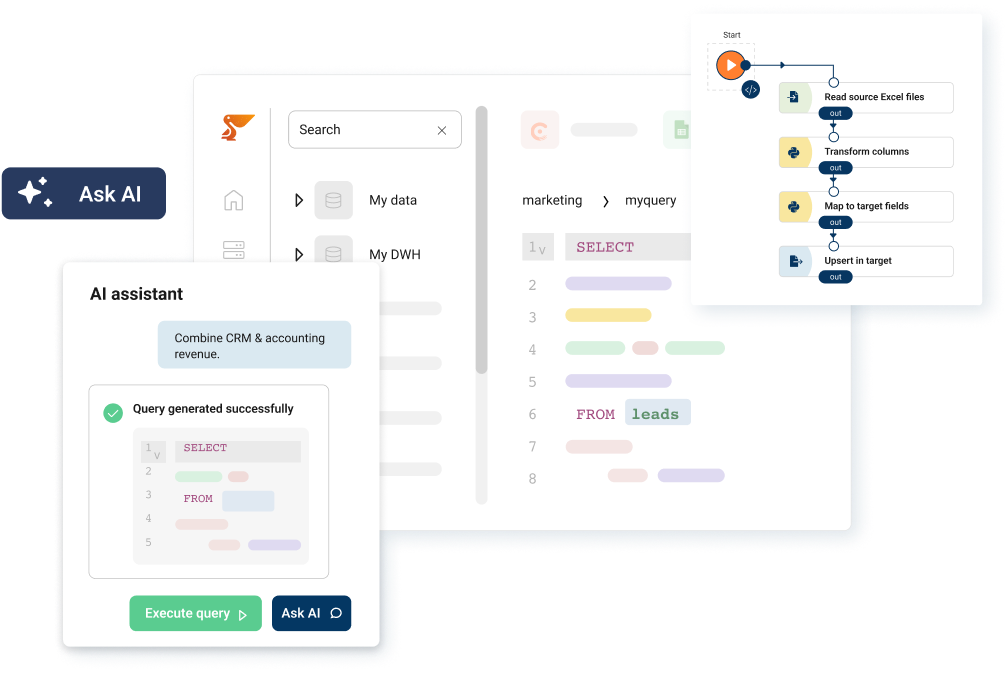
What it is: an all-in-one data platform – built-in Postgres and Trino warehouse, 300+ connectors, transformations, reverse ETL, APIs, and AI agents in a single environment.
Pricing: transparent fixed subscription, not consumption-based. No surprises at quarter close.
Best fit: mid-market teams, SaaS companies, service providers, and enterprise business units that want Snowflake-class capability without assembling 5-7 tools.
Where it falls short: not the right choice for petabyte-scale pure data science workloads – a lakehouse fits better there. Newer than Snowflake, so fewer third-party tooling integrations.
Most Snowflake stacks assemble 5-7 tools: ingestion (Fivetran or Airbyte), warehouse (Snowflake), transformation (dbt), BI (Looker, Tableau, Power BI), reverse ETL (Census or Hightouch), observability (Monte Carlo), and orchestration (Airflow). Every tool is a contract, a failure mode, and an integration seam.
Peliqan collapses most of that into one platform.
The capability set covers 300+ pre-built connectors with a 2-week SLA for custom builds, a built-in Postgres and Trino-powered warehouse (or bring-your-own Snowflake, BigQuery, or Redshift), and low-code SQL and Python transformations.
Active data delivery runs via ETL and reverse ETL.
REST API publishing and AI agents with MCP support round out the activation layer.
White-label and multi-customer management make it practical for service providers and SaaS companies. It is SOC 2 Type II, ISO 27001, GDPR, HIPAA, and CCPA certified, EU-hosted on AWS Frankfurt.
The core trade-off is honest: Peliqan is not trying to be Snowflake at petabyte scale. It is trying to be the right answer for teams where Snowflake would be over-provisioned and under-utilized, which is most teams.
2. Google BigQuery – serverless analytics on GCP
BigQuery is Snowflake’s closest architectural sibling: serverless, separated storage and compute, fully managed. The practical difference comes down to ecosystem. If your stack already runs on Google Cloud, BigQuery is usually cheaper and simpler. If not, the egress fees add up.
On-demand pricing is $6.25 per TiB scanned as of 2026. Storage runs $0.02 per GB monthly for active data. Reserved slots start at around $2,000/month for committed capacity. The pay-per-query model is a double-edged sword: predictable when queries are planned, explosive when a runaway dashboard scans terabytes every refresh.
Best for: GCP-committed organizations, teams running built-in ML with BigQuery ML, sporadic analytical workloads where serverless scaling beats provisioned compute. Avoid if: your stack is multi-cloud and egress matters, or you need predictable cost forecasting.
3. Amazon Redshift – AWS-native warehouse
Redshift is built on a Massively Parallel Processing (MPP) architecture and sits deep inside the AWS ecosystem. RA3 nodes separate compute from storage similar to Snowflake; DC2 nodes keep them coupled for cost-sensitive workloads. Redshift Serverless handles automatic scaling without cluster management.
Pricing starts at $0.25 per hour per node for on-demand RA3, with reserved instances offering up to 75% savings for predictable workloads. Redshift Spectrum lets you query data in S3 directly, useful for lakehouse-style analytics without duplicating storage.
Best for: AWS-native shops with Glue, S3, and Lambda already in the stack, and teams that prefer cluster tuning over consumption unpredictability. Avoid if: you need real-time streaming analytics at scale, or your team does not have AWS operational expertise.
4. Databricks – unified lakehouse platform
Databricks takes a different approach: it is a lakehouse, not a warehouse. Built on Apache Spark with Delta Lake for ACID transactions, it unifies data engineering, streaming, ML, and SQL analytics. Unity Catalog provides governance across workloads.
Pricing uses Databricks Units (DBUs) from $0.07 to $0.55 per DBU-hour depending on workload type, plus underlying cloud infrastructure costs. Companies commonly spend $50,000 to $200,000+ annually even for moderate usage. It is not cheap, and it is not simple. Our full breakdown of Databricks alternatives covers that side of the fence.
Best for: data science and ML-heavy teams, organizations working with diverse data types, streaming pipelines, and teams that want one platform for both engineering and BI. Avoid if: you have a traditional BI workload, lack Spark expertise, or need straightforward pricing.
5. Microsoft Azure Synapse Analytics – enterprise Microsoft stack
Azure Synapse combines MPP data warehousing with Apache Spark pools for big data, deeply integrated with Power BI, Azure ML, and Azure Data Factory. Microsoft has been consolidating Synapse into Microsoft Fabric, which is worth evaluating if you are starting fresh; our guide to Microsoft Fabric alternatives covers that landscape.
Dedicated SQL pools run $1,200 to $30,000+ monthly based on DWUs. Serverless SQL is $5 per TB processed. Apache Spark pools run $0.261 per vCore hour. Billing integrates with existing Microsoft enterprise agreements, often the deciding factor for Microsoft-committed shops.
Best for: Microsoft-first enterprises with existing Azure and Office 365 investments, teams prioritizing Power BI integration, hybrid data scenarios. Avoid if: you value simplicity – the learning curve is steeper than Snowflake and configuration choices heavily impact performance.
Quick category picker
- Pure SQL analytics, multi-cloud: Snowflake or BigQuery
- ML, streaming, unstructured data: Databricks
- AWS-native, cost-optimized BI: Redshift
- Microsoft-committed stack: Synapse or Fabric
- Want one platform, not seven: Peliqan
- Sub-second customer-facing queries: Firebolt or ClickHouse
- Query without moving data: Starburst or Dremio
6. Firebolt – sub-second performance warehouse
Firebolt focuses on one thing: extreme query speed. Sparse indexes, aggregate indexes, and join indexes prune data aggressively, enabling sub-second response times on complex queries. Firebolt reports large price-performance improvements in customer benchmarks; your mileage will vary, but the engine is legitimately fast.
Engine-based pricing with pay-per-use. Best suited for customer-facing analytics, interactive dashboards, and operational analytics where a 5-second dashboard load kills the product experience. Smaller ecosystem than Snowflake or BigQuery, with fewer third-party integrations and community resources.
7. ClickHouse – open-source OLAP performance leader
ClickHouse consistently leads open-source analytical benchmarks through vectorized query execution and advanced compression. Zero licensing cost if you self-host; ClickHouse Cloud and Altinity offer managed services for teams that do not want to run it themselves.
The trade-off is operational complexity. Self-hosting ClickHouse at production scale requires significant engineering expertise: replication, sharding, mutations, and backup strategies are not hands-off. Best for technical teams that can own the infrastructure and want maximum performance per dollar.
8. Starburst – query federation without data movement
Starburst (enterprise Trino) tackles a different problem. Rather than consolidating data into one warehouse, it queries data where it lives, across S3, Postgres, Snowflake, Kafka, and dozens of other sources. Pricing starts at around $0.50 per compute hour.
Best for heterogeneous environments where physical consolidation is blocked by compliance, latency, or cost. The semantic layer and data products features in Starburst Galaxy make it credible for enterprise data mesh implementations. If your current problem is “too much data in too many places and I cannot move it,” Starburst is the answer before you go back to warehouses.
9. Dremio – lakehouse with semantic layer
Dremio is a lakehouse platform focused on fast query performance directly on Apache Iceberg and open formats. Data reflections pre-compute common query patterns; the semantic layer exposes virtual datasets to BI tools without duplicating storage. Recent updates support writing to Iceberg REST catalogs including Snowflake Open Catalog and Unity Catalog.
Pricing starts around $1 per compute hour with volume discounts. Best for organizations committed to open table formats who want to avoid warehouse lock-in while getting warehouse-level query performance. Fortune 10 customers use it at scale.
10. Teradata VantageCloud – enterprise hybrid analytics
Teradata has decades of enterprise deployment experience and MPP architecture that still holds up on the largest workloads. VantageCloud Lake runs on cloud object storage with open table format support; VantageCloud Enterprise targets hybrid deployments.
Compute starts as low as $4.80/hour, block storage from $1,445/TB per year. Strong workload management for mixed BI, operational, and analytical workloads sharing infrastructure. Best for large enterprises with hybrid requirements and proven reliability needs, not for teams optimizing for simplicity.
11. Vertica – columnar with on-prem option
Vertica combines columnar storage with aggressive compression and built-in machine learning. Eon Mode separates compute and storage for cloud deployments. Community Edition is free up to 1TB.
Best for organizations needing high compression ratios, hybrid deployment with both cloud and on-premises options, and predictable data volumes where license-based pricing beats consumption. Smaller ecosystem and fewer modern features than Snowflake or Databricks.
12. IBM Db2 Warehouse – cloud-native with open formats
IBM Db2 Warehouse uses BLU Acceleration for columnar in-memory processing with high compression ratios. 2026 updates added native support for Apache Iceberg, Parquet, and ORC, with data sharing into IBM watsonx.data lakehouse and multi-engine querying via Presto and Spark.
Best for IBM-committed enterprises already running watsonx or legacy Db2, regulated industries needing hybrid deployment, and organizations prioritizing open table format interoperability. Less attractive for new stacks starting from scratch.
13. Apache Druid – real-time time-series
Apache Druid specializes in real-time ingestion and sub-second queries on time-series and event data. Column-oriented storage with bitmap indexing handles streaming data with high throughput.
Not a general-purpose warehouse replacement: Druid is optimized for time-series and event analytics workloads. Open-source with managed cloud options. Best for observability pipelines, ad-tech, gaming telemetry, and operational dashboards on streaming data.
14. TimescaleDB – PostgreSQL-native time-series
TimescaleDB extends PostgreSQL with automatic time-based partitioning and columnar compression: full SQL compatibility, open-source free, cloud from $0.25/hour. Ideal for teams already invested in Postgres who need time-series at scale without leaving the ecosystem they know.
15. DuckDB – embedded analytics
DuckDB is an embedded analytical database: SQLite for analytics. Zero configuration, columnar with vectorized execution, completely free and open-source. MotherDuck offers a managed cloud hybrid. Perfect for data science notebooks, local analytics, and development workflows, not an enterprise multi-user replacement.
Snowflake alternatives comparison table
Peliqan vs Snowflake – capability by capability
The right comparison is not just price, it is what comes in the box. Snowflake is an excellent warehouse; Peliqan is an end-to-end platform. If you already own the other six tools, this comparison reads differently than if you are starting from scratch. There is also a direct Peliqan vs Snowflake comparison if you want the two-column version.
A migration framework: what actually breaks when you switch
Migrating off Snowflake is more work than the vendor demos suggest. Before committing, understand the five areas where migrations stall. Most teams budget for the data transfer and forget the rest.
Where Snowflake migrations actually stall
- SQL dialect differences: Snowflake-specific functions (VARIANT, LATERAL FLATTEN, QUALIFY) do not translate directly. Expect 10-20% of queries to need rewrites.
- Downstream tool integrations: every BI dashboard, reverse ETL sync, and ML pipeline pointing at Snowflake needs re-pointing. Audit your connectors before you migrate data.
- Time Travel and Fail-safe behavior: Snowflake’s 90-day Time Travel and 7-day Fail-safe are unique. Alternatives use different backup and recovery models that your compliance team will scrutinize.
- Zero-copy cloning workflows: if your dev/test environments rely on instant clones, few alternatives replicate this. Plan the workflow change, not just the data move.
- Data sharing partnerships: Snowflake Marketplace and Data Sharing relationships with vendors and customers need migration paths. This can be the dealbreaker that keeps you on Snowflake for some workloads.
A pragmatic pattern: do not migrate everything. Many teams keep Snowflake for data sharing partnerships and petabyte analytical workloads while moving operational pipelines, reverse ETL, and mid-scale BI to a consolidated platform. Hybrid beats all-or-nothing.
2026 trends that will reshape this comparison
Three shifts are changing which alternatives matter most. Factor these into any decision you make this year.
Open table formats as the new default
Apache Iceberg, Delta Lake, and Hudi are moving from niche to default for analytical storage. Snowflake, Databricks, BigQuery, Redshift, and IBM Db2 Warehouse all support Iceberg in some form now. The strategic implication: proprietary table formats are becoming liabilities, and platforms committed to open formats (Dremio, Databricks on Delta and Iceberg, Starburst) are positioning for portability. This reduces warehouse lock-in as a competitive barrier.
Consumption governance from vendors themselves
Snowflake launched simplified hybrid table pricing and uniform Snowpipe rates in March 2026, and platforms are investing heavily in cost monitoring tools. The underlying problem, unpredictability, has not gone away, but tooling around it is better. Budget for a FinOps person or tool if you stay on consumption-based pricing.
Agentic AI changing compute profiles
Snowflake’s agent tooling, Databricks’ agent frameworks, and MCP-based AI agents are creating new compute patterns. Autonomous agents executing multi-step workflows burn credits at rates humans cannot, and governance and cost guardrails matter more than ever; algorithmic cost governance will be a line item in 2027 procurement.
If you want agents on your data without agent-shaped bills, a fixed-price governed MCP server over the warehouse is the pattern to evaluate.
Real-world example: Ziggu
Ziggu, a SaaS platform for the housing industry, runs its analytics on Peliqan instead of assembling a Snowflake-plus-five-tools stack: ingestion, warehouse, transformation, and customer-facing reporting in one environment, saving the team 200+ hours of data work. Read the case studies.
Decision framework: pick the right alternative for your actual problem
Match the alternative to the real driver
- If the problem is cost unpredictability: Peliqan (fixed pricing), Redshift reserved instances (up to 75% off), or commit to Snowflake Capacity contracts. Avoid on-demand BigQuery and Databricks if forecasting matters.
- If the problem is stack complexity: Peliqan consolidates 5-7 tools into one. BigQuery plus built-in features is a simpler alternative on GCP. Resist adding more specialized tools.
- If the problem is ML and unstructured data: Databricks is purpose-built for this. Azure Synapse works if you are Microsoft-committed.
- If the problem is query speed for customer-facing apps: Firebolt for hosted, ClickHouse for self-managed. Snowflake is not built for sub-second latency on dashboards with many concurrent users.
- If the problem is too much data in too many places: Starburst or Dremio before you consolidate. Sometimes federation beats migration.
- If the problem is on-premises or hybrid deployment: Teradata VantageCloud, Vertica, or IBM Db2 Warehouse. Snowflake and BigQuery are cloud-only.
- If the problem is budget for a small team: Peliqan on a fixed plan, ClickHouse self-hosted, or DuckDB for local workloads. The Snowflake minimum gets expensive fast.
Conclusion
Snowflake is not wrong, it is just not always the answer. The 15 alternatives covered here serve different problems: cost predictability (Peliqan, Redshift reserved), ecosystem fit (BigQuery on GCP, Synapse and Fabric on Azure), ML workloads (Databricks, Dremio), sub-second performance (Firebolt, ClickHouse), and federation (Starburst). The right shortlist comes from being honest about which problem is actually driving the evaluation.
If the answer is “we want Snowflake-class capability without assembling five more tools to make it usable,” that is the case Peliqan was built for: transparent fixed pricing, 300+ connectors with a 2-week custom SLA, a built-in Postgres and Trino warehouse, low-code SQL and Python, and the activation layer most data stacks are still trying to buy separately.
Plans are on the pricing page.