




Fivetran alternatives have moved from niche curiosity to mainstream procurement question in 2026. Monthly Active Rows pricing has tripped up too many teams as data volumes grew, the lack of on-prem options blocks regulated industries, and the ETL-only scope leaves teams stitching together dbt, Hightouch, Looker, and a warehouse to get to a working stack. This guide compares 11 proven Fivetran alternatives – Peliqan, Airbyte, Hevo Data, Matillion, Stitch, Segment, dbt Cloud, Zapier, Make, Apache NiFi, and Pentaho – across deployment, pricing, transformation depth, reverse ETL, and ideal fit.
The data integration market reached $15.19 billion in 2024 and is projected to hit $25.69 billion by 2030. Fivetran pioneered the modern ELT approach and simplified data pipeline creation – but the market has evolved. Organizations switching from usage-based platforms to credit-based or fixed-fee alternatives report 34-71% savings, and the broader move toward all-in-one platforms is driven by one practical fact: managing 5-8 separate tools for a complete data workflow is expensive, brittle, and slows down every downstream AI initiative.
Why consider alternatives to Fivetran in 2026
Fivetran is a capable platform with a strong managed-ELT story. Three forces are pushing teams to evaluate alternatives more actively:
- Pricing unpredictability: Monthly Active Rows billing scales nonlinearly with data growth. A pipeline that costs $500/month at launch can hit $4,000-$8,000 in 18 months. As of March 2025, bulk sync discounts now apply on a per-connector basis rather than workspace-wide, raising prices for many existing customers.
- Feature scope: Fivetran’s ETL-only focus means teams layer dbt for transformation, Census or Hightouch for reverse ETL, Looker or Tableau for BI, and additional tooling for activation. That’s a 5-vendor stack to deliver one workflow.
- Deployment constraints: No self-hosting option blocks regulated industries (healthcare, financial services, government) that need on-prem or air-gapped deployments. Limited custom connector support compounds the problem when a needed source isn’t in the catalog.
The teams that switch most aggressively are mid-market and enterprise data teams hitting one of those three walls – and modern alternatives now cover everything from open-source flexibility to enterprise all-in-one platforms.
Quick decision framework
- Want all-in-one with predictable fixed pricing: Peliqan.
- Want open-source flexibility, self-hosting: Airbyte or Apache NiFi.
- Want no-code with strong support: Hevo Data or Stitch.
- Want warehouse-optimized transformations: Matillion or dbt Cloud (transformation only).
- Want customer data platform with reverse ETL: Segment.
- Want workflow automation with broad app coverage: Zapier or Make.
- Want traditional enterprise ETL: Pentaho.
Fivetran competitors and alternatives in 2026
Each of the 11 alternatives below addresses different limitations of Fivetran. The deep dives cover features, strengths, weaknesses, and pricing so you can match the tool to your stack instead of the marketing pitch.
1. Peliqan – the complete all-in-one data platform
Peliqan stands as the definitive Fivetran alternative for teams that want to consolidate their stack instead of layering more tools. Founded in 2022 by data infrastructure veterans, Peliqan combines ETL, data warehousing, transformation, activation, and reverse ETL in a single platform with predictable fixed pricing.
Core capabilities and differentiators
- Built-in data warehouse (Postgres + Trino) with automatic optimization, or bring your own Snowflake, BigQuery, Redshift, or Databricks
- ETL/ELT pipelines with 250+ pre-built connectors and 2-week custom connector SLA
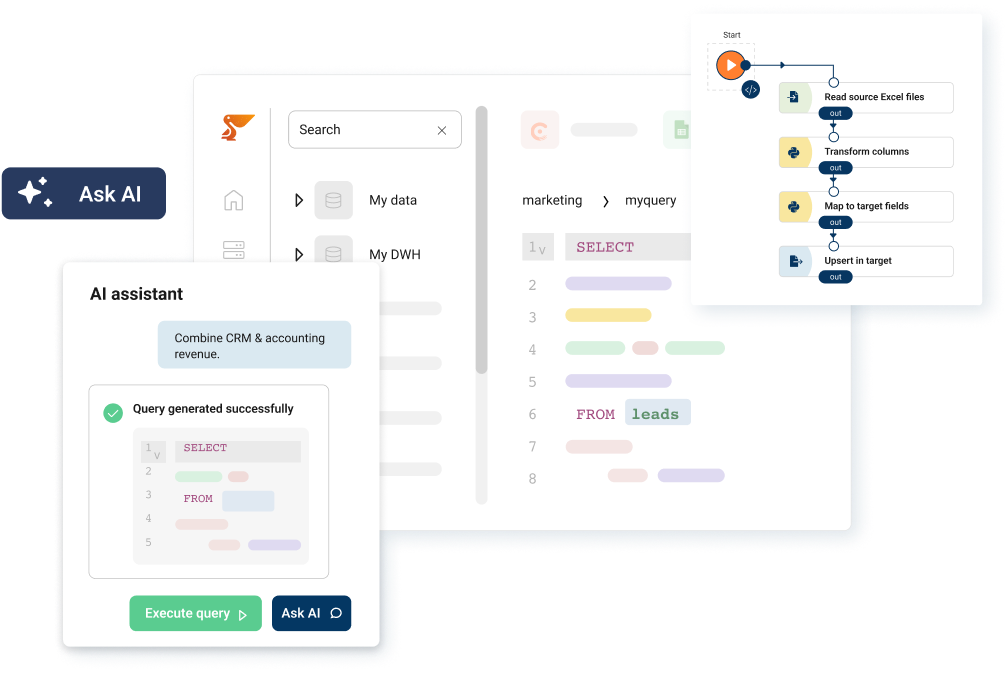
- SQL and low-code Python transformations with AI-assisted “Magical SQL” features
- Reverse ETL and data activation for syncing modeled data into business applications
- Built-in BI tools with visual analytics, dashboards, and Excel/Google Sheets writeback
- Federated query engine powered by Trino for cross-source queries without copying data
- AI agent tooling with Text-to-SQL, RAG, and MCP server support
Unlike Fivetran’s ETL-only approach that requires 5-8 additional tools, Peliqan ships complete functionality including automated alerts, BI reporting, and spreadsheet-like data exploration in one product.
Strengths
- Fastest deployment in the category – working pipelines in under 5 minutes
- Transparent fixed pricing eliminates surprise charges as data volumes grow
- All-in-one platform reduces tool sprawl and total cost of ownership
- Accessible to both technical teams (Python, SQL) and business users (spreadsheet UI)
Transparent, predictable pricing
Cost structure designed for budget predictability:
- Starter tier: $380/month
- Pro tier: $550/month
- Enterprise: custom, fixed-fee
Note: Peliqan offers transparent pricing – no surprises – unlike Fivetran’s row-based MAR billing or Snowflake’s compute consumption volatility.
Technical architecture
- Cloud-native SaaS foundation with SOC 2 Type II, ISO 27001, GDPR, HIPAA, and EU-hosted compliance
- Trino-powered federated query engine for real-time cross-source queries
- Built-in PostgreSQL warehousing plus bring-your-own warehouse integration
- Multi-cloud support including AWS, GCP, and Azure
- Enterprise security with role-based access, audit logging, and secret vaulting
2. Airbyte – leading open-source flexibility
Airbyte represents the largest open-source data integration ecosystem, offering 600+ connectors with strong community support and flexible deployment options. The approach combines the cost benefits of open-source with enterprise features through their managed cloud offering.
Key features
- Industry’s largest connector library with 600+ integrations
- Visual and code-based connector development capabilities
- Support for unstructured data and vector databases for AI workloads
- Both cloud and self-hosted deployment options for compliance flexibility
Strengths
- Open-source flexibility with no vendor lock-in
- Cost-effective for high-volume data processing when self-hosted
- Extensive connector ecosystem addresses long-tail integration needs
Weaknesses
- Technical complexity requires significant DevOps expertise to operate at scale
- Many connectors remain in alpha or beta status with variable maintenance
- Limited enterprise features in the open-source edition
Pricing
- Free open-source edition with unlimited usage
- Cloud at $10/month base plus $2.50 per credit
- Usage-based at $15/million rows for API sources
3. Hevo Data – comprehensive no-code platform
Hevo Data positions as a complete ETL/ELT platform designed for mid-market organizations prioritizing ease of use and comprehensive feature coverage. The approach combines no-code transformations with enterprise-grade capabilities and strong customer support.
Key features
- 150+ pre-built connectors across major data sources
- ETL/ELT and reverse ETL functionality in a single platform
- Visual data transformations with drag-and-drop interface
- Real-time data replication and streaming capabilities
Strengths
- Strong customer support with comprehensive documentation
- Intuitive UI accessible to non-technical users
- Fast onboarding with minimal setup complexity
Weaknesses
- Fewer connectors compared to top competitors
- Pricing can escalate with significant data growth
- Limited customization for complex transformation requirements
Pricing
- Free tier for up to 1 million events monthly
- Starter at $239/month for 5 million events
- Professional at $679/month for 100 million events
4. Matillion – cloud-native transformation powerhouse
Matillion delivers purpose-built cloud data transformation with visual, low-code interfaces optimized for modern cloud warehouses. The platform excels at complex transformation scenarios requiring enterprise-grade performance and governance.
Key features
- Pushdown optimization for maximum cloud warehouse performance
- Native integration with cloud warehouses (Snowflake, BigQuery, Redshift)
- Advanced orchestration capabilities with workflow management
- Git integration for version control and CI/CD pipeline support
Strengths
- Exceptional transformation performance through intelligent pushdown
- Enterprise security features and governance capabilities
- Sophisticated workflow orchestration for complex ETL processes
Weaknesses
- Higher total costs including VM infrastructure expenses
- Requires existing cloud data warehouse investment
- Complex pricing calculations with multiple cost components
Pricing
- Credit-based consumption model with Basic at $1,000/month
- Advanced at $2,000/month, Enterprise custom pricing
- Credits cost $2-$3.50 per hour plus cloud infrastructure expenses
5. Stitch Data – developer-focused simplicity
Stitch Data emphasizes simplicity and reliability for straightforward ELT use cases, using the Singer protocol ecosystem for extensibility. Acquired by Talend, Stitch maintains its developer-friendly data replication focus with enterprise security features.
Key features
- 130+ data source connectors with Singer protocol compatibility
- Simple configuration and setup process
- Enterprise security compliance and certifications
- Reliable ELT workflows with a set-and-forget approach
Strengths
- Straightforward implementation with minimal complexity
- Strong enterprise security and compliance features
- Reasonable pricing for smaller data volumes
Weaknesses
- Limited transformation capabilities beyond basic ELT
- Batch-only processing without real-time options
- Slower innovation pace since the Talend acquisition
Pricing
- Row-based tiers starting at $100/month for 5 million rows
- Advanced at $1,250/month for 100 million rows
- Premium at $2,500/month for 1 billion rows
6. Segment – customer data platform leader
Segment specializes in customer data infrastructure with event tracking, profile unification, and activation capabilities. Now part of Twilio, Segment combines CDP functionality with reverse ETL features for customer-centric organizations.
Key features
- Event tracking and data collection across all touchpoints
- Customer profile unification and identity resolution
- 300+ destination integrations for data activation
- Reverse ETL capabilities for operational data activation
Strengths
- Comprehensive CDP functionality unmatched by general ETL tools
- Extensive destination ecosystem for marketing activation
- Real-time processing capabilities for immediate insights
Weaknesses
- High pricing particularly at enterprise scale
- Limited general-purpose ETL capabilities beyond customer data
- Complex pricing structures with potential vendor lock-in
Pricing
- Monthly Tracked Users (MTU) model
- Enterprise contracts typically $25,000-$200,000 annually
- Reverse ETL includes 1 million records with custom pricing for larger deployments
7. dbt Cloud – modern data transformation standard
dbt Cloud has become the industry standard for data transformation using SQL-based modeling, version control, and comprehensive testing frameworks. By 2026, dbt is essentially the default analytics-engineering tool paired with most ELT platforms.
Key features
- SQL-based transformations and data modeling framework
- Git-based version control and collaborative development
- Comprehensive data testing and documentation capabilities
- Automatic lineage tracking and impact analysis
Strengths
- Industry-standard transformation practices with software engineering rigor
- Excellent documentation and data lineage capabilities
- Strong community support with extensive learning resources
Weaknesses
- Transformation-only – requires separate ingestion tools (Fivetran, Airbyte, etc.)
- Pricing unpredictability with the newer consumption-based model
- Steep learning curve for non-SQL users
Pricing
- Developer tier free for up to 3,000 model builds monthly
- Team at $0.01 per successful model build
- Enterprise requires custom negotiations
8. Zapier – business automation leader
Zapier dominates business process automation with the largest app ecosystem and a user-friendly no-code interface. While not primarily designed for heavy data integration, Zapier excels at workflow automation and business process connectivity.
Key features
- 7,000+ app integrations with extensive ecosystem coverage
- Intuitive no-code automation builder with drag-and-drop interface
- Multi-step workflow capabilities with conditional logic
- AI-powered automation features and Copilot for Zap generation
Strengths
- Largest integration ecosystem enabling virtually any app connection
- Strong user experience with minimal learning curve
- Strong automation capabilities for business process optimization
Weaknesses
- Limitations for heavy data integration and large volumes
- Restrictive task limits can become expensive for data-intensive workflows
- Design focus is automation rather than data warehousing
Pricing
- Free tier for 100 tasks monthly
- Professional at $19.99/month for 750 tasks
- Team at $49/month for 2,000 tasks
9. Make – visual automation platform
Make (formerly Integromat) provides visual workflow automation with more cost-effective pricing than Zapier and advanced logic capabilities. The platform balances powerful automation features with accessible visual interfaces.
Key features
- 2,400+ app connectors with comprehensive integration options
- Visual workflow builder with drag-and-drop interface
- Advanced logic and conditional branching capabilities
- Real-time execution with instant trigger processing
Strengths
- Cost effectiveness compared to Zapier and similar alternatives
- Visual and intuitive workflow design interface
- Advanced conditional logic for complex workflows
Weaknesses
- Smaller app ecosystem compared to Zapier
- Hidden costs in polling operations can increase expenses
- Reduced fit for pure data integration at scale
Pricing
- Free tier for 1,000 operations monthly
- Core at $9/month for 10,000 operations
- Pro at $16/month for 10,000 operations plus advanced features
10. Apache NiFi – open-source data flow management
Apache NiFi delivers comprehensive open-source data flow management with visual design and enterprise-grade security features. Developed by the NSA and donated to the Apache Foundation, NiFi handles complex data routing and transformation scenarios.
Key features
- Visual data flow design and management interface
- Real-time data processing and intelligent routing capabilities
- Comprehensive data provenance tracking and audit trails
- Extensive processor library for transformations and integrations
Strengths
- Complete cost freedom with open-source licensing
- Powerful data flow management with fine-grained control
- Real-time processing capabilities for streaming data
Weaknesses
- Complex setup and configuration requirements
- Significant technical expertise needed for implementation
- Limited cloud-native optimization compared to modern alternatives
Pricing
- Free open-source licensing
- Only infrastructure costs required for hosting
- No software licensing fees or usage restrictions
11. Pentaho Data Integration – traditional enterprise ETL
Pentaho provides traditional enterprise ETL capabilities with drag-and-drop design interfaces and comprehensive transformation features. As part of Hitachi Vantara, Pentaho serves organizations with complex ETL requirements and big data processing needs.
Key features
- Drag-and-drop ETL design environment with visual interface
- Extensive transformation and data processing capabilities
- Big data platform support (Hadoop, Spark, NoSQL databases)
- On-premises deployment options with enterprise control
Strengths
- Comprehensive ETL functionality with mature feature set
- Free community edition available for basic requirements
- Strong support for complex transformations and business logic
Weaknesses
- Older technology architecture with limited cloud-native capabilities
- Complex user interface with steep learning curve
- Performance challenges with very large datasets
Pricing
- Enterprise starting at $1,200/year for single user
- Scaling to $60,000/year for 100 users
- Both perpetual and subscription licensing models available
Fivetran alternatives comparison: key metrics and features
Selecting the right Fivetran alternative depends on your specific organizational needs, technical requirements, and strategic priorities. The table below summarizes the top 11 across deployment, pricing model, connector count, transformation depth, and reverse ETL support.
Watch out: hidden costs when switching from Fivetran
- MAR pricing escalation: Fivetran’s per-connector bulk sync discount change (March 2025) raised prices for many existing customers. Model the renewal price before assuming flat year-over-year.
- Open-source ops cost: Self-hosting Airbyte or NiFi is “free” but requires DevOps time, Kubernetes management, and on-call coverage. Budget 2-8 hours per month of engineering time.
- Stacking transformation tools: Fivetran + dbt + Census + Looker is four contracts and four upgrade cycles. All-in-one platforms collapse the bill but require migration effort.
- Connector backlogs: Most vendors quote 3-6 months for custom connectors. Faster SLAs (like Peliqan’s 2-week commitment) compress launch timelines.
- Re-platforming engineering time: Migrating from Fivetran to any alternative typically takes 2-8 weeks. Factor this into the savings math, not just the platform fee.
Peliqan vs Fivetran: quick comparison
Peliqan provides a broader range of features, greater flexibility, and capabilities Fivetran doesn’t offer. Here’s how Peliqan stacks up against Fivetran.
Architectural decision tree
Walk through these questions to land on the right Fivetran alternative for your stack:
- Do you want to consolidate ETL, warehouse, transformations, and reverse ETL in one platform? → Peliqan.
- Is open-source flexibility and self-hosting non-negotiable? → Airbyte (cloud-friendly) or Apache NiFi (heavy customization).
- Do you need on-prem deployment for regulatory reasons? → Peliqan, Apache NiFi, or Pentaho.
- Is the team mid-market with no dedicated data engineers? → Hevo Data or Stitch.
- Are transformations the bottleneck, not ingestion? → Matillion (visual) or dbt Cloud (code-first).
- Is customer data unification the core need? → Segment.
- Is workflow automation across business apps the actual goal? → Zapier or Make.
- Do you have 7-figure budget and need traditional ETL? → Pentaho or other enterprise vendors.
Real-world example: CIC Hospitality
CIC Hospitality manages 40+ hotels with 50+ different data sources spanning ERP, PMS, accounting, and POS systems. By consolidating everything into one data platform and automating the board reporting layer, they save more than 40 hours per month in manual data preparation – the kind of all-in-one workflow that’s hard to build on Fivetran alone. Read the full case study.
How AI agent workloads change the alternative-selection criteria
Fivetran was designed for the BI era – move data from SaaS to warehouse so dashboards work. The AI agent era has shifted the criteria:
- Connector coverage matters more, not less: AI agents need governed access to every business system, not just the top 50 SaaS apps.
- Transformation depth feeds RAG quality: Raw API payloads make agents hallucinate. Cleaned, modeled entities make them useful.
- Reverse ETL is now an agent destination, not just a marketing destination: Agents read from the warehouse and write back to operational systems.
- MCP server support is the new category: Tools that ship MCP servers expose warehouse data to Claude, ChatGPT, and Cursor with one configuration.
- Governance must extend to the AI layer: Row-level access, PII masking, and audit logging need to follow data into the agent, not stop at the BI dashboard.
Alternatives that ship more of the stack natively – Peliqan with built-in warehouse, transformations, reverse ETL, and MCP server – reduce the integration surface area dramatically. Single-purpose tools (Fivetran + dbt + Hightouch + Looker + custom MCP server) require stitching, observability, and ownership across four vendors.
Conclusion
As the modern data landscape grows more complex, relying on rigid, usage-based platforms like Fivetran can lead to escalating costs and architectural limitations – especially for B2B SaaS companies handling diverse data sources, AI agent workloads, and dynamic reporting needs.
Whether you’re looking for open-source control (Airbyte, Apache NiFi), no-code simplicity (Hevo, Stitch), advanced transformation pipelines (Matillion, dbt Cloud), or workflow automation (Zapier, Make), there’s no shortage of Fivetran alternatives. Most tools, however, address only one slice of the puzzle.
Peliqan stands apart by offering an all-in-one, low-code platform that combines ETL/ELT pipelines, transformation, and reverse ETL with flat pricing, 250+ connectors, and support for SQL, Python, and API-based workflows. It’s purpose-built for modern B2B SaaS teams that need flexibility, control, and speed without juggling multiple tools – and ready for AI agent workloads on top.
Looking for a simpler, more capable alternative to Fivetran?
Try Peliqan today and build smarter data pipelines, faster.