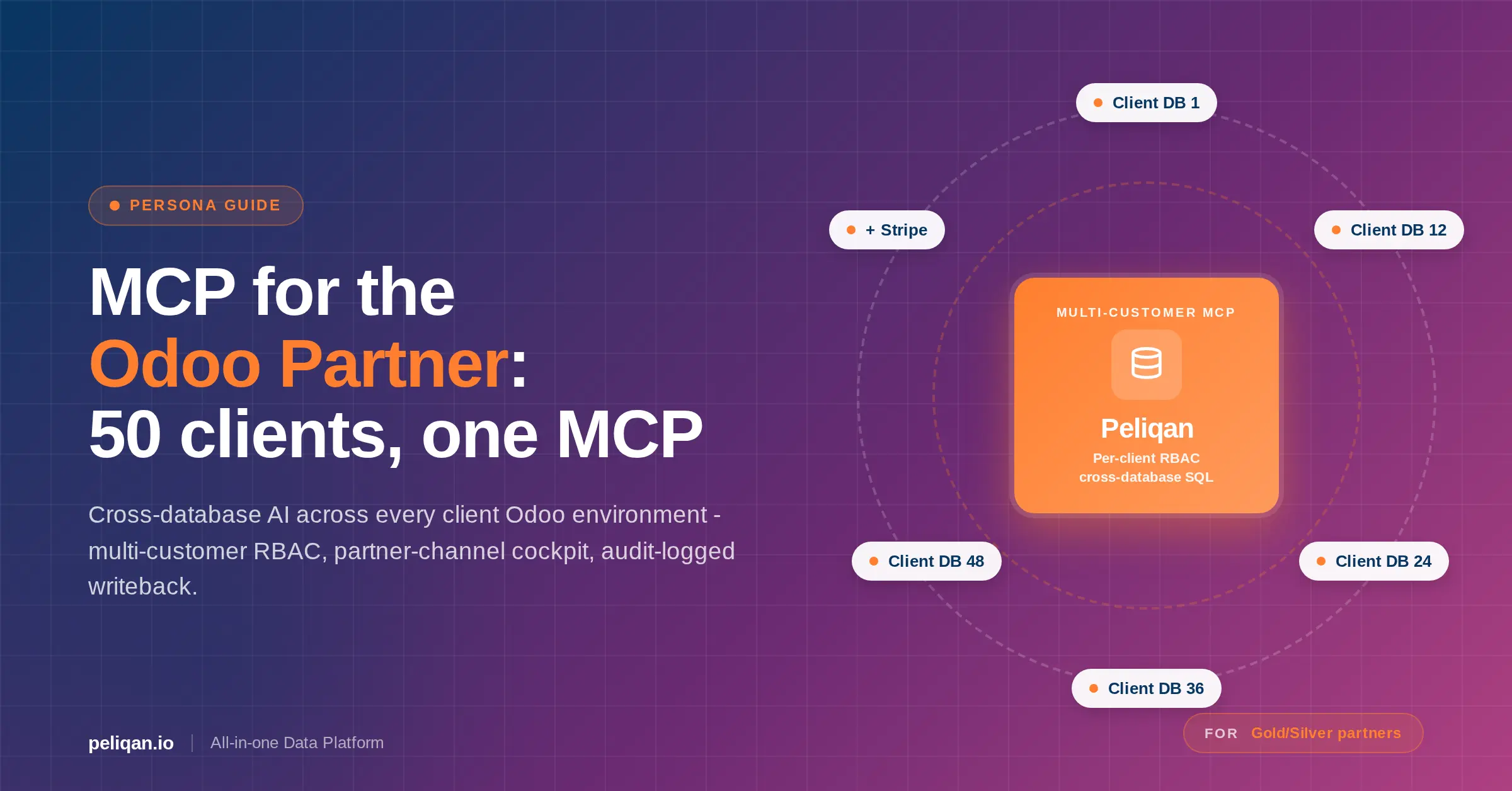


“Across all 50 client Odoo databases, which clients have margin contraction in the last 90 days?” This is the standing partner-channel question every Gold or Silver Odoo Partner asks but cannot answer inside any single client’s Odoo database. None of the per-database MCP wrappers reach across the client book. This is the persona post for the Odoo Partner running 20 to 100 client environments, anchored to the existing Odoo MCP playbook and the multi-database warehouse pattern that no other vendor delivers as a first-class capability.
Odoo’s 2026 reality matters because it shapes the partner channel’s incentives. Specifically, Odoo raised €500 million in a secondary share sale led by CapitalG and Sequoia in November 2024, with participation from BlackRock, Mubadala, HarbourVest, AVP, and Alkeon. Furthermore, the round valued the Belgian-headquartered company at €5 billion (roughly $5.3 billion). The product crossed 12 million users with 7 million daily active. Indeed, Odoo is projecting €1 billion in billings by 2027 from a base of roughly €650 million.
The product roadmap on AI matters even more for partners. Specifically, Odoo 18 shipped native AI features including predictive lead scoring, content generation, and OCR-driven bank reconciliation. Furthermore, Odoo 19 added a native AI chatbot in September 2025. As a result, every client database now has a credible in-database AI experience without any partner-side work.
However, none of those native AI features serve the cross-database partner-channel question. Specifically, “which of my 50 clients has margin contraction this quarter?” cannot be answered inside one client’s database. That is the architectural slot the warehouse-first MCP pattern fills, anchored to the existing Odoo MCP playbook and the cross-source MCP cornerstone.
The Odoo Partner’s operating reality in 2026
The typical Odoo Partner runs a consultancy practice with 20 to 100 client environments. Specifically, the practice maintains Gold, Silver, or Ready partner tier certification with Odoo SA. Furthermore, the partner’s revenue mix splits across new-customer implementation projects, ongoing customisation, support retainers, and licensing margin. As a result, the partner-channel revenue depends on a deep client book where every client uses Odoo well.
The geographic distribution of Odoo Partners follows the Odoo installed base. Specifically, Belgium hosts the highest partner density (Odoo’s home market). Furthermore, France, Spain, and Italy carry large Community installed bases that turn into partner-led Enterprise migrations. Latin America is Odoo’s fastest-growing geography for both Community and Enterprise editions. Finally, North America covers mid-market Odoo Enterprise with the partner channel handling implementation.
The architectural challenge is uniform across geographies. Specifically, no Odoo Partner can run their 50 client databases as one operational unit using Odoo’s own tools. Indeed, Odoo Community and Enterprise both isolate each client database. Furthermore, the community GitHub MCPs (ivnvxd/mcp-server-odoo, tuanle96, pantalytics, vzeman, industream) handle single-database scenarios excellently. However, the cross-database fan-out across the partner’s whole book sits outside their scope.
The six standing questions every Odoo Partner asks
The questions below are not theoretical. Each is a real partner-channel ask that today requires opening 50 client databases by hand or building an internal data warehouse from scratch.
1. Cross-database margin contraction analysis
“Across all 50 client Odoo databases, which clients have margin contraction in the last 90 days? Group by industry and revenue tier.” Specifically, the agent joins margin metrics from every client database into one cross-client view. As a result, the partner triggers proactive advisory conversations with the at-risk clients before they ask.
2. Multi-client unreconciled bank entries
“Multi-client compliance evidence: which client databases have unreconciled bank entries older than 14 days, ranked by client priority?” Furthermore, the agent surfaces the highest-impact reconciliation gaps in priority order. Indeed, the same pattern works for unpaid supplier invoices and overdue customer receivables.
3. Community-to-Enterprise upsell signal
“Partner upsell signal mining: which clients are running on Community edition but their volume now justifies Enterprise – surface the migration candidates.” Specifically, the agent reads transaction volume, user count, and module density across each Community-edition client. As a result, the partner gets a ranked migration-candidate list every quarter.
4. Cross-database performance benchmarking
“Cross-database performance benchmarking: which clients on the same module mix are outperforming peers – and which are underperforming?” Furthermore, the agent compares similar clients to surface best-practice signals. Indeed, this is the advisory-conversation opener that turns Community-edition partners into trusted consultants.
5. Partner-channel billing health
“Client billing health: across all 50 clients, who is overdue on subscription invoices versus project work?” Specifically, the agent joins the partner’s own Stripe billing records to per-client project status. As a result, the practice owner sees both the cash-collection list and the project-priority list in one prompt.
6. Module-level adoption analysis
“Module-level adoption: which Odoo modules are heavily used by 80% of our clients, and which are sitting installed-but-unused – opportunity for advisory engagement?” Furthermore, the agent surfaces under-utilised modules across the client book. As a result, the partner schedules adoption-coaching engagements before clients churn for under-use.
Five cross-database workflows the warehouse-first MCP unlocks
Partner-channel cockpit
All 50 client Odoo databases join Stripe billing join Salesforce or HubSpot pipeline. Specifically, one agent surface covers project, billing, and pipeline health across the whole consultancy. As a result, the practice owner’s Monday morning starts with one prompt instead of fifty database logins.
Multi-database compliance evidence
Per-client audit-log evidence pack for SOC 2 plus EU AI Act Article 26 plus Belgian Peppol obligations. Furthermore, the Billit Peppol playbook covers the e-invoicing layer that every Belgian Odoo client needs in 2026. Indeed, the same audit log satisfies both ITAA-adjacent compliance and the partner’s own SOC 2 review.
Cross-client benchmarking
Industry and revenue-tier comparisons across the client book surface outliers (positive or negative). Specifically, the agent ranks clients by performance percentile per module mix. As a result, the partner has a real benchmark-based advisory conversation rather than a generic best-practice deck.
Module-level upsell signal
Community-edition clients whose volume now justifies Enterprise surface as a ranked migration list. Furthermore, the partner-channel revenue trigger is automated. As a result, the practice owner schedules quarterly migration-candidate reviews from a real data source.
Cooperative architecture with Odoo’s own AI
Odoo 18 AI features and Odoo 19 chatbot handle in-database workflows for each client. Then Peliqan handles the cross-client analytical layer. Specifically, this is the same cooperative pattern documented in the Notion MCP playbook and the Airtable MCP playbook earlier in this cluster. As a result, the partner runs both layers side by side rather than picking one.
How adjacent Odoo MCP options fit alongside Peliqan
The community GitHub Odoo MCPs deserve fair-framing because they are real, useful tools. Specifically, ivnvxd/mcp-server-odoo is the most-starred community Odoo MCP and handles single-database scenarios cleanly. Furthermore, tuanle96, pantalytics, vzeman, and industream all maintain credible Odoo MCP implementations for different community needs. As a result, any partner running a single client environment can pick one of these and get good in-database AI capability.
Odoo 18’s native AI features cover the in-database AI lane too. Specifically, predictive lead scoring works inside CRM. Content generation works inside Marketing. OCR-driven bank reconciliation works inside Accounting. Furthermore, Odoo 19’s native chatbot (September 2025) provides the conversational layer across modules. As a result, Odoo’s own AI is increasingly the right answer for in-database work.
However, the partner-channel question is structurally different. Specifically, none of the per-database MCPs or Odoo’s own AI features cross client boundaries. Indeed, that is the partner’s whole job. Furthermore, Composio’s Odoo toolkit targets dev-tool agents rather than the partner buyer. Pipedream Odoo is workflow-shaped rather than analytical. Apideck does not cover Odoo deeply. As a result, the partner’s cross-database multi-tenant question has exactly one architectural answer in 2026: warehouse-first MCP. The broader comparison context sits in the Composio + Pipedream + Peliqan MCP analysis and the best MCP server listicle.
How Peliqan multi-customer management serves the Odoo Partner
The multi-database architecture for the Odoo Partner
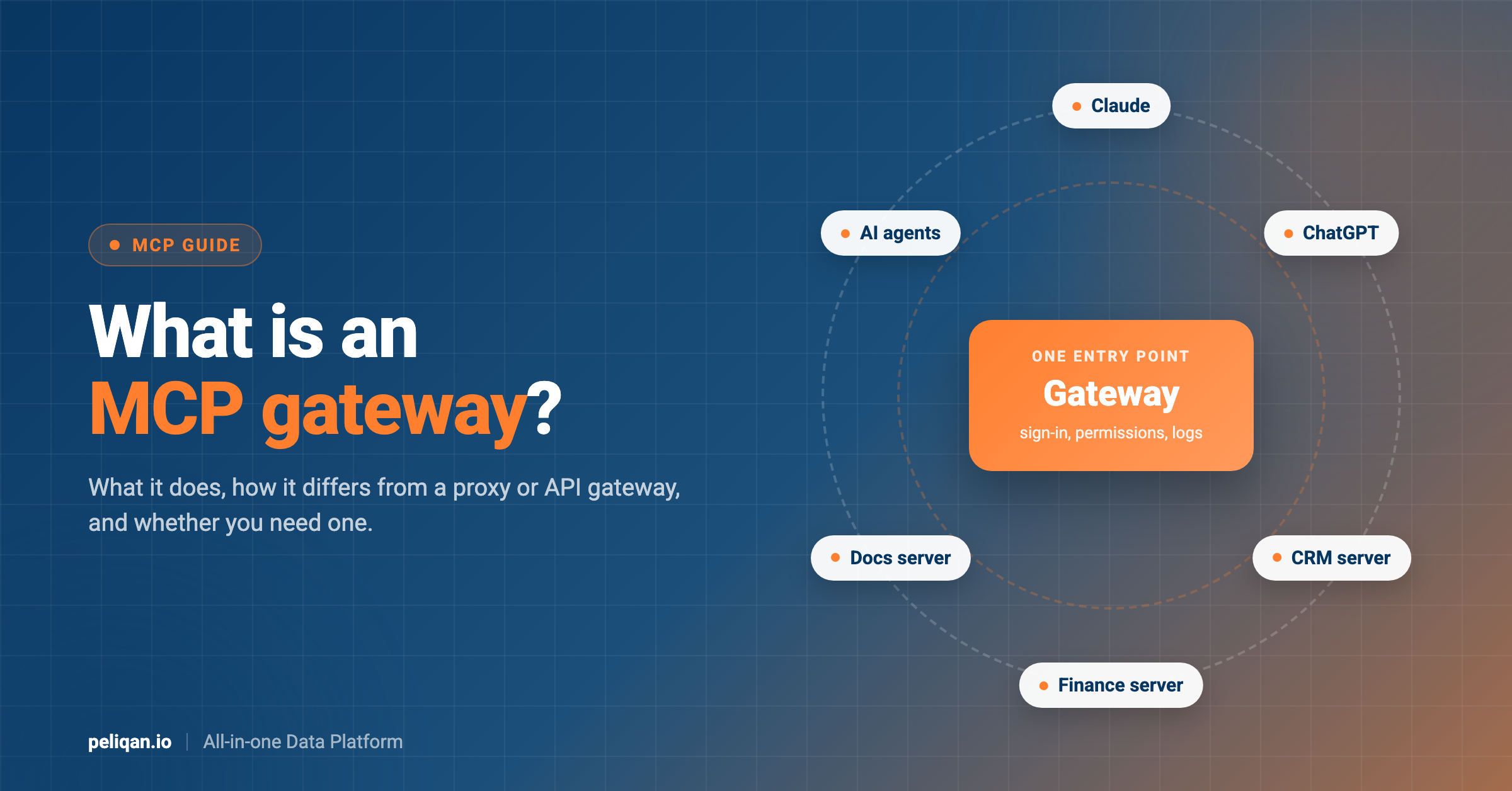
The multi-customer management capability is the architectural moat. Specifically, no per-database MCP handles 50 clients as one operational unit with audit-logged cross-tenancy. Furthermore, the help documentation on multi-customer management at help.peliqan.io/multi-customer-management covers the per-client RBAC and audit-log behaviour in detail.
ICP and pricing for the Odoo Partner
The ideal customer is the practice owner or technical lead at a Gold, Silver, or Ready certified Odoo Partner. Specifically, the practice runs 20 to 100 client Odoo environments across Community and Enterprise editions. Furthermore, the partner sells implementation, customisation, support retainers, and increasingly advisory services. As a result, the cross-database view drives both operational efficiency and partner-channel revenue growth.
Peliqan’s pricing is fixed from €150 per month annual (€1,800 per year), with multi-customer management included. Furthermore, the per-client RBAC means the partner serves their whole client book under one workspace without per-client license inflation. As a result, the architecture economics favour scale – the more clients the partner serves, the lower the marginal cost per client. The platform overview sits at the main Peliqan MCP page.
The Odoo Partner’s compliance posture matters too. Specifically, EU jurisdiction plus SOC 2 Type II plus audit-logged writeback satisfies the next round of partner-channel due diligence from larger Odoo clients. Furthermore, the EU AI Act Article 26 obligations apply to any AI agent acting on client data in high-risk use cases. The broader GDPR-compliant MCP servers pillar covers the regulatory frame.
Real-world example from the Odoo Partner channel
Real-world example: Rezolv / OdooExperts
OdooExperts (Rezolv) consolidates reporting and AI workloads across 50+ client Odoo environments through Peliqan’s multi-customer management. Specifically, each client’s Odoo database lands into the same warehouse architecture with per-client RBAC and audit-logged writeback. As a result, one MCP server serves the whole consultancy with no data crossover between clients. Furthermore, the partner runs cross-database margin analysis, Community-to-Enterprise upsell signal mining, and module-adoption benchmarking as routine operating cadences rather than ad-hoc quarterly exercises. Read the full OdooExperts case study.
How to roll out cross-database Odoo MCP for a partner channel
The deployment plan breaks into three phases for a typical Odoo Partner. First, connect three to five priority client databases to Peliqan. Specifically, generate API credentials per client database (Odoo API key or OAuth depending on edition) and configure the per-client RBAC. Furthermore, validate that the warehouse partitioning works as expected before adding more clients.
Second, install the MCP server with pip install mcp-server-peliqan and connect Claude. Then run the first three cross-database queries from the six above. Specifically, the cross-database margin analysis or the Community-to-Enterprise upsell query usually reveals at least one partner-channel revenue opportunity inside the first 30 days.
Third, scale the connection pattern across the whole client book. Specifically, add the remaining 40-plus clients in batches over the next month. Furthermore, layer additional connected systems where relevant: Stripe billing for the partner’s own subscription revenue, Exact Online for clients on hybrid stacks, AFAS for Benelux HR-heavy clients. As a result, the partner-channel cockpit covers the whole book by the end of the third month. The persona-sibling MCP for the EU CFO playbook covers the finance-side architecture each client’s CFO will eventually adopt too.
How this connects to the broader Peliqan cluster
This persona post is the fourth in the planned persona-hub series, after the EU CFO playbook, the EU RevOps Leader playbook, and the Belgian Accountancy Partner playbook. Specifically, the Odoo Partner inherits multi-tenancy architecture similar to the Belgian Accountancy Partner but optimised for ERP-database fan-out rather than mixed Visma stack coverage. Furthermore, the architectural foundation in the SQL on anything help doc covers the federated query engine that handles 50-plus database fan-out without copying data.
The Peliqan persona page at peliqan.io/odoo-partners covers the partner-channel proposition in product form. As a result, this persona post links into the existing persona surface and lets the partner buyer move directly from blog to onboarding.
The bottom line for the Odoo Partner in 2026
Odoo’s product roadmap is strong. Specifically, Odoo 18 native AI features and Odoo 19 chatbot (September 2025) cover in-database AI for every client. Furthermore, the community GitHub MCPs serve single-database scenarios well. As a result, the per-client AI question is largely solved in 2026.
However, the partner-channel question is different. Specifically, “which of my 50 clients needs my attention this week?” cannot be answered inside any single client’s Odoo database. Furthermore, the cross-database multi-tenant pattern is the partner’s whole operating model. As a result, the architectural answer is warehouse-first MCP with multi-customer management.
The procurement decision that compounds is not which Odoo AI feature to enable for which client. Specifically, you will probably enable several across the book. Rather, it is whether you have a warehouse layer beneath every client database that lets you operate at partner-channel scale instead of per-client scale. For Odoo Partners targeting 70 clients with the same headcount that used to serve 50, that layer is the difference between linear and non-linear partner-channel growth. That is the architectural choice that survives the next three years of Odoo partner-channel expansion.