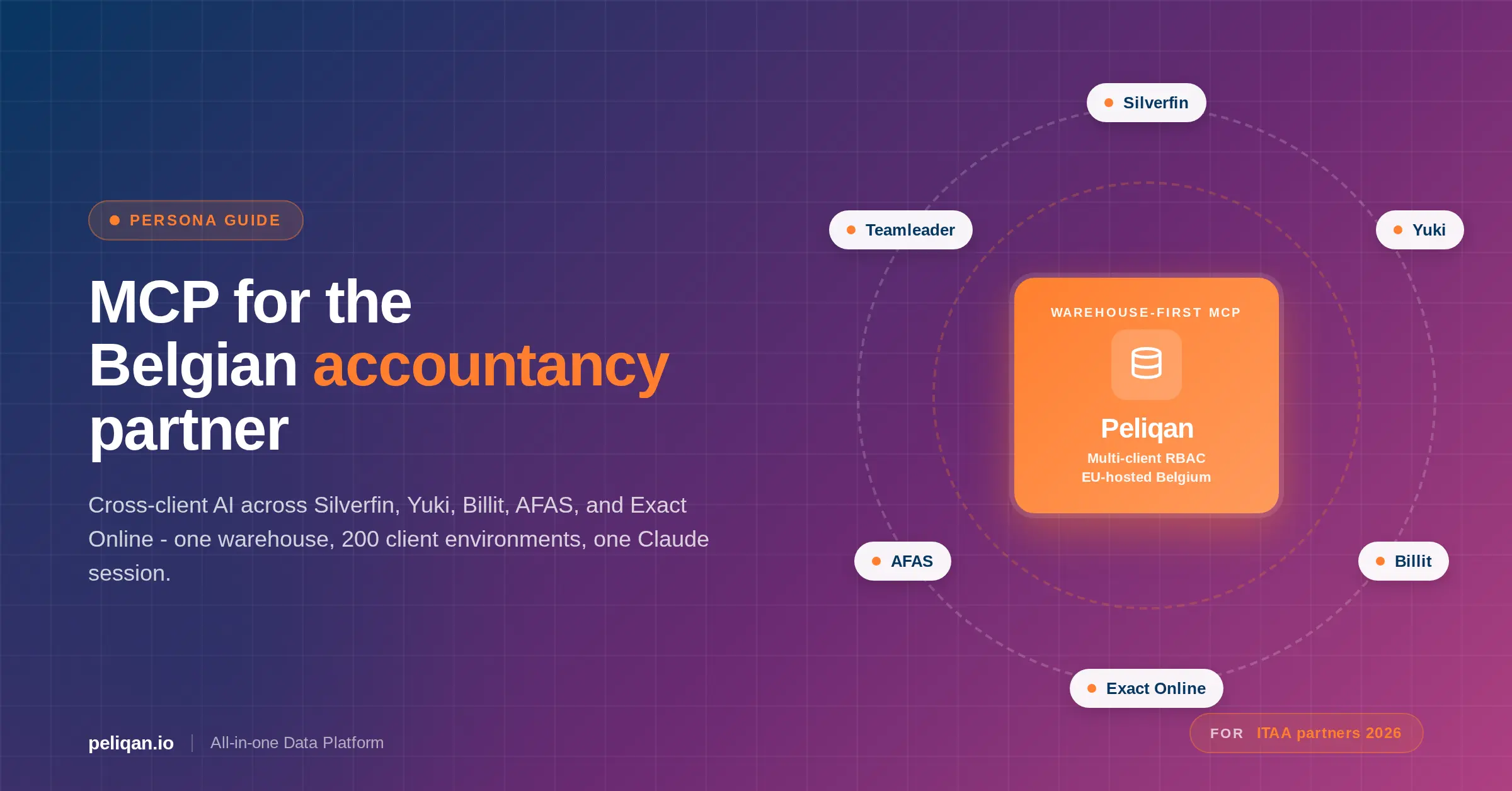





“Across all 200 client environments, which Belgian Peppol invoices haven’t been acknowledged within 48 hours? Group by client and AccessPoint.” This is the standing partner-level question every Belgian accountancy firm has been quietly asking since the January 1, 2026 Peppol mandate went live. None of the per-vendor AI tools answer it. This is the persona post for the Belgian accountancy partner running a tight Silverfin plus Yuki plus Billit plus AFAS plus Exact stack across 50 to 500 SMB clients, looking for one cross-client view that no single vendor can produce alone.
The Belgian accountancy sector reorganised in 2020-2021. Specifically, the Act of 17 March 2019 ratified the merger of the IAB-IEC (Institute of Accountants and Tax Consultants) and the BIBF-IPCF (Institute of Accounting Professionals and Tax Experts) into the ITAA (Institute for Tax Advisors and Accountants). Furthermore, the royal decree implementing the merger came on 11 September 2020. As a result, the ITAA now represents more than 14,500 members and trainees, with 20,000+ employees working through recognised firms. The IBR-IRE remains the separate institute for registered auditors.
The operational reality of a Belgian accountancy partner in 2026 is concrete. Specifically, the firm runs Silverfin as the workpaper and compliance operating system. Yuki holds the Dutch SMB clients’ books. Billit handles the Belgian Peppol e-invoicing gateway. AFAS covers Benelux HR and finance for the larger clients. Exact Online serves multi-division SMBs. Furthermore, partners increasingly inherit hybrid Belgian-Dutch-French client portfolios that demand cross-EU compliance views. As a result, the partner’s data stack spans five to seven systems, each owned by a different vendor.
The killer detail: three of the five core systems (Silverfin, Yuki, Teamleader) are now Visma-owned. Furthermore, Visma’s own AI tools talk to each other inside the Visma surface. However, the cross-client view across all 200 clients is the architectural layer Visma’s own products are not built for. That is where the warehouse-first MCP pattern sits, anchored in the cross-source MCP cornerstone.
The 2026 operating reality for the Belgian accountancy partner
Belgium runs 2,500+ accountancy firms (per ITAA membership data extrapolated across firms with employees). Specifically, the typical practice serves between 50 and 500 SMB clients. Furthermore, the partner manages a tight tech stack that varies by client size and language preference (Dutch in Flanders, French in Wallonia, often mixed in Brussels).
Five systems dominate the Belgian accountancy stack in 2026. First, Silverfin from Visma serves as the post-accounting workpaper platform across 850+ firms in 15 countries. Second, Yuki serves 50,000+ Dutch SMB customers under the Visma umbrella. Third, Billit operates as the dominant Belgian Peppol AccessPoint with 120,000+ businesses and 2 million+ invoices per month. Fourth, AFAS covers Benelux HR and finance for 14,000+ organisations representing 3.8 million employees. Fifth, Exact Online serves 675,000+ SMEs across NL, BE, DE, and UK, under KKR ownership.
Three regulatory regimes intersect at the partner’s desk. First, Belgian B2B Peppol e-invoicing is live since January 1, 2026 with fines of €1,500 to €5,000 per offence plus 60-100% proportional to VAT. Second, France’s mandate hits September 1, 2026, which matters for any Belgian firm with French SMB clients. Third, DORA has been live since January 17, 2025 and the EU AI Act Article 26 obligations apply from August 2, 2026 for any AI agent acting on client data in high-risk scenarios.
The seven standing questions the Belgian accountancy partner asks
The questions below are not theoretical. Specifically, each is a real practice-management ask that today takes hours of manual cross-client work. With cross-source MCP, each becomes one prompt against the cross-client warehouse.
1. Pan-client Peppol delivery monitoring
“Across all 200 client environments, which Belgian Peppol invoices have not been acknowledged within 48 hours? Group by client and AccessPoint.” Specifically, the agent joins Billit AccessPoint delivery status to Exact Online invoice records to Yuki client metadata. As a result, the partner gets one cross-client exception list instead of opening 200 dashboards.
2. Cross-client bank reconciliation triage
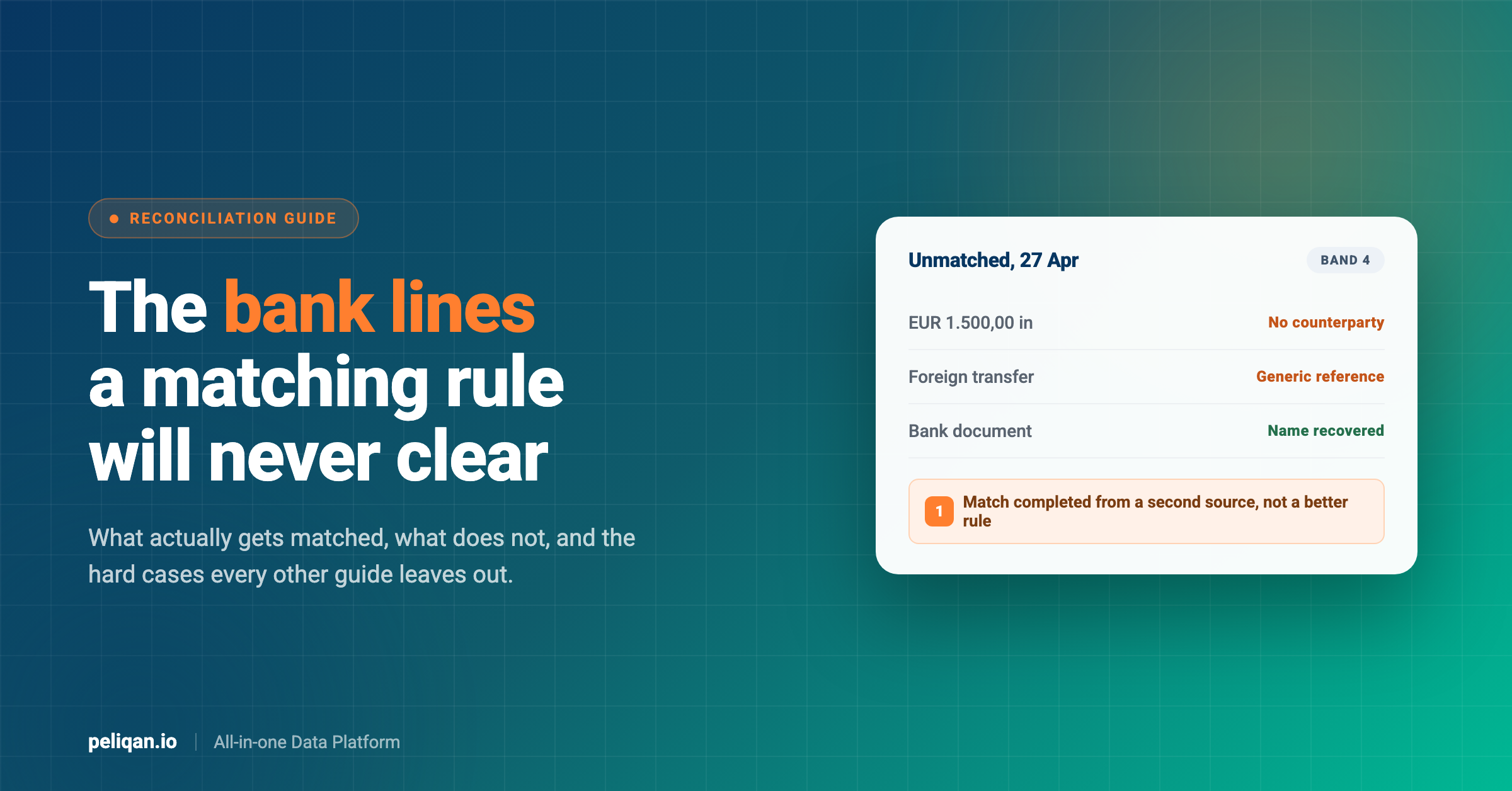
“For our SMB clients on Yuki, surface every unreconciled bank line older than 14 days, ranked by client size.” Furthermore, the agent surfaces the highest-impact reconciliation gaps without the partner having to log into 50 client Yuki environments. Indeed, the same workflow works across Exact Online and AFAS client books.
3. Silverfin workpaper stall detection
“Across all Silverfin client files, which clients have stalled bank rec older than 5 days past target – flag for partner review.” Specifically, the agent reads the workpaper state across the firm’s whole client portfolio. As a result, the partner reviews exceptions rather than reading every workpaper.
4. Margin contraction analysis across advisory clients
“For our top 50 advisory clients, show margin contraction in the last 90 days – Exact Online journal entries cross-referenced against industry benchmarks.” Furthermore, the agent surfaces clients trending toward profitability problems before the partner’s next advisory call. Indeed, this is the upsell-signal workflow that converts compliance work into advisory revenue.
5. UBL validation root-cause analysis
“Peppol delivery monitoring: which clients had failed UBL validation this week, with the root-cause error code grouped?” Specifically, the agent groups failures by Peppol error code (BR-CO-25, UBL-CR-414, BII-T10-R040) and the affected clients. As a result, the partner sends one targeted fix-it message per error code rather than chasing individual rejections.
6. Multi-client compliance evidence package
“Multi-client compliance evidence: SOC 2 + EU AI Act Article 26 + DORA – produce on demand from the audit log.” Furthermore, the audit log captures every AI prompt, every read, and every writeback across every client environment. As a result, the partner’s compliance officer produces the evidence pack in hours instead of weeks.
7. Cross-client upsell signal mining
“Which clients show advisory-conversation triggers – margin contraction, debtor concentration, growth bottleneck – ripe for partner outreach?” Indeed, this is the practice-growth workflow that turns the partner from a compliance-checker into a strategic advisor across the whole client book.
Five cross-client workflows the warehouse-first MCP unlocks
Practice-wide Peppol monitoring
The agent joins Billit AccessPoint delivery status across all client environments to Exact Online journal entries and Yuki suppression-list events. Specifically, one prompt covers 200 client environments simultaneously. As a result, the partner’s Peppol-readiness dashboard is real instead of theoretical.
Cross-client month-end close acceleration
Silverfin workpaper status joins Yuki bank reconciliation joins Exact Online journal anomalies. Specifically, the agent surfaces clients ready to close versus clients needing partner intervention. Furthermore, the same workflow shifts close coordination from a weekly all-hands to a 15-minute Friday review.
Advisory upsell signal mining
Cross-client margin trend joins debtor concentration joins cash conversion cycle. Specifically, the agent ranks clients by advisory-conversation readiness. As a result, the partner-channel revenue pipeline becomes a managed pipeline instead of an ad-hoc one.
Multi-tenant compliance evidence
SOC 2 plus Article 26 plus DORA evidence package generated per-client from one unified audit log. Furthermore, the broader compliance frame sits in the GDPR-compliant MCP servers pillar. Indeed, the audit-log artefact is the same one that satisfies the next external audit.
Hybrid client portfolio reporting
Belgian Peppol delivery joins French e-invoicing readiness (September 2026 mandate) joins Dutch Yuki SMB book. Specifically, one consolidated view per partner covers cross-border client portfolios. As a result, the cross-EU advisory engagement becomes a managed practice motion.
How adjacent AI tooling fits alongside Peliqan in the Belgian stack
The Visma group reality dominates this conversation. Indeed, three of the five core Belgian accountancy systems (Silverfin, Yuki, Teamleader for SMB CRM and advisory work) sit under the Visma umbrella. Furthermore, Visma has been shipping its own AI products inside each.
Silverfin AI Insights handles in-Silverfin reasoning over workpapers and compliance records. Yuki Assistant handles in-Yuki SMB bookkeeping queries. Exact Online ships AI Insights inside its own surface. As a result, each platform’s in-platform AI is genuinely useful for the work that happens inside that platform.
However, the cross-client view across 200 clients on five different systems is the architectural layer none of the in-platform AIs serve. Specifically, that is where the warehouse-first MCP pattern lives. Furthermore, Peliqan does not replace Silverfin AI Insights or Yuki Assistant. Rather, it layers beneath them and joins their data into one cross-client surface. As a result, the partner runs the Visma-native AI tools for in-platform work and Peliqan for cross-client analytical work.
Other Belgian and EU options include Chift (Belgian unified API for accounting) and Apideck Unified Accounting (covered in the Composio + Pipedream + Peliqan MCP comparison). However, both target embedded SaaS builders rather than practice firms. As a result, neither serves the cross-client multi-tenant pattern. The broader vendor comparison sits in the best MCP server listicle.
Architecture for the multi-tenant Belgian accountancy partner
How the 5-system stack lands into one cross-client warehouse
ICP and pricing for the Belgian accountancy partner
The ideal customer is the partner at a Belgian accountancy firm with 1 to 200 staff, a client book of 50 to 500 SMBs, and a multi-Visma technology footprint. Specifically, the partner makes the buying decision on practice management technology. Furthermore, the partner increasingly inherits hybrid Belgian-Dutch-French client portfolios that demand cross-EU compliance views. As a result, the warehouse-first MCP plus EU jurisdiction plus audit-logged writeback hits all three procurement axes simultaneously.
Peliqan’s pricing is fixed from €150 per month annual (€1,800 per year). Furthermore, multi-customer management lets the partner serve every client under one workspace with per-client RBAC. As a result, adding the cross-client view does not scale with client count in a problematic way. The Peliqan platform page covers multi-customer management in detail.
Real-world example from the multi-tenant cross-client lane
Real-world example: OdooExperts
OdooExperts consolidates reporting and AI workloads across 50+ client Odoo environments through Peliqan’s multi-customer management. Specifically, each client’s environment lands into the same warehouse architecture with per-client RBAC. As a result, one MCP server serves the whole consultancy with no data crossover between clients. The same multi-tenant pattern translates directly to Belgian accountancy firms managing 50-500 client books across Silverfin, Yuki, Billit, AFAS, and Exact Online. Read the full OdooExperts case study.
How to roll out cross-client MCP for a Belgian accountancy firm
The deployment plan breaks into three phases for the typical Belgian practice. First, connect Silverfin and one other system (usually Exact Online or Yuki depending on the client mix). Specifically, generate API tokens for both and let the warehouse fill for 14 days. Furthermore, validate that the cross-client RBAC works as expected before granting partner-wide access.
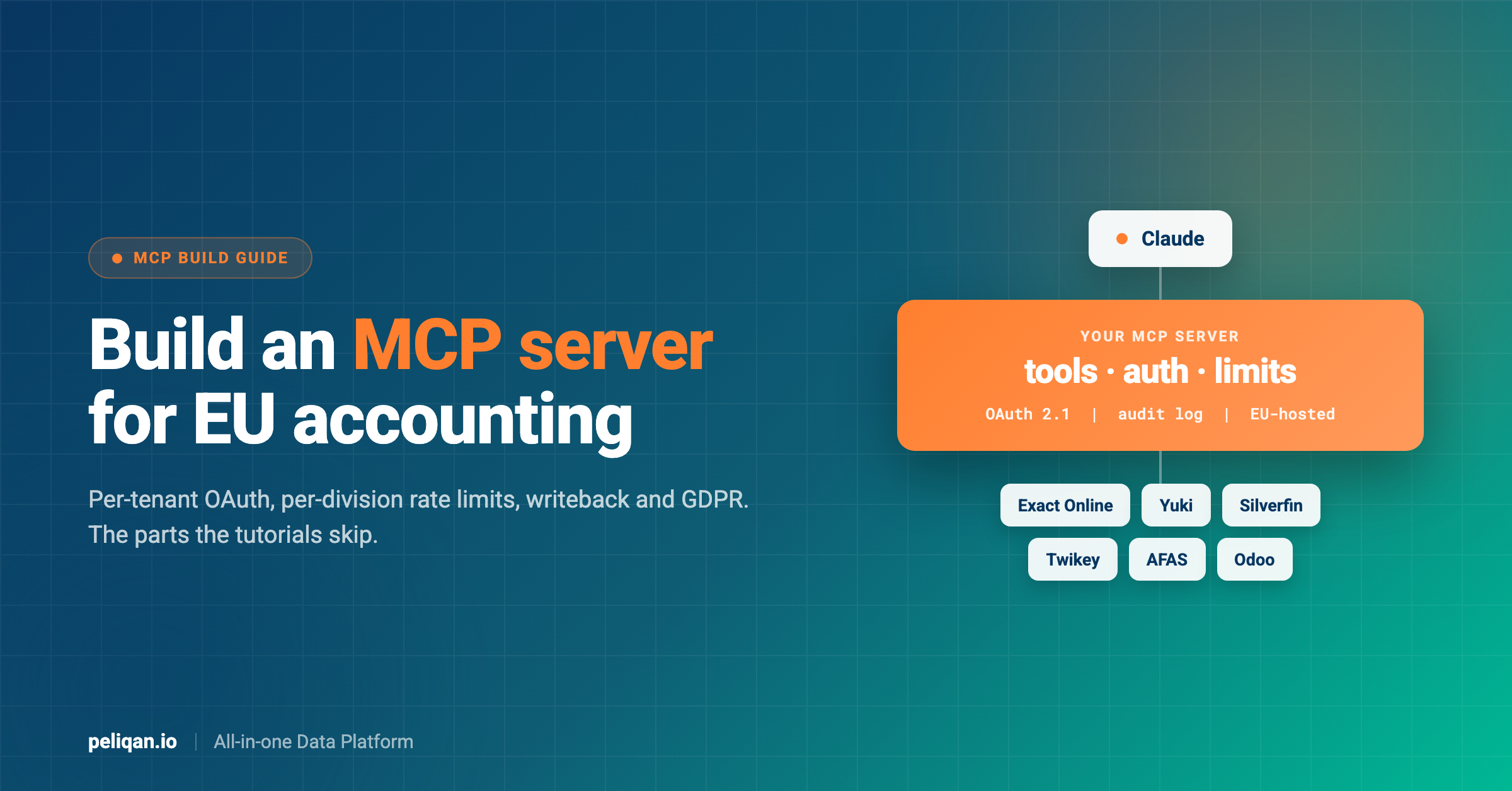
Second, add Billit for Peppol delivery monitoring and AFAS for HR and finance clients. Then install the Peliqan MCP server with pip install mcp-server-peliqan and connect Claude. Indeed, the first cross-client query usually surfaces at least one Peppol exception the firm did not know about.
Third, operationalise the compliance evidence cycle. Specifically, hand the audit log to the firm’s compliance lead. Then connect the audit log to the next ITAA-required compliance review. As a result, the cross-client MCP investment pays for itself at the next quality assurance review and at the next external audit simultaneously.
How this connects to the broader Peliqan cluster
This persona post sits as the second of four planned persona hubs in the Peliqan MCP cluster, alongside the EU CFO playbook, the EU RevOps Leader post, and the Odoo Partner post. Specifically, the Belgian accountancy partner reads the same warehouse-first architecture as the EU CFO but applies it across many client books rather than within one company. Furthermore, the cross-client multi-tenant pattern compounds with the platform’s multi-customer management capability for any consultancy or partner-channel buyer.
For the platform foundations, the main Peliqan MCP page covers the warehouse, federated query engine, and read-write surface that the partner’s cross-client architecture rides on.
The bottom line for the Belgian accountancy partner in 2026
Belgium’s Peppol mandate is live. France’s mandate is months away. ITAA compliance expectations rise every year. Furthermore, the partner’s client book sits across five Visma and non-Visma systems with no native cross-client view across them.
For 2026, the architectural answer is the cooperative MCP pattern. Specifically, Silverfin AI Insights handles in-Silverfin work, Yuki Assistant handles in-Yuki work, and Exact Online’s AI handles in-Exact work. Then Peliqan’s warehouse-first MCP joins all of them at the cross-client layer with audit-logged writeback. As a result, the partner gets one Claude conversation that spans 200 client environments instead of opening five systems per client per week.
The procurement decision that compounds is not which Visma AI tool to enable. Specifically, you will probably enable several. Rather, it is whether you have a warehouse layer beneath every system that can answer the cross-client questions all of them, individually, cannot. For Belgian firms under ITAA, Peppol, DORA, and Article 26 pressure simultaneously, that layer needs to be EU-hosted, SOC 2 Type II, and audit-logged with multi-tenant per-client RBAC. That is the choice that turns compliance work into advisory revenue and survives the next three years of Belgian accountancy regulation.