




Matillion is a capable cloud ELT platform, now rebranded as the Data Productivity Cloud with an agentic AI assistant called Maia. But credit-based pricing, a more limited connector library, and a focus limited to the data warehouse push many teams to evaluate Matillion alternatives. Here is a current comparison of the top 11 Matillion alternatives and competitors for 2026.
Matillion is a cloud-native ELT platform used to load and transform data in modern data warehouses like Snowflake, Redshift, and BigQuery through a drag-and-drop interface, with pushdown optimization as its core strength. In 2025 it relaunched as the Data Productivity Cloud and introduced Maia, an agentic AI that can build, validate, and optimize pipelines from natural-language prompts, and it sits as a Challenger in the Gartner Magic Quadrant for Data Integration Tools. In August 2026 it appointed a new CEO, Girish Pancha, to scale Maia as an AI data automation product.
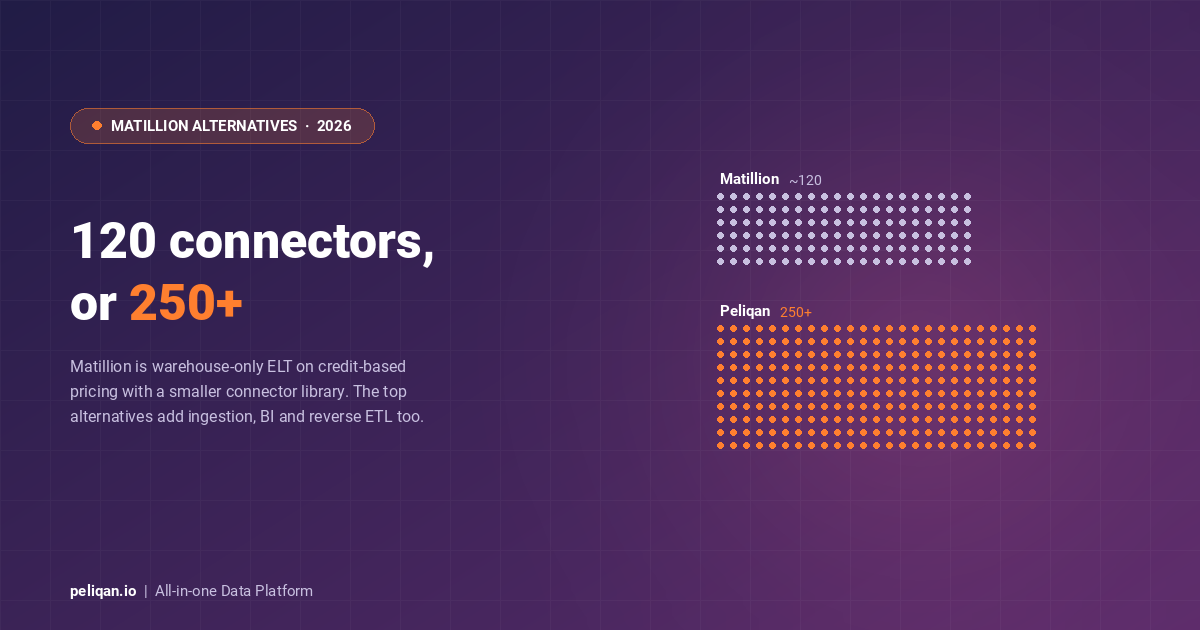
Even so, its pricing and scope prompt many teams to look elsewhere. Matillion’s credit-based model starts around $1,000/month for a base credit allotment and grows with usage, on top of the data warehouse compute it consumes, which makes total cost hard to forecast. Teams also cite a steep learning curve and a more limited connector catalog (around 120) than ingestion-first platforms, which drives a search for alternatives with simpler pricing, more connectors, or built-in data warehousing and activation.
Why consider Matillion alternatives?
Matillion is a solid choice for data warehouse-centric ELT, but a few recurring drawbacks send teams looking at other options.
Common reasons teams seek Matillion alternatives
- Unpredictable cost: the credit-based model plus separate data warehouse compute makes budgets hard to forecast, where many competitors offer transparent fixed tiers.
- Limited connector coverage: Matillion’s connector library is smaller than ingestion-first platforms like Airbyte or Peliqan, which carry 300+ sources.
- Data warehouse-only scope: Matillion transforms data once it is in a cloud data warehouse, so you still bring ingestion of operational and SaaS data, a data warehouse contract, BI, and reverse ETL separately.
- Learning curve: CI/CD, advanced pipelines, and version control require real expertise, and debugging tools are thinner than code-first platforms.
- Missing modern features out of the box: a built-in data warehouse, reverse ETL, and BI are not native, so the stack still needs additional tools.
The top Matillion alternatives for 2026
The best Matillion alternative depends on your use case: real-time versus batch, cloud versus hybrid, and how much of the stack you want in one place. Below are 11 leading alternatives used by data engineers and analysts, starting with the most consolidated option.
1. Peliqan – all-in-one data platform
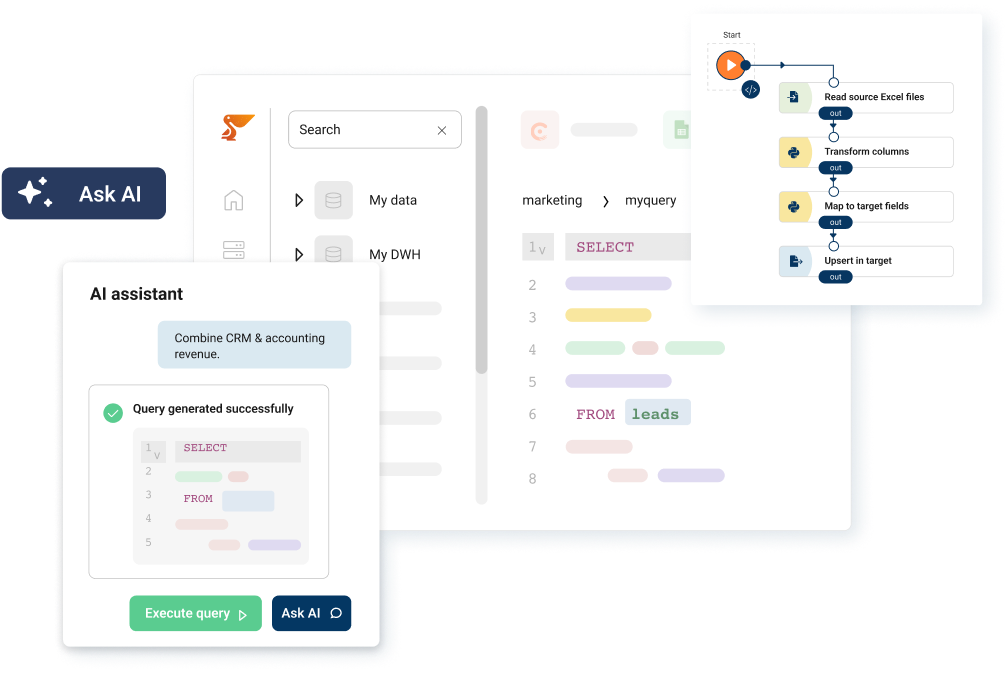
Peliqan is the strongest Matillion alternative for teams that want more than data warehouse transformation. Where Matillion handles the transform step and expects you to bring ingestion, a data warehouse, BI, and reverse ETL, Peliqan brings the whole modern data stack into one platform, so a single tool covers what Matillion needs several to complete.
It pairs 300+ pre-built connectors with a built-in Postgres and Trino data warehouse, so ingestion and storage are handled without a separate contract.
SQL and low-code Python transformations with an AI-assisted “Magical SQL” assistant cover the modeling work, and unlike Matillion’s data warehouse-only scope, Peliqan also moves operational and SaaS data, not just tables already in the data warehouse.
On the output side, built-in visual analytics, alerting, reverse ETL, and API publishing mean dashboards and writeback do not need extra tools.
Pricing is transparent and fixed rather than credit-based, which removes the budget surprises that come with per-credit billing plus data warehouse compute; current tiers are on the pricing page.
Peliqan is SOC 2 Type II, ISO 27001, GDPR, HIPAA, and CCPA certified, EU-hosted on AWS Frankfurt, builds custom connectors within 2 weeks when a source is missing, and supports white-label, multi-tenant deployment for agencies and consultants.
Real-world example: CIC Hospitality
CIC Hospitality unified data from 50+ sources into Peliqan and now saves 40+ hours per month by fully automating board reports that used to be built by hand, replacing what would otherwise be ELT plus a data warehouse plus a separate BI layer. Read the case studies.
Best for: teams that want a unified ELT, data warehouse, BI, and reverse ETL stack with predictable pricing and fast setup, rather than data warehouse-only transformation. The trade-off is that Peliqan is newer than legacy vendors and optimized for cloud-native workflows.
2. Skyvia
Skyvia is a no-code cloud data integration platform with 200+ connectors across SaaS apps, databases, file storage, and cloud data warehouses. It covers ETL and ELT, reverse ETL, one-way and bi-directional data sync, workflow automation, and live data access from one platform, with a free tier, volume-based pricing, and unlimited users on every plan.
Where Matillion assumes data already sits in a cloud data warehouse, Skyvia handles the ingestion into it and the operational sync between apps around it, which makes it a practical fit for teams that want Matillion-style pipelines without the credit math. It is less focused on heavy pushdown transformation and low-latency streaming CDC than specialist platforms. Best for: data-driven teams that want fast no-code setup and multiple integration scenarios without managing infrastructure.
3. Informatica IICS
Informatica Intelligent Cloud Services is a heavyweight ETL/ELT platform for large organizations that need strong governance, lineage, and scale, with 600+ connectors, the CLAIRE AI engine, and hybrid cloud and on-premise support. Acquired by Salesforce in late 2025, it covers the full data lifecycle.
It offers rich governance and scalable orchestration, but setup is complex and it is expensive for smaller teams, with IICS typically $1,000-$5,000/month and PowerCenter around $50,000/year. Best for: large enterprises with complex governance and metadata requirements well beyond data warehouse ELT.
4. Fivetran
Fivetran is a fully managed ELT platform known for hands-off, auto-maintained connectors and reliable syncing into Snowflake, BigQuery, and Redshift, with 700+ connectors, automatic schema evolution, and reverse ETL. Following its completed 2026 merger with dbt Labs, it now spans ingestion and transformation.
Setup is easy and maintenance is minimal, but its Monthly Active Rows pricing scales quickly and it is light on in-pipeline transformation. Our Fivetran alternatives guide compares the field. Best for: cloud-native teams that want zero-maintenance ingestion and can absorb volume-based pricing.
5. Airbyte
Airbyte is a developer-first, open-source alternative to Matillion with one of the largest connector catalogs in the industry, a connector builder for custom sources, and modular self-hosted or cloud deployment. It appeals to engineering teams that want full control and no lock-in.
The trade-off is operational effort: self-hosting needs engineering expertise and the UI is still maturing. Our Airbyte alternatives guide goes deeper. Best for: technical teams that want open-source flexibility and long-tail connectors over a fully managed experience.
6. SnapLogic
SnapLogic brings visual, AI-assisted integration to ETL with its library of pre-built “Snaps” for apps, data, and APIs, and the Iris AI assistant for designing pipelines. It is built for enterprises that want low-code data and application integration on one platform.
It is enterprise-ready and approachable for non-developers, but pricing is high and it is overkill for small teams, typically starting in the tens of thousands per year. Best for: enterprises that want AI-guided, low-code integration across data and applications.
7. Apache Airflow
Apache Airflow is the leading open-source orchestration tool, giving engineering teams full control over complex workflows through Python-based DAGs, an extensive operator library, and integration with cloud tools and CI/CD pipelines. There are no licensing costs and managed options exist via Astronomer, GCP, and AWS.
It is flexible and scalable but DevOps-heavy, with a real maintenance burden and no built-in data warehouse or UI. Airflow orchestrates rather than ingesting, so it is usually paired with other tools. Best for: engineering teams that need code-first orchestration and can own the infrastructure.
8. Workato
Workato blends iPaaS and workflow automation, with a no-code recipe builder, real-time triggers, and governance features that suit business teams integrating apps without heavy development. It is fast to deploy for cross-functional automation.
It is less suited to complex data workflows and carries a high price point, starting around $15,000-$25,000/year. Our Workato alternatives guide compares the options. Best for: business teams automating SaaS workflows rather than data warehouse-centric data engineering.
9. Rivery (Boomi Data Integration)
Rivery is a SaaS data platform combining ingestion, transformation, orchestration, and reverse ETL, with change data capture, a custom API builder, and Python support. Boomi acquired Rivery in December 2024, and the product now sits inside the Boomi Enterprise Platform as its data integration layer, which adds iPaaS and API management around it. It remains a solid Matillion alternative when you want flexibility and speed with no per-connector fees.
Its credit-based pricing runs roughly $0.75 to $1.25 per credit, and the UI can feel complex for new users with a smaller community than larger players. Best for: fast-moving teams that want unified ELT and reverse ETL with flexible credit pricing, especially if they already run Boomi.
10. Talend
Talend, now part of Qlik, is a data integration platform with an open-source heritage and a drag-and-drop ETL designer that generates Java, supporting on-premise, hybrid, and cloud deployments along with built-in data quality and governance tools.
It has a strong foundation and handles large-scale pipelines, but it requires technical know-how and the interface can feel dated. Enterprise pricing is quote-based. Best for: teams that want flexible, governed integration with hybrid deployment and are comfortable with a more technical tool.
11. Keboola
Keboola combines ETL, orchestration, and data collaboration in one SaaS platform, with pre-built components for extraction, transformation, and orchestration, a low-code UI with full developer mode, plus data catalog and lineage tracking. It suits modern data teams that want low-code tooling with developer flexibility.
It is fast to deploy with strong documentation, though its connector ecosystem is smaller and premium tiers can get expensive. A free tier is available, with paid plans based on usage and seats. Our Keboola alternatives guide goes deeper. Best for: data teams that want an all-in-one data ops platform with both low-code and code-first paths.
Matillion alternatives compared
A quick side-by-side of the top Matillion alternatives on strengths, pricing model, and limitations. Confirm current pricing with each vendor before deciding.
How to choose the right Matillion alternative
Match the choice to what you actually need: how much of the stack you want in one place, how technical your team is, and how predictable your costs have to be.
Quick decision guide
- One platform for ETL, a data warehouse, BI, and reverse ETL with fixed pricing: Peliqan
- No-code ETL/ELT, reverse ETL, data sync, and workflow automation: Skyvia
- Enterprise governance, lineage, and hybrid at scale: Informatica IICS
- Zero-maintenance managed ingestion: Fivetran
- Open-source flexibility and long-tail connectors: Airbyte
- AI-assisted low-code data and app integration: SnapLogic
- Code-first orchestration of complex workflows: Apache Airflow
- Business-user SaaS workflow automation: Workato
- Unified ELT with CDC and reverse ETL on credits, inside the Boomi platform: Rivery
- Governed, hybrid integration with open-core heritage: Talend
- Low-code data ops with developer flexibility: Keboola
Matillion vs a unified platform: what changes
The biggest practical difference is scope. Matillion is a transformation layer that assumes data already lands in a cloud data warehouse, so a working setup usually means an ingestion tool, a data warehouse contract, a BI tool, and a separate reverse ETL product around it. Each piece has its own pricing, its own learning curve, and its own failure modes to monitor.
Moving to a unified platform collapses that into one bill and one place to build and watch pipelines. The transformation work you do in Matillion maps cleanly to SQL and low-code transformations elsewhere, while ingestion of operational and SaaS sources, the data warehouse, dashboards, and writeback come included rather than bolted on. The trade-off is that a consolidated platform is less specialized than a best-of-breed data warehouse transformation tool, so teams running very large, complex pushdown transformations on a single cloud data warehouse may still prefer a dedicated ELT engine.
When evaluating, audit what you actually run in Matillion, separate the data warehouse transformation work from the ingestion and activation around it, and pressure-test the alternative on a representative pipeline before committing. Most teams find that the credit math and tool count both shrink once the stack is consolidated.
Conclusion
Matillion has helped many teams modernize their data stack, and the Data Productivity Cloud with Maia is a genuine step forward on the transformation side. But it is not always the most cost-effective or complete option, especially if you are hitting credit-based pricing ceilings, missing connectors, or assembling a data warehouse, BI, and reverse ETL around it.
For an easy-to-use platform that combines ELT, a data warehouse, BI, and reverse ETL in one place with predictable pricing, Peliqan is the most consolidated alternative. Skyvia is a strong fit for teams that want no-code ETL/ELT, reverse ETL, data sync, and workflow automation in one platform. Fivetran and Airbyte lead on ingestion, Informatica and Talend on enterprise governance, Workato on workflow automation, and Airflow on code-first orchestration. Match the platform to your team’s skills, data stack, and integration needs, and the right one can save real engineering time while delivering analytics-ready data faster.