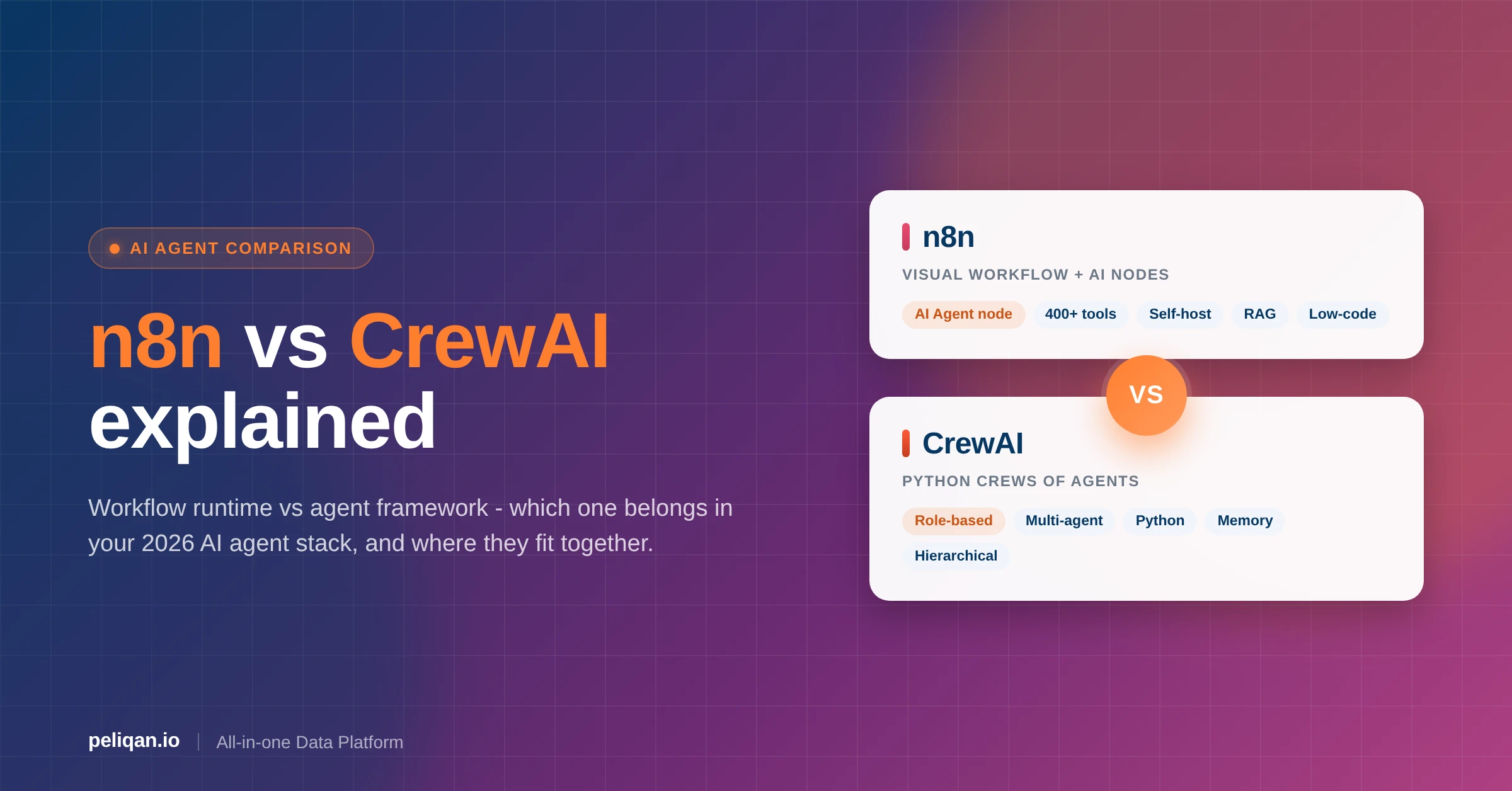




n8n vs CrewAI is a comparison between two different categories of tooling that are increasingly being asked to solve the same problem: production AI agents. n8n is a visual workflow automation platform with first-class AI agent nodes; CrewAI is a Python framework purpose-built for orchestrating crews of role-based agents. This guide breaks down the architecture, code patterns, pricing, debugging story, and where a data layer like Peliqan fits underneath both for teams building AI agents that need to read from real business data.
The “AI agent” category has fragmented sharply in the last 12 months. On one side, automation platforms like n8n have added AI agent capabilities to their visual canvas – effectively turning every workflow into a candidate for LLM orchestration. On the other side, Python-native frameworks like CrewAI, LangGraph, and AutoGen have pushed the agent-as-code model into production at companies that need full control over reasoning loops, multi-agent collaboration, and custom tool routing. n8n and CrewAI are now the two most-asked-about names in this space, and the right pick is rarely obvious from a vendor demo.
Quick decision framework: n8n vs CrewAI at a glance
When to choose what
Platform overview: workflow runtime vs agent framework
n8n: AI inside a visual workflow runtime
n8n is an open-source workflow automation platform founded in 2019 by Jan Oberhauser in Berlin. It uses a node-based visual canvas where every step is a node – an HTTP call, a database query, a transformation, or an LLM call. The platform added a dedicated AI Agent node in 2024 that has matured into a serious production primitive: it supports tool calling, memory, multi-step reasoning, RAG via vector databases, and direct integration with LangChain.
In n8n, the primary entity is the workflow, not the agent. The AI Agent node sits inside that workflow as one intelligent step that can reason, use tools, and hand off to the next node. This is a very different model from agent-first frameworks, and it changes how teams think about building.
CrewAI: Python framework for crews of agents
CrewAI is a Python framework created by João Moura, designed from the ground up for orchestrating teams of AI agents. The core mental model is a “crew” – a group of agents, each with a defined role, goal, backstory, and set of tools. The crew works together on a shared objective, with tasks coordinated either sequentially or hierarchically.
CrewAI has grown rapidly in 2025 and 2026 – over 30,000 GitHub stars and adoption inside companies building agent products. The framework ships with built-in support for memory, knowledge integration, custom tools, and process orchestration. CrewAI Plus is the hosted commercial offering on top of the open-source core.
The philosophy divide: workflow-first vs agent-first
Feature comparison: deep technical analysis
Code patterns: what each one looks like in practice
The clearest way to understand the trade-off is to see the same logic expressed in each tool. Below is a research-and-summarize agent in CrewAI Python and the same idea expressed as a workflow in n8n.
CrewAI: defining a research crew in Python
from crewai import Agent, Task, Crew, Process
from crewai_tools import SerperDevTool

search_tool = SerperDevTool()

researcher = Agent(
    role="Senior Market Researcher",
    goal="Find recent product launches in the data platform space",
    backstory="A seasoned analyst with 10 years covering data infrastructure.",
    tools=[search_tool],
    verbose=True,
)

writer = Agent(
    role="Content Strategist",
    goal="Turn research notes into a 200-word briefing for the CMO",
    backstory="Former tech journalist who writes for executive audiences.",
    verbose=True,
)

research_task = Task(
    description="Find 5 data platform launches in the last 30 days.",
    expected_output="A bullet list of launches with dates and one-line summaries.",
    agent=researcher,
)

write_task = Task(
    description="Write a CMO briefing from the research notes.",
    expected_output="A 200-word briefing in plain prose.",
    agent=writer,
    context=[research_task],
)

crew = Crew(
    agents=[researcher, writer],
    tasks=[research_task, write_task],
    process=Process.sequential,
)

result = crew.kickoff()
n8n: the same idea as a workflow
In n8n you’d drop the AI Agent node onto the canvas, point it at a Serper search tool node, send the output to a second AI Agent node configured as the writer, and trigger the workflow on a schedule or webhook. The role/goal/backstory framing gets compressed into a system prompt on each AI Agent node, and the handoff between researcher and writer becomes a simple edge between two nodes.
The difference is structural: CrewAI gives you explicit agent objects with rich identity (role, goal, backstory), and the framework reasons about how they collaborate. n8n treats the LLM call as one step in a broader business workflow that also moves data through Salesforce, Slack, or a warehouse.
AI capabilities: where each platform leads
n8n’s AI arsenal
- 70+ AI-focused nodes covering OpenAI, Anthropic Claude, Google Gemini, Hugging Face, and local LLMs via Ollama.
- Native LangChain integration for multi-step agent workflows and tool routing.
- RAG with vector DB support for Pinecone, Qdrant, Supabase, Weaviate, and pgvector.
- AI Agent node with system prompts, tool selection, memory, and chat completion all configured visually.
- 400+ tool surface area – every n8n node can be exposed as a tool to the agent without writing code.
CrewAI’s AI capabilities
- Role-based agents with explicit personas, goals, and backstories that shape reasoning.
- Crew process modes – Sequential, Hierarchical, and custom orchestration patterns.
- Built-in memory with short-term, long-term, and entity-level scopes baked into the framework.
- Knowledge integration for connecting structured and unstructured sources as agent context.
- Hierarchical delegation where a manager agent assigns tasks to specialized agents based on the goal.
- Tool ecosystem with crewai-tools, LangChain tools, and custom Python tool definitions.
The practical takeaway: n8n wins when AI is a step in a broader workflow that also touches CRMs, ERPs, support tools, and data warehouses. CrewAI wins when the work itself is multi-agent collaboration – research, writing, planning, review – and the workflow is mostly internal to the agent crew.
Pricing and total cost of ownership
LLM API consumption is the dominant cost driver for both platforms. The platform fees themselves are usually a small fraction of monthly spend once you’re running real agent workloads. The bigger TCO factor is engineering time: CrewAI demands Python-fluent engineers writing custom code; n8n lets a competent ops team ship the same logic visually in a fraction of the time.
Watch out: hidden cost traps with AI agents
- Runaway agent loops: A misconfigured agent can hit an API 200 times in a single run. Set step limits and circuit breakers from day one.
- Token amplification in CrewAI crews: Each agent reasoning step consumes tokens. A 4-agent crew with 3 tasks each can burn 10x more tokens than a single-agent workflow.
- n8n self-host infra overhead: Queue mode requires Redis and Postgres. Plan for 2-8 hours per month of ops maintenance.
- RAG embedding regeneration: Re-embedding a 100k document corpus on every change is expensive. Cache embeddings centrally and update incrementally.
Ease of use and learning curve
n8n: productive in hours
n8n’s visual builder is the fastest path to a working AI agent. A team can wire up an AI Agent node, point it at a tool, and ship a working prototype in an afternoon. The trade-off is that complex orchestration patterns (parallel agents, hierarchical delegation, custom reasoning loops) become awkward to express on a visual canvas.
CrewAI: productive in days to weeks
CrewAI demands Python literacy and a willingness to think in terms of agent identity, task design, and process orchestration. The investment pays off when you’re building a multi-agent system that genuinely needs those abstractions – but for simple “call an LLM, do something with the result” workflows, it’s heavier than necessary.
Integration ecosystem
n8n: broad SaaS coverage out of the box
n8n ships with 400+ official integrations and 2,900+ community nodes covering CRMs, ERPs, marketing platforms, databases, vector stores, and AI providers. Any REST API can be wired up with the HTTP Request node, and a strong data integration tooling story sits underneath when workflows need cleaner business data.
CrewAI: Python-native tool ecosystem
CrewAI tools live in the crewai-tools package and the broader LangChain tool ecosystem. The framework can call any Python function as a tool, which gives near-infinite flexibility but means you’re writing the integration code yourself for anything that isn’t already packaged. The community has shipped tools for common needs (search, scraping, file I/O, vector stores), but bespoke business systems require custom Python wrappers.
Hosting, security, and observability
n8n: self-host or cloud, with strong ops story
n8n can be self-hosted on-prem, on private cloud, or in regulated environments via on-premises connectivity. SSO, RBAC, audit logs, and queue mode for high-volume workloads are all part of the platform. Visual execution logs make debugging straightforward.
CrewAI: any Python runtime, plus CrewAI Plus for managed
CrewAI runs anywhere Python runs – serverless functions, containers, or full VMs. The open-source framework leaves observability up to you (or your APM stack). CrewAI Plus adds managed hosting, tracing, and team features for production deployments.
How Peliqan complements n8n and CrewAI for AI agents
Both platforms are excellent at orchestrating reasoning loops, but neither solves the underlying problem that breaks most production AI agents: the data they’re operating on. Raw API calls produce inconsistent JSON. Different systems hold contradictory versions of the same customer. Embedding refresh becomes expensive. Governance is invisible.
Peliqan sits underneath both n8n and CrewAI as the data foundation layer that turns scattered business data into something agents can actually reason about.
What Peliqan adds to AI agent workflows
- 250+ connectors: Unify CRM, ERP, billing, support, and product data into a single warehouse without writing connector code.
- Built-in data warehouse: Cache embeddings, SQL results, and intermediate retrieval outputs so agents don’t pay the API cost on every run.
- Centralized transformations: Run SQL and Python transformations centrally so agents read clean, modeled entities instead of raw API payloads.
- RAG and Text-to-SQL: Built-in RAG and Text-to-SQL so n8n nodes or CrewAI agents can query structured business data through one consistent interface.
- Governance: Row-level access control, schema enforcement, PII handling, and automatic data lineage across every agent interaction.
- MCP-ready data plane: Expose warehouse tables to Claude, ChatGPT, Cursor, and any MCP-compatible AI agent via the Peliqan MCP server.
n8n and CrewAI: with and without Peliqan
Real-world example: Globis
Globis, a SaaS ERP provider, activates customer data through Peliqan to predict sea container arrivals. They combine ERP records with weather feeds, run ML in Python, and publish the predictions back as APIs into operational systems – the exact pattern an n8n workflow or CrewAI crew would consume from. Read the full case study.
Real-world use cases and example architectures
n8n excels at
- AI-enhanced business workflows: Customer support triage where an LLM classifies tickets and routes them to the right team via Slack or Salesforce.
- Lead enrichment with AI: Pull a new lead from HubSpot, enrich via an LLM call, score, and write back to the CRM.
- RAG over customer data integration: Use the Peliqan warehouse as the source of truth, with n8n routing queries through the AI Agent node.
- Scheduled AI reporting: Daily summary of new product reviews, support trends, or sales pipeline movement.
CrewAI excels at
- Deep research crews: Researcher → Analyst → Writer → Editor agents collaborating on a single deliverable.
- Multi-step planning: Goal decomposition, task assignment, and hierarchical execution with explicit manager agents.
- Domain-expert simulations: Multiple agents with distinct personas debating or coordinating on complex outputs.
- Custom agent products: Embedded AI features inside SaaS products where the agent logic is the product, not the workflow.
Architectural decision tree
Walk through these questions in order to pick the right tool:
- Is AI one step in a broader business workflow that also touches SaaS apps? → n8n.
- Is the entire system a multi-agent reasoning crew with distinct roles? → CrewAI.
- Do you have Python-fluent engineers comfortable with framework code? → CrewAI is a real option; otherwise n8n.
- Do you need 400+ pre-built integrations to SaaS systems? → n8n wins on breadth.
- Do you need hierarchical agent delegation or sequential crew processes? → CrewAI wins on agent abstractions.
- Are you self-hosting for compliance? → Both support self-hosting; n8n’s UI makes ops easier.
- Do agents need clean, governed business data to reason on? → Add Peliqan underneath either.
- Do you need MCP-compatible data access for Claude or ChatGPT clients? → Peliqan MCP server pairs with both.
Migration and interoperability
The two tools aren’t really competitors in the way “n8n vs Zapier” is. Many production teams use both:
- n8n as the workflow orchestrator, with one node calling out to a CrewAI HTTP endpoint when the deeper multi-agent reasoning is needed.
- CrewAI as the agent crew, deployed as a microservice that n8n triggers via webhook for complex tasks.
- Peliqan as the data plane feeding both via REST APIs or MCP.
This hybrid pattern is increasingly common because it splits the work cleanly: n8n handles “what happens when an event occurs and where the data goes,” CrewAI handles “what does the agent crew reason about,” and Peliqan handles “what does the data layer look like underneath.”
Best practices for production AI agents
What works at scale
- Start with the simplest tool that fits: Prototype in n8n for AI-enhanced automations; reach for CrewAI when multi-agent collaboration is the actual goal.
- Centralize data underneath: Both tools benefit from a clean warehouse layer like Peliqan AI agent tooling so agents query governed entities, not raw API payloads.
- Set step limits and circuit breakers: Cap reasoning loops to a fixed step count. Agents that don’t terminate cost real money.
- Instrument tracing from day one: LangSmith, OpenTelemetry, or CrewAI Plus observability are all cheaper than debugging blind.
- Cache embeddings centrally: Re-embedding the same documents in every run is the most common cost mistake in RAG deployments.
- Version your prompts: Treat system prompts and agent backstories like code. Change them through review, not directly in production.
Conclusion
n8n and CrewAI solve different problems even when they look like they’re competing. n8n is the right call when AI sits inside a broader automation pipeline that already touches CRMs, ERPs, support tools, and databases – a working AI feature ships in hours. CrewAI is the right call when the system is fundamentally a crew of agents collaborating on goals that benefit from explicit roles, hierarchies, and process orchestration.
Most serious production deployments end up using both, often with Peliqan acting as the data backbone that feeds clean, governed business data into either platform. The teams that win in 2026 are the ones that pick the right tool for each layer instead of trying to make one platform do everything.
Pair Peliqan with the right data activation strategy and your AI agents – whether they live in n8n nodes, CrewAI crews, or both – operate on reliable business data instead of fragile API JSON.
FAQs
Is CrewAI better than n8n for AI agents?
It depends on what you’re building. CrewAI is better for true multi-agent systems where role-based collaboration is the point – researchers, writers, planners working together with explicit hierarchies. n8n is better when AI is one step in a broader workflow that also moves data through SaaS apps and databases. Most teams end up using both for different layers.
Can you use n8n and CrewAI together?
Yes, and many teams do. The common pattern is n8n as the workflow orchestrator triggering CrewAI crews via HTTP when deep multi-agent reasoning is needed, with Peliqan supplying governed business data to both. This hybrid architecture splits responsibilities cleanly: n8n handles event routing and data movement, CrewAI handles agent reasoning, Peliqan handles the data plane.
How much does CrewAI cost?
The CrewAI Python framework is open-source under the MIT license and free to use. CrewAI Plus, the hosted commercial offering with managed runtime, observability, and team features, starts around $99/month and scales up for enterprise tiers. The bigger cost driver for any CrewAI deployment is LLM API consumption from OpenAI, Anthropic, Google, or other model providers.
Which is easier to learn: n8n or CrewAI?
n8n is dramatically easier for teams without Python expertise. The visual canvas, pre-built nodes, and AI Agent node make it possible to ship a working AI workflow in hours. CrewAI demands Python literacy and a willingness to think in terms of agent identity, task design, and process orchestration – useful skills for serious agent products, but a steeper investment if your goal is just to add AI to an existing automation.