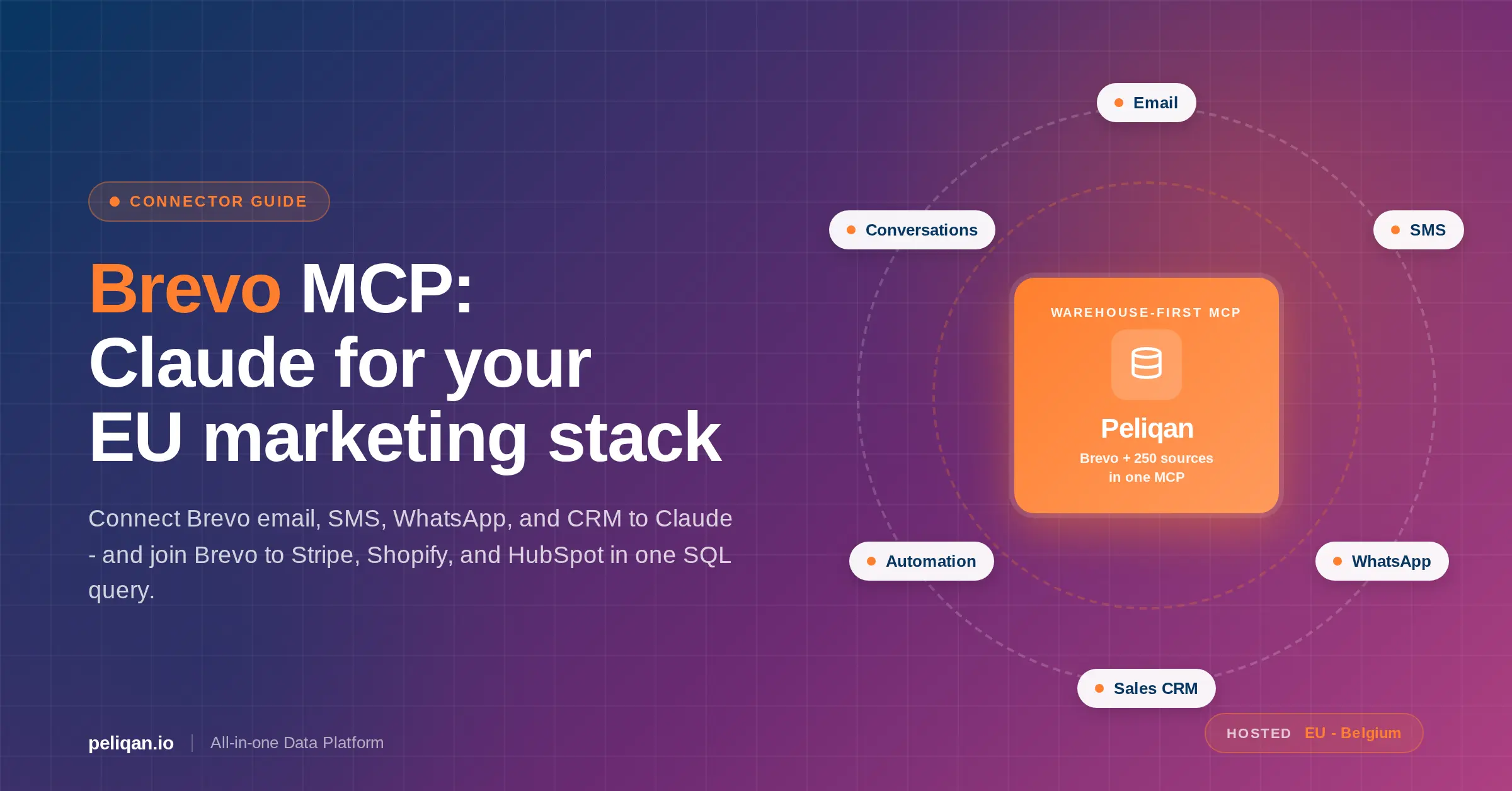





Brevo MCP is the integration layer that lets AI agents like Claude, ChatGPT, and Cursor query and act on your Brevo email, SMS, WhatsApp, marketing automation, transactional, and CRM data. Brevo shipped its own MCP server in 2026 as part of the €50 million Brevo AI Lab initiative, and that’s the right answer for in-Brevo agent work.
For the harder question – cross-source SQL joining Brevo campaigns to Stripe revenue, Shopify orders, and HubSpot deals in one Claude prompt – the warehouse-first MCP pattern is the architectural complement that Brevo’s native MCP wasn’t built for. This is the practitioner’s guide to both.
Brevo is the European marketing automation platform that most other listicles miss. Headquartered at 106 Boulevard Haussmann in Paris, originally founded in 2012 by Armand Thiberge as Sendinblue, rebranded to Brevo in May 2023, now serving 600,000 customers across 180 countries with eight offices globally (Paris, Berlin, Sofia, Vienna, Delhi, Seattle, Toronto, New York).
Brevo achieved unicorn status in 2025 following a €500 million funding round led by General Atlantic with Bridgepoint reinvesting from its earlier Series B. The €50 million Brevo AI Lab announced in February 2025 has already shipped Marketing, Sales, and Conversations agents plus the MCP connector that links Brevo to Claude, ChatGPT, and Mistral’s Le Chat.
That MCP layer is real and good. The question this post answers is the one Brevo’s own MCP doesn’t try to solve: how do you connect Brevo to the rest of your stack – Stripe payments, Shopify orders, HubSpot CRM, Pipedrive deals, Exact Online invoicing – in a single agent conversation that joins all of them with SQL, audit logs, and EU-jurisdiction hosting? That’s the cross-source job, and it lives in the Peliqan MCP architecture rather than inside any single vendor’s MCP surface.
What Brevo is and why it matters in 2026
Brevo is the EU-rooted alternative to the US-headquartered marketing automation stack (HubSpot, Mailchimp, ActiveCampaign, Klaviyo). Its core product spans six surfaces that all share the same customer-data layer:
The six Brevo product surfaces
The strategic point for EU AI agent buyers in 2026: Brevo is one of very few customer-engagement platforms where the entire data graph – email, SMS, WhatsApp, transactional, automation, sales CRM, conversations – lives inside a single EU-headquartered, EU-hosted vendor. That matters for GDPR posture, for the upcoming EU AI Act Article 26 obligations, and for any deployer who wants to keep the entire customer-engagement layer inside European jurisdiction.
Brevo’s native MCP server: what it does well
Brevo’s own MCP server, shipped as part of the AI Lab initiative, gives Claude (and ChatGPT, Cursor, Le Chat, and any MCP-compatible client) structured access to Brevo’s email, SMS, automation, and contact-management surfaces. The setup is clean: log into Brevo, navigate to Settings > SMTP & API > API Keys & MCP, generate an MCP key, plug it into the agent. The agent can then create and schedule campaigns, manage contacts and companies, build templates, and pull account analytics on your behalf.
For in-Brevo agent workflows – “draft tomorrow morning’s product update campaign, segment by last-90-day engagement, schedule it for 09:00 CET” – the native MCP is the right tool. Brevo controls the schema, owns the rate-limit handling, and surfaces every capability of the underlying API. Anything that can be done by a marketer inside Brevo can be done by Claude through Brevo’s MCP.
The boundary is the same one every vendor-native MCP hits: it speaks Brevo, and only Brevo. The moment the question crosses to Stripe revenue, Shopify orders, HubSpot deal stage, or Exact Online invoice status, the native MCP can’t reach. That’s not a flaw; it’s the design. The right answer for cross-source questions is to compose Brevo’s MCP with a warehouse-first MCP that holds the rest of the stack.
The cross-source job Brevo’s MCP can’t reach
The questions a CMO, RevOps lead, or head of growth actually asks span Brevo plus everything else. A few representative examples:
“Which of last quarter’s Brevo email campaigns produced the highest Stripe-confirmed revenue per recipient, by segment?” That joins Brevo campaign engagement to Stripe payment intents to Brevo contact segments – three sources, one question.
“For Shopify customers who received the post-purchase SMS flow, what’s the 90-day repeat-purchase rate compared with customers who didn’t?” That joins Shopify orders to Brevo SMS delivery logs to Shopify customer cohort tags.
“Our Brevo MQL handoff sends qualified leads into HubSpot – which channel inside Brevo (email vs SMS vs WhatsApp vs Conversations chat) produces the deals that actually close in HubSpot?” Three sources again: Brevo channel attribution, HubSpot deal stage, and the closing event.
“Across our 50 client Brevo accounts, which clients are over-sending and risking deliverability damage, ranked by sender reputation and last-30-day complaint rate?” This is the agency rollup question that wants the multi-customer pattern, not just one account.
None of these is answerable by Brevo’s native MCP alone, by a workflow MCP like Pipedream, or by a unified-API MCP like Apideck (see the Apideck MCP alternative breakdown for the architectural ceiling). Each requires a SQL JOIN across at least two systems, with consistent customer identifiers and a single audit log. That’s the warehouse-first MCP’s job.
How Peliqan turns Brevo into a cross-source MCP surface
Peliqan syncs Brevo’s data – campaigns, contacts, lists, events, automation runs, transactional logs, deals, conversations – into a Postgres + Trino warehouse alongside data from 250+ other connectors. The warehouse holds the data in Brevo’s native schema (no flattening to a “unified email” shape), and Peliqan’s MCP server exposes the whole warehouse to Claude as a SQL surface with read and write access.
The architecture beneath:
Brevo through Peliqan’s MCP, end to end
Set-up is the standard Peliqan motion: pip install mcp-server-peliqan, paste your API token, add the Brevo connector through the workspace, point Claude at the MCP endpoint. The full Claude MCP setup guide covers the agent-side configuration.
Five killer Brevo MCP use cases that need cross-source SQL
Each of these is one prompt, one SQL statement, one audit-log entry. The native Brevo MCP can’t answer any of them on its own.
1. Brevo campaign performance crossed with Stripe revenue per segment
The CMO question: which campaigns drive actual revenue, not just opens. Brevo holds the campaign send and engagement data; Stripe holds the conversions. The JOIN happens on customer email or external customer ID. The output ranks campaigns by realised revenue per recipient, segmented by Brevo list – the answer that determines next quarter’s budget allocation.
2. Brevo SMS delivery crossed with Shopify post-purchase repeat rate
The growth question: does the post-purchase SMS flow actually drive repeat orders. Brevo tracks SMS delivery and click events; Shopify MCP data tracks the order history and customer cohorts. The cross-source view splits customers into “received post-purchase SMS” and “didn’t” cohorts and reports the 30 / 60 / 90 day repeat-purchase delta. Agency or in-house growth teams run this query monthly.
3. Agency multi-account rollup across 50 client Brevo workspaces
Marketing agencies running Brevo for 50+ clients need a single view of deliverability health, sender reputation, complaint rate, and unsubscribe trend across every account. Peliqan’s multi-customer management lands each client’s Brevo workspace into a row-segmented warehouse with per-client RBAC. One agent query produces the rollup; one MCP server serves the whole agency. This is the same pattern OdooExperts uses for 50+ client Odoo environments.
4. Marketing-to-sales handoff: Brevo MQL into HubSpot deal closed-won
The standing RevOps question: which Brevo nurture campaigns actually produce closed-won deals downstream. Brevo holds the MQL trigger and channel attribution; HubSpot MCP data holds the deal stage progression and closing event. The JOIN attributes revenue to the originating Brevo touchpoint, by channel (email vs SMS vs WhatsApp vs Conversations). Pipedrive and Salesforce variants of the same query work the same way.
5. GDPR-compliant unsubscribe propagation across Brevo, Salesforce, and Exact Online
The compliance question: when a contact unsubscribes in Brevo, are they actually suppressed everywhere the company holds their data? Brevo’s suppression list, Salesforce’s marketing-opt-out flag, and Exact Online’s customer record need to stay in sync. A single audit-logged Peliqan query identifies any contact whose Brevo unsubscribe hasn’t propagated, then a reverse-ETL writeback fixes it. The audit trail satisfies GDPR Article 17 and the Article 26 logging obligation in one motion.
Setting up Brevo MCP with Peliqan in three steps
The hardest part of any MCP setup is usually rate-limit handling, schema reconciliation, and audit logging. Peliqan handles each of those before Claude ever connects, so the practitioner’s path is short.
Step one: connect Brevo as a data source inside Peliqan. From the Peliqan workspace, add a new connector, select Brevo, paste your Brevo API key (Settings > SMTP & API > API Keys in your Brevo account), and pick which tables to sync. The default sync covers contacts, lists, campaigns, events, automations, transactional logs, deals, companies, and conversations. The connector respects Brevo’s x-sib-ratelimit headers automatically, so the sync won’t trip rate limits even at the largest scale.
Step two: install the Peliqan MCP server on whichever machine runs your Claude client. pip install mcp-server-peliqan followed by mcp-server-peliqan --api-token YOUR_TOKEN is the full command. Add the server to Claude Desktop’s MCP config or to your Cursor / Windsurf / VS Code MCP config and the warehouse becomes immediately introspectable.
Step three: ask the first cross-source question. The agent will introspect the warehouse schema, find the Brevo tables alongside whatever else you’ve connected (Stripe, Shopify, HubSpot, Salesforce, Exact Online), and translate your natural-language question into the SQL JOIN that answers it. Every prompt-to-SQL translation lands in the audit log with the session ID and the rows touched.
For agency or multi-customer setups, the same pattern adds RBAC per client. Each customer’s Brevo workspace lands into a row-segmented warehouse partition with its own permissions; one Peliqan MCP server can serve 50 clients without leaking data across the boundaries.
Migrating from US-default marketing automation to Brevo plus MCP
Many EU-headquartered teams arrive at Brevo from HubSpot Marketing Hub, Mailchimp, or ActiveCampaign – usually triggered by pricing creep on the per-contact tier, by data-residency procurement pressure, or by the realisation that the AI agent layer needs an EU-jurisdiction provider before the EU AI Act deadline. The migration is more practical than most teams expect because the data model maps closely across all four platforms.
The harder migration is the AI agent layer, because what worked in HubSpot’s MCP (or didn’t work at all in Mailchimp’s MCP) doesn’t necessarily translate to Brevo’s MCP. The cross-source dimension matters here: if the existing agent setup joined HubSpot to Stripe to Salesforce through a US-hosted workflow MCP, switching to Brevo doesn’t fix the cross-source jurisdiction problem – it shifts it. The complete migration is Brevo MCP for in-platform actions plus a warehouse-first MCP underneath for cross-source analytics and writeback. That’s the architectural answer; the rest is project management.
The five-step migration playbook most teams follow: (1) replicate the existing email and SMS programs in Brevo over a 2-3 week parallel-run period, (2) connect Brevo plus the existing CRM and payments systems to Peliqan, (3) rebuild the cross-source dashboards and AI agent prompts against the new warehouse, (4) cut over the transactional sends to Brevo, (5) decommission the prior platform’s contract at the next renewal window. Most teams complete the full cutover inside 60 days.
Brevo MCP options compared: six ways to expose Brevo to AI agents
The honest summary: Brevo’s native MCP wins inside Brevo, Composio and Pipedream cover the dev-tool and workflow lanes, n8n is the sovereign-cloud self-host answer, and Peliqan owns the cross-source analytical lane. None of these patterns compete; they layer. A typical EU marketing stack ends up running Brevo’s MCP for in-platform actions and Peliqan’s MCP for the cross-source analytical work, with no overlap.
Compliance posture for French and EU buyers
Brevo is one of the cleanest EU-headquartered options on this list – French HQ, EU-hosted, GDPR-native by design. The Brevo MCP server inherits that posture, which removes the CLOUD Act conversation that follows every US-headquartered alternative. For French SMBs, German Mittelstand, Italian and Spanish SMBs, and Benelux mid-market, Brevo is often the local-language alternative to HubSpot or Mailchimp that procurement actually approves.
Where the compliance question opens up is the cross-source layer. Brevo’s MCP keeps Brevo data inside Brevo’s jurisdiction; the moment you join Brevo to Stripe, Shopify, HubSpot, or Salesforce, the cross-source query touches multiple vendors with different residency. The warehouse-first pattern reconciles this by landing every source into one EU-hosted warehouse with consistent audit logs. Peliqan ships SOC 2 Type II, ISO 27001 in progress, GDPR-native, EU-hosted in Belgium – the Peliqan Trust Center publishes the report and sub-processor list. For the procurement checklist, that matches Brevo’s compliance posture cleanly.
For deployers preparing for the EU AI Act Article 26 deadline on August 2, 2026, the combination – Brevo MCP for in-Brevo agent work, Peliqan MCP for cross-source analytical work, both EU-hosted, both audit-logged – is the cleanest end-to-end EU-compliant stack a CMO can put on a procurement spreadsheet.
Real-world example from the marketing-to-revenue lane
Real-world example: Skindr
Skindr consolidated advertising and RevOps data across multiple ad networks, CRM, and analytics into Peliqan’s warehouse – the same cross-source pattern that joins Brevo campaign engagement to Stripe revenue and customer cohort data. The team reports faster channel-attribution analysis and fewer manual spreadsheet joins. Read the full Skindr case study.
Common Brevo MCP failure modes (and how to avoid them)
Three patterns trip teams up in the first 90 days. None of them is a Brevo problem or a Peliqan problem; all three are MCP-architecture problems that show up at scale.
The first is rate-limit cascading. Brevo’s general rate limits are generous (1,000-6,000 requests per second on paid plans), but a chatty AI agent that calls the Brevo MCP in a loop without backoff can still trip the 429 response. The fix is sync-once-query-many: land the data into the warehouse on a schedule and query the warehouse, not the upstream API, for the heavy analytical lift. Brevo’s native MCP handles this for in-Brevo actions; the warehouse-first pattern handles it for analytics.
The second is suppression-list drift. When a contact unsubscribes in Brevo but the suppression doesn’t propagate to Salesforce, Pipedrive, or the team’s internal “marketing-eligible” CRM flag, the next campaign goes out anyway and the company books a GDPR Article 17 problem. The fix is one reverse-ETL job from Brevo’s suppression list to every downstream “marketing-eligible” field, with audit logs on every row written.
The third is multi-channel attribution collapse. When an AI agent prompts Brevo to send a follow-up but doesn’t know whether the contact already received an SMS from the post-purchase flow, the contact gets double-tapped and complaint rates climb. The fix is a unified events table in the warehouse where every Brevo email, SMS, WhatsApp, and Conversations message lands in one event log that the agent can introspect before sending the next touchpoint.
Pricing and ICP – who Brevo MCP plus Peliqan is built for
The ideal customer is the EU-headquartered mid-market team running Brevo as the primary customer-engagement platform, with at least three other systems in the stack (typically Stripe + Shopify or Stripe + HubSpot or Stripe + Pipedrive + Exact Online for the Benelux setup). French SMBs, German and Italian and Spanish mid-market, Benelux scale-ups, and EU agency partners managing 30+ Brevo accounts all sit in this lane.
Peliqan’s pricing line is fixed from €150/month annual, which compares favourably with per-account models from Merge or per-task models from Zapier and Pipedream when the workload includes regular analytical queries. The Peliqan platform page covers the connector library, warehouse architecture, and reverse-ETL writeback that the MCP layer rides on.
For verticals where Brevo crosses into accountancy or ERP-heavy stacks – Belgian or Dutch SMBs running Brevo alongside Yuki, French agencies running Brevo plus their finance stack, German Mittelstand running Brevo plus Datev – the cross-source value compounds quickly. The Yuki MCP playbook covers the BE/NL accounting integration pattern that pairs naturally with Brevo for full marketing-to-cash visibility.
The bottom line on Brevo MCP
Brevo shipped its own MCP server and it’s the right answer for in-Brevo agent work. Use it. The €50 million Brevo AI Lab is producing real product – Marketing, Sales, and Conversations agents – and the EU-headquartered compliance posture is genuinely cleaner than most US-default alternatives.
For the cross-source question – “show me Brevo campaign performance against Stripe revenue against Shopify orders against HubSpot deals in one Claude prompt” – Brevo’s MCP isn’t the tool, and that’s not a criticism of Brevo. It’s the architectural reality of vendor-native MCPs. The complement is the warehouse-first cross-source SQL MCP pattern running alongside, sharing the same EU-jurisdiction posture and the same Claude session.
The cleanest 2026 EU marketing stack is both: Brevo’s native MCP for in-platform actions, Peliqan’s MCP for cross-source analytics and writeback. Pick one or the other, or layer both – the architectures don’t compete and the procurement checklist comes out the same either way.