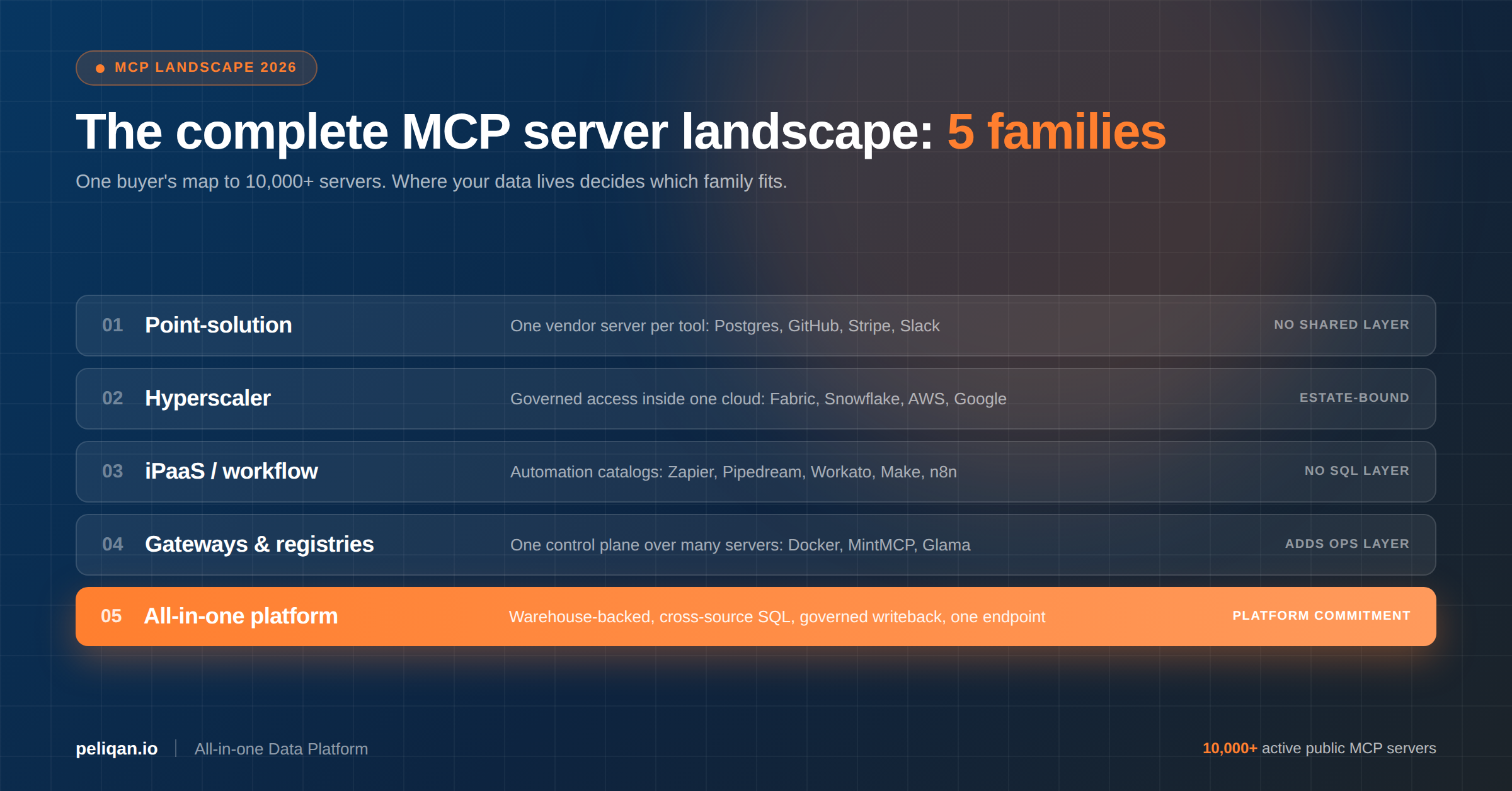





The best MCP servers in 2026 don’t share a single shape. There are more than 10,000 active public MCP servers now, and they fall into five very different families, each with genuine strengths and honest constraints. This is the complete MCP server landscape, organized as a buyer’s map. Where your data lives, what you need the AI to do, and where your governance line sits will decide which family fits. This is a reference post, not a ranking.
Here is the hard fact that frames the decision. In December 2025, Anthropic reported more than 10,000 active public MCP servers and over 97 million monthly SDK downloads. So the Model Context Protocol went from a promising standard to default infrastructure in roughly a year. The problem for a buyer isn’t finding an MCP server. It’s choosing among five families that look superficially similar and behave nothing alike. Our roundup of the 13 MCP servers every European business should know is a useful companion to this map.
The pressure is real. Gartner predicts that over 40% of agentic AI projects will be cancelled by the end of 2027 due to escalating costs, unclear business value, or inadequate risk controls.
Gartner also predicts that by 2028, 25% of enterprise generative AI applications will experience at least five minor security incidents per year. So the MCP server you pick is not a small architectural detail. It sits on the cost line and the risk line at the same time.
The GDPR-compliant MCP servers playbook covers the governance side of that risk. This guide walks the five families, gives each tool one balanced paragraph, and ends with a single comparison table.
Family 1: Point-solution MCP servers
These are individual vendor-run or community MCP servers that wrap one tool at a time. So you connect Claude to Postgres, or to GitHub, or to Stripe, one server per system. They are the fastest way to give an agent access to a single source, and for many teams the first MCP server they ever run is a point solution.
→
Postgres official MCP (Anthropic reference)
Anthropic’s reference Postgres server gave agents read-only SQL access to a Postgres database. Its strength was simplicity. However, its constraint is that Anthropic archived it in 2025, so it is now unmaintained. Datadog Security Labs also found a SQL-injection flaw that bypassed its read-only guarantee, so it should be treated as a learning artifact, not a production dependency.
GitHub official MCP
GitHub’s own remote MCP server reached general availability in September 2025, hosted with OAuth so there’s no local install. Its strength is deep, first-party coverage of repositories, issues, pull requests, and CI. Its constraint is scope: it speaks GitHub and nothing else, which is exactly what you want for a code agent and not enough for a cross-system one.
Slack MCP
Slack context (channels, messages, threads) reaches agents through MCP. Anthropic’s original reference Slack server is among those archived, so community servers now fill much of the gap. The strength is bringing conversational context into an agent. The constraint is that without a maintained first-party server, trust varies by maintainer, which is where supply-chain risk enters.
Stripe hosted MCP
Stripe hosts a remote MCP server at mcp.stripe.com with OAuth and both read and write tools over much of its API. The strength is that it’s official and hosted, so payments data and actions are a first-party connection. The constraint is that write tools move real money, so tool scoping and human confirmation are not optional.
Salesforce Agentforce
Salesforce shipped native MCP-client support in Agentforce and a hosted MCP server for its own platform. The strength is native agent access to CRM data plus server-side Apex automation. The constraint is gravity: it is built around the Salesforce estate. Its API budget, roughly 100,000 calls per day for Enterprise orgs, shapes how hard an agent can lean on it.
The honest constraint for the whole family is twofold. First, there is no shared data layer: five point solutions mean five separate connections, five credential stores, and no way to join across them in one query.
Second, community servers carry supply-chain risk. CVE-2025-6514, an OS command-injection flaw in the widely used mcp-remote proxy, scored CVSS 9.6 and affected a package downloaded more than 437,000 times.
Then there was CVE-2025-49596, a remote-code-execution flaw in Anthropic’s own MCP Inspector tool. It scored CVSS 9.4 because its local web UI shipped without authentication. So the convenience of a one-tool server has a governance cost that scales with how many you run.
Family 2: Hyperscaler and big-platform MCP
These are governed, enterprise-grade MCP servers that expose data already living inside a specific cloud. So if your analytical data sits in Snowflake, or your lakehouse is in Fabric, the hyperscaler MCP gives an agent access under the same permissions model you already run. They are strongest exactly where your data already lives.
→
Microsoft Fabric and Azure AI Foundry
Fabric exposes a Data Agent as an MCP server, and Azure AI Foundry’s agent service supports remote MCP endpoints. The strength is governed access to data already in the Microsoft estate, under existing identity and access controls. However, the value is highest only when your data is in Fabric or Azure to begin with.
Snowflake Cortex MCP
Snowflake’s managed MCP server is a first-class object inside Snowflake, exposing Cortex Analyst, Cortex Search, and SQL execution under OAuth and role-based access control. The strength is that governance never leaves Snowflake. The constraint is that queries and writes stay within the Snowflake estate, so it is not a cross-source layer. Our Snowflake MCP guide covers the detail.
Databricks MCP
Databricks offers managed MCP servers exposing Genie spaces, Unity Catalog functions, and vector search, with Unity Catalog enforcing permissions. The strength is unified governance through Unity Catalog. The constraint, again, is estate gravity: it shines when Databricks is your platform.
Google Cloud MCP
Google announced managed remote MCP servers in December 2025 for BigQuery, Google Maps, Compute Engine, and Kubernetes Engine, with more services following. The strength is managed, remote, first-party access to Google Cloud services. The constraint is that it is bound to the Google Cloud estate.
AWS MCP
AWS Labs maintains a large open-source collection of MCP servers plus a managed AWS API server. It covers Bedrock Knowledge Bases, Cost Explorer, ECS, EKS, Lambda, and more. The strength is breadth across the AWS surface. The constraint is that it is AWS-estate bound by design.
The honest constraint for the family is gravity. Hyperscaler MCP servers are excellent when the data already lives in that cloud and weak as a general cross-source layer. Say your data is spread across a CRM, an ERP, a payment processor, and a warehouse from three vendors. A single hyperscaler MCP will only ever see its own slice.
Family 3: iPaaS and workflow MCP
These are automation catalogs wrapped as MCP, and their defining feature is app breadth. So where a point solution wraps one tool, an iPaaS MCP can reach thousands. They are the right choice when the agent’s job is to trigger actions across many SaaS apps rather than to query a unified dataset.
→
→
Zapier MCP
Zapier exposes 8,000+ apps and tens of thousands of actions through MCP. The strength is the broadest no-code catalog and a roughly five-minute setup. The constraint is pricing at agent scale. One MCP tool call consumes two tasks from your plan quota, so a busy agent burns through tasks quickly.
Pipedream Connect
Pipedream offers 3,000+ connectors and developer-grade, event-driven workflows. The strength is depth for engineers who want code-level control. The constraint is that there is no warehouse and no cross-source SQL beneath it, and hosting is US-default. Its future direction is now tied to Workday, which announced its acquisition in November 2025. See our Pipedream alternatives guide for the landscape.
Workato
Workato is enterprise iPaaS and has been shipping MCP servers at a fast clip, from an initial handful toward a catalog it says will exceed 100. The strength is enterprise governance and depth. The constraint is a high entry price and a business-workflow rather than warehouse-analytical orientation. Our Workato alternatives guide covers the trade-offs.
Make
Make (formerly Integromat) offers a visual scenario builder with both an MCP server and client, billed on a per-operation (credit) model. The strength is the visual builder for non-developers. So the constraint is that per-operation billing scales poorly for high-frequency agents.
n8n
n8n is source-available and self-hostable from its Berlin base, with an MCP server trigger node and an MCP client node. The strength is control: you can self-host and keep data on your own infrastructure. Still, self-hosting needs the DevOps effort you may not want to own.
Klaviyo native MCP
Klaviyo ships a native MCP server, and its expanded Anthropic partnership in May 2026 connected Klaviyo customer and performance data directly into Claude. The strength is native, first-party marketing-data access. The constraint is single-domain scope: it is marketing and customer data, not a general layer.
The honest constraint for the family is architectural. iPaaS MCP servers have no shared SQL layer. So an agent can fire an action in one app and another action in a second app. Still, it cannot join their data in a single query. Residency is US-default for most. And the per-task or per-operation pricing curve punishes agent scale, which is exactly the workload MCP is meant to unlock. Our MCP rate limits guide covers how these limits bite in practice.
Family 4: Governance gateways and registries
These are not MCP servers in themselves. They are a layer that sits above many MCP servers and consolidates them behind one control plane, or a directory that helps you find servers in the first place. So when a team has accumulated a dozen point-solution and iPaaS servers, a gateway is how it regains control of credentials and monitoring.
→
→
Docker MCP Gateway
Docker’s MCP Gateway reached general availability. It ships alongside a catalog of 200+ verified, containerized MCP servers on Docker Hub. The strength is containerized isolation, a single connection point, and credential control. The constraint is that it adds an operational layer to run and monitor.
TrueFoundry
TrueFoundry offers an enterprise MCP gateway with role-based access, OAuth, tool discovery, and observability inside a unified AI gateway. The strength is an enterprise control plane. The constraint is one more layer to operate.
MintMCP
MintMCP is a governance-first gateway with single sign-on, tool-level access control, credential management, and audit logging, available in US and EU regions. The strength is permissions-aware governance. The constraint is operational overhead.
Glama
Glama is both a large MCP registry and a hosting platform with an AI gateway. The strength is a big directory plus hosting in one place. However, directory breadth means server quality varies.
Smithery
Smithery is a discovery registry with one-click and CLI deploy plus hosted remote servers. The strength is fast discovery and deployment. The constraint is that registry curation, again, varies.
PulseMCP
PulseMCP is a free discovery directory for servers, clients, and use cases. The strength is a neutral discovery surface. However, it is a directory only, with no control plane.
The honest constraint for the family is that a gateway solves credential sprawl but adds an operational layer you then have to run and monitor. It is the right move once you have too many servers to govern by hand, and premature before that.
Family 5: All-in-one data platform with MCP
These are warehouse-backed platforms that expose many connectors, cross-source query, and governed writeback under one endpoint. So instead of wiring one server per tool, you connect once. The agent can then read across every connected system, join their data in SQL, and write back under a single audit log. The trade-off is a platform commitment rather than a per-tool one.
⇄
⇄
Peliqan
Peliqan is a warehouse-first platform with 300+ connectors, a built-in Postgres and Trino engine, and governed writeback under one MCP endpoint. Its strength is that an agent can run cross-source SQL joins and write back to source apps. Writes are read-only by default and enabled per role, per table, with a full audit log.
Peliqan is EU-hosted and holds SOC 2 Type II, ISO 27001, GDPR, HIPAA, and CCPA. Its honest constraint is that its heaviest connector depth is in the EU, Belgian, and Dutch software ecosystem, so it fits EU stacks best. A global-only stack may find a hyperscaler option equally strong. Our writeback MCP playbook covers the pattern in detail.
Composio
Composio is a US-based agent-tooling platform that raised a $25M Series A led by Lightspeed in 2025. It offers a universal MCP gateway called Rube with a shared skill layer. The strength is developer-grade agent tooling across thousands of tools plus SOC 2 Type II. The constraint is that its toolkit is closed-source, hosting is US-default, and there is no warehouse beneath it for cross-source SQL. Our Composio alternatives guide covers the field.
Apideck
Apideck is a Belgian-founded company, now headquartered in San Francisco. It offers a unified-API MCP across accounting, CRM, HRIS, file storage, and ecommerce, with SOC 2 Type 2 and a no-data-storage model. The strength is one normalized schema across roughly 200 providers. The constraint is that the unified schema abstracts away provider-specific edge features, and there is no warehouse beneath it. Our Apideck MCP alternative guide covers the trade-offs.
Chift
Chift is a Brussels-based EU unified API focused on financial tools. It connects to 100+ accounting, invoicing, POS, payment, and ecommerce apps with an “act and fetch” posture for agents. The strength is deep European financial-tool coverage. The constraint is that its scope is the finance and fintech vertical rather than a general data layer.
The honest constraint for the family is platform commitment. You are adopting a platform, not a single-tool server, which is more to evaluate up front and more value once it’s in place. For teams whose priority is agents that read across systems and write back under governance, that trade is usually worth it.
The five families compared
Here is the buyer’s view in one table. The columns are the five families, and the rows are the ten questions that actually decide a purchase. Read it as a fit map, not a scoreboard, because the right answer depends on your stack.
For the pricing detail behind the last row, see our MCP server pricing 2026 guide.
And for the CFO-level total-cost view, see the MCP for the CFO hub.
How to read the landscape for your own stack
Start with where your data lives. If it sits inside one cloud, a hyperscaler MCP gives you governed access with the least new infrastructure. If it is spread across many SaaS apps and the agent’s job is to fire actions, an iPaaS MCP has the breadth. If the agent needs to join data across systems and write back under one audit log, the all-in-one family is built for that, as our cross-source MCP SQL guide shows. If you already run many servers and the problem is control rather than access, a gateway is the fix.
Then set your governance line. The IBM Cost of a Data Breach Report 2025 put the global average breach at $4.44M. So credential custody and audit trails are not paperwork, they are the controls that keep an agent’s write path from becoming an incident. A server that stashes production credentials in the AI client, or writes with no immutable log, moves the risk line the wrong way. Speed of setup does not offset that.
Finally, weigh the pricing model against the workload. Per-task and per-operation pricing is cheap to start and expensive at agent scale, because an autonomous agent makes far more calls than a human clicking through a workflow. Flat and consumption models behave differently under that load. The right choice is the one whose cost curve matches how hard your agents will actually work.