




Workday signed the definitive agreement to acquire Pipedream on November 19, 2025, with the deal expected to close in Workday’s fiscal Q4 by January 31, 2026. Pipedream’s 5,000+ customers and 10,000+ workflow tools now sit inside an enterprise HR-cloud company’s agentic AI roadmap.
If you picked Pipedream for the dev-friendly experience and you are now reviewing your options before pricing changes and Workday-aligned product direction set in, this is the 2026 EU-focused buyer’s guide that compares the seven most credible Pipedream alternatives, including the warehouse-first option no other listicle covers properly.
Three things changed in late 2025 that pushed Pipedream onto the procurement-review list for most teams that picked it.
First, the Workday acquisition was announced on November 19, 2025, so Pipedream’s 3,000+ pre-built connectors and AI-agent integration platform now sit inside Workday’s broader Sana and Flowise agentic AI bet.
Second, Workato launched Enterprise MCP in October 2025 with the “MCP Monday” cadence that has shipped 38+ pre-built MCP servers, signalling a direct play for Pipedream-leavers in the enterprise lane.
Third, every alternatives listicle ranking today is US-skewed and does not position EU-hosted, warehouse-first, or sovereign-cloud options as first-class answers. This post fixes that gap. It covers the seven alternatives that matter in 2026, with fair-frame “best for” and “watch out for” calls on each, plus the migration steps from Pipedream that determine how cheap or expensive the switch actually is.
The Workday-Pipedream acquisition in three bullets
- Announced: November 19, 2025, definitive agreement signed, expected to close by January 31, 2026 (Workday FY2026 Q4).
- Strategic rationale: Pipedream extends Workday AI agents to “the thousands of applications where work happens,” named explicitly as Asana, HubSpot, Jira, Recurly, and Slack.
- Customer impact: Workday has committed to supporting Pipedream’s existing 5,000+ customers, though product direction will increasingly favour Workday-adjacent use cases.
Why teams are reviewing Pipedream contracts in 2026
The acquisition itself is not the only reason. Four shifts are happening at the same time, and any one of them is enough to trigger a procurement review.
The first is roadmap alignment. Pipedream’s customer base was historically split between developer-focused mid-market teams and AI-agent builders looking for the broadest connector catalog. Workday’s strategic priority is the Workday plus Sana plus Flowise plus Pipedream agentic stack for HR-cloud and finance-cloud customers, which is a different gravity than dev-friendly polyglot workflows. The product will not stop working; the roadmap weight just shifts.
The second is pricing. Enterprise acquisitions tend to bring enterprise pricing, not always immediately, but inside the contract renewal cycle. Teams running Pipedream on a developer-friendly tier are reading the room and getting quotes from alternatives before next year’s renewal lands.
The third is hosting and jurisdiction. With the EU AI Act’s August 2, 2026 deadline closing in, EU buyers running US-hosted Pipedream on US-headquartered Workday infrastructure are reviewing every US-default vendor for CLOUD Act exposure and Article 26 readiness at the same time. The two reviews are converging into one decision.
The fourth is architectural. Pipedream is, by design, a workflow-first integration platform. The AI agent capabilities are real, but the underlying pattern is event-driven automation: when X happens, do Y. For analytical workloads that need cross-source SQL, audit-logged writeback at scale, or a single warehouse beneath multiple MCP servers, the workflow shape is not the right answer. Teams discovering this six months in are also evaluating the warehouse-first pattern that Pipedream’s product was never built to be.
1. Peliqan – warehouse-first MCP for cross-source analytics and EU buyers
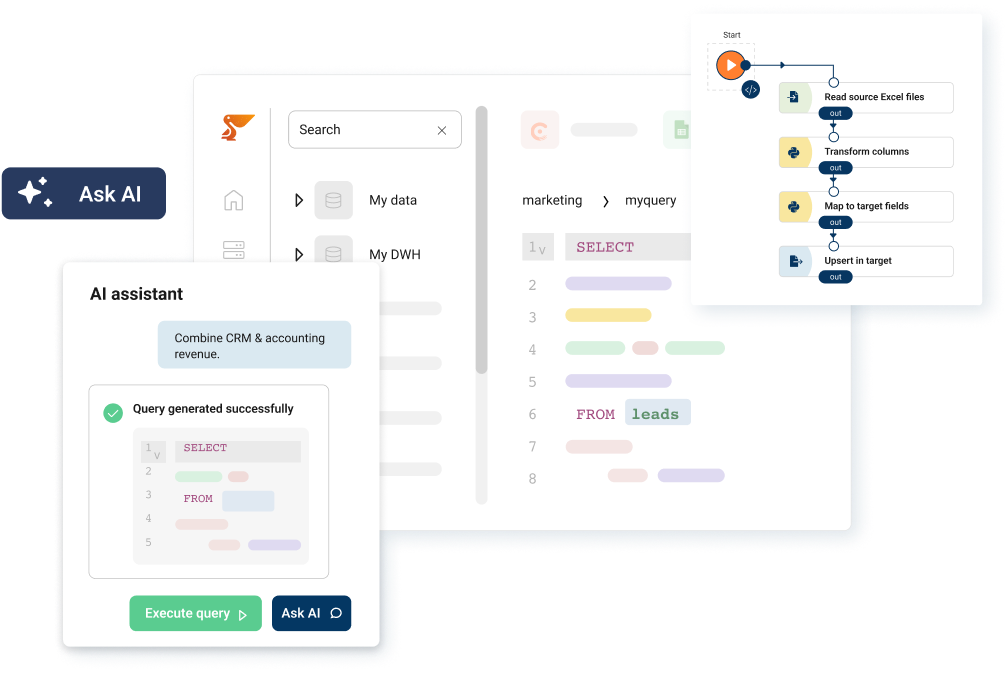
Peliqan is the warehouse-first answer in this list and the one most other listicles skip. Instead of an event-driven workflow runtime, it lands every connector’s data into a Postgres and Trino warehouse in its native schema, then exposes one MCP server that speaks SQL against the whole warehouse. The cross-source SQL cornerstone walks through ten worked examples that span Salesforce, Exact Online, Stripe, Zendesk, MEWS, AFAS, Yuki, and Notion in single queries, the kind of question Pipedream’s workflow model cannot answer in one shot.
The product specs: 250+ connectors with a 2-week custom-connector SLA, full reverse ETL writeback through one audited path, a Postgres and Trino federated query engine for SQL on anything, column-level masking and granular RBAC by default, SOC 2 Type II, ISO 27001, GDPR, HIPAA, and CCPA certified, EU-hosted on AWS Frankfurt, and fixed, transparent annual pricing on the pricing page.
Founded by Niko Nelissen and Piet-Michiel Rappelet, who previously sold Blendr.io to Qlik. The Peliqan platform overview covers the warehouse, federated query engine, and reverse-ETL audit-log surface in detail.
Best for: EU teams running internal analytics, RevOps, finance, and customer-success workflows that need cross-source SQL plus audit-logged writeback. It is a strong fit for accountancy partners managing multi-client environments and any deployer planning for EU AI Act Article 26.
Watch out for: not the cheapest option for pure event-driven single-system automation, since the warehouse beneath is overkill if you only need Pipedream-style workflow trigger-action chains.
2. Workato – enterprise iPaaS with Enterprise MCP layered on top
Workato is the loudest direct play for Pipedream-leavers in the enterprise lane. The Enterprise MCP product launched October 1, 2025, and the “MCP Monday” cadence has shipped 38+ pre-built MCP servers covering ZoomInfo, Highspot, Microsoft Teams, Outlook, Notion, Discord, Salesforce, Workday, GitHub, and Databricks, and growing. The integration platform underneath has been at enterprise scale for years, with strong adoption in regulated industries.
The architectural pattern is enterprise iPaaS plus MCP, but without a warehouse beneath, so cross-source analytical SQL is not part of the product shape. Pricing reflects the enterprise target, typically six figures annually for the bundle, which makes Workato the right answer for the regulated-enterprise buyer with budget and the wrong answer for SMB-to-mid-market teams who picked Pipedream because it was reasonably priced.
Best for: enterprise teams already on Workato iPaaS, regulated industries such as financial services and pharma that need a single attested vendor, and any team wanting integration platform plus MCP under one contract. Watch out for: US-hosted (CLOUD Act exposure), an enterprise pricing tier that excludes SMB and most mid-market budgets, and no warehouse beneath the MCP layer.
3. n8n self-hosted – open-source, EU-headquartered, run-anywhere
n8n is the closest functional match to Pipedream for teams that want code-friendly workflow building with JavaScript nodes and a wide connector library. Founded in Berlin in 2019, n8n raised a $180M Series C at a $2.5B valuation in 2025-2026 and remains independent. The self-host story is the differentiator: deploy n8n inside your own EU-located cloud account and the CLOUD Act conversation simply does not apply.
The trade-off is operational ownership. You run the workflow runtime, you pay the cloud bill, you absorb upstream API changes when connector specs break, and you handle the upgrades. For teams with the engineering headcount to operate this, the savings versus a managed enterprise iPaaS are significant; for teams that picked Pipedream specifically to avoid this operational burden, n8n self-host re-introduces that work.
Best for: engineering teams with operational headcount, hard data-residency requirements, code-flexible workflow building, and a preference for open-source ownership. Watch out for: operational ownership is the whole product, so it is the cost as well as the feature, with no warehouse layer, no analytical SQL surface, and no cross-source JOIN pattern.
4. Composio – per-toolkit MCPs for dev-tool agent builders
Composio publishes per-toolkit MCP servers covering 500+ tools, with SOC 2 Type II posture and strong adoption among Cursor and Claude Code developers building dev-tool agents. The architectural pattern is one toolkit per system, so an agent connected to Composio’s Salesforce, Stripe, and HubSpot toolkits has three independent MCP surfaces with no shared schema. For dev-tool workflows across GitHub, Linear, Slack, Notion, and Cursor, the per-toolkit pattern is exactly right.
The same pattern collapses for internal RevOps or finance analytics that need to JOIN across toolkits, for the same reason every per-API MCP pattern collapses: the JOIN has to happen in the agent loop with all the latency, token, and audit-log costs that brings. Composio is also US-headquartered, which puts CLOUD Act exposure back on the table for EU buyers reviewing both alternatives at once.
Best for: dev-tool agent building in Cursor and Claude Code, per-system workflows where cross-source JOINs are not required, and GitHub, Linear, and Slack-centric agentic work. Watch out for: US-hosted, no warehouse, no cross-source SQL surface, and an audience mismatch for CFO and RevOps buyers.
5. Apideck – unified API plus MCP for embedded SaaS builders
Apideck is the unified-API answer in this list and a sensible alternative for any team that picked Pipedream because they needed broad connector coverage for an embedded SaaS product. The Belgian-rooted vendor launched a 229-tool MCP server in May 2026, auto-generated from its OpenAPI spec, with dynamic tool discovery that keeps session cost at roughly 1,300 tokens. The 150+ connectors span accounting, CRM, HRIS, file storage, and e-commerce. The full architectural detail sits in the dedicated Apideck MCP alternative deep-dive.
The architectural pattern is unified API, one normalised schema across many providers, which is excellent for “your end customers plug in their accounting” and structurally limited for “your CFO joins five systems in one SQL question.” Apideck shares Pipedream’s Belgian and EU founder roots but hosts on US infrastructure by default, which keeps the CLOUD Act conversation on the procurement checklist.
Best for: embedded SaaS builders shipping a customer-facing integration story, and HR-tech and fintech products where unified schemas across providers is the feature. Watch out for: a lowest-common-denominator schema that hides per-connector depth, no cross-source SQL JOINs across unified APIs, and US infrastructure by default.
6. Nango – integration framework you deploy in your cloud
Nango is the sovereign-cloud answer: deployable integration components (OAuth flows, credential storage, token refresh, rate limit management, request proxying) that you run inside your own cloud account. The product is the framework, not the host. For teams with hard data-residency or sovereignty requirements that cannot be satisfied by vendor “EU region” claims, Nango self-host removes the CLOUD Act conversation entirely.
The trade-off is the same as n8n’s: operational ownership of the integration runtime is the whole product. You maintain the components, you absorb the upstream changes, and you pay the cloud bill. The pattern is integration-framework-first, and the MCP layer rides on top, so the same warehouse-versus-workflow architectural question applies.
Best for: engineering teams with sovereign-cloud requirements, regulated industries with hard residency rules, and any team that wants to own the abstraction layer end-to-end. Watch out for: operational ownership across the integration runtime, with no warehouse layer by default.
7. Activepieces – open-source workflow automation
Activepieces is the closest open-source Pipedream-shape match in 2026: MIT license, Zapier-like interface, 200+ integrations, and full Docker self-hosting. It has grown fast as the n8n alternative for teams that find n8n’s licensing terms restrictive, since n8n’s “fair-code” license has constraints commercial users sometimes find awkward. For event-driven automation with full ownership and no vendor relationship, Activepieces is a credible answer.
The architectural pattern is workflow-first, the same shape Pipedream, n8n, and Activepieces all share. The MCP support is nascent compared to the commercial alternatives in this list, which is the trade-off for the open-source posture. For teams whose Pipedream use case was primarily workflow automation rather than AI agent integration, Activepieces is the lowest-friction migration.
Best for: open-source-first teams, event-driven workflow automation, and full self-host with permissive licensing. Watch out for: an MCP layer that is less mature than commercial alternatives, no warehouse, and a smaller connector catalog than Pipedream’s 3,000+.
How the seven alternatives compare side by side
Migration considerations: what breaks, what survives, what is net-new
The cost of switching depends mostly on what the existing Pipedream workflows actually do. The migration matrix below covers the five categories that account for almost every Pipedream use case in the wild.
What migration looks like by Pipedream use case
- Event-driven Slack and email notifications: n8n self-host or Activepieces, a direct workflow-to-workflow port, with most workflows transferring in a day per category.
- Multi-system reconciliation that grew analytical needs: Peliqan warehouse-first, replacing the workflow chain with a single SQL query running on a Trino federation, time-to-first-query usually two weeks.
- AI-agent tool calling for dev workflows: Composio, whose per-toolkit MCP servers map cleanly to per-system Pipedream actions.
- Embedded customer-facing connectors in your product: Apideck or Merge unified APIs, with rework needed as schemas flatten, but the embedded UX simplifies significantly.
- Enterprise scale plus regulated-industry compliance: Workato (US enterprise) or Peliqan (EU mid-market), with the choice depending on jurisdiction and pricing tier.
Decision framework: which alternative fits which Pipedream buyer
A practical decision tree
- “We just need Slack notifications to keep firing”: n8n self-host, or stay on Pipedream until renewal.
- “We need cross-source analytics that Pipedream never gave us”: Peliqan warehouse-first MCP.
- “We need enterprise iPaaS plus MCP at any cost”: Workato.
- “We are building dev-tool agents in Cursor or Claude Code”: Composio.
- “We are embedded in a SaaS product and need unified schemas”: Apideck or Merge.
- “We have hard sovereign-cloud requirements”: Nango self-host or n8n self-host on EU infrastructure.
- “We are EU-headquartered with an EU AI Act audit on the calendar”: Peliqan (EU-hosted, SOC 2 Type II, audit-logged reverse ETL, column-level masking by default).
- “We are price-sensitive and open-source-friendly”: Activepieces.
What the warehouse-first pattern unlocks that Pipedream cannot
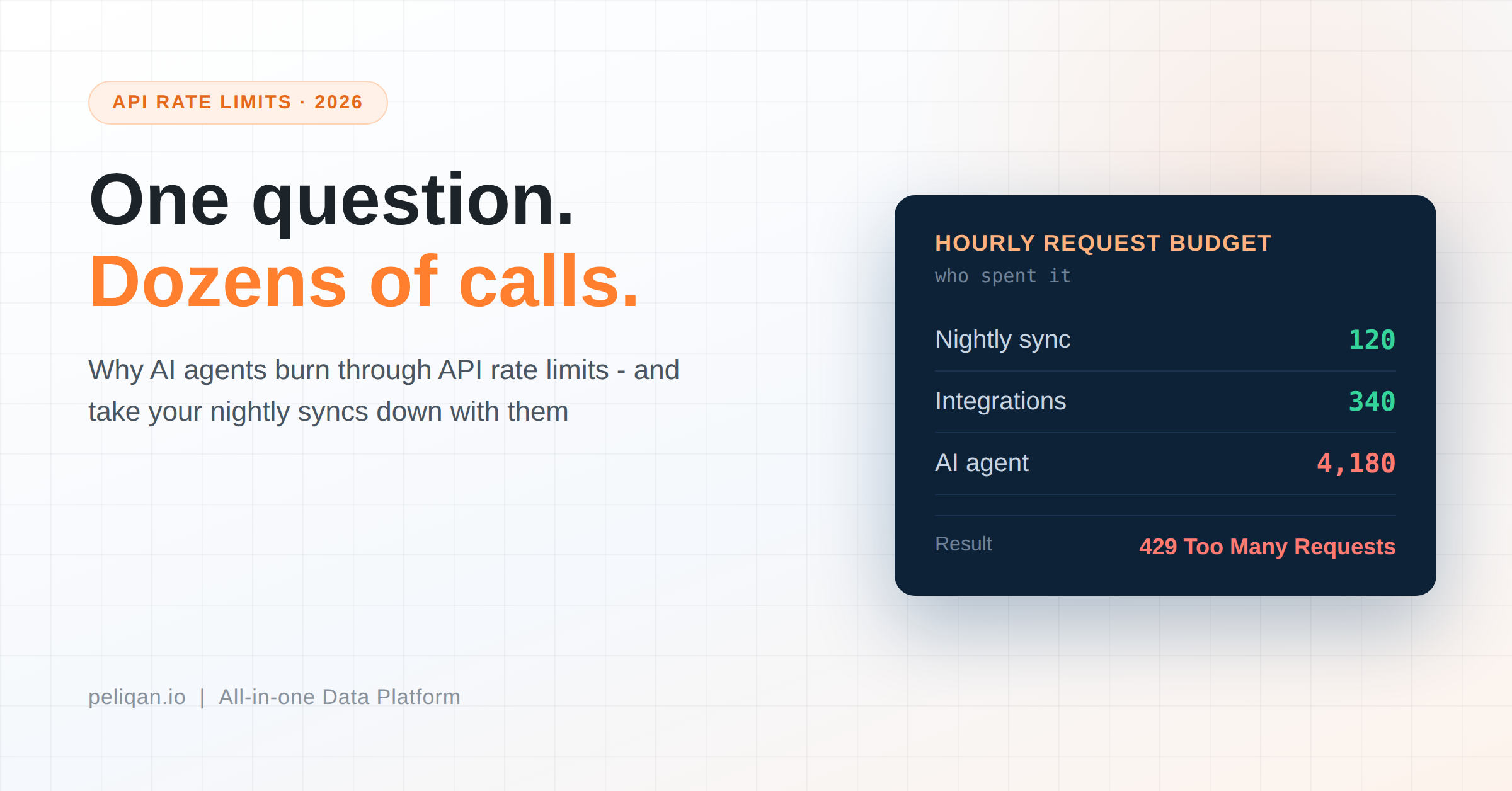
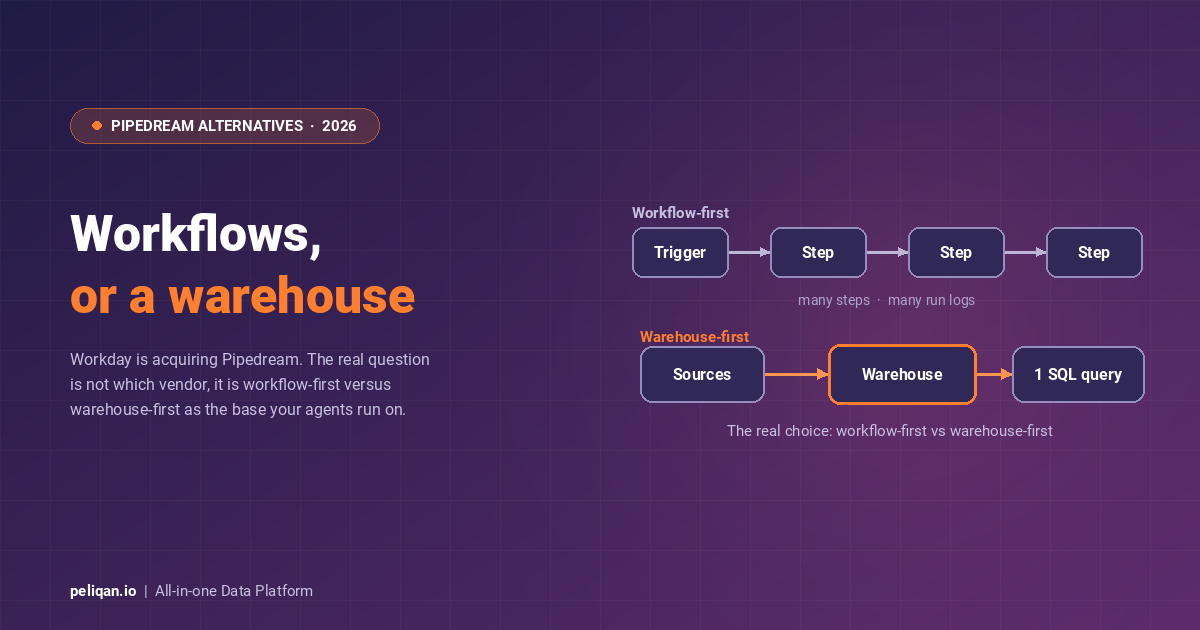
This is the architectural distinction worth dwelling on, because it is the one the existing Pipedream alternatives listicles all miss. Pipedream is workflow-first: the agent’s job is to sequence actions across systems, with each call costing a task on the bill and producing a workflow-run log as the evidence trail. Cross-source analytical questions that span 10,000 rows across three systems become 10,000 workflow steps with 10,000 logs and no SQL surface beneath.
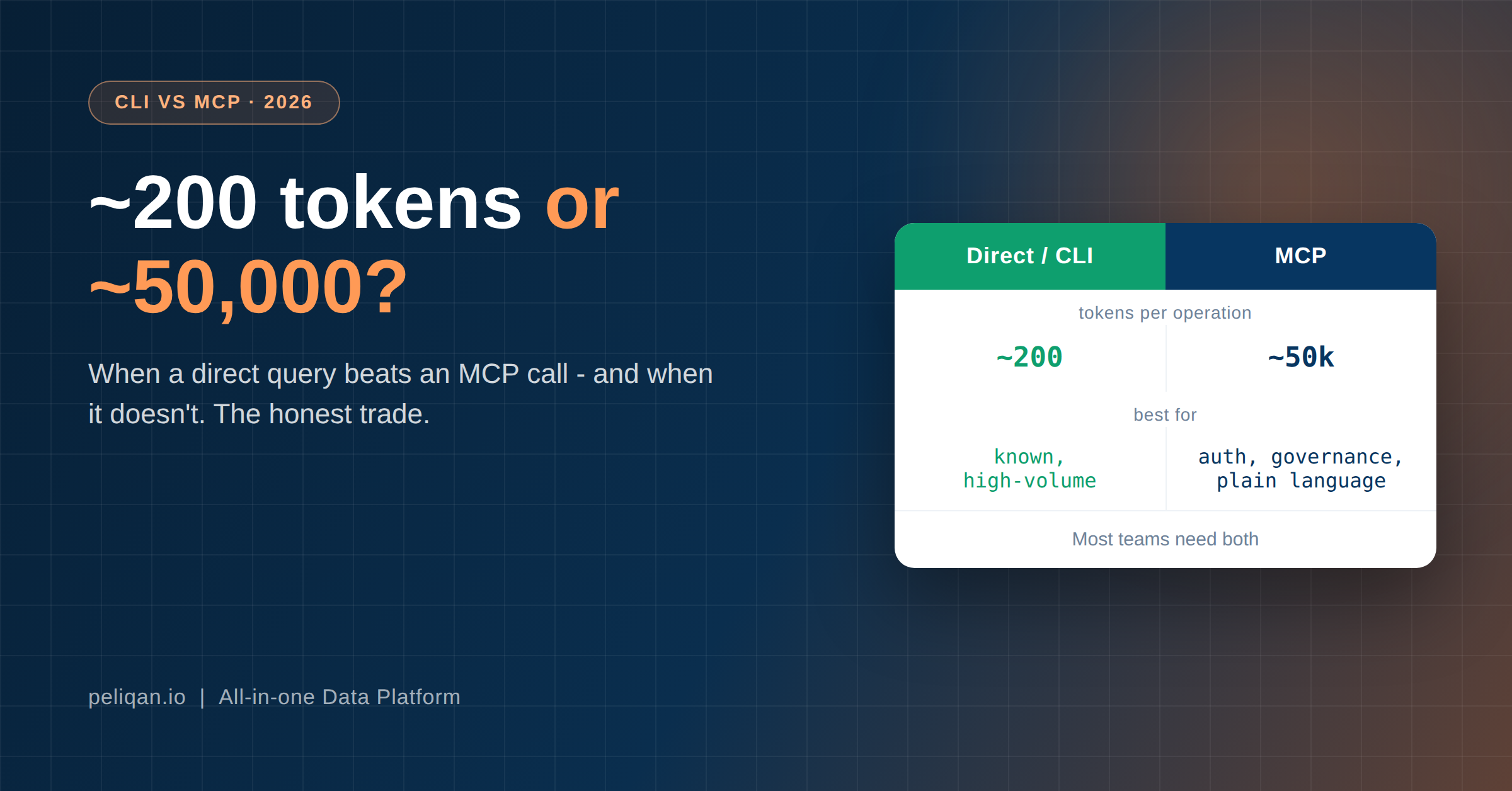
The warehouse-first pattern inverts this. Connector data lands into Postgres and Trino once on a sync schedule. The MCP server queries the warehouse, not the upstream APIs, which means the same question becomes one SQL statement and one audit-log entry. The Postgres MCP setup guide covers the security and governance layer that makes this auditable.
The SQL-on-anything help doc walks through the federated queries that join materialised tables with live external sources.
For specific vertical depth, the connector-level MCP product pages document each integration’s coverage in detail. Exact Online MCP preserves all 12 divisions.
AFAS MCP exposes the Get-Connectors with their native depth.
The Yuki MCP playbook covers the BE/NL accountancy stack that Pipedream’s horizontal connector model does not reach with the same fidelity.
Real-world example: CIC Hospitality
CIC Hospitality consolidated 50+ data sources across PMS, payments, and accounting into one Peliqan warehouse, the kind of multi-system reconciliation that would have required dozens of Pipedream workflows running in parallel and a manual join layer on top. The MEWS Claude MCP playbook covers how the hospitality data flow lands into the warehouse.
The single warehouse plus one MCP server pattern saves 40+ hours per month on board reporting and produces the audit log that satisfies SOC 2 evidence on the same artefact. Read the full CIC Hospitality case study.
The hosting and compliance question every EU buyer is asking
The EU compliance posture is now a primary procurement axis, not a secondary one. With EU AI Act Article 26 obligations live on August 2, 2026, DORA enforceable since January 17, 2025, NIS2 obligations on important entities, and the Cloud and AI Development Act in development, “US-hosted with EU region” is no longer a clean answer for sensitive workloads. The Trust Center conversation, where Peliqan’s published SOC 2 Type II posture and sub-processor list sits, is where the procurement review now starts.
For Pipedream-leavers specifically, the jurisdiction question matters twice: once for the existing Pipedream contract under Workday (US HQ, US infrastructure), and once for whichever alternative comes next. The cheapest decision is the one that does not require redoing the jurisdiction review in 18 months when the next regulatory deadline lands. EU-headquartered, EU-hosted, audit-logged platforms with a clean sub-processor chain are the structurally cheaper answer over the next three years.
The bottom line on Pipedream alternatives in 2026
Workday’s acquisition of Pipedream is neither a crisis nor an excuse to switch indiscriminately. Existing workflows will keep working through the integration, and Workday has committed to supporting the 5,000+ customer base. What is changing is the gravity: the roadmap will trend toward Workday-adjacent agentic use cases, the pricing model will likely shift over multiple renewal cycles, and the architectural question every team should ask is whether workflow-first was the right pattern in the first place.
For event-driven automation, the answer is often still yes: n8n self-host, Activepieces, or staying on Pipedream are all sensible. For AI agent dev-tool work, Composio is the cleaner match. For embedded SaaS, Apideck or Merge unified APIs take the lane. For Odoo partner consultancies running 50+ client environments, the Odoo Claude MCP playbook shows the multi-customer pattern. For internal RevOps, CFO analytics, multi-system reconciliation, and any EU buyer planning around Article 26 and DORA simultaneously, the warehouse-first pattern wins, and Peliqan is the EU-headquartered vendor whose architecture lives there.
The architectural decision that compounds is not between Workato and Composio and Apideck. It is between workflow-first and warehouse-first as the foundation your AI agents read from and write to for the next three years. Pick that one correctly, and the vendor inside the pattern is almost a footnote.