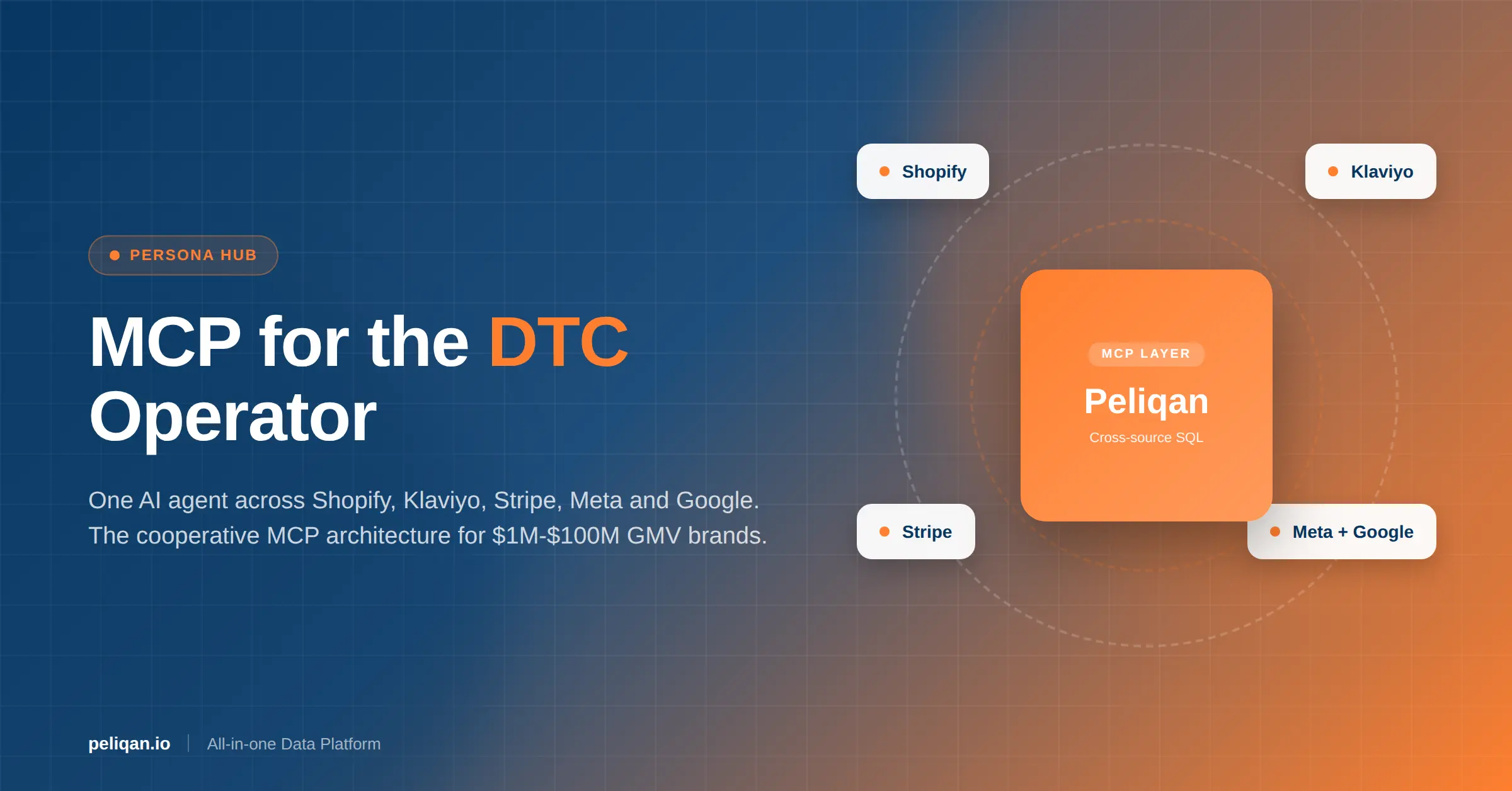





MCP for ecommerce in 2026 is not one tool. It’s four cooperating MCP surfaces, with a warehouse-first MCP on top to answer the one question none of them can answer alone. This is the persona hub for the VP eCommerce, Head of Growth, or founder running a $1M to $100M GMV DTC brand on Shopify + Klaviyo (or Brevo) + Stripe + Meta/Google ads + a 3PL or Airtable inventory sheet. The killer story is cross-channel CAC reconciliation, and no single tool can do it.
Native MCPs are now real. Shopify Sidekick ships as a proactive in-admin agent. Klaviyo expanded its Anthropic partnership on May 7, 2026 to extend its MCP across Claude.ai and Claude Cowork. Stripe runs a hosted MCP at mcp.stripe.com plus the Agent Toolkit on GitHub. So every major DTC platform now speaks MCP natively. However, each one speaks only its own data.
That’s where the attribution war starts. Klaviyo claims an order was email-driven. Meta claims the same order was paid-driven. Shopify says it was direct because the UTM dropped. Stripe quietly refunds it 30 days later, and nobody updates LTV. This blog is the procurement-grade playbook for the DTC operator who’s done losing that war.
The cooperative architecture for DTC AI in 2026
The right mental model is four MCP surfaces, each doing what it was built for. So Shopify Sidekick handles inside-Shopify operations. Klaviyo MCP handles marketing-only context. Stripe Agent Toolkit handles inside-Stripe actions. Peliqan layers cross-channel reconciliation on top of all three.
The same cooperative pattern is documented in our EU CFO hub.
The four MCP surfaces a DTC operator needs to know
For the technical foundation, see our Shopify MCP setup playbook.
For marketing-side context, the Klaviyo MCP guide walks through the connector setup.
And for payments, the Stripe MCP cornerstone covers the Agent Toolkit and hosted MCP server.
The 7 standing questions every DTC operator can’t answer in one tool
If you run a DTC brand between $1M and $100M GMV, these seven questions come up every week. Each one sits across at least two systems. So a single-tool MCP gives you a partial answer at best.
The standing question set
So the operator needs an AI agent that can do all seven without four browser tabs and an export-to-CSV ritual. That’s the warehouse-first wedge.
The 5 cross-source workflows that pay for the warehouse
1. Cross-channel CAC reconciliation
Join Shopify orders (with raw UTMs preserved) to Klaviyo email attribution to Meta CAPI server events to Google Ads conversion exports to Stripe payment intents net of refunds and chargebacks. So you get one blended CAC per customer cohort that doesn’t double-count and doesn’t omit. Triple Whale’s pixel approach solves this for in-Shopify view of paid. However, it doesn’t natively reconcile against Stripe-confirmed net revenue at the SKU level. Furthermore, the warehouse approach is structurally different because the JOIN happens in SQL, not in a pixel. See our cross-source MCP SQL cornerstone for the architectural pattern.
2. Stockout prediction by SKU velocity
Join Shopify inventory levels to historical sales velocity to supplier lead times (typically in Airtable for $1M-$50M brands) to current open POs. So you project days-of-cover per SKU per warehouse zone. Then trigger a Klaviyo back-in-stock flow before the SKU runs out, not after. The Airtable MCP guide covers the supplier-data side of this pattern.
3. Cohort LTV by acquisition channel
First-touch attribution from Klaviyo, UTM, Meta CAPI, and Google Ads gclid joined to Stripe lifetime revenue net of refunds for the same customer ID over 6, 12, and 24 months. So you learn which channel actually produces durable customers, not which channel last-clicked the first order. Klaviyo’s native predictive CLV is a model. This is the realized number to back-test it against.
4. Subscription churn intervention
Stripe’s invoice.payment_failed webhook fires. The agent looks up the customer’s Klaviyo profile and last engagement. It checks Shopify customer order history. Then it triggers the right Klaviyo win-back flow with the right discount tier. Stripe’s own documentation shows recovery rates above 50 percent are achievable with Smart Retries plus customer emails. The average SaaS subscription failure rate is 4-8 percent, and the same logic applied to DTC subscriptions is the single highest-ROI agent workflow for any subscription DTC brand.
5. True margin by SKU including hidden costs
Shopify cost-of-goods plus supplier landed cost plus shipping zone variance (3PL data) plus return rate by SKU plus ad spend allocated by channel attribution equals real CM2 per SKU. Most “profitability dashboards” stop at gross margin minus blended ad spend. The warehouse pattern attributes return rates and refund rates per SKU and lets you kill the zombies. For more on the warehouse-side pattern, see the warehouse materialization documentation.
The 3 failure modes of single-tool DTC analytics
This is the defensible IP a Head of Growth can take into the procurement room. Three failure modes recur across every DTC stack we audit. Each one is structural, not a vendor bug.
Failure mode 1: the attribution war
Klaviyo’s pixel claims credit for an order. Meta’s CAPI claims credit for the same order. Shopify’s analytics tags it as direct because the UTM dropped. The disagreement is not a bug. Indeed, it’s the consequence of different attribution windows (Meta 7-day click vs Klaviyo last-click vs Shopify last-non-direct), different identity resolution (deterministic vs probabilistic vs cookie-based), and different post-iOS 14.5 modelling assumptions. Per Stella’s 2025 incrementality study of 225 geo tests, “platform ROAS exceeding 2-3x incremental ROAS warrants skepticism: the gap represents attribution inflation, conversions that would have occurred without advertising.” So platform ROAS overstates true incremental ROAS by 2x or more on Meta-heavy accounts. You cannot fix this inside any one tool because no single tool sees all four signals at once.
Failure mode 2: the anonymous-revenue blackout
After iOS 14.5 ATT, opt-in has risen from the early-2021 lows but remains a structural ceiling. AppsFlyer reported approximately 50 percent global opt-in as of April 2024. Meanwhile, Adjust reported approximately 35 percent globally as of July 2025. Combined with Safari ITP and the slow third-party cookie deprecation, a meaningful share of cross-device buyers fall out of native attribution. A customer who browses on iPhone, gets a Klaviyo email, clicks on desktop, and converts is increasingly invisible to the pixel chain. Server-side events (Meta CAPI, Google Enhanced Conversions, Klaviyo server events) recover 10-30 percentage points of match rate. However, the residual gap is permanent. Only warehouse-side identity resolution against Shopify customer email plus Stripe customer ID stitches the cross-device journey back together.
Failure mode 3: refund-blind LTV
Shopify’s default analytics show gross revenue, not net of refunds. Klaviyo’s Predicted Lifetime Value model is trained on gross order events. Triple Whale’s dashboards show blended ROAS on a pixel basis. None of them, by default, subtract Stripe-side refunds and chargebacks from the customer’s lifetime value the day the refund actually settles. For apparel brands with 25-30 percent return rates (per NRF and Eightx 2025 data), this means published LTV is overstated by exactly that percentage. The warehouse pattern joins Stripe charge.refunded events to the original order and computes net LTV continuously.
The DTC analytics vendor map, fair-framed
Triple Whale, Northbeam, Polar Analytics, Daasity, and Composio each occupy a real lane. So the question isn’t “which one beats the others.” It’s “which one fits where in your stack.” Here’s the honest map.
For a deeper TCO comparison across the MCP server market, see our MCP server pricing 2026 guide.
Furthermore, the MCP rate limits guide covers the API ceilings every DTC operator should know before signing.
Pricing reality: per-channel tool stacking vs flat-rate warehouse
The DTC analytics stack inflates fast. A typical $10M GMV brand running Triple Whale Advanced ($219/mo) plus a separate Klaviyo seat plus 3PL software plus an attribution tax through Meta CAPI integrations lands at $800-$1,200/month before the warehouse layer even ships. So the comparison isn’t “Peliqan vs one tool.” It’s “Peliqan vs the stack you’re already paying for.”
So the warehouse-first pricing is structurally different. The same flat tier handles Shopify + Klaviyo + Stripe + Meta + Google + Airtable + 3PL without per-source meters. Furthermore, the cost of asking 100 cross-source questions a month equals the cost of asking 10,000. There’s no per-action token meter.
5 buyer sub-segments and the right answer for each
The recommendation depends on GMV, brand count, and EU jurisdiction. So here’s the decision framework, organized by where most DTC brands actually land in 2026.
Why DTC stack fragmentation is structural, not a bug
The DTC stack is more fragmented now than at any point in the post-iOS-14.5 era. Ringly’s 2026 DTC report cites 222 percent CAC growth over eight years and average DTC CAC of $45-70. NRF’s 2025 Retail Returns Landscape projects 19.3 percent of online sales returned in 2025, up from 16.9 percent in 2024 (worth $890 billion). Apparel runs even higher: Eightx reports women’s apparel at 28 percent returns and shoes at 31 percent.
Meanwhile, Klaviyo’s own 2026 benchmark report shows email flows drive nearly 41 percent of total email revenue from just 5.3 percent of sends. So top-quartile DTC brands now derive 25-35 percent of total revenue from email plus SMS combined. Every one of these numbers lives in a different system. CAC sits in Meta and Google. Returns sit in Shopify and Stripe. Flow revenue sits in Klaviyo. Margin sits in your COGS spreadsheet.
That’s the structural problem MCP doesn’t solve on its own. Indeed, MCP makes each tool’s data addressable by Claude. However, joining the four together still requires a warehouse. For the regulatory layer, see our EU AI Act and MCP Article 26 reference.
Peliqan’s posture on the DTC stack
Peliqan was built for exactly this shape of problem. EU-hosted from day one. Warehouse-first by design. The procurement-checklist questions all have pre-built answers.
How Peliqan handles the DTC operator’s stack
For the Brevo path specifically, see our Brevo MCP playbook.
The reverse ETL documentation covers the writeback pattern that closes the AI agent loop.
Real-world example: Skindr
Skindr, a Belgian-hosted mobile app connecting consumers with dermatologists, used Peliqan to consolidate marketing data from multiple social ad tools, Apple App Store, and Google Play Store into one warehouse. The team then visualized the consolidated data in Metabase. The case study documents campaign-level attribution of mobile app downloads to social campaigns and downstream RevOps metrics. This is structurally the same workflow a DTC operator needs to attribute Shopify orders to Meta and Google campaigns. Read the full Skindr case study.
The 4-stage DTC adoption path
Stage 1: under $5M GMV, days 0-30
Turn on Shopify Sidekick. Install the Klaviyo MCP Connector in Claude. Add Stripe MCP via the OAuth flow at mcp.stripe.com. Pick one cross-tool question. A good starter is “what was my real CAC by Meta campaign last month, net of Stripe refunds?” Accept that Claude will give you a multi-step answer that orchestrates the three native MCPs imperfectly. The friction you feel is the data you need. So move to Stage 2 when you find yourself asking the same cross-source question more than once a week.
Stage 2: $5M-$25M GMV, days 30-90
Layer in either Triple Whale (if Shopify-first and Meta-heavy under $50K/mo paid spend) or Polar Analytics (if you want Snowflake access and Klaviyo enrichment). Keep the native MCPs. Treat Triple Whale’s blended ROAS and Polar’s dashboards as the in-channel answer. Start a parallel weekly question that they cannot answer. A good one is SKU-level margin net of returns by acquisition channel. So move to Stage 3 when you cross $25M GMV, when you launch a subscription product, when you add a second brand or marketplace, or when you start selling into the EU.
Stage 3: $25M-$100M GMV, days 60-120
Deploy a warehouse-first MCP alongside the native ones. Either Northbeam for incrementality-grade measurement plus Peliqan for everything else, or Peliqan alone if measurement isn’t your bottleneck. The five cross-source workflows above become weekly muscle memory. CAC reconciliation, stockout prediction, cohort LTV, churn intervention, SKU margin. So move to Stage 4 when multi-brand consolidation, GDPR/AI-Act exposure, or PE diligence enters the picture.
Stage 4: multi-brand holdco, EU-resident, or PE-backed
Peliqan is the default. EU-hosted in Belgium, SOC 2 Type II, ISO 27001 certified, audit-logged writeback, fixed pricing from €150/month annual. Furthermore, the compliance story (EU AI Act Article 26 from August 2, 2026; GDPR; column-level masking) becomes the procurement story. For the full posture, see the GDPR-compliant MCP servers reference.
The bottom line on MCP for the DTC operator
The DTC stack is now structurally fragmented. CAC sits in Meta and Google. Returns sit in Shopify and Stripe. Flow revenue sits in Klaviyo. Margin sits in your COGS spreadsheet. MCP makes each tool’s data addressable by Claude. However, joining the four together still requires a warehouse.
So the cheap procurement decision is the cooperative architecture. Native MCPs do what they were built for. A warehouse-first MCP layers cross-source reconciliation on top. The seven standing questions become daily muscle memory instead of weekly fire drills. The three failure modes (attribution war, anonymous-revenue blackout, refund-blind LTV) all get neutralized at the warehouse layer.
The DTC operators who win 2026 aren’t the ones who picked the best single tool. They’re the ones who picked the right tool for each layer and let an agent walk across them. The next year of agentic DTC work compounds on whatever architecture you set in May 2026.
This post is for informational purposes only. Vendor pricing, product features, and AI Act timelines reflect publicly available information as of May 2026 and may change. Verify current details with each vendor before any procurement decision.