




ETL data mapping is the process of defining how fields from source systems correspond to fields in a target system, so data lands in the right place, in the right format, with its meaning intact. This guide explains what data mapping is in ETL, the main types and techniques, the process step by step, the common pitfalls, and how a modern platform automates most of the work.
Every ETL process rests on one quiet but critical step: deciding how each piece of source data maps to its destination. Get the mapping right and analytics are trustworthy; get it subtly wrong and the errors hide for months before someone spots a wrong number in a dashboard. Data mapping is where most silent data corruption originates, and where careful design pays off the most.
What is data mapping in ETL?
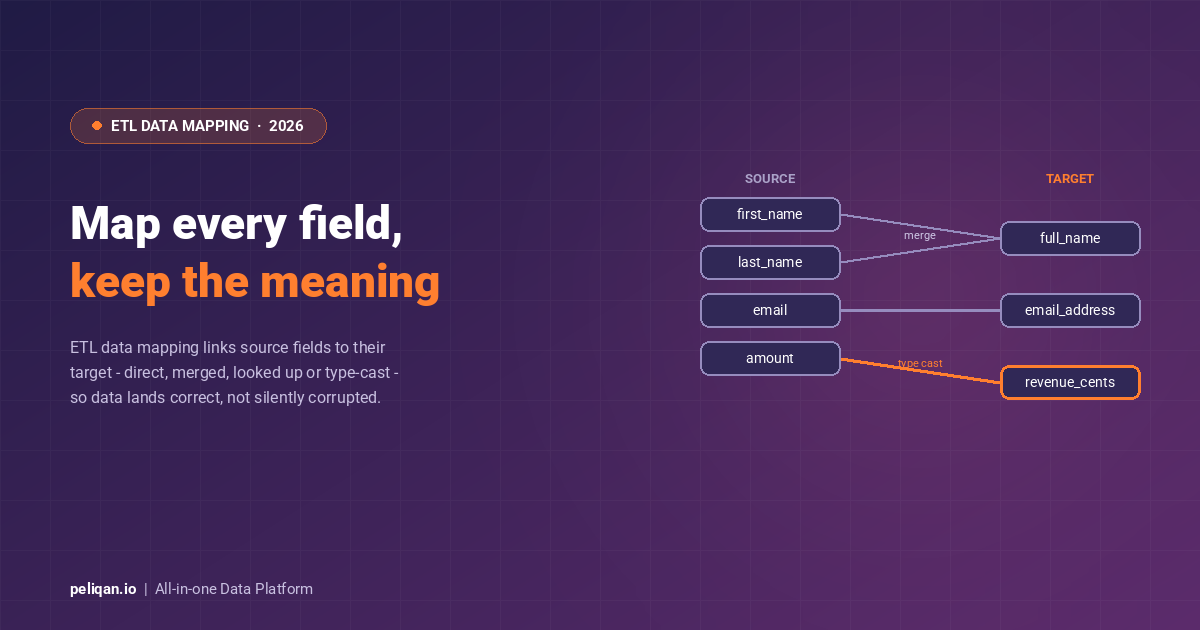
Data mapping is the practice of matching fields from a source system to fields in a target system, and defining how the values should be transformed along the way. In an ETL pipeline, it sits between extraction and loading: once data is pulled from a source, mapping rules describe how each column, data type, and relationship translates into the target schema. A mapping might be as simple as “source field email goes to target field email_address,” or as involved as “concatenate first and last name, convert the currency, and split one address field into five.” Tools like a visual data mapper let teams define these rules without hand-coding every one.
Why data mapping matters
Accurate mapping is what keeps data integrity intact as information moves between systems. The classic failure is a silent type mismatch: a value like $100.00 loaded into a field expecting cents becomes 10,000, data that loads “successfully” but is fundamentally broken. Differences in field names, data types, formats, and relationships between systems all create these traps. Strong mapping prevents them, which is why it is one of the highest-risk and highest-value steps in any data migration or integration project. Beyond correctness, good mapping also makes pipelines easier to maintain, audit, and adapt when a source schema changes.
Types of data mapping
Data mapping approaches fall into three broad categories, defined by how much of the work is automated.
Most teams use a mix: automated suggestions for the obvious one-to-one matches, with manual review for the fields where business meaning matters. The trend in 2026 is toward AI-assisted mapping that proposes column matches and flags likely type conflicts, cutting the manual effort for each new source.
Common data mapping techniques
Within a mapping, individual fields are handled with a handful of recurring patterns. Direct (one-to-one) mapping moves a value across unchanged. Derived mapping computes a target value from one or more source fields, such as building full_name from first and last name. Lookup mapping replaces a code with its meaning using a reference table, like turning a country code into a country name. Type conversion casts values between formats (string to date, text to decimal) and is where mismatches most often bite. Split and merge mapping breaks one field into several or combines several into one. And default-value mapping fills a target field when the source is null. Doing these with SQL or low-code Python transformations keeps the logic readable and version-controlled.
The data mapping process step by step
A rigorous mapping process follows five stages. First, inventory the source and target: document every table, column, data type, constraint, and relationship on both sides. Second, define the mapping rules: decide how each source field maps to a target field and which technique applies. Third, build the transformations that implement those rules. Fourth, validate the output against the rules, checking accuracy, completeness, and conformity to business logic. Fifth, test on both full and incremental loads before going to production, then monitor for schema drift. Treating joining and combining data as part of this process, rather than an afterthought, is what keeps the result coherent across sources.
Common challenges in ETL data mapping
Several issues recur across projects. Complex or deeply nested source schemas (common with SaaS APIs) are hard to flatten into clean relational tables. Type and format mismatches cause silent corruption when a target field interprets a value differently than intended. Evolving schemas break mappings when a source adds, renames, or removes a field. And high data volumes make full re-mapping expensive, so incremental approaches matter. Good schema design on the target side reduces all of these by giving mappings a stable, well-structured destination.
Data mapping best practices
- Document every mapping: maintain a clear record of each source-to-target rule, including data types and transformation logic, as your migration manifest.
- Validate types explicitly: never assume a string and a number will convert cleanly, define and test type conversions to avoid silent corruption.
- Map for business meaning, not just structure: confirm that a mapped field means the same thing in the target as it did in the source.
- Handle nulls and defaults deliberately: decide what happens when a source value is missing rather than letting the target decide for you.
- Track lineage: keep a record of how each target value was derived so issues can be traced back to their source.
- Test before and after cutover: run validation on sample and full loads, and re-check after any source schema change.
How Peliqan simplifies data mapping
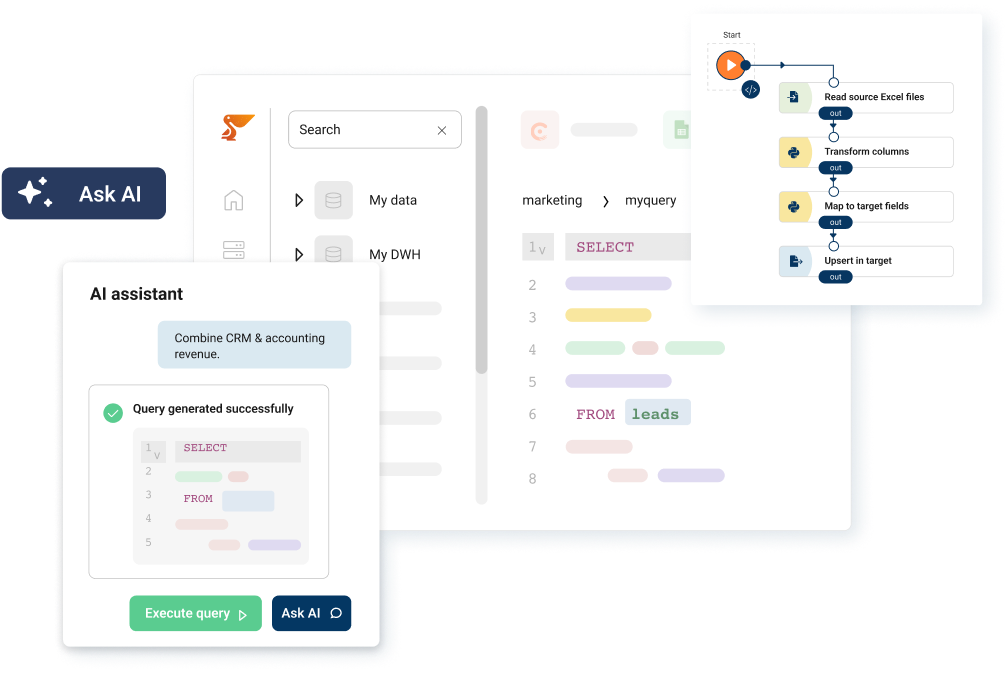
Peliqan removes most of the manual mapping burden. Pre-built connectors auto-detect source schemas and create one clean table per object type, so the starting point is already structured. A visual data mapper and SQL or low-code Python transformations let you define direct, derived, lookup, and type-conversion rules without hand-writing pipeline code, while AI assistance suggests column mappings and flags likely type conflicts for new sources.
Built-in column-level data lineage records how every value was derived, so a questionable number can be traced straight back to its source and the rule that produced it, which makes mappings far easier to audit and debug.
It brings the whole pipeline into one platform: 250+ connectors, a built-in Postgres and Trino warehouse (or your own Snowflake, BigQuery, or Redshift), and SQL plus low-code Python for transformations and validation. It is SOC 2 Type II, ISO 27001, GDPR, HIPAA, and CCPA certified, EU-hosted on AWS Frankfurt, with custom connectors delivered within 2 weeks.
Real-world example: CIC Hospitality
CIC Hospitality consolidated data from 50+ sources across 40+ hotels, mapping inconsistent ERP, PMS, and accounting fields into one consistent warehouse schema. Standardizing those mappings is what lets them save 40+ hours per month on board reporting that used to be reconciled by hand. Read the case studies.
Conclusion
Data mapping is the step that decides whether an ETL pipeline produces trustworthy data or quietly corrupts it. The fundamentals are simple: document the rules, validate types, map for meaning, and track lineage. The differentiator in 2026 is automation, letting connectors and AI handle the obvious mappings while people focus on the fields where business meaning matters. To see automated schema detection and visual mapping on your own sources, you can try Peliqan free.