
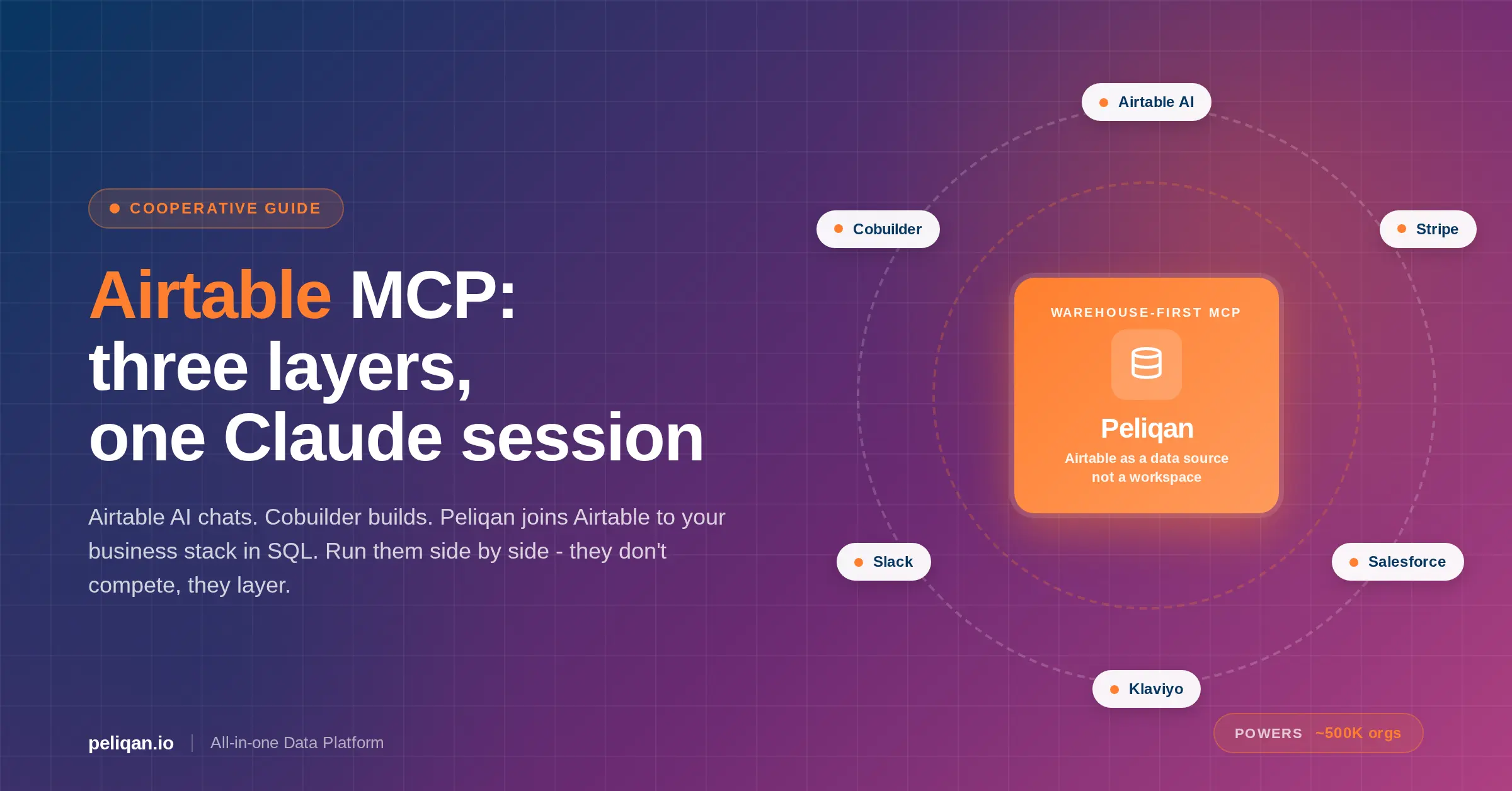





Airtable AI chats with your tables. Airtable Cobuilder builds lightweight no-code AI apps on top of bases. Peliqan’s MCP joins Airtable data to the rest of your business stack. Run them side by side – they don’t compete, they layer. This is the practitioner’s guide to Airtable MCP in 2026, covering Airtable’s official MCP server, the native AI features, and the warehouse-first cross-source layer that joins your Airtable bases to Stripe revenue, Salesforce deals, Klaviyo campaigns, and Slack channel activity in one Claude prompt.
“Did the campaigns we tracked in Airtable actually drive revenue in Stripe?” That is the standing question every product manager, growth lead, and agency owner running an Airtable-first stack asks. Specifically, the answer lives across an Airtable content calendar, Stripe payment intents, Klaviyo campaign engagement, and the CRM. Indeed, no single MCP server answers it alone. However, three MCPs running in one Claude session do.
Airtable matured fast in 2024-2026. Specifically, the company has been valued at $11 billion and serves roughly 500,000 organisations from its San Francisco headquarters. Furthermore, Airtable AI launched in 2023 with AI fields, chat-with-table, and generative content. Then Airtable Cobuilder shipped on July 24, 2024, enabling no-code AI app creation on top of any base. As a result, the in-Airtable AI experience now includes both data-layer reasoning and app-building agents.
The official Airtable MCP server arrived in 2026. Specifically, the server (available at https://mcp.airtable.com/mcp) lets Claude, ChatGPT, Cursor, and any MCP-compatible client read records, create new ones, update fields, manage tables, retrieve schemas, and automate project tracking. Furthermore, a May 2026 update added the upload_attachment tool for file management. As a result, in-Airtable agent capability is now fully covered by Airtable’s own tooling.
However, none of those native layers answers the cross-source question. Specifically, joining Airtable records to Stripe revenue or Klaviyo campaigns requires a SQL surface beneath. That is the warehouse-first MCP pattern’s home turf, covered in detail in the cross-source MCP cornerstone. This post is the third cooperative-architecture playbook in the cluster, after the Notion playbook and the Slack playbook.
What Airtable AI does well (and what Cobuilder adds)
Airtable AI shipped in 2023 with three native capabilities. First, AI fields generate content from other fields in the same record (summaries, classifications, translations, extracted entities). Second, chat-with-table lets users ask natural-language questions against base data without writing formulas. Third, generative content fills in records based on a prompt template. Moreover, Airtable AI lets customers choose which AI platforms and models to use, including Claude and OpenAI.
Airtable Cobuilder launched on July 24, 2024, as the fastest way to build no-code apps. Specifically, users describe what they want in plain English, and Cobuilder generates a customisable application in seconds. Furthermore, during beta testing 90% of AI-generated apps were rated useful by users. Indeed, Cobuilder turned Airtable from a database into a no-code AI app platform.
For in-Airtable agent workflows, both products are the right tools. Specifically, “summarise the open issues in this tracker” or “build a customer onboarding workflow from this base” returns useful answers without leaving Airtable. However, the architectural ceiling is the same one every vendor-native AI hits. The moment a question crosses from Airtable into Stripe payments, Salesforce deals, or Slack channel activity, Airtable AI cannot reach. That is not a flaw; it is the design.
The official Airtable MCP server: what it adds
Airtable’s official MCP server lets AI agents connect to bases through a single HTTP endpoint. Specifically, the server respects existing Airtable permissions, so read-only access stays read-only and edit permissions translate to write capability. Furthermore, the server exposes tools for ask-data, create-records, update-fields, manage-tables, retrieve-schemas, and (as of May 2026) upload-attachments up to 5 MB.
For Claude users who want to read and write Airtable content from inside Claude, this is excellent. Furthermore, the MCP server’s permission model means procurement and security teams approve it more easily than third-party wrappers. Indeed, this is the official “Claude as an Airtable agent” pattern, fully blessed by Airtable.
However, the architectural pattern is still “Claude reads and writes one Airtable base at a time.” It is not “Claude joins Airtable to Stripe to Klaviyo to Salesforce in one SQL query.” That is a different job, and a different architecture.
The cross-source job neither Airtable AI nor Cobuilder can reach
Five questions drive operating decisions in Airtable-heavy stacks in 2026. None of them is answerable inside Airtable AI alone, and none works through the official Airtable MCP alone either. Specifically, each requires SQL JOINs across at least two systems with consistent identity and a single audit log.
“Which features on our roadmap base correlate with Stripe MRR growth and Mixpanel adoption?” This is the product roadmap question.
“Which posts on our Airtable content calendar drove actual revenue, not just opens?” This is the marketing attribution question.
“For our 50 client agency bases, which clients have active project work AND overdue Stripe invoices?” This is the agency billing-risk question.
“Which leads we captured in our Airtable lightweight CRM were never converted into a Salesforce opportunity?” This is the handoff-leakage question.
“What is our engineering scope-versus-throughput trend – Airtable project tracker against Jira tickets against GitHub PRs against Slack engineering channel volume?” This is the velocity tracking question.
None of these is an Airtable question. Furthermore, none of them is a Claude-in-Airtable question either. Specifically, the JOIN happens across vendors. As a result, the answer needs a SQL surface beneath both Airtable and the other systems.
How Peliqan adds the warehouse layer beneath every Airtable base
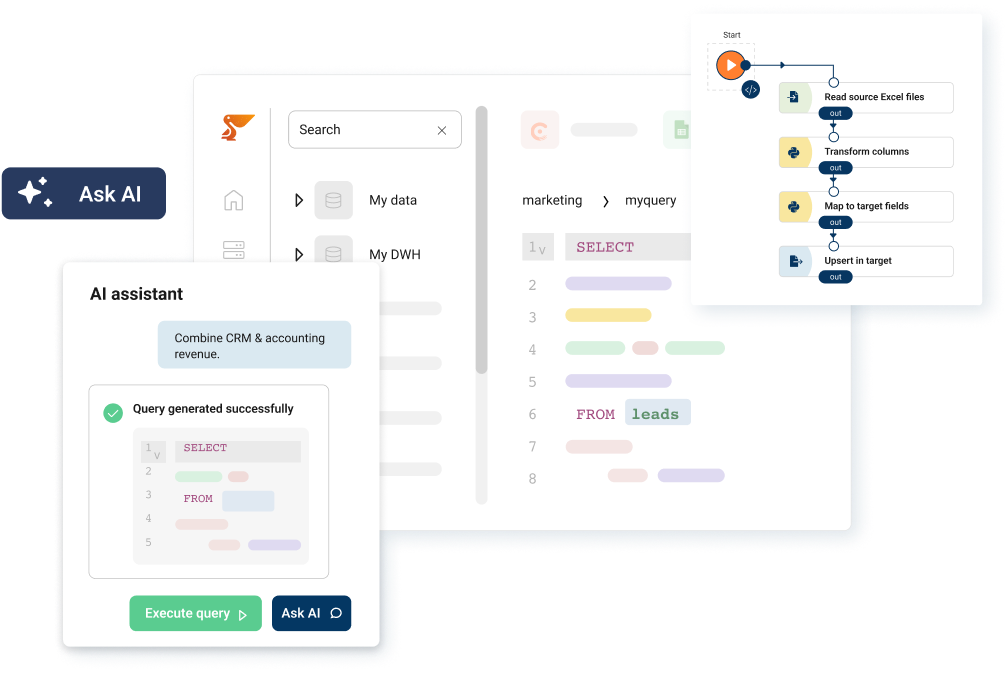
Peliqan reads Airtable as a data source, not as a no-code workspace. Specifically, the connector ingests records, schemas, linked-record relationships, formula outputs, AI field values, and attachment metadata into a Postgres + Trino warehouse. Furthermore, the same warehouse holds Salesforce, Stripe, HubSpot, Klaviyo, Slack, Zendesk, Pipedrive, and 240+ other connectors. As a result, the cross-source SQL JOIN happens in real query time, not in the agent’s reasoning loop.
Airtable through Peliqan’s MCP, end to end
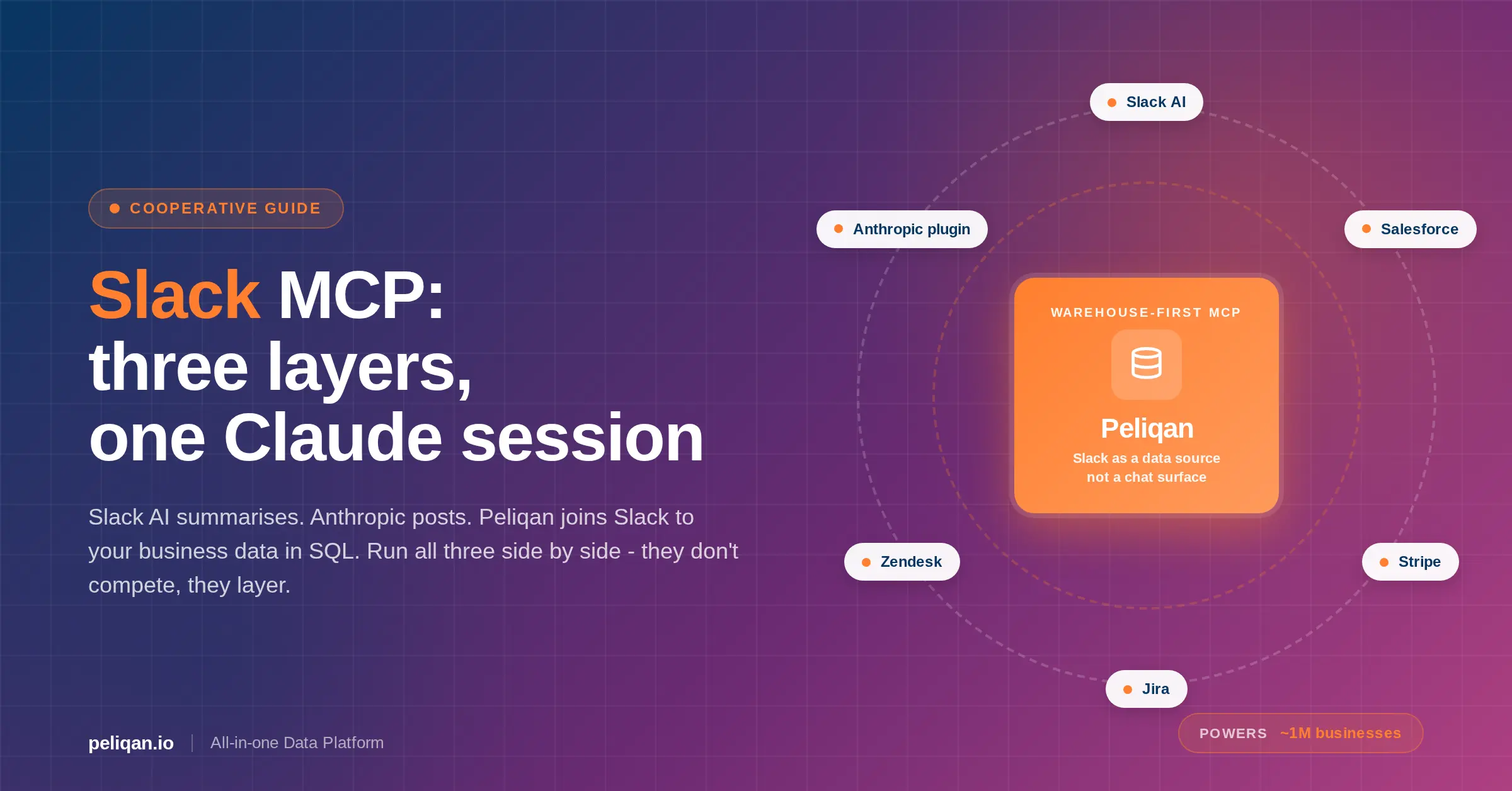
This is the cooperative MCP pattern the Notion and Slack playbooks introduced. Specifically, two or three MCPs run in one Claude session and each handles the job it was designed for. Airtable’s official MCP handles the Airtable surface. Peliqan’s MCP handles the cross-source SQL surface. The architectures do not compete – they layer.
Five Airtable MCP use cases that need cross-source SQL
1. Product roadmap times revenue impact
The standing product prioritisation question. Specifically, the agent joins the Airtable roadmap base (features, status, ship dates) to Stripe MRR by product line to Mixpanel feature adoption. Then it ranks roadmap items by addressable revenue and adoption gap. As a result, the PM gets a real prioritisation list instead of a gut-feel ranking. Indeed, this is the question that turns Airtable from a roadmap tracker into a revenue-attributed planning system.
2. Content calendar times campaign attribution
The standing growth question. Specifically, the agent joins the Airtable content calendar (post date, channel, asset, owner) to Klaviyo email campaign engagement to Stripe conversion events. Then it surfaces which content actually drove revenue versus which content just sent emails. Furthermore, the same pattern works for Brevo email and SMS campaigns when Brevo is the marketing automation platform.
3. Agency client tracker times billing risk
The standing agency owner question. Specifically, the agent joins the agency’s Airtable base tracking 50 client engagements (project status, milestones, deliverables) to Stripe billing records. Then it surfaces clients with active project work AND overdue invoices. As a result, the account manager gets the cash-collection list and the project-priority list as one Claude prompt. This is the same multi-tenant pattern documented in OdooExperts’ multi-client Odoo work, covered in the case study referenced later in this post.
4. Lightweight Airtable CRM versus real CRM
The handoff-leakage question. Specifically, many Series-A-stage startups use Airtable as a quick CRM before moving to Salesforce or HubSpot. Furthermore, the transition creates a gap: which Airtable leads were captured but never converted into a Salesforce opportunity? The agent joins both data sources by email or external customer ID. As a result, the sales lead surfaces dropped leads worth re-working before the next quarter closes.
5. Project tracker times engineering velocity
The standing engineering management question. Specifically, the agent joins the Airtable project tracker (scope, milestones, deliverables) to Jira ticket throughput to GitHub PR merges to Slack engineering channel activity. Then it surfaces scope-versus-throughput trends. Furthermore, the cross-source signal is more reliable than any single metric. As a result, the engineering manager catches the velocity dip before the sprint review.
Six Airtable MCP options compared
The honest summary: Airtable AI and Cobuilder win the in-Airtable lane. The official Airtable MCP wins for Claude-as-Airtable-agent workflows. Composio covers dev-tool agents, Pipedream covers event-driven automation, and n8n self-host covers the sovereign-cloud lane. However, only Peliqan reads Airtable as a data source and joins it to the rest of your business stack in one SQL query. As a result, the cleanest 2026 Airtable stack runs all three patterns side by side. The fuller comparison context sits in the Composio + Pipedream + Peliqan MCP comparison and the best MCP server listicle.
Airtable API rate limits: the 5-per-second ceiling and how to work with it
Airtable’s rate limit architecture has one specific characteristic that matters at scale. Specifically, the per-base limit is 5 requests per second across all pricing tiers. As a result, a chatty AI agent making 20 reads in parallel hits the 429 status code fast. Furthermore, when the limit triggers, Airtable enforces a 30-second wait before subsequent requests succeed.
However, the Personal Access Token (PAT) opens a different ceiling. Specifically, PATs introduced in February 2024 allow up to 50 requests per second across all traffic from a given user or service account. As a result, the right pattern is one PAT per integration plus careful per-base throttling. Furthermore, Airtable supports batching of up to 10 records per request, which means you can update 50 records per second using batched PUT requests against the same endpoint.
The Team plan adds another consideration. Specifically, if you exceed your Team plan’s monthly call limit, the API slows to 2 requests per second until the calendar month resets. Therefore, high-volume use cases need Business or Enterprise plans (which uplift the monthly ceiling) or a warehouse layer beneath that runs analytical queries against the cached copy.
Peliqan’s Airtable connector handles all three constraints automatically. Specifically, it uses PATs, respects the 5-per-second per-base ceiling during ingestion, batches updates where possible, and falls back gracefully on the 429 plus 30-second wait pattern. As a result, the warehouse stays current without ever saturating Airtable’s API limits even on workspaces with hundreds of active bases.
Compliance posture for GDPR and Article 26
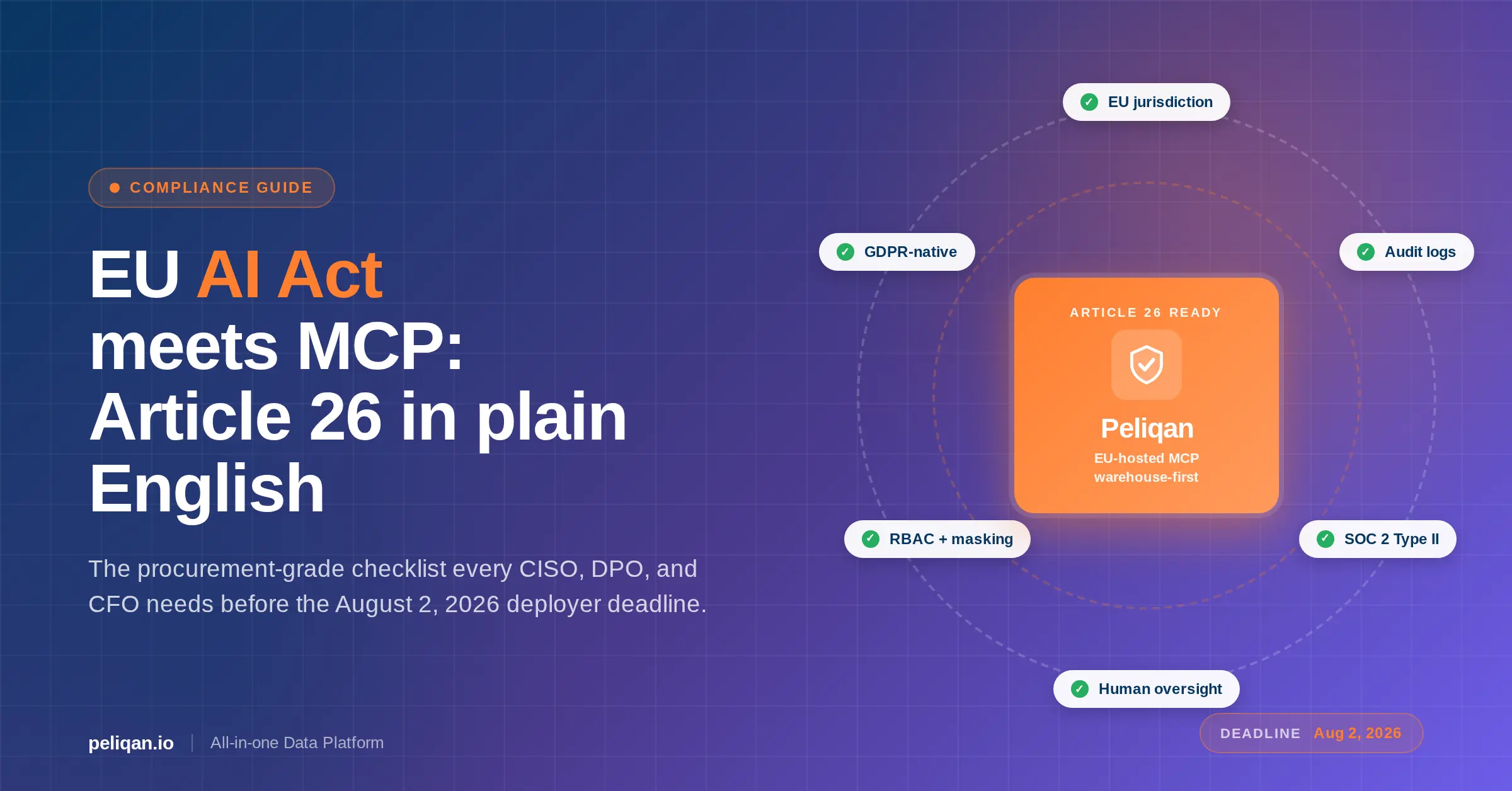
Airtable is US-headquartered, which carries CLOUD Act exposure for EU buyers under DORA, NIS2, and the EU AI Act Article 26 deadline on August 2, 2026. Furthermore, AI agent activity on Airtable data falls under Article 26’s deployer obligations for any high-risk use case. As a result, the procurement question splits into two parts: Airtable’s own jurisdiction and the cross-source analytical layer beneath.
For the cross-source layer, Peliqan ships EU-hosted infrastructure in Belgium, SOC 2 Type II certified, ISO 27001 in progress, with column-level masking by default and audit-logged reverse ETL. Furthermore, the procurement checklist mapping Article 26 obligations onto MCP vendors sits in the EU AI Act and MCP compliance guide. Likewise, the broader compliance frame sits in the GDPR-compliant MCP servers pillar.
For EU teams with hard data-residency requirements, the architecture pattern is straightforward. Specifically, Airtable’s official MCP handles in-Airtable agent work (acknowledging the US-jurisdiction trade-off for that data). Then Peliqan’s EU-hosted warehouse layer handles the cross-source analytical work with audit logs that satisfy Article 26. As a result, the deployer obligations are met for the cross-source layer even when Airtable itself runs in US regions.
ICP: who Airtable MCP plus Peliqan is built for
Six buyer profiles dominate this conversation. First, operations leaders at SaaS scale-ups using Airtable as the lightweight database, CRM, and project hub. Second, product managers running roadmap and spec tracking in Airtable. Third, marketing teams using Airtable for campaign tracking, content calendars, and asset libraries. Fourth, Series-A-stage startups using Airtable as a quick CRM before graduating to Salesforce or HubSpot. Fifth, agency teams managing 30 to 50 client Airtable bases. Finally, founders running a lightweight operating stack with Airtable as the workspace database.
For SaaS operations leaders, the value is the cross-source signal across multiple Airtable bases and the rest of the stack. Specifically, “what’s working” is rarely answerable inside one base alone. Furthermore, the Airtable lightweight DB pattern translates well to Ziggu’s real-estate use case, where lightweight tracking sits alongside CRM and customer support data.
For product managers, the value is roadmap revenue attribution. Indeed, “did the feature we shipped last quarter move MRR?” is the standing question that no single tool answers.
For agencies, the value is multi-tenant cross-client analytics. Specifically, one Peliqan workspace can serve 50 client Airtable bases through per-client RBAC. As a result, the agency lead gets cross-client billing-risk views without exposing one client’s data to another.
Peliqan’s pricing is fixed from €150/month annual (€1,800/year). Furthermore, the platform includes 250+ connectors, the Postgres + Trino warehouse, reverse ETL, and the MCP server in one bundle. Therefore, the Airtable MCP capability does not add to the bill on top of the base subscription.
Real-world example from the agency multi-tenant lane
Real-world example: OdooExperts
OdooExperts consolidates reporting and AI workloads across 50+ client Odoo environments through Peliqan’s multi-customer management. Specifically, each client’s environment lands into the same warehouse architecture with per-client RBAC. As a result, one MCP server serves the whole consultancy with no data crossover between clients. The same multi-tenant pattern translates directly to agencies managing 30-50 client Airtable bases. Read the full OdooExperts case study.
The same pattern also fits e-commerce content tracking at smaller scale. For instance, Skindr consolidates advertising and RevOps data across multiple ad networks, CRM, and analytics into Peliqan’s warehouse. Furthermore, the cross-source pattern is structurally the same when Airtable holds the content calendar and Klaviyo plus Stripe hold the conversion data.
A 60-day rollout plan for Airtable MCP plus Peliqan
Most teams can deploy a working cross-source Airtable MCP setup inside 60 days. The plan breaks into three phases.
First, install Airtable’s official MCP server for the in-Airtable lane. Specifically, run claude mcp add --transport http airtable https://mcp.airtable.com/mcp and authenticate. Furthermore, configure PAT scope to the bases the agent needs access to. As a result, Claude-in-Airtable is live within the first week.
Second, connect the relevant business systems to Peliqan: Stripe, Salesforce, HubSpot, Klaviyo, Brevo, Slack, or Zendesk depending on the stack. Then add Airtable as a data source through the same Peliqan workspace. Specifically, the Airtable ingestion uses PATs and respects the 5-per-second per-base ceiling automatically.
Third, install the Peliqan MCP server with pip install mcp-server-peliqan and point Claude at it alongside the existing Airtable official MCP. Then run the first three cross-source queries from the use case list above. Indeed, the roadmap-revenue or content-attribution query usually reveals at least one prioritisation gap the team did not see before.
How this connects to the broader Peliqan MCP cluster
The Airtable MCP story is the third cooperative-architecture post in the Peliqan cluster, after the Notion and Slack playbooks. Specifically, all three follow the same pattern: a vendor-native AI plus an official vendor MCP plus the Peliqan warehouse-first layer running side by side in one Claude session. Furthermore, the use cases compound across the cluster – Airtable roadmap meets Stripe MRR meets Klaviyo campaigns meets Salesforce deals meets Slack channel activity in one query.
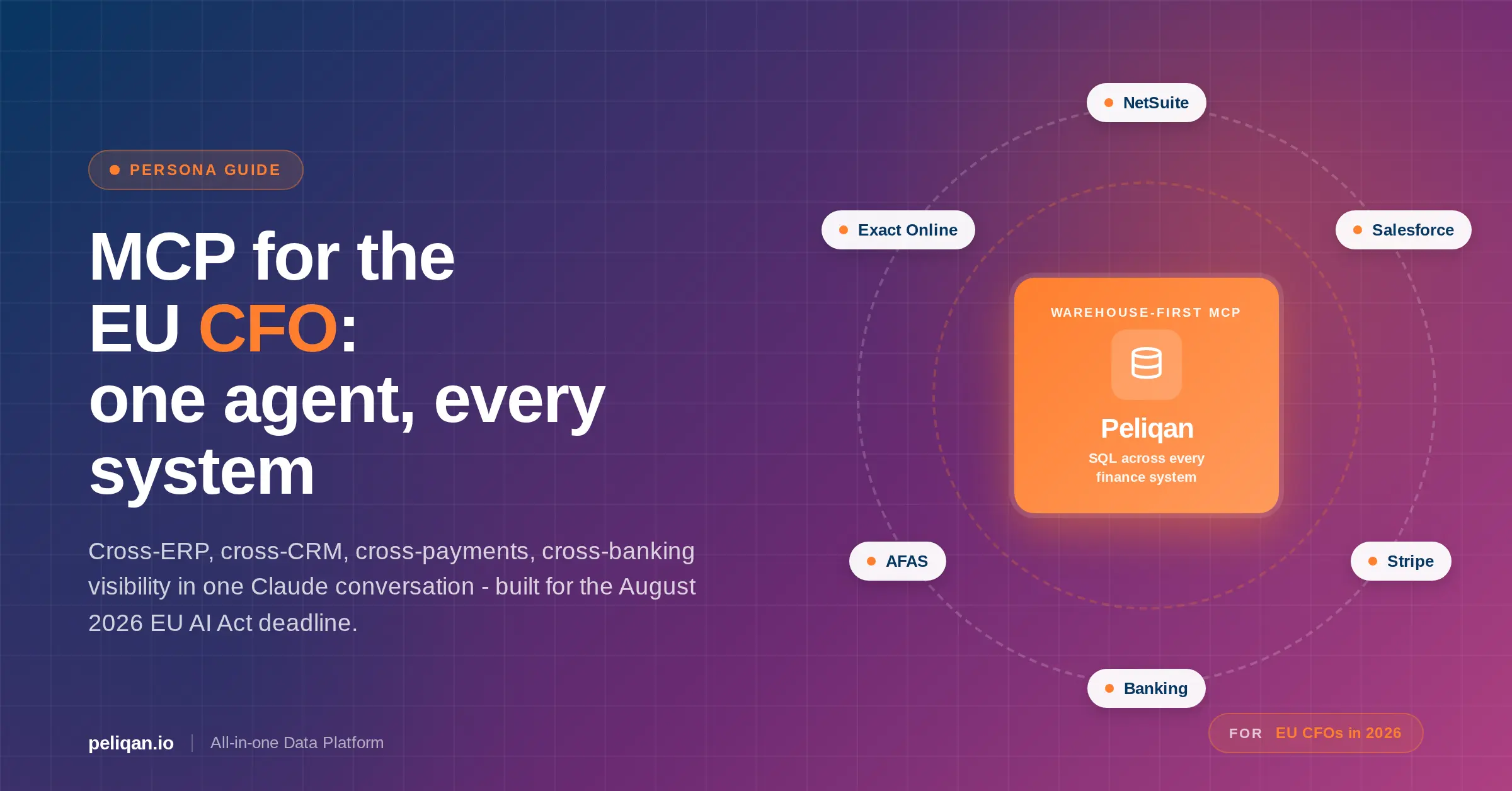
For finance and operations buyers specifically, the MCP for the EU CFO playbook covers the persona-level pattern. For Pipedrive-heavy stacks, the Pipedrive MCP playbook sits alongside Airtable as the lightweight CRM alternative. Finally, the main Peliqan MCP page covers the connector library and read-write surface in detail.
The bottom line on Airtable MCP
Airtable AI chats with your tables. Airtable Cobuilder builds lightweight AI apps on top of bases. Peliqan’s MCP joins Airtable data to the rest of your business stack. Run all three side by side. They don’t compete. They layer.
For the in-Airtable lane (chat-with-table, AI fields, generative content, Cobuilder apps), use Airtable AI and Cobuilder. For the Claude-as-Airtable-agent lane (Claude reads, creates, updates records inside one base), use Airtable’s official MCP. For the cross-source analytical lane (Airtable plus Stripe plus Klaviyo plus Salesforce plus Slack in one SQL JOIN), use Peliqan’s warehouse-first MCP.
The architectural choice that compounds for the next three years is not which Airtable MCP to pick. Specifically, you will probably use the official one for in-Airtable work. Rather, it is whether you have a warehouse layer beneath every base that can answer the cross-source questions Airtable alone cannot. For EU teams planning around Article 26, DORA, and GDPR simultaneously, that layer needs to be EU-hosted, SOC 2 Type II, and audit-logged. That is the procurement decision that turns Airtable from a no-code workspace into a data source for the next generation of agentic work.