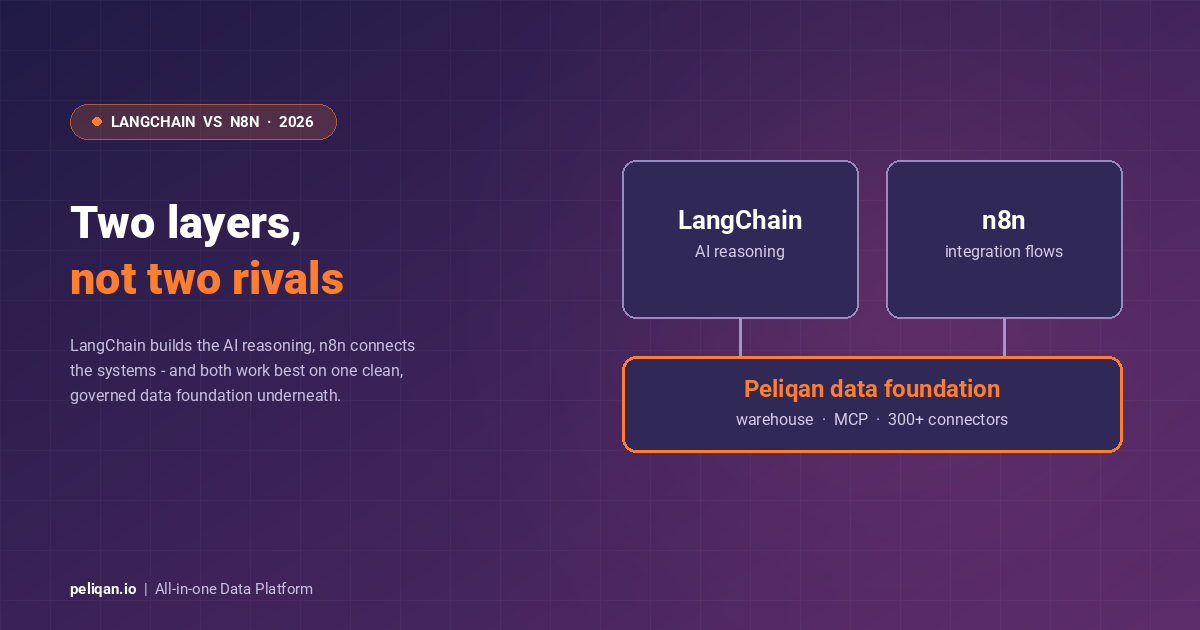

Choosing between LangChain vs n8n is really a choice between two different layers of your automation stack. LangChain is a code-first framework for building the reasoning core of AI applications; n8n is a visual platform for connecting systems and moving data between them. Both changed materially over the past year – LangChain shipped its 1.0 release, n8n restructured its pricing and doubled down on AI agent nodes – so the right answer in 2026 looks different than it did when most comparisons were written. This guide covers what each tool actually does, what they cost now, and how data teams combine them without building a brittle mess.
Platform overview: LLM orchestration vs workflow orchestration
The fastest way to understand the difference: n8n answers “when X happens in app A, do Y in app B.” LangChain answers “given this input, how should the AI retrieve context, reason, and respond.” One sits at the integration layer, the other at the AI reasoning layer. Neither replaces the other, which is why so many production stacks run both.
LangChain in 2026 – a code-first agent framework
LangChain reached its 1.0 milestone on October 22, 2025 – a significant marker for a framework that had been criticized for breaking changes and abstraction sprawl. The 1.0 release re-centers everything on a single create_agent abstraction: you give it a model, tools, and optional middleware, and it runs the agent loop on LangGraph’s execution engine under the hood. Middleware hooks (before_model, wrap_model_call, wrap_tool_call, after_agent) replace the old pattern of subclassing chains, and they are how teams now implement guardrails, conversation summarization, selective tool access, and dynamic prompts.
In practice LangChain remains a developer tool. You write Python or TypeScript, you manage deployment yourself (it embeds in your application rather than running as a service), and you get maximum control over retrieval pipelines, agent state, and multi-step reasoning in return. For teams building AI agents on their company data, it is still the deepest toolbox available.
n8n in 2026 – a visual workflow and integration platform
n8n is a workflow automation platform with a visual node canvas: triggers, transformations, and actions chained together across 500+ official integrations, with a community node library that pushes the practical total past 1,000. It handles the unglamorous parts of automation well – OAuth flows, webhooks, polling triggers, retries – and its fair-code license means you can self-host the Community Edition for free with unlimited executions.
n8n has also pushed hard into AI. Its AI Agent nodes let non-developers wire an LLM, memory, and tools together visually – and, notably, those nodes are built on LangChain’s JavaScript library under the hood. That tells you a lot about how the two tools relate: n8n packages a curated subset of LangChain’s capabilities into visual blocks, trading depth for accessibility.
Quick technical comparison
What changed in 2025-2026 (and why older comparisons mislead)
Three shifts worth knowing before you commit:
- LangChain 1.0 stabilized the framework. The create_agent + middleware model ended the era of constant breaking changes, and LangGraph 1.0 became the durable execution runtime underneath. Teams that dismissed LangChain as “too churny” in 2024 are re-evaluating it.
- n8n removed its free cloud tier. Cloud now starts at the Starter plan (2,500 successful executions per month), with Pro and Business tiers above it. Self-hosting the Community Edition remains free with unlimited executions – which is why the self-host vs cloud decision now matters more than plan selection.
- n8n’s execution counting changed in your favor. Only successful production executions count toward cloud limits; failed runs and test executions no longer burn quota.
Pricing and cost model
LangChain the framework is open source and free. Your real costs are LLM API spend, the infrastructure you run agents on, and optionally LangSmith for tracing and evaluation. For AI-heavy pipelines, model spend usually dominates everything else, so LangChain-based builds live or die on how well you control token usage – retrieval quality and caching matter more than license fees.
n8n splits into two worlds. n8n Cloud is priced per successful execution: Starter at 24 euro/month for 2,500 executions, Pro at 60 euro/month for 10,000, and Business at 800 euro/month for 40,000 with SSO and environments (annual billing runs about 17% cheaper). Self-hosted Community Edition is free with unlimited executions – you pay only for a small server. The catch: SSO, LDAP, audit logs, and similar controls sit behind self-hosted Enterprise licensing. An execution in n8n is one full workflow run regardless of steps, which keeps costs predictable compared to per-task tools like Zapier – a difference we break down in our n8n vs Zapier comparison.
The honest cost comparison: a LangChain build costs engineering time up front and model spend forever; n8n costs little to start but execution volume scales with usage, and heavy AI workloads inside n8n still incur the same LLM API costs. Neither tool solves the data-preparation bill – if your workflows repeatedly fetch and re-fetch the same CRM or ERP data, you pay in API rate limits and latency on both platforms.
Ease of use
LangChain – built for engineers
There is no way around it: LangChain assumes you write code. The 1.0 release genuinely lowered the barrier – create_agent gets a working agent running in a dozen lines – but designing retrieval pipelines, debugging agent loops, and tuning middleware is engineering work. LangSmith and LangGraph Studio help with visibility, yet the day-to-day experience is an IDE, not a canvas. For a developer team this is a feature: version control, tests, and code review apply to your AI logic the same way they apply to everything else.
n8n – visual first, engineer extendable
n8n’s canvas is approachable for technically minded non-developers: pick a trigger, chain nodes, map fields visually. Complex workflows still demand real technical thinking – expressions, error handling, pagination – and sprawling canvases become their own maintenance burden. The escape hatch is the Code node, where you drop into JavaScript or Python when the visual approach runs out. Most teams find n8n dramatically faster for integration work and noticeably shallower for AI logic, which matches what it is built for. If your automation needs lean more toward agent frameworks, our n8n vs CrewAI comparison covers that angle.
Integration ecosystem
n8n’s 500+ official nodes cover the SaaS tools most businesses run – CRMs, marketing platforms, databases, messaging – with authentication, pagination, and triggers handled for you. The community library adds hundreds more. When a connector does not exist, the HTTP Request node calls any API, though at that point you are doing the plumbing yourself.
LangChain integrates differently: vector stores, embedding models, document loaders, and tool definitions, all via code. It is unlimited in theory and hand-built in practice. For RAG pipelines – load documents, embed, retrieve, generate – LangChain’s integration surface is exactly right. For “sync HubSpot deals to a spreadsheet,” it is the wrong tool entirely.
Worth noting: neither tool is a data integration platform. Connector nodes move records event by event; they do not give you historical sync, schema evolution, or a queryable copy of your data. Teams that need that layer typically pair either tool with a platform offering 300+ pre-built data connectors and a built-in warehouse, then let n8n or LangChain consume clean tables instead of hammering source APIs.
Hosting and security
LangChain inherits your application’s security posture – it is a library, so wherever your app runs, your agents run. That is attractive for teams with strict data-residency requirements: nothing leaves your infrastructure unless you send it to a model API. The trade-off is that observability, secrets management, and scaling are entirely your responsibility, though LangGraph Platform now offers managed deployment for teams that want it.
n8n gives you the choice: n8n Cloud (hosted in Germany, GDPR-aligned) or self-hosting anywhere via Docker. Self-hosting keeps credentials and payloads on your servers and is the common choice for European companies with compliance constraints. Enterprise-grade controls – SSO, LDAP, external secrets, log streaming – require paid tiers on either deployment model.
Customization and developer power
LangChain offers maximum control: custom retrievers, custom middleware, custom agent graphs in LangGraph when the standard loop is not enough. If your product IS the AI behavior – a legal research agent, a support copilot with fine-grained guardrails – this control is non-negotiable. Compare that with agent-framework alternatives in our AutoGen vs LangChain guide.
n8n’s extensibility is practical rather than deep: Code nodes for custom logic, community nodes you can publish, and webhooks in both directions. You can bend n8n a long way, but you cannot restructure its execution model – long-running stateful agent conversations with checkpointing, for example, are a LangGraph strength that a workflow runner is not designed for. We cover that distinction in detail in LangGraph vs n8n.
Decision guide: which one should you pick?
- Pick n8n when the job is connecting systems: sync data on triggers, route notifications, orchestrate approvals, add a modest AI step (summarize, classify, draft) inside a business process.
- Pick LangChain when the AI logic is the product: custom RAG over your documents, multi-step agent reasoning, memory across conversations, strict control over prompts and guardrails.
- Use both when workflows trigger intelligence: n8n catches the webhook and moves the data, then calls a LangChain-powered service for the heavy reasoning, then routes the result onward. This is the most common production pattern we see.
- Add a data foundation when either tool spends most of its time fetching, cleaning, and joining data from business systems – that work belongs in a data layer, not in flows.
How Peliqan complements LangChain and n8n
Both tools share a weakness that only shows up in production: they process data in motion, but they do not manage data at rest. Every flow that needs “all customers with open invoices and recent support tickets” either hammers three APIs on every run or maintains its own fragile cache. Multiply that across dozens of flows and you get rate-limit errors, inconsistent model inputs, and no single place to see what data your automations actually used.
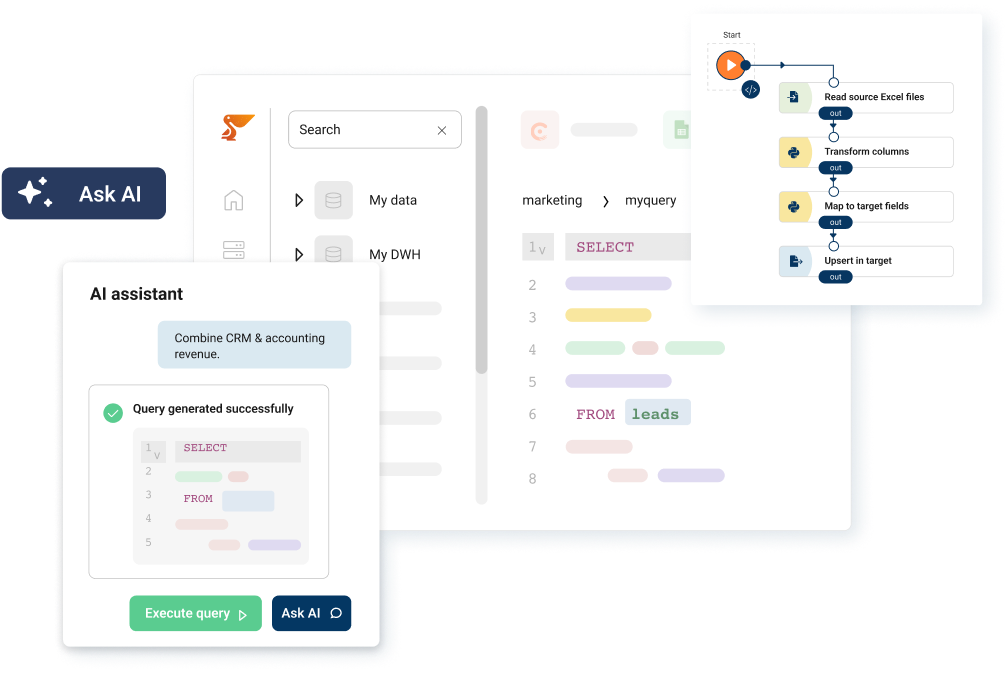
Peliqan sits underneath as the data foundation. It syncs your business systems – ERP, CRM, accounting, databases – into a built-in Postgres + Trino warehouse using 300+ connectors, with custom connectors delivered on a 2-week SLA. Transformations run centrally in SQL or low-code Python, so LangChain agents and n8n workflows consume clean, deduplicated tables instead of raw API payloads.
Peliqan also exposes a native MCP server, so AI agents can query all connected business data through one governed interface – with SOC 2 Type II, ISO 27001, GDPR, HIPAA, and CCPA compliance, EU-hosted on AWS Frankfurt.
Pricing is transparent and fixed rather than volume-based; see Peliqan pricing for the model.
Real-world example: CIC Hospitality
CIC Hospitality unified 50+ data sources – PMS, booking, accounting, and operational systems – in Peliqan, saving 40+ hours per month previously lost to manual data wrangling, and giving downstream automations one consistent place to read from. Read the CIC Hospitality case study.
LangChain and n8n – with and without a data foundation
Typical combined patterns: document Q&A where Peliqan syncs and prepares source data before LangChain handles retrieval and generation; customer 360 enrichment where n8n triggers on CRM events and reads the full customer picture from the warehouse; automated reporting where central data pipelines feed both dashboards and agent context.
And when the use case is fully data-centric, teams can build AI agents directly in Peliqan without a separate orchestration layer at all.
Conclusion
LangChain and n8n are complementary, not competitors. LangChain 1.0 is the strongest option for teams building serious LLM applications in code; n8n is the fastest way to operationalize workflows across hundreds of systems. The pragmatic 2026 architecture is layered: n8n where systems meet, LangChain where reasoning happens, and a dedicated data foundation like Peliqan underneath handling ingestion, transformation, caching, and governance – so both tools work from clean data instead of raw API responses. For more head-to-head breakdowns, browse our comparison guides.
If the missing piece in your stack is the data layer itself, start with our overview of the leading data integration tools in 2026.